The Engineering Biology Strategy Gap: What Programmable Biology Companies Need, and What IP Advice Still Often Fails to Integrate

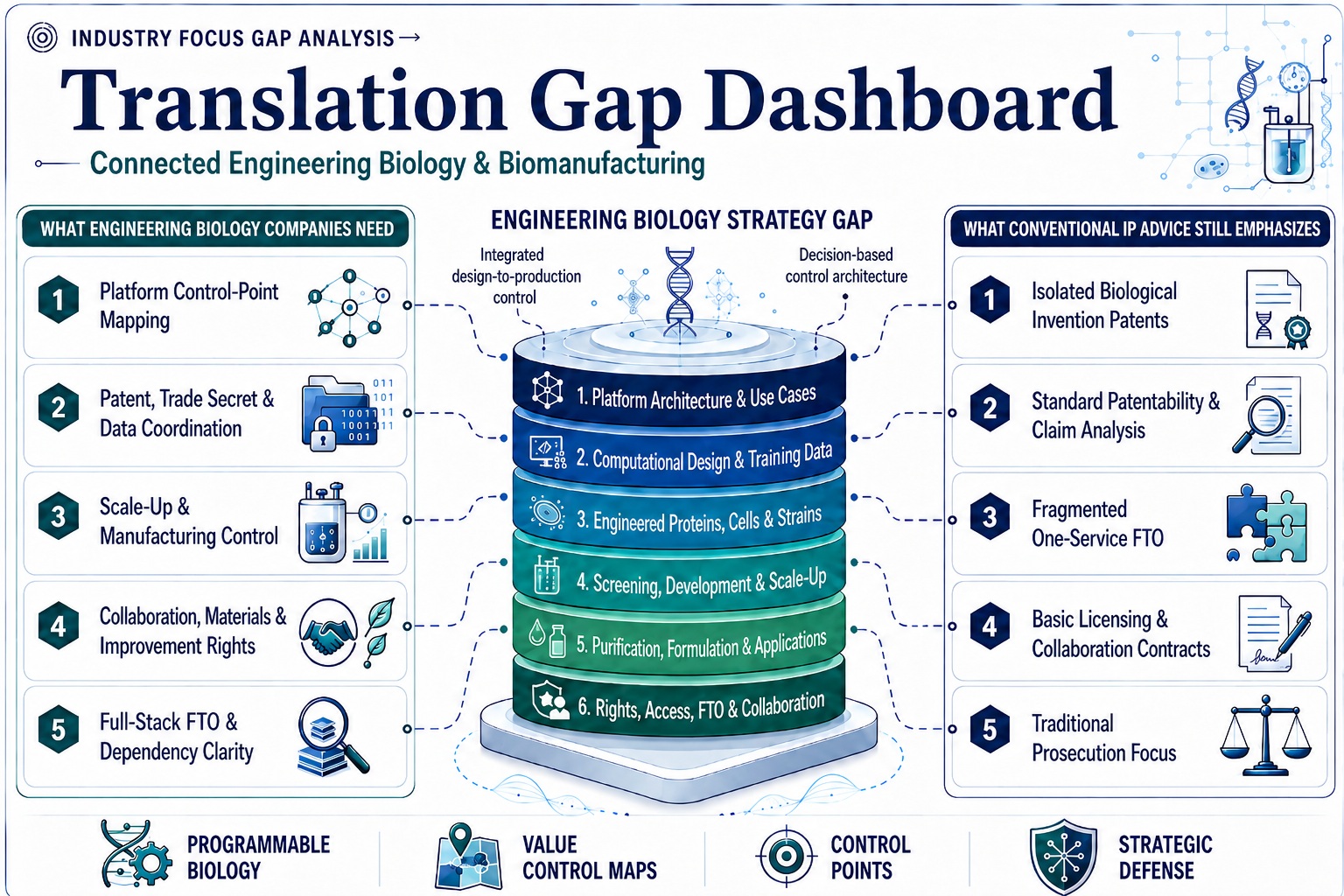
Engineering biology is moving from scientific possibility into industrial decision-making, as biological systems are increasingly designed computationally, tested through automated experimentation and transferred into production environments. Companies are no longer developing only isolated sequences, proteins, cells, microorganisms or fermentation processes, but are building interconnected systems that combine biological materials, computational models, experimental data, engineered organisms, production methods and industrial applications. This development is visible across healthcare, food, agriculture, chemicals, materials and environmental technologies, where biology is becoming both a development platform and a form of production infrastructure. The strategic IP question is therefore no longer limited to whether a biological invention can be patented, because companies must also determine how they can control the path from biological design to scalable production, market access and commercial deployment. A structural gap is emerging between these integrated business requirements and the way IP expertise is still frequently divided and communicated as a collection of separate legal services.
This is not an argument that patents, trade secrets, Freedom to Operate analyses, licences or collaboration agreements have become less important. Each of these instruments remains essential, but engineering biology companies increasingly need them to operate as elements of one control architecture rather than as independent solutions to isolated legal questions. Their commercial position may depend simultaneously on patent claims, confidential process knowledge, access to biological materials, ownership of experimental data, manufacturing rights and the allocation of improvements created by partners. Decisions concerning these assets often arise before an individual patent application is drafted, because they are embedded in technology selection, platform architecture, production planning and collaboration design. The central thesis is therefore that IP must evolve from a protection function applied to individual inventions into a decision system that helps engineering biology companies understand where value, control, dependency and defensibility arise across the complete business model.
The demand side: what engineering biology companies increasingly need
Engineering biology companies are not primarily asking whether they can obtain a patent for a biological invention, because their operational questions usually extend across several connected technical and commercial layers. A company developing an engineered microorganism may combine strain design, genetic circuits, screening methods, cultivation conditions, feedstock selection, fermentation control, downstream processing and application-specific formulation. An enzyme engineering company may depend on computational prediction, training data, sequence generation, laboratory validation, production hosts, purification methods and customer-specific applications. A cultivated food or biomaterials company may similarly combine biological materials, growth conditions, process equipment, monitoring technologies, production data and regulatory evidence. In each case, commercial value arises from the interaction of several elements rather than from one biological object considered in isolation.
The strategically relevant question is therefore not simply what the company can protect, but what it must control in order to develop, manufacture, finance and commercialise its technology. Value may arise in a nucleotide sequence, an engineered protein, a modified cell or a production organism, but it may equally arise in a computational design method, an experimental dataset, a fermentation window, a purification sequence or a field-specific application. Some of these elements may be suitable for patent protection, whereas others may depend on trade secrets, contractual access or control over physical biological materials. The company must also distinguish between ownership and practical control, because it may own the original biological invention while depending on a third party for an enabling technology, a commercially viable production process or the data required to improve the platform. The demand is consequently not for more protection in the abstract, but for an integrated understanding of which rights, knowledge and data access are necessary to execute the business model.
This requirement becomes particularly important as engineering biology companies move from laboratory development into scale-up and external collaboration. Production improvements may be created by pilot facilities, contract manufacturers, equipment suppliers or industrial partners after the original platform patents have already been filed. Experimental and manufacturing data may accumulate outside of the company, while improvements to strains, processes or analytical methods may be created jointly or under contractual arrangements that do not provide the company with exclusive access. Changes to production hosts, equipment, purification methods or target applications may also introduce new Freedom to Operate risks that were not relevant during early research. Companies therefore need IP advice that accompanies the development and commercialisation process instead of intervening only when an invention disclosure, licence agreement or patent search is required.
The demand side can consequently be described as a need for strategic control across the biological design-to-manufacturing path. Management must understand which layers should be patented, which knowledge should remain confidential, which third-party technologies create dependencies and which rights must be retained when entering collaborations. It must also determine whether the company can transfer production, change suppliers, access historical data and continue developing the platform after a partnership ends. These questions are not secondary legal details, because they influence valuation, investment readiness, negotiating leverage and the company’s ability to reach the market. An engineering biology company therefore needs a coherent IP architecture that reflects how its technology is actually created, scaled and commercialised.
The supply side: what IP communication still often emphasises
Public communication concerning biotechnology-related IP expertise still frequently emphasises scientific qualifications and established legal services. Advisory firms may demonstrate experience in molecular biology, genetics, microbiology, biochemistry, pharmaceuticals, diagnostics, agriculture or industrial biotechnology, while offering patent drafting, prosecution, Freedom to Operate analysis, opposition, litigation, licensing, contracting, due diligence and trade secret protection services. These capabilities are necessary, and many IP advisors possess the scientific depth required to understand highly complex biological inventions. Nevertheless, the visible service narrative often remains organised around individual legal tasks rather than the connected strategic control problem faced by the company. The message is commonly that an IP advisor can protect biotechnology innovations, whereas a more differentiated message would explain how the IP advisor can identify where control and dependency arise across the complete engineering biology system.
This distinction matters because a legally appropriate result within one service category does not necessarily create a defensible commercial position. A patent covering an engineered cell may not protect the computational or experimental system used to produce improved candidates, while protection for a biological product may not cover the process knowledge required to manufacture it economically. A contract may establish ownership of the original technology without providing access to improvements, production data or derivative biological materials created during a partnership. A Freedom to Operate analysis directed to one sequence or organism may overlook risks arising from gene-editing tools, production hosts, bioreactors, purification methods or application-specific technologies. When the respective services are delivered without an integrating strategic framework, the company may receive technically correct advice while remaining exposed at the level of its complete business architecture.
The supply-side challenge is therefore not primarily an absence of relevant expertise, but the way that expertise is packaged and translated. Patent attorneys, lawyers, technical specialists and licensing professionals may each address an important part of the company’s position, yet management must often connect their findings independently. This fragmentation becomes particularly problematic for startups and scale-ups that do not possess an experienced internal IP function capable of translating separate legal analyses into portfolio, production and partnership decisions. An IP advisory offer that merely lists patents, FTO, trade secrets, licences and contracts may therefore appear comprehensive while providing little guidance on how these instruments should interact. Engineering biology companies increasingly require advisors who can connect specialist services to the technical architecture, development stage and commercialisation pathway of the business.
Where the mismatch becomes visible
The mismatch becomes clearest when the situations encountered by engineering biology companies are compared with the separate legal categories through which IP services are commonly organised. A company does not experience biological design, data, production, collaboration and market entry as independent legal boxes, because it experiences them as one connected decision environment. The scientific logic asks whether the engineered system performs the required biological function, while the computational logic asks whether models and data can improve candidate selection and experimental learning. The patent logic asks which methods, functions and applications can be claimed, whereas the trade secret logic asks which process parameters, recipes and negative results can remain confidential. The manufacturing, collaboration, regulatory and investment logics add further questions concerning reproducibility, ownership, disclosure, dependencies and future commercial options.
When these perspectives are treated separately, important gaps can remain between formal ownership and practical control. A company may patent a production organism but depend on a licensed editing platform, a particular host technology or a manufacturing process controlled by another organisation. It may want to retain fermentation parameters as trade secrets without creating the documentation and contractual safeguards required to preserve confidentiality across employees, suppliers and manufacturing partners. It may own the initial platform while granting an early commercial partner overly broad exclusivity across future application fields. It may also retain extensive patent rights while lacking the process data, samples and documentation required to move production to another facility.
The mismatch is particularly visible when patent portfolios are evaluated through patent counts or isolated filing decisions. Engineering biology creates value across computational models, sequences, proteins, cells, microorganisms, screening methods, production processes, analytical methods, data and applications, which means that portfolio architecture must follow the layers through which value is created and captured. Protection directed only to the final biological product may be insufficient when competitors can use alternative organisms or processes, while platform protection may provide limited commercial control if the decisive advantage lies in manufacturing yield, purification or application-specific performance. Patenting every process improvement may disclose valuable operational knowledge without producing enforceable rights, whereas relying excessively on secrecy may create vulnerability when production is outsourced or regulatory disclosure becomes necessary. The appropriate strategy therefore depends on how patents, trade secrets, contractual rights and technical documentation reinforce one another within the commercialisation pathway.
Freedom to Operate and collaboration provide further examples of the same mismatch. FTO in engineering biology may need to address not only the final sequence or organism but also enabling tools, vectors, hosts, cultivation systems, equipment, software, purification technologies and downstream applications. Collaboration agreements must regulate more than formal ownership of patentable results, because access to biological materials, datasets, improvements, manufacturing knowledge and future application rights can be equally important. These issues cannot be solved effectively through standardised legal procedures applied after the final product has already been decided. They must influence platform selection, design alternatives, partner choice, manufacturing arrangements and licensing strategy before dependencies become difficult or expensive to reverse.
The resulting risk is that a company can possess substantial intellectual property while lacking strategic control. It may be patent-active but dependent on a critical third-party platform, rich in know-how but unable to preserve confidentiality, or collaborative but weak in the assignment of rights to improvements and future fields of use. It may own a scientifically valuable invention while lacking access to the production capabilities and operational data required to commercialise it. This is the central engineering biology strategy gap: a difference between the connected way value is created in programmable biology and the fragmented way IP support is often communicated and delivered. Closing the gap requires more than adding further specialist services, because it requires integrating those services around the company’s actual control problem.
A gap in translation
What appears is therefore not primarily a lack of scientific competence or legal sophistication, but a gap in translation between professional expertise and management needs. Engineering biology companies increasingly experience IP through questions of platform control, manufacturing access, data ownership, scale-up, collaboration, investment, regulation and market entry. Publicly visible IP expertise, by contrast, often continues to describe the field through separate categories such as patents, trade secrets, FTO, licensing, contracts and litigation. Those categories remain necessary, but they are not identical to the strategic problems experienced by any company. The opportunity for IP experts is to translate their existing capabilities into integrated decision support that enables management to understand the consequences of technical and commercial choices.
In one company, the defensible control point may lie in a family of engineered proteins, whereas in another it may lie in a production strain, a computational screening method, a fermentation process or an application-specific formulation. In other cases, no single control point will be sufficient, and the strategic position will depend on combining patent rights, confidential process knowledge, biological materials, data access and manufacturing agreements. The IP advisor must therefore help determine what the company should own, what it must be able to access, what it should keep confidential and what it can safely share or license. This requires translating specialist legal findings into choices concerning technology architecture, collaboration design, portfolio priorities and commercial fields. The advisor’s differentiated contribution lies not merely in explaining the available rights, but in showing management how those rights can be combined to preserve strategic options.
The strategic opportunity
The market opportunity is not simply to tell engineering biology companies that intellectual property is important, because most companies and investors already understand that patents can influence financing and partnerships decisions and market exclusivity. The greater opportunity is to demonstrate how IP can operate as a decision system for programmable biology by connecting biological inventions, digital assets, process knowledge and production capabilities. Such an approach can help management identify the layers that deserve patent protection, the know-how that requires trade secret protection and the dependencies that must be addressed through licences or contractual access. It can also integrate FTO before platform choices become fixed, structure collaborations without transferring unintended future value and ensure that scale-up knowledge remains documented and transferable. This is where the next stage of differentiation in engineering biology IP advice can arise.
Companies that adopt this integrated approach gain greater room to act because they can design portfolios around layers of value rather than isolated inventions and can connect protection decisions with manufacturing, financing and partnership strategies. They can explain to investors not only what has been invented, but why the company controls a credible path from biological design to commercial production. Companies that treat IP reactively face the opposite risk, because they may become scientifically advanced while remaining dependent on external platforms, production partners or inaccessible know-how. The engineering biology strategy gap is therefore not a gap between programmable biology and intellectual property, but between connected biological production systems and fragmented IP advisory narratives. Closing it means translating IP expertise into strategic control over the technologies, materials, data, processes and partnerships through which biology is becoming an industrial platform.