CEIPI IP Business Talk with Hermione Thompson and John Leeming: Building Patent Strategies for Cleantech Innovation

Cleantech innovation rarely sits within a single technical discipline. New solutions can combine engineering, advanced materials, electronics, software, manufacturing processes and environmental performance. For companies developing these technologies, the challenge is therefore not only to create strong inventions, but to identify which technical contributions should be protected and how patent portfolios should evolve as technologies move towards commercial deployment.
That is why the next CEIPI IP Business Talk will focus on a central challenge for cleantech innovators: how can companies build patent protection that supports scaling, investment and future product development across increasingly complex technologies?
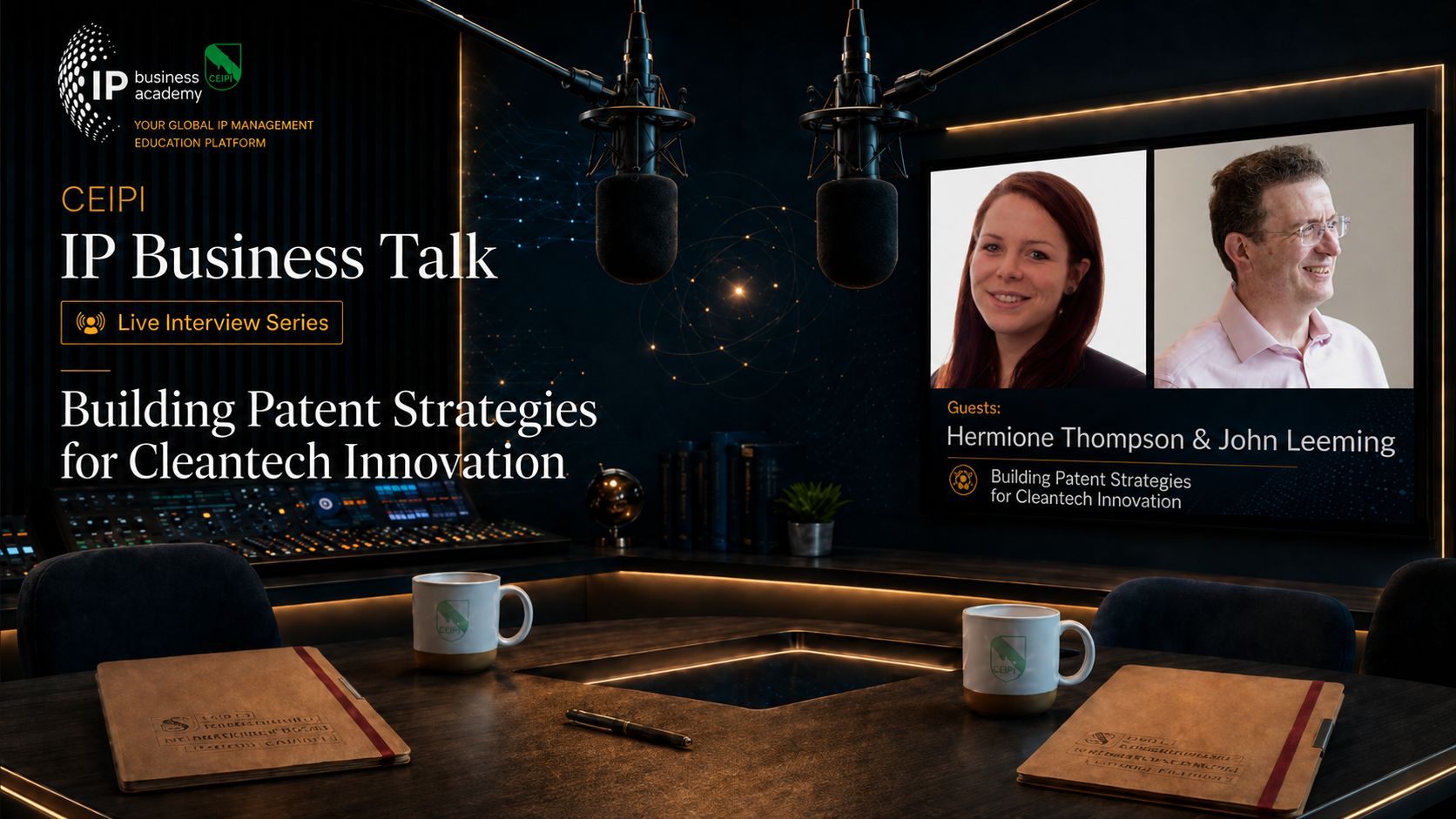
On Wednesday 26 August 2026, at 12:00 CEST, Hermione Thompson and John Leeming from J A Kemp will join us for a 45-minute CEIPI IP Business Talk on: Building Patent Strategies for Cleantech Innovation. Here is the registration link.
Building Patent Strategies for Cleantech Innovation
Cleantech encompasses a broad range of technologies designed to reduce environmental impact, improve resource efficiency or enable the transition towards more sustainable industrial and energy systems. From new materials and production technologies to energy systems, electronics and software-controlled solutions, these innovations often combine several technical layers within the same product or process. Patent strategy therefore needs to reflect not only individual inventions, but also how those inventions interact within a commercially relevant technology.
At the same time, cleantech companies frequently develop in environments where research, pilot projects, partnerships and commercialisation overlap. Decisions about patent filing, freedom to operate and portfolio development may therefore have to be taken while the underlying technology is still changing.
The upcoming CEIPI IP Business Talk with Hermione Thompson and John Leeming will look at how companies can structure patent protection around these technical and commercial developments.
Identifying the core technical contribution
One of the first challenges in protecting cleantech innovation is determining what exactly should form the centre of the patent strategy. A new cleantech solution may include improvements in mechanical engineering, materials, electronics, control systems, manufacturing methods or environmental performance. These elements may be closely interconnected, but they do not necessarily contribute equally to the competitive advantage of the resulting product.
Companies therefore need to distinguish between features that are necessary for implementation and technical contributions that create meaningful differentiation. This can require looking beyond the final product. Important inventions may lie in the manufacturing process, the interaction between individual components, the control of a system or the way a technical effect is achieved.
A strong patent strategy therefore begins with understanding where the technically defensible contribution lies and how different aspects of the innovation can be translated into complementary forms of patent protection.
Integrating IP into the scaling process
Cleantech companies often need to move quickly from research and prototypes towards pilot production, partnerships and commercial deployment. Each step can change the IP situation. New technical solutions may emerge during scale-up. Collaboration partners may contribute additional know-how. Manufacturing processes may need to be adapted. At the same time, the company may enter markets where third-party patents become commercially relevant.
Patent portfolio development and freedom-to-operate analysis therefore need to evolve alongside the technology rather than being treated as isolated exercises. Filing too early without understanding how the technology will develop can result in protection that no longer reflects the commercial product. Filing too late can create problems once technical information has been disclosed through partnerships, pilot projects or market activity.
Freedom to operate raises a parallel question. As a company approaches commercial deployment, it needs to understand not only what it owns, but also whether third-party rights could restrict the planned product, process or market entry. The challenge is therefore to integrate IP decisions into the scaling process at the points where they can still influence technical and commercial choices.
Protecting innovation across solar technologies
Solar technologies illustrate particularly clearly why patent protection may need to address several technical layers. Innovation can concern the architecture of an individual solar cell, semiconductor materials, production methods, electrical systems, module construction or the integration of solar technology into larger energy systems. These different layers can require different forms of claim coverage.
A patent focused only on a particular material may leave important manufacturing or system-level innovations unprotected. Conversely, protection centred exclusively on the final solar panel may fail to capture technological advantages created at cell or process level. Patent applications therefore need to be structured around the way value is created across the technology. This can involve developing complementary claim strategies covering materials, devices, processes and system integration while maintaining sufficient flexibility for future technical developments.
For companies operating in rapidly evolving solar markets, the objective is not simply to obtain individual patents. It is to create protection that remains relevant as the underlying technology moves from laboratory development towards industrial production.
Building portfolios for next-generation solar cells
This challenge becomes particularly important for emerging technologies such as perovskite and tandem solar cells. These technologies are attracting attention because of their potential to improve solar-cell performance, but commercial success depends on much more than laboratory efficiency. Materials need to remain stable, manufacturing processes need to scale and new cell architectures need to be integrated into commercially viable products.
Patent portfolios therefore need to anticipate several possible stages of development. Early inventions may concern material compositions or cell structures. Later developments may involve deposition processes, manufacturing equipment, encapsulation, stability improvements, module architecture or integration with established photovoltaic technologies.
For companies seeking investment, these different layers can also become strategically important. Investors need to understand whether a company controls technology that can remain defensible as development progresses towards industrialisation. The patent portfolio therefore has to protect more than the current prototype. It should provide room for future product generations and manufacturing improvements while creating a credible proprietary position around the company’s technological development path.
The upcoming CEIPI IP Business Talk with Hermione Thompson and John Leeming will therefore address a central question for cleantech innovators: how can patent strategy connect technical contribution, scaling, freedom to operate and future technology development into a coherent protection strategy?
Hermione Thompson
 Hermione Thompson is a Partner and European and UK Patent Attorney at J A Kemp and a member of the firm’s cleantech team. With a background in engineering, she advises on patent protection across mechanical systems, electronics, software and manufacturing technologies. Her work also includes freedom-to-operate analysis and strategic portfolio development, making her particularly relevant for questions around how cleantech companies identify protectable technical contributions and develop their IP strategy while scaling.
John Leeming
 John Leeming is a Partner and European and UK Patent Attorney with extensive experience in physics-based technologies, electronics, optics and semiconductors. His expertise is especially relevant to solar technologies, including solar cells, semiconductor structures and manufacturing processes. He has also contributed publicly to discussions around perovskite solar technology and the role of patents in supporting investment and commercialisation.