Two Ways to Make GreenTech IP Legible: Sustainable Innovation Ecosystems at Mewburn Ellis and Net-Zero Technology Trajectories at D Young

GreenTech presents a particular communication challenge for IP practice groups. It is not one technology sector, but a transformation cutting across batteries, hydrogen, renewable energy, sustainable aviation, recycling, materials, digital infrastructure and industrial processes.
The IP questions are correspondingly broad. Companies may need to decide what to patent, what to keep secret, how to structure collaborations, where freedom-to-operate risks arise, which technologies are attracting investment and how protection should evolve as an emerging technology moves towards industrial deployment.
This makes conventional sector language insufficient. Saying “we advise on green technologies” establishes relevance, but does not yet explain which uncertainty the practice helps clients resolve.
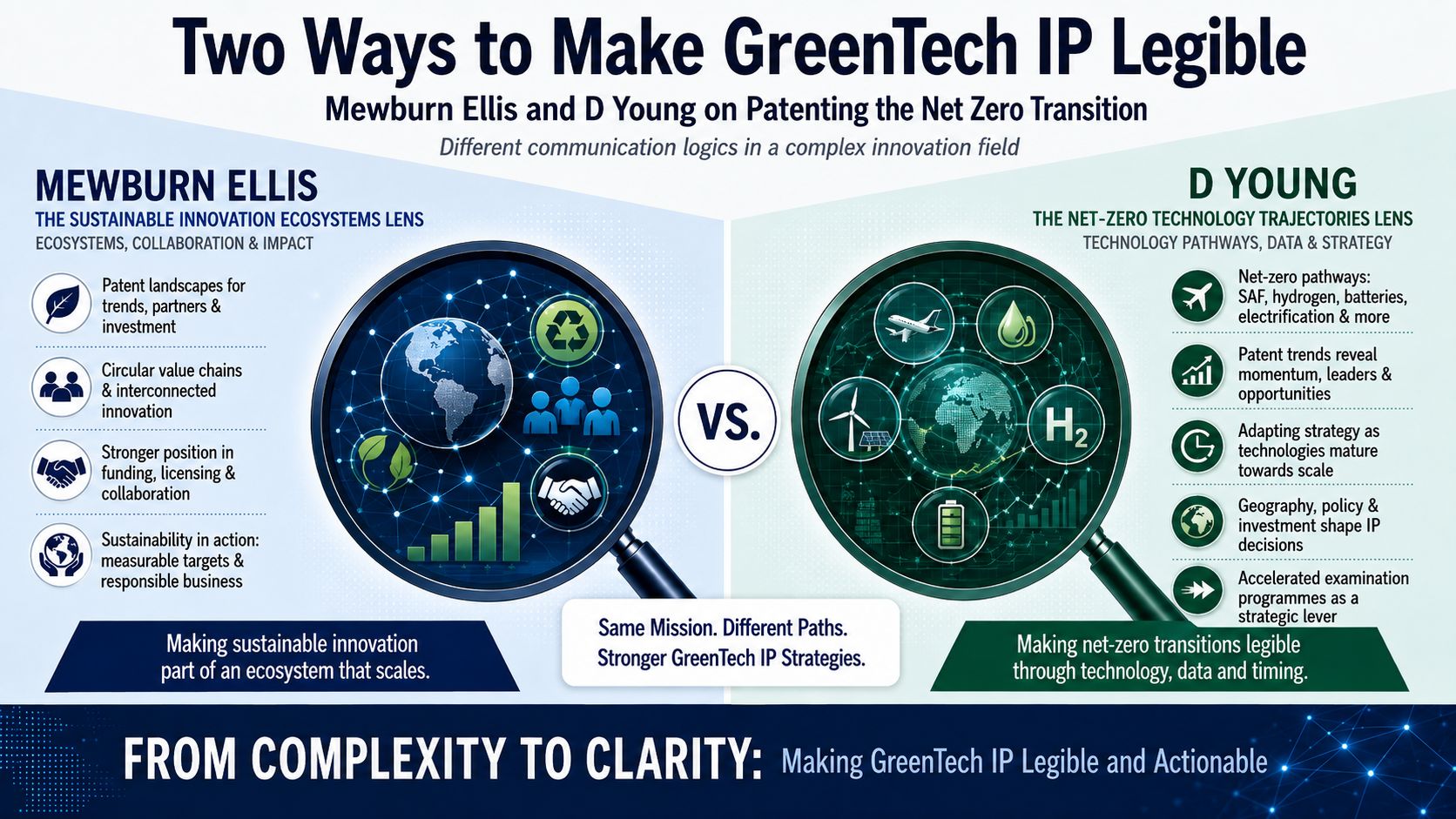
The public communication of Mewburn Ellis and D Young provides two distinct answers. Mewburn Ellis frequently frames sustainable innovation as an ecosystem in which patents interact with technology landscapes, investment, collaboration, circular value chains and wider sustainability responsibilities. D Young more often follows technology trajectories: how particular net-zero technologies develop, what patent data reveals about their momentum and how patent strategy should respond to technological maturity, geography, policy and patent-office mechanisms.
This is not a comparison of the firms’ legal capabilities. Public communication cannot establish which practice is stronger. It is an examination of how two firms make GreenTech IP understandable and commercially relevant to potential clients.
The Common Field
Both firms recognise that GreenTech cannot be communicated effectively as a single patent category. Mewburn Ellis covers sustainable technologies across areas including batteries, energy, advanced materials, bio-based polymers, recycling and circular-economy solutions. Its Green IP communication explicitly describes patents as both a driver and a barometer of innovation and presents patent landscapes as sources of information for partnering, collaboration and investment. D Young similarly publishes across batteries, solar technology, green chemistry, hydrogen, sustainable aviation, energy and other sustainability-related fields. Its dedicated Net Zero communication combines technology explanation with patent statistics, filing trends and protection considerations.
Both therefore move beyond a simple service catalogue. They use technology developments and patent information to create orientation. The difference lies in the organising logic. Mewburn Ellis tends to connect individual technologies to the broader ecosystem through which sustainable innovation is financed, commercialised and adopted. D Young tends to decompose the transition into individual technological pathways and ask what their development means for patent strategy.
Mewburn Ellis: Positioning GreenTech Through Sustainable Innovation Ecosystems
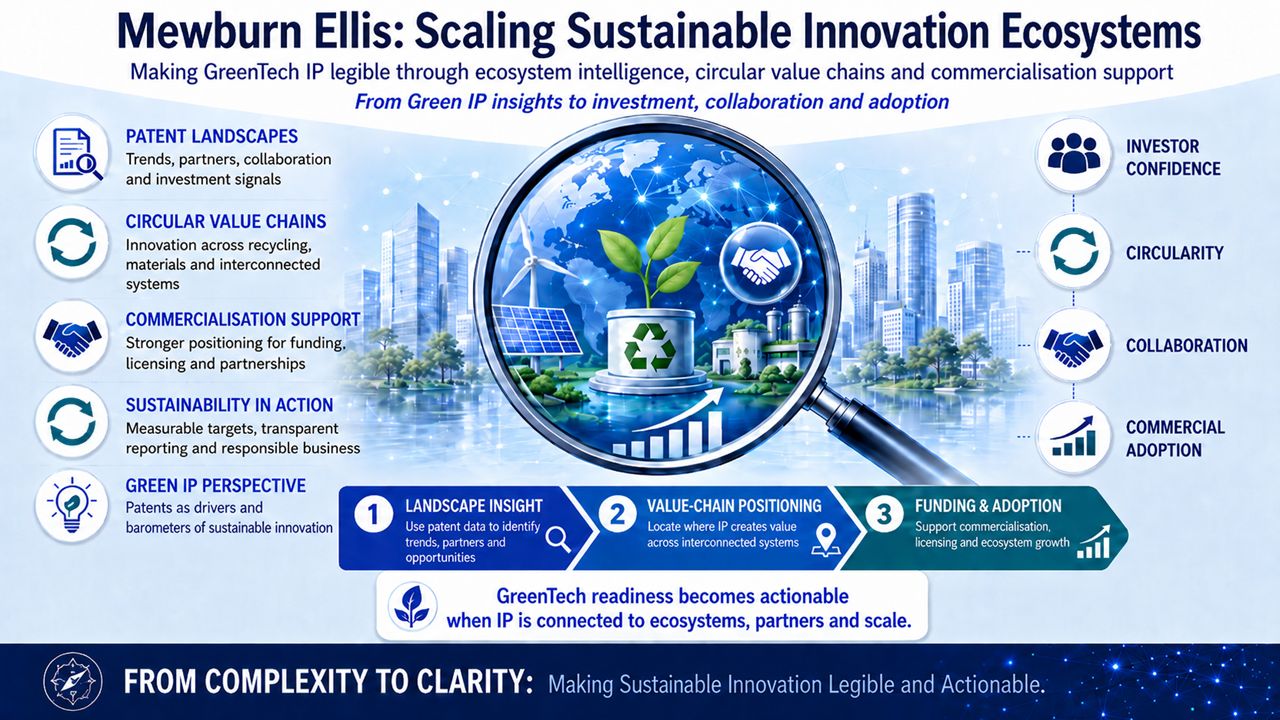
Mewburn Ellis’s public communication suggests an organising principle of sustainable innovation ecosystems. Its Green IP Report is a particularly clear example. The firm does not present patents only as protection for individual inventions. It describes them as indicators of where innovation is occurring and explicitly connects patent landscapes with opportunities for investment, partnership and collaboration.
That changes the role of patent information. A patent landscape is not relevant only because it identifies prior art or competitors. It may also help a company understand where technological activity is accelerating, which organisations are becoming active and where opportunities for cooperation or investment may emerge.
The range of technologies used in the communication reinforces this ecosystem perspective. Mewburn Ellis discusses subjects ranging from carbon utilisation and renewable energy to batteries, sustainable materials and circular plastics. The connecting theme is not one technical discipline, but the transition towards more sustainable industrial systems.
Its recent communication on battery recycling makes this particularly visible. Rather than treating batteries only as electrochemical inventions, the analysis follows innovation across reuse, collection, sorting, dismantling, material recovery, and chemical processing. It also connects patent activity with regulation, supply-chain resilience and critical-material availability. For companies in the field, the relevant IP landscape therefore extends beyond cell chemistry into the broader circular battery value chain.
A similar logic appears in Mewburn Ellis’s communication on plastics. Patent trends are used to examine changes in mechanical, chemical and biological recycling and the emergence of a more circular plastics economy. This is an important positioning choice.
Sustainable innovation increasingly creates value across interconnected activities rather than within one isolated invention. A recycling technology may depend on material composition, sorting systems, process conditions, traceability data and downstream reuse. A battery business may depend on chemistry, software, manufacturing, second-life applications and recovery technologies. Mewburn Ellis’s communication helps make these interdependencies visible.
There is also another element that distinguishes its sustainability positioning: the firm connects its work around sustainable technologies with its own environmental strategy. Its public sustainability communication discusses emissions measurement, Scope 1–3 emissions, business travel, science-based reduction targets and other operational measures. The firm therefore presents sustainability not only as a client technology sector, but also as an organisational issue requiring measurable internal action.
From a positioning perspective, these elements create a broad narrative:
Sustainable innovation should be understood as an ecosystem in which technology, IP, investment, collaboration, circularity and responsible business practices interact.
This likely creates relevance for start-ups, scale-ups, corporate innovation teams, investors and research organisations whose challenge is not simply obtaining a patent, but understanding how IP supports participation in an emerging sustainable value chain. Mewburn Ellis makes GreenTech IP legible by placing patents within the wider system through which sustainable technologies find partners, attract capital and move towards adoption.
D Young: Positioning GreenTech Through Net-Zero Technology Trajectories
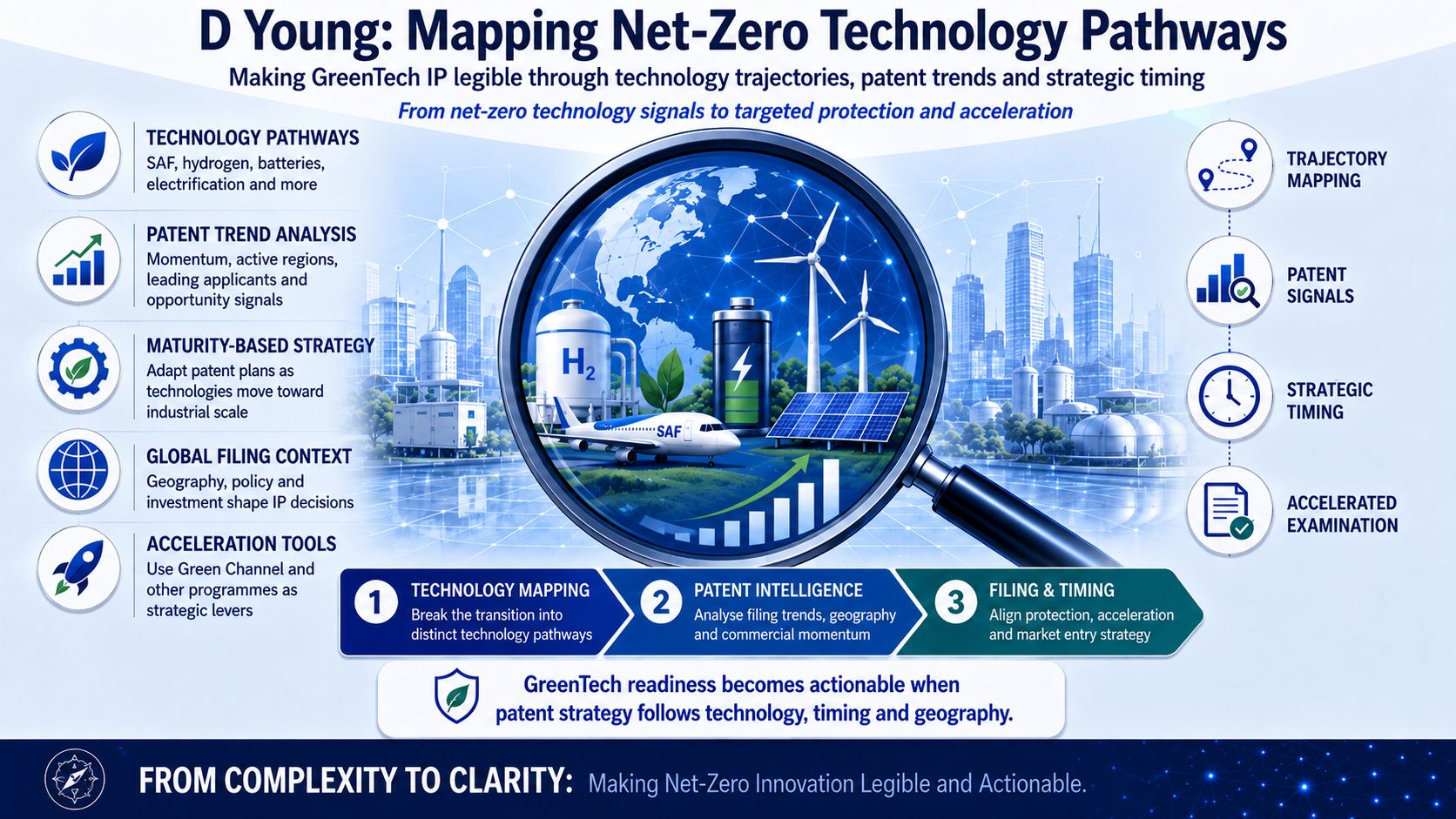
D Young uses a different communication logic. Its sustainability content frequently starts with a specific industrial transition and then decomposes that transition into the technologies required to achieve it.
Aviation is a strong example. Its Fly Net Zero communication explains that aviation decarbonisation will not depend on one breakthrough. Sustainable aviation fuel, hydrogen, electrification, aircraft technology and infrastructure will contribute at different stages and with different technical constraints.
The sustainable aviation fuel article then move deeper into one of those pathways. It discusses different fuel compositions, infrastructure compatibility, certification constraints, supply limitations and the challenge of scaling SAF sufficiently to contribute to aviation’s 2050 targets.
Hydrogen is treated differently because it sits at another point on the technology-maturity curve. D Young’s hydrogen-in-aviation communication discusses both combustion and fuel-cell approaches and the technical barriers associated with introducing hydrogen into aviation.
This creates a useful strategic narrative: net zero is not one technological race. Different solutions mature at different speeds and therefore create different IP opportunities and risks.
Patent data plays an important role in this communication. D Young’s analysis of green hydrogen, for example, examines the rapid growth in patent-family publications and distinguishes between domestic filing activity and families entering Europe. The result is not merely a statement that hydrogen is innovative. Patent data is used to show where activity is increasing and how applicant behaviour differs geographically.
Its battery communication follows the same model. Patent classifications and filing data are used to identify growth in battery innovation and to highlight technical subfields ranging from electrodes and cell construction to charging systems and electric-vehicle applications.
D Young extends this approach from technology-specific trends to the global GreenTech landscape. Its analysis of worldwide green patent statistics compares activity across major patent offices, considers differences between domestic and international filing behaviour and relates these patterns to changes in public funding and climate policy.
The implicit question is:
What do patent signals tell companies about where the net-zero transition is gaining technological and commercial momentum?
D Young also connects these trajectories to patent-system strategy. Its communication on accelerated examination compares the UK Green Channel with acceleration mechanisms available in other jurisdictions and explains when environmentally beneficial inventions may qualify for faster processing. This creates another decision point. If a sustainable technology is approaching investment, market entry or licensing, obtaining an earlier patent may have greater strategic value than following the normal examination timeline.
Taken together, D Young’s communication suggests the following proposition:
Net-zero technologies should be followed as evolving technical trajectories, and patent strategy should adapt to their maturity, competitive intensity, geography and policy environment.
This likely resonates particularly strongly with R&D teams, technology companies and in-house IP functions that must decide where emerging technological opportunities justify protection and how portfolios should evolve as markets mature. D Young makes GreenTech IP legible by translating the net-zero transition into identifiable technologies, patent signals and strategic filing decisions.
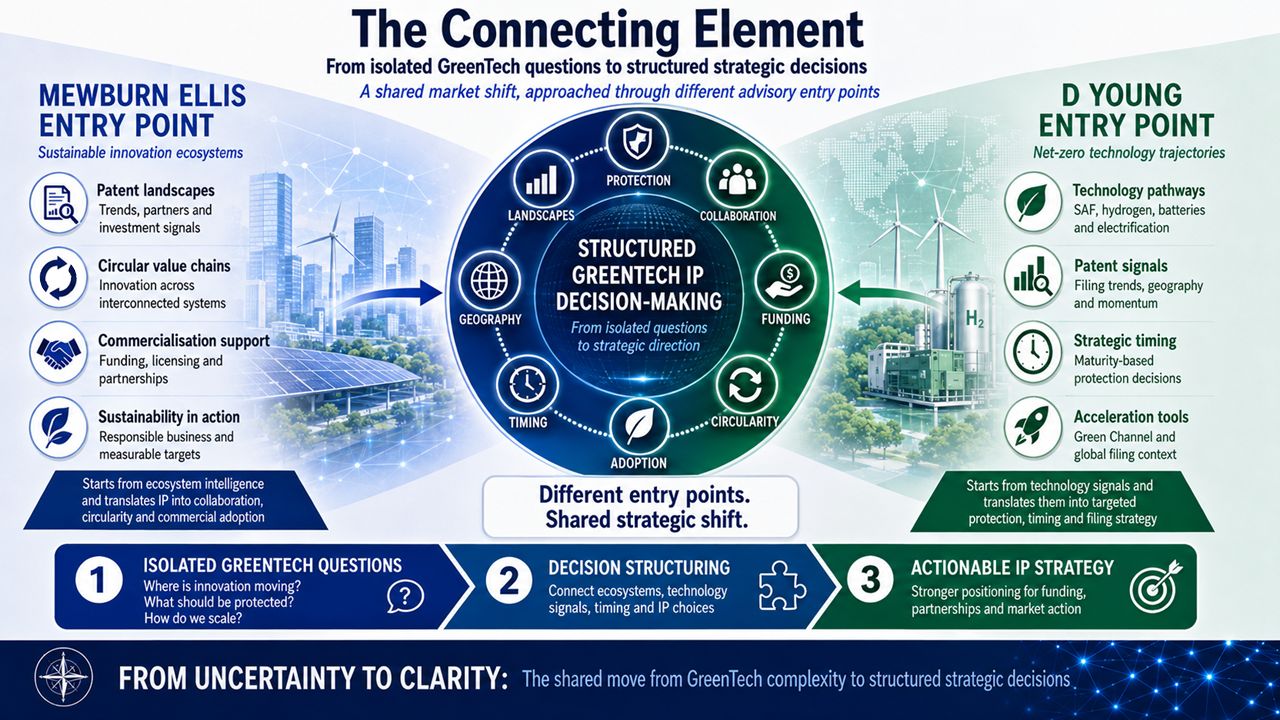
The Connecting Element
The connecting element is a broader structural change in GreenTech. Sustainable technologies increasingly operate within interconnected industrial systems. Batteries connect energy storage, mobility, software, raw materials and recycling. Hydrogen connects generation, infrastructure, transportation and industrial use. Aviation decarbonisation connects fuels, aircraft systems, energy infrastructure and regulation. This can be described as a shift from protecting individual inventions towards maintaining strategic control within complex innovation ecosystems.
Both communication strategies respond to this development. Mewburn Ellis makes the interdependencies surrounding sustainable innovation visible. D Young makes the technological pathways within the transition visible. One helps the reader understand how value is connected across an innovation ecosystem. The other helps the reader understand how individual technologies are progressing within the transition.
The Difference
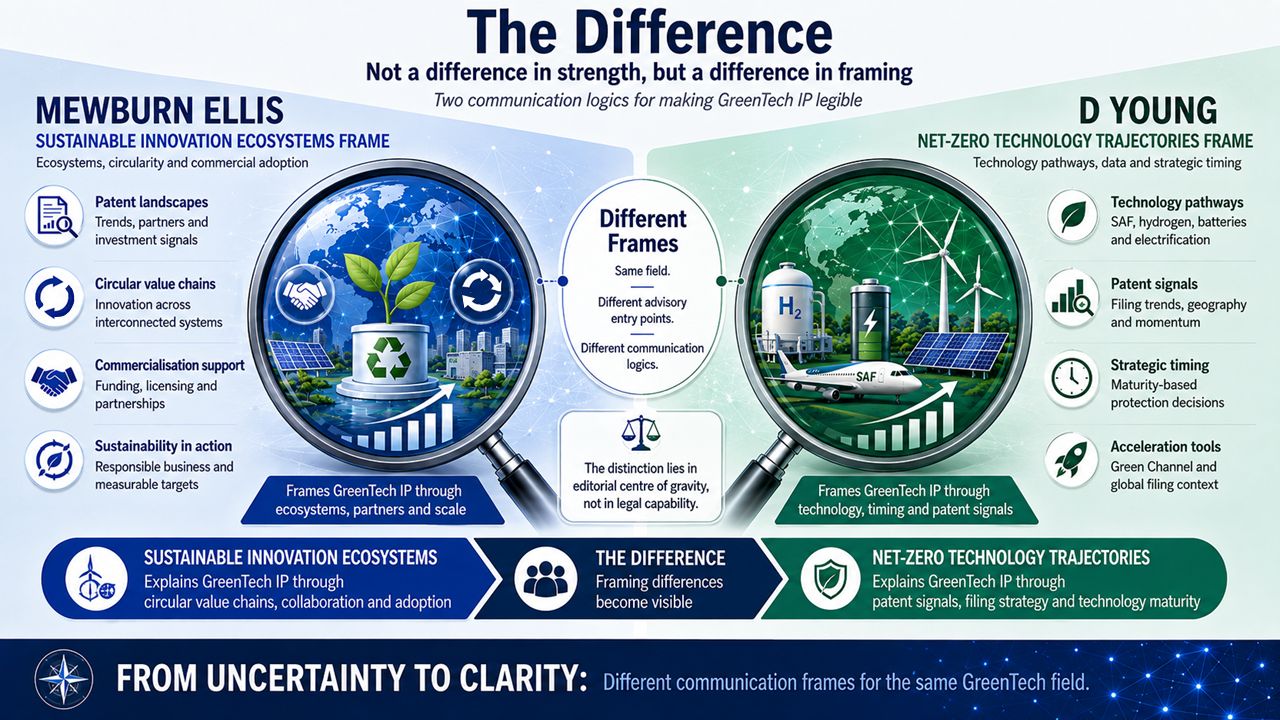
The central difference can therefore be described as:
Sustainable innovation ecosystems versus net-zero technology trajectories.
Mewburn Ellis appears to lead from the wider sustainable innovation system towards IP decisions. Patent landscapes, circular value chains, investment, collaboration and the firm’s own sustainability commitments create a broad ecosystem narrative. D Young appears to lead from individual transition technologies towards strategic patent decisions. Its communication follows technologies such as SAF, hydrogen and batteries, uses patent data to assess momentum and considers how protection should respond to maturity, geography and policy.
Neither approach excludes the other. Mewburn Ellis also discusses patent trends and individual technologies. D Young also recognises the interconnected nature of the net-zero transition. The difference lies in emphasis and editorial centre of gravity. Mewburn Ellis makes the sustainable innovation ecosystem understandable. D Young makes the direction of technological transition understandable.
What IP Practice Groups Can Learn from This
The first lesson is that “GreenTech expertise” is not yet a positioning strategy. The field is too broad. A practice group needs an organising lens that helps potential clients understand why its expertise is relevant.
The second lesson is that patent information can create relevance before a mandate exists. Mewburn Ellis uses patent landscapes to discuss investment, collaboration and emerging value chains. D Young uses patent statistics to identify technology momentum, geographic differences and changing competitive activity. In both cases, patent information becomes market intelligence.
The third lesson is that communication should connect technology developments to decisions. A company does not only need to know that hydrogen patenting is increasing or battery recycling is growing. It needs to understand whether this affects portfolio priorities, FTO, collaboration strategy, investment decisions or filing geography.
The fourth lesson is that coherent positioning emerges from repeated framing. Mewburn Ellis repeatedly connects sustainability with ecosystems, circularity and broader organisational responsibility. D Young repeatedly connects net-zero objectives with specific technology pathways and patent trends. That consistency makes the underlying advisory proposition easier to recognise.
Why This Matters for IP Business Development
GreenTech companies often encounter an IP problem before they know which legal service they require. A company may see patent activity accelerating around a competing battery technology. A sustainable-materials business may need partners to industrialise its process. A hydrogen developer may need to decide whether rapidly evolving infrastructure changes its filing priorities. An aviation company may need protection across several technologies developing on different timelines. The adviser who helps structure these questions becomes relevant before the mandate has been reduced to “draft this patent application”.
That is the business-development value of strong subject-matter communication. Mewburn Ellis creates orientation by showing how IP fits within sustainable innovation ecosystems. D Young creates orientation by showing how patent strategy follows technological change within the transition to net zero. Both demonstrate that strong GreenTech communication should answer a more precise question than:
“Do we work with sustainable technologies?”
The stronger question is:
“Which uncertainty in the GreenTech transition do we help companies understand?”
IP Expertise Demand Index 2026
This distinction is also relevant to the IP Expertise Demand Index 2026. The Index focuses on fields in which technological change creates new decision pressure before the advisory market has fully standardised the corresponding services. GreenTech is a strong example because companies increasingly need support around portfolio architecture, patent intelligence, freedom to operate, investment readiness, collaboration, regulation and control across interconnected technologies.
The GreenTech Strategy Gap identified by the IP Business Academy describes a related mismatch: companies experience patents, trade secrets, data, partnerships, standards, funding and market access as interconnected issues, while IP services are often still communicated separately.
The two firms illustrate different ways of narrowing that gap. Mewburn Ellis helps the market interpret sustainable innovation as an ecosystem of technological and commercial relationships. D Young helps the market interpret the transition through technology development, patent activity and strategic timing.
The broader lesson is that GreenTech communication becomes most valuable when it does not merely demonstrate expertise, but gives potential clients a framework for interpreting change.
Sources Used
Mewburn Ellis
Sustainability / Green IP Report
👉https://www.mewburn.com/sustainability
New Green IP Report launched
👉https://www.mewburn.com/forward/new-green-ip-report-launched
Battery recycling moves centre stage: what the surge in circularity innovation means for industry and IP strategy
👉https://www.mewburn.com/forward/battery-recycling-moves-centre-stage-what-the-surge-in-circularity-innovation-means-for-industry-and-ip-strategy
Plastics in Transition: EPO Report Highlights Innovation Surge in Waste Management
👉https://www.mewburn.com/forward/plastics-in-transition-epo-report-highlights-innovation-surge-in-waste-management
Mewburn Ellis – sustainability and the road to net zero
👉https://www.mewburn.com/forward/mewburn-ellis-sustainability-and-the-road-to-net-zero
Energy and Power
👉https://www.mewburn.com/energy-and-power-patent-advice
D Young
Fly net zero 2050
👉https://www.dyoung.com/en/knowledgebank/articles/fly-net-zero-2050
Sustainable Aviation Fuel (SAF)
👉https://www.dyoung.com/en/knowledgebank/articles/sustainable-aviation-fuel-fly-net-zero
Green hydrogen innovation and patent trends
👉https://www.dyoung.com/de/wissensbank/artikel/green-hydrogen-patent-trends-innovation
Battery technology: patent filings and future development areas
👉https://www.dyoung.com/de/wissensbank/artikel/netzero-battery-technology-patents
Is the appetite for green technology waning? Insights from worldwide patent office statistics
👉https://www.dyoung.com/en/knowledgebank/articles/greentech-worldwide-patent-statistics
Greentech gets the green light: accelerating patent applications towards grant
👉https://www.dyoung.com/en/knowledgebank/articles/greentech-patent-acceleration
Net Zero Week 2024 IP Update
👉https://www.dyoung.com/de/wissensbank/artikel/net-zero-2024-ip-update
IP Business Academy / dIPlex
The GreenTech Strategy Gap: What Sustainable Innovation Companies Need, and What IP Advice Still Often Fails to Integrate
👉https://ipbusinessacademy.org/the-greentech-strategy-gap
IP in Green Tech: From Protecting Inventions to Controlling Sustainable Innovation
👉https://profwurzer.com/diplex/docs/green-tech/
Why Green Tech Is Reshaping the Role of Intellectual Property
👉https://profwurzer.com/diplex/docs/green-tech/why-green-tech-is-reshaping-the-role-of-intellectual-property/
IP Market Report: IP in Green Tech
👉https://profwurzer.com/diplex/docs/green-tech/ip-market-report-ip-in-green-tech/
The Emerging Market for Green Tech IP Services
👉https://profwurzer.com/diplex/docs/green-tech/the-emerging-market-for-green-tech-ip-services/
IP Expertise Demand Index 2026
👉https://ipbusinessacademy.org/ip-expertise-demand-index-2026