Two Ways to Make UPC Litigation Legible: Procedural Architecture at Kather Augenstein and Integrated Case Building at Hoffmann Eitle

The Unified Patent Court has entered a new communication phase. The basic architecture of the system is increasingly familiar. For companies facing an actual dispute, the harder question is no longer simply how the UPC works. It is how to prepare a case for a court that moves quickly, expects arguments early and combines technical, validity and procedural questions within a compressed timetable.
That creates a positioning challenge for patent litigation practices. Saying that a firm acts before the UPC establishes capability, but says relatively little about how it helps a client prepare for the pressures of the new system. Stronger communication makes the litigation problem itself easier to understand.
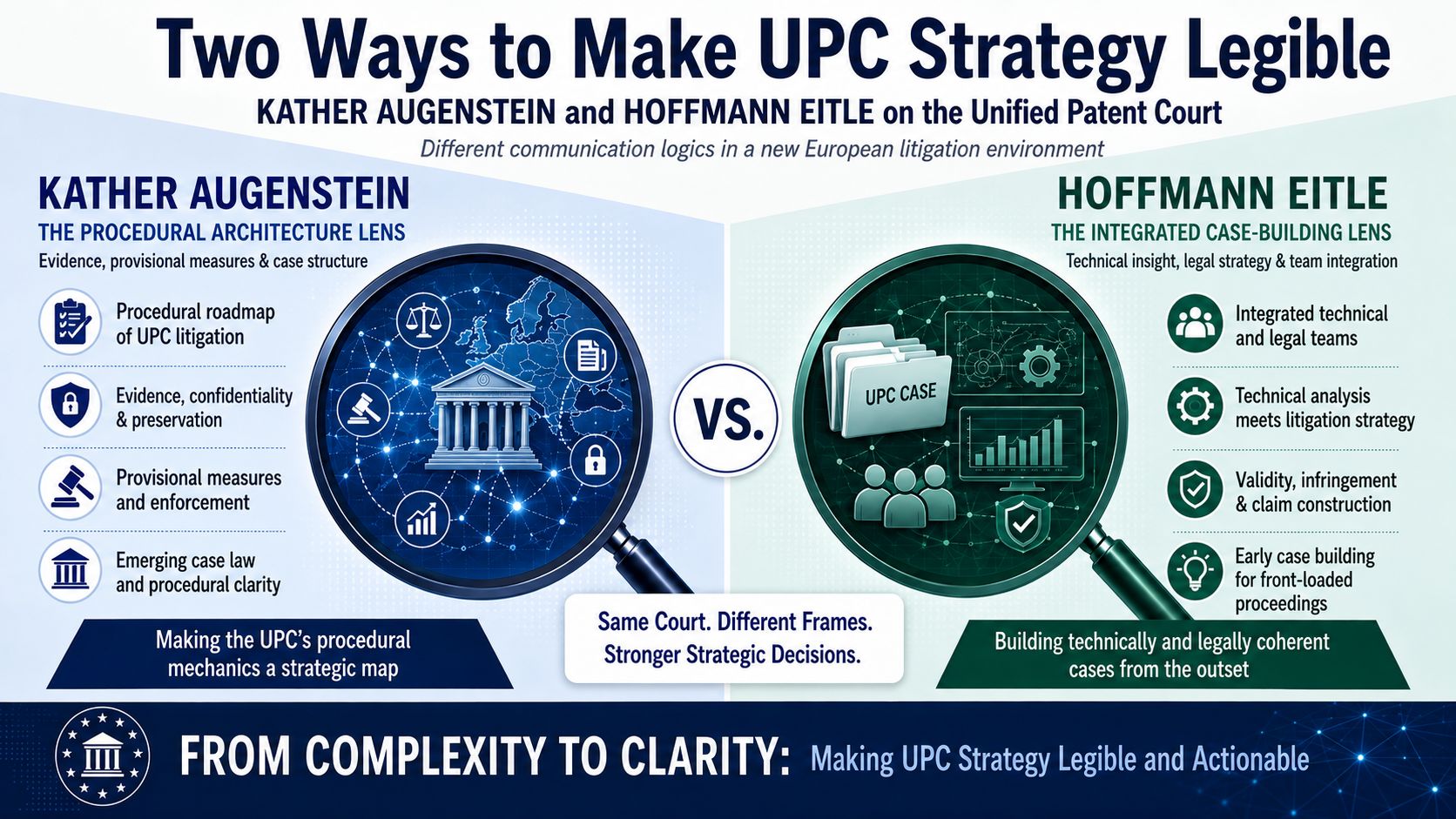
The publicly visible communication of KATHER AUGENSTEIN and HOFFMANN EITLE illustrates two distinct approaches. KATHER AUGENSTEIN places particular emphasis on the procedural architecture of UPC litigation: how proceedings unfold, when arguments and evidence must be introduced, how confidentiality and provisional measures operate and how emerging decisions refine the Rules of Procedure. HOFFMANN EITLE places stronger emphasis on integrated technical-legal case building: assembling patent attorneys and litigators around the technical, scientific, validity and legal substance of the dispute from the outset.
This is not a ranking of the firms’ legal capabilities. Both clearly operate across broader areas than these communication lenses suggest. It is a comparison of the organising principles most visible in their public UPC communication.
The Common Field
Both firms communicate a similar underlying reality: the UPC rewards preparation. Its compressed procedure leaves limited room to develop a case incrementally. Infringement positions, validity challenges, evidence and procedural choices often need to be developed substantially earlier than parties accustomed to some national systems may expect.
KATHER AUGENSTEIN makes that preparation visible through a detailed explanation of the procedural framework. Its UPC seminar series follows contentious proceedings from preparation of the action through written and interim proceedings to enforcement. Separate modules address preservation of evidence, statements of claim, case management, provisional measures, appeals, costs and remedies. HOFFMANN EITLE begins from the same pressure but emphasizes the team required to respond to it. Its UPC communication explicitly connects the court’s streamlined procedure and short deadlines with close cooperation between attorneys-at-law and patent attorneys. The stated objective is to bring technical, scientific, legal, procedural and strategic analysis together within one litigation team. The common concern is therefore litigation readiness. The difference is where each firm places the lens.
KATHER AUGENSTEIN: Positioning the UPC Through Procedural Litigation Architecture
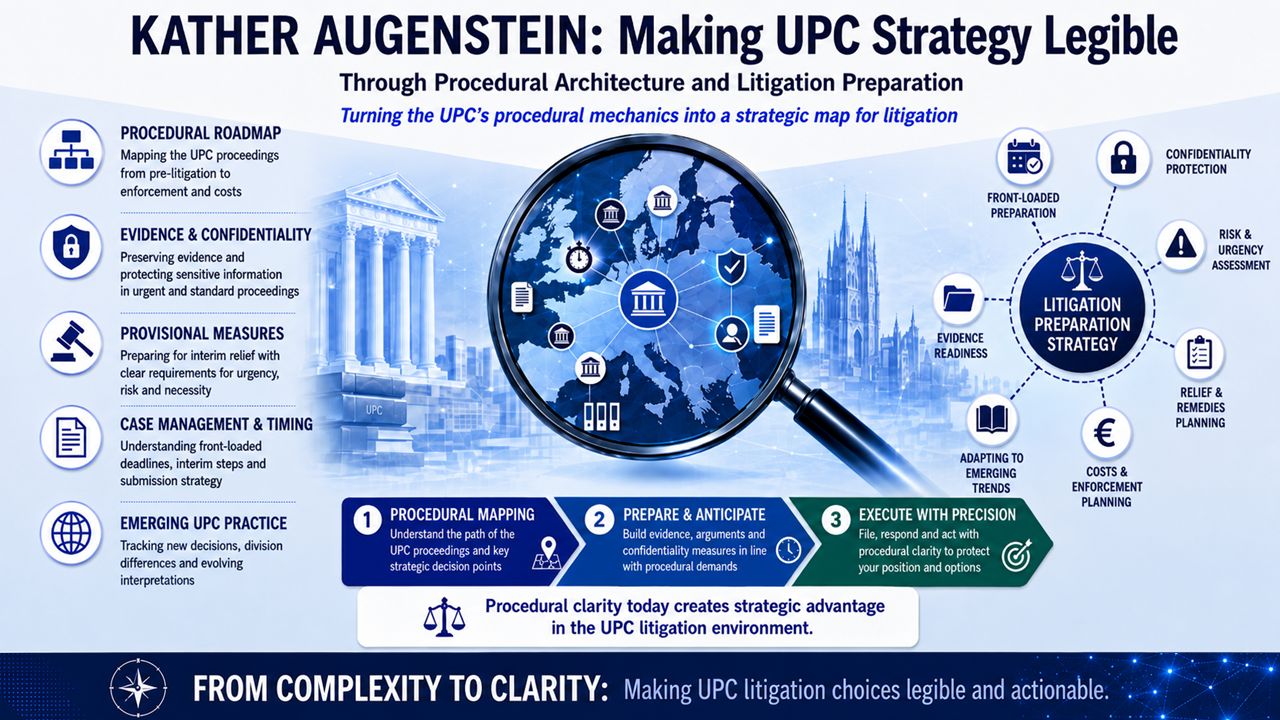
KATHER AUGENSTEIN’s communication is unusually systematic in showing the UPC as a sequence of procedural decisions. Its seminar architecture effectively maps the litigation process:
- pre-litigation conduct;
- preservation of evidence;
- preparation of the statement of claim;
- defense and counterclaims;
- case management;
- interim proceedings;
- provisional measures;
- appeals;
- remedies;
- enforcement and costs.
This creates a clear positioning effect. The procedure itself becomes the strategic map. A potential claimant is encouraged to ask not only whether its patent is infringed, but whether the necessary evidence has been secured, whether the requested relief has been formulated correctly and whether the factual and technical record is ready for a front-loaded proceeding. A potential defendant is encouraged to think equally early about validity, evidence, confidentiality and the procedural response that may be required within a short timetable.
The firm’s continuing UPC updates reinforce this approach. Rather than limiting communication to major judgments, KATHER AUGENSTEIN frequently isolates specific procedural questions and explains what an individual order means for future litigation. Its analysis of confidentiality in provisional proceedings, for example, examines who may access alleged trade secrets and how the need for confidentiality must be balanced against a party’s ability to prepare its case under very short deadlines. Its communication on provisional measures similarly follows the Court of Appeal’s developing criteria around necessity, imminent infringement and the circumstances in which the main proceedings cannot reasonably be awaited. This is significant because provisional relief is not presented merely as an available remedy. The communication translates emerging case law into preparation requirements.
Another recurring feature is attention to differences emerging between divisions and to interpretations that cannot simply be assumed from the wording of the Rules. Its early analysis of access to pleadings, for instance, compared different approaches taken by the Munich Central Division and the Nordic-Baltic Regional Division. The resulting communication proposition can be summarised as:
Understand the UPC’s procedural mechanics early enough to build the case around them.
The emphasis is therefore not procedure for its own sake. Procedure becomes a form of litigation architecture: a framework determining what must be prepared, when it must be introduced and which procedural instruments can create or contain commercial pressure. KATHER AUGENSTEIN makes UPC litigation legible by turning an evolving set of procedural rules and decisions into a structured map for conducting the dispute.
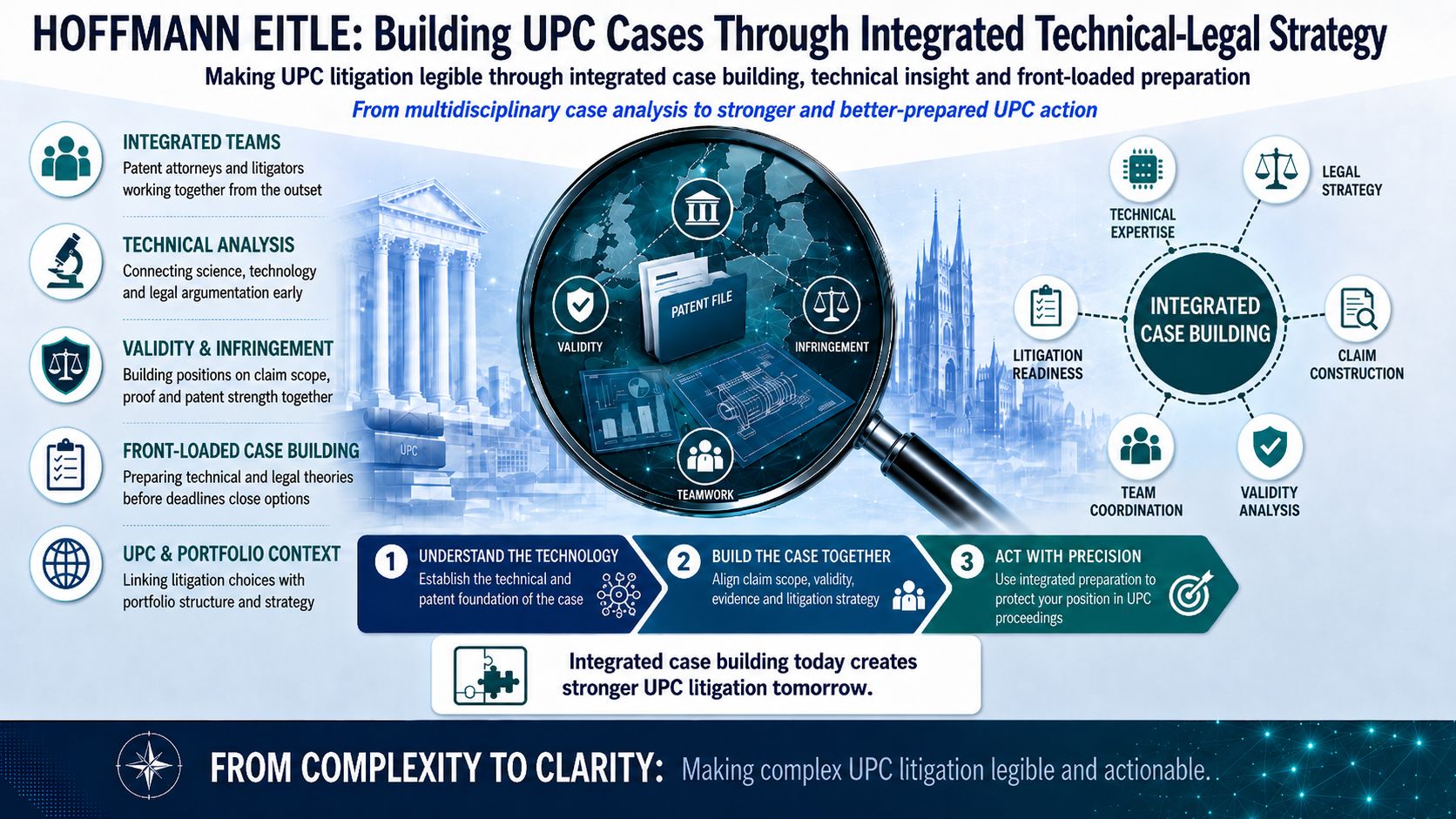
HOFFMANN EITLE: Positioning the UPC Through Integrated Technical-Legal Case Building
HOFFMANN EITLE approaches the preparation problem from another direction. Its UPC communication repeatedly foregrounds the composition of the litigation team. The firm describes close cooperation between attorneys-at-law and specialised patent attorneys as a core strength. According to its public positioning, these mixed teams establish the technical, scientific or medical background of a case together and translate that analysis into legal assessment and litigation arguments.
The underlying logic is particularly suited to a front-loaded system. If infringement, claim construction, validity and evidence must be addressed quickly, technical analysis cannot remain a separate upstream exercise that is later handed to the litigation team. It needs to be integrated into the construction of the case.
HOFFMANN EITLE’s case-law communication illustrates this lens. A recent analysis of a preliminary-injunction decision concerning a medical device focuses simultaneously on technical claim construction, the factual evidence required to demonstrate infringement and the allocation of the burden concerning validity. The article stresses that summary proceedings leave little scope for later clarification through additional fact-finding or expert evidence.
Another case analysis examines a failed attempt to shift from direct to indirect infringement during proceedings. The firm connects the outcome directly with the UPC’s front-loaded system: a new infringement theory can introduce factual and subjective requirements that should have been developed earlier. Its recent discussion of mechanical claim construction similarly works from the technical meaning of structural features towards infringement and provisional relief. This communication makes a different aspect of readiness visible. The central question becomes:
Have the technical and legal theories of the case been constructed together before procedural deadlines begin closing options?
The firm’s UPC Handbook broadens that approach beyond an individual dispute. It addresses prosecution strategy, opt-outs, portfolio structure, EPO divisionals and the choice between national litigation and the UPC. The stated purpose is to give practitioners a systematic basis for navigating the system rather than treating litigation as detached from patent strategy.
HOFFMANN EITLE therefore makes a particular organisational capability central to its positioning: technical expertise + patent expertise + litigation expertise = integrated case construction. The implicit proposition can be read as:
Build the technical, validity and infringement case together from the beginning.
HOFFMANN EITLE makes UPC litigation legible by showing how a multidisciplinary team can turn complex technology questions into a litigation position capable of surviving a compressed procedure.
The Connecting Element
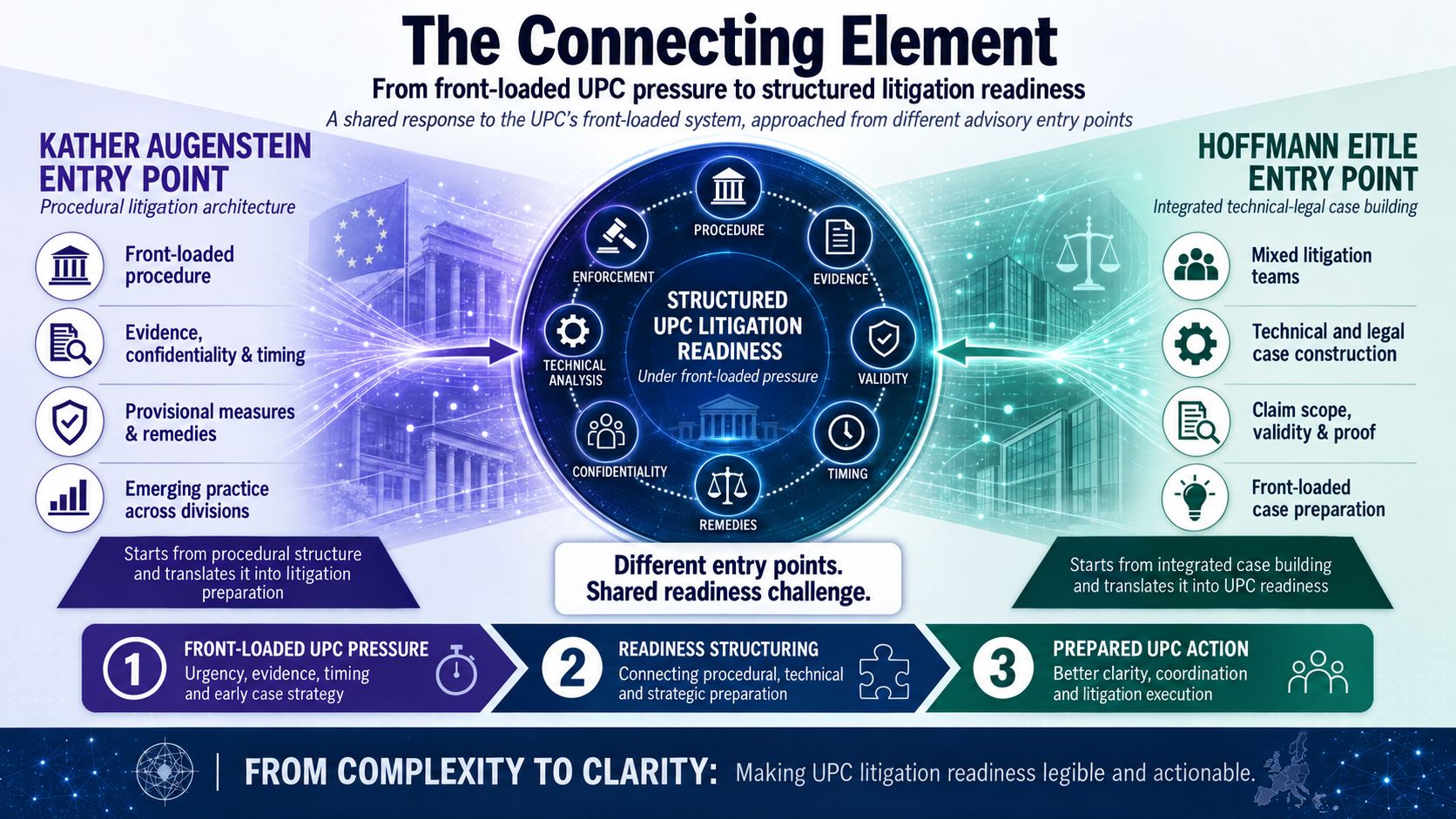
The connecting element is front-loading. The UPC increases the cost of discovering weaknesses late. An infringement theory that has not been developed completely may be difficult to amend. An invalidity challenge that was not properly prepared may lose procedural relevance. Evidence that cannot be disclosed safely may create confidentiality problems. A provisional-measures application can force both sides to address technically and commercially important issues before a full main action has developed.
A broader analysis of UPC litigation readiness reaches a similar conclusion from the corporate side: companies should identify relevant patents, products, competitors, technical experts and internal decision-makers before a dispute becomes urgent.
Both firms’ communication responds to this pressure.
KATHER AUGENSTEIN asks: What must the party do within the procedural architecture?
HOFFMANN EITLE asks: What must the litigation team understand and construct before entering that architecture?
The same problem produces two different forms of preparation.
The Difference
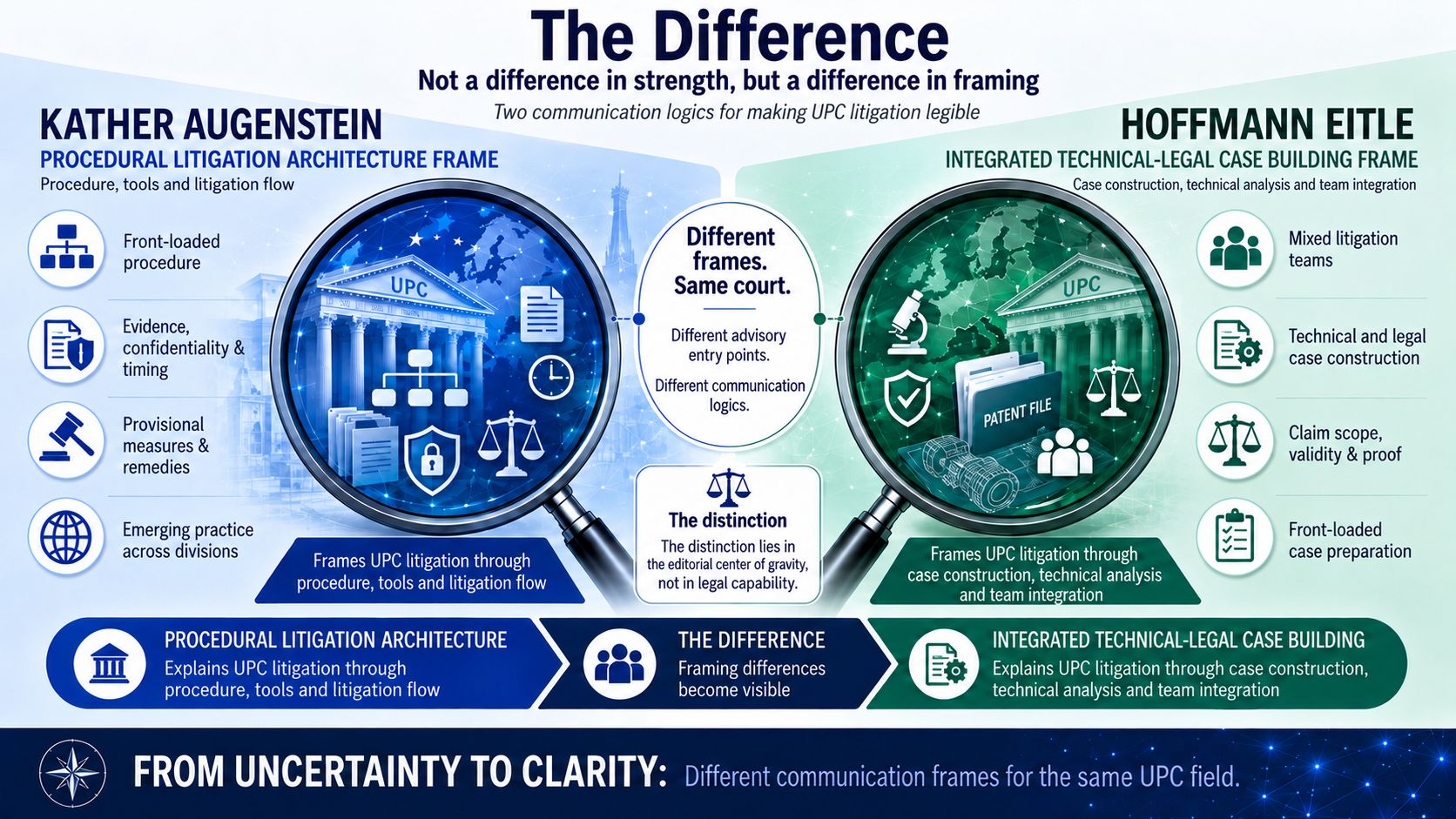
The distinction can therefore be expressed as:
Procedural litigation architecture versus integrated technical-legal case building.
KATHER AUGENSTEIN leads from the mechanics of the proceeding towards litigation strategy. Its communication makes procedural sequence, evidentiary instruments, confidentiality, provisional measures and developing court practice highly visible. HOFFMANN EITLE leads from the substance of the case towards procedural execution. Its communication makes mixed litigation teams, technical understanding, validity analysis and the interaction between patent attorneys and litigators particularly visible.
Neither lens excludes the other. A technically sophisticated UPC case obviously requires procedural discipline, and procedural strategy cannot succeed without an understanding of the patent and the technology.
The distinction lies in the entry point and editorial center of gravity.
KATHER AUGENSTEIN foregrounds how the case must move through the court.
HOFFMANN EITLE foregrounds how the case must be constructed before and while it moves through the court.
What IP Practice Groups Can Learn from This
The first lesson is that UPC experience alone is becoming a weak differentiator. As the court matures, sophisticated clients can increasingly expect leading litigation practices to have UPC experience. Communication therefore needs a more specific reasoning.
The second lesson is that procedure becomes more useful when translated into preparation. A description of Rule 262 or Article 62 UPCA is technically accurate. Explaining how confidentiality arrangements affect the composition of the working team or what evidence must already exist before seeking provisional relief makes the information operational.
The third lesson is that multidisciplinary capability should be demonstrated rather than merely claimed. HOFFMANN EITLE’s strongest communication does not simply state that lawyers and patent attorneys cooperate. Case analyses show why technical claim interpretation, validity arguments and procedural timing need to be addressed together.
The fourth lesson is that an evolving court creates room for interpretation-led positioning. Clients cannot rely completely on habits imported from established national systems. Firms that consistently explain what emerging UPC practice changes in the preparation and conduct of the next case can build authority before a mandate arises.
Why This Matters for IP Business Development
Patent disputes rarely begin with a client asking for an abstract explanation of UPC procedure. They begin with operational uncertainty. A competitor is approaching launch. Critical evidence is difficult to obtain. A patent may be vulnerable. Confidential technical information must be submitted. A preliminary injunction could disrupt several markets. An engineering team has only days to explain the accused product. These situations create demand for advisers who make the next decision clearer.
KATHER AUGENSTEIN’s communication does this by exposing the procedural structure behind the uncertainty. HOFFMANN EITLE does it by showing how technical and legal expertise can be assembled around the substantive case. Both approaches demonstrate a broader business-development principle:
A litigation practice becomes easier to select when its communication shows not only what it knows, but how it prepares a client for the pressure of the dispute.
The relevant positioning question is therefore no longer: Can we litigate before the UPC? It is:
Which part of UPC litigation readiness do we make easier for clients to understand and execute?
IP Expertise Demand Index 2026
The UPC market increasingly illustrates a shift from information demand to decision demand. Companies now have extensive access to case updates, webinars and procedural commentary. The remaining gap is often the translation of that information into preparedness: which patents matter, which technical facts must be established, which evidence should be secured, who needs to be involved and which decisions cannot safely wait until litigation has started.
This is where differentiated communication becomes commercially valuable. KATHER AUGENSTEIN translates procedural evolution into a framework for conducting litigation. HOFFMANN EITLE translates technical and legal complexity into a framework for constructing the case. Both show how patent law firms can move beyond reporting UPC developments and instead make litigation readiness itself visible as an advisory capability.
Sources Used
KATHER AUGENSTEIN
UPC Online Seminar Series / UPC Videos — Comprehensive public materials covering the structure of UPC proceedings, preservation of evidence, statements of claim, case management, provisional measures, appeals and enforcement. Source
Provisional protection of secrecy in summary proceedings before the UPC — Analysis of confidentiality arrangements, access restrictions and the requirements of effective case preparation in urgent proceedings. Source
Latest case law of the Unified Patent Court on provisional measures — Analysis of necessity, imminent infringement and the Court of Appeal’s emerging approach to provisional relief. Source
On the requirements of an imminent patent infringement within Art. 62(1) UPCA — Discussion of the evidentiary threshold for anticipated infringement in provisional-measures proceedings. Source
On access to written pleadings and evidence — Comparison of differing approaches to access taken by UPC divisions during the court’s emerging procedural practice. Source
HOFFMANN EITLE
UPC Hub — The firm’s central positioning around multidisciplinary UPC teams, short procedural timelines and cooperation between patent attorneys and attorneys-at-law. Source
Patent Litigation and Contracts Team — Explanation of how litigators and specialised patent attorneys jointly establish the technical and scientific foundation of cases. Source
The Unified Patent Court and Unitary Patent: A Practitioner’s Handbook — Systematic guidance covering prosecution, portfolio structure, opt-out and litigation strategy. Source
Working worse is no defence: a recent UPC order reinforces feature-based claim scope — Analysis connecting technical claim construction, proof, validity and preliminary-injunction procedure. Source
LD Düsseldorf rejects last-minute pivot from direct to indirect infringement — Analysis highlighting the consequences of the UPC’s front-loaded procedure for infringement theories. Source
Mechanical claims at the UPC: Context is key — Discussion of technical claim interpretation and infringement in provisional-measures proceedings. Source
IP Business Academy / dIPlex
IP Market Report: Unified Patent Court (UPC) — Market analysis of emerging client needs around litigation readiness, portfolio strategy, cross-border enforcement and strategic interpretation of UPC developments. Source
The Emerging Strategy Gap in the UPC Market — Analysis of the shift from an information deficit towards a decision and implementation deficit as the UPC matures. Source
Unitary Patent and Unified Patent Court as a Strategic IP Management Challenge — Deeper analysis of litigation readiness, product and patent mapping, internal preparation and organisational response to UPC exposure. Source