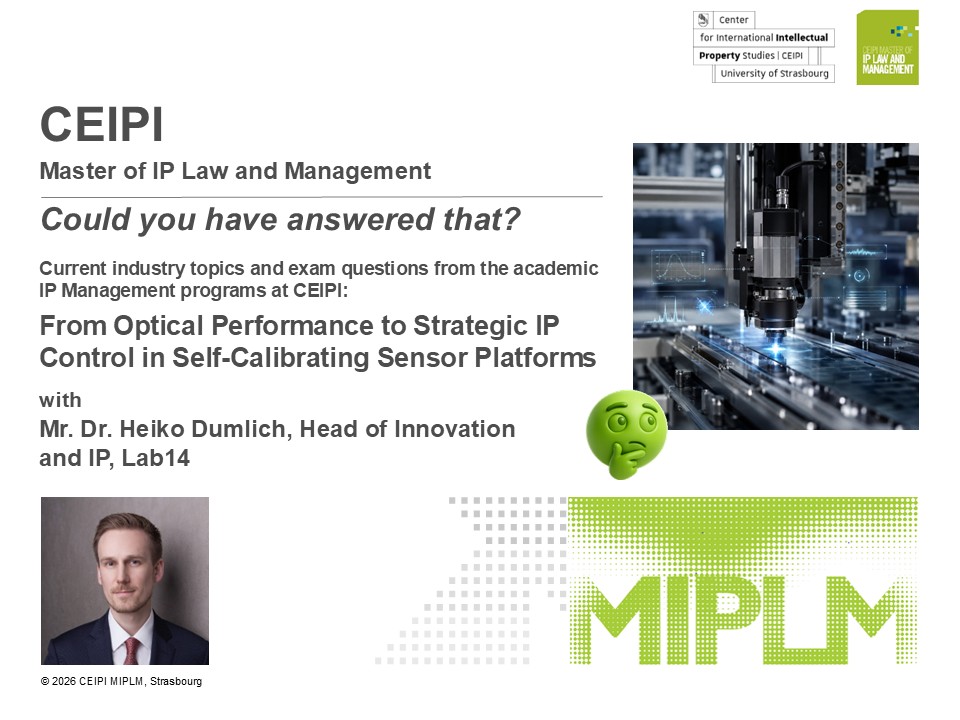
Practical Question Photonics/Optics with Dr. Heiko Dumlich: From Optical Performance to Strategic IP Control in Self-Calibrating Sensor Platforms

Photonics companies are no longer developing only isolated optical components, sensors or measurement devices. Increasingly, they are building integrated technology systems in which optical architecture, detectors, manufacturing precision, calibration, signal processing, software and data work together to create the performance that customers actually buy.
This changes the IP question. A self-calibrating optical sensor may be valuable not only because of its optical design or detector configuration, but because manufacturing know-how makes the required tolerances reproducible, calibration compensates for physical variation, software interprets complex signals and field data continuously improves system performance. The commercially relevant asset may therefore sit in the interaction between several technical and knowledge layers rather than in one individually protectable component.
The strategic challenge becomes particularly visible when such a technology moves from successful pilots toward industrial scale. A major equipment manufacturer can provide market access and accelerate adoption, but integration requires technical transparency, access to interfaces, calibration knowledge and selected data. Customer-specific adaptations may generate new routines, application knowledge and performance data. The same collaboration that creates commercial growth can therefore also influence where future knowledge accumulates and who controls the most valuable learning.
This is exactly the type of structural shift described in the CEIPI IP Business Academy analysis “The Photonics Strategy Gap”. The study shows that photonics companies increasingly operate in layered value architectures in which patents, trade secrets, fabrication know-how, calibration, software, data, freedom to operate, supplier relationships and collaboration agreements must be connected into one coherent strategic control position.
The central question is therefore no longer simply what can be patented. It is what a photonics company must continue to control in order to scale, collaborate, preserve freedom to act and maintain a defensible position as its technology becomes embedded in customers’ industrial systems.
Here you find the findings of this study: The Photonics Strategy Gap: What Light-Based Technology Companies Need, and What IP Advice Still Often Fails to Integrate
Against this background, the CEIPI IP Business Academy integrates practice-based questions from industry into its teaching. These questions help students understand IP not only as a legal protection tool, but as a management instrument for strategic decision-making in complex innovation systems. In photonics, this means looking beyond individual optical inventions and identifying where control over technology, manufacturing knowledge, calibration, software, data and collaboration must sit in order to support the company’s business model.
We are therefore pleased to include this industry case study with Dr. Heiko Dumlich, who brings a practitioner perspective to a central challenge for photonics and optical sensor companies.
His practical question focuses on how a company should design a layered IP control strategy when customer value results from the interaction of optical architecture, detector configuration, manufacturing, calibration, software and data, while the strategically important control points may change depending on how the company intends to manufacture, collaborate, license and scale its technology.
Here is Dr. Heiko Dumlich’s assessment of the case:
“The case addresses a highly relevant IP management challenge in high-technology businesses: customer value increasingly results from the interaction of hardware, manufacturing know-how, calibration, software, and data rather than from a single protectable component. The decisive strategic task is therefore to identify and preserve the IP control points that allow the technology provider to capture value in line with the company’s business model while scaling through collaborations.”
Mini Case Study
A European photonics company has developed a new generation of compact optical sensors for industrial process monitoring. The sensors are designed to detect very small changes in material properties and process conditions directly inside production environments. Compared with conventional systems, the new sensor achieves higher sensitivity and remains stable under changing temperatures, vibration and other environmental influences.
The performance advantage comes from several technical layers working together. The company has developed a specific optical architecture and, as a separate technical layer, a highly sensitive detector configuration. Dedicated manufacturing and alignment processes allow critical optical tolerances to be achieved consistently. A first calibration layer compensates for device-to-device variations resulting from manufacturing and alignment. A second, adaptive calibration layer adjusts sensor behaviour to different machines, materials and operating environments. Signal-processing software filters noise, interprets the optical response and converts raw measurements into information that can be used directly by the customer’s production system.
During development, these elements have increasingly become interdependent. Improvements in software allow less stringent component tolerances. Better device calibration enables the use of more cost-efficient optical components. Adaptive calibration can compensate for application-specific variations. Changes in the optical design generate richer signals that the software can interpret. Manufacturing data, calibration data and field measurements are beginning to create a feedback loop that continuously improves sensor performance.
The first industrial pilots have been successful. One of these pilots was conducted with a large international equipment manufacturer under an NDA and limited pilot terms. These arrangements covered confidentiality and evaluation use, but did not comprehensively allocate rights to customer-specific calibration routines, future improvements, application knowledge or the data and learning that could arise from a broader commercial rollout. The equipment manufacturer now proposes to integrate the sensor into several product lines. The potential volume would move the photonics company from a specialist technology supplier toward a significant industrial platform position.
The customer, however, needs adaptations for different machines, materials and operating environments. Its engineers therefore request detailed information about calibration procedures, interfaces and performance parameters. They also want access to selected data so that the sensor can be integrated into the customer’s own control software. The customer already controls operational data generated by its own machines, while the photonics company generates sensor diagnostics, calibration parameters and derived performance data. Data and learning from other pilot or customer projects may be subject to confidentiality obligations, contractual restrictions or third-party rights. Future versions could be jointly optimized for specific industrial applications.
Internally, this opportunity creates different views about where the company should build its IP position.
The optical engineering team sees the distinctive optical architecture and detector configuration as core innovations and argues for broad patent protection around the underlying optical principles, relevant system combinations and possible alternative implementations.
The manufacturing team believes that competitors could design around the optical architecture. In its view, the real competitive advantage lies in knowing how to manufacture and align the system consistently at industrial scale. Some of this knowledge may be difficult to observe from the finished product and could therefore be more valuable if retained as confidential know-how.
The measurement specialists point to calibration as two different control points. Device calibration determines whether individual sensors can achieve consistent performance despite manufacturing variation. Adaptive calibration determines how the system maintains accuracy across different machines, materials and operating conditions. A competitor may be able to reproduce the physical sensor, yet still lack the calibration knowledge required to deliver comparable performance.
The software and data team sees the next generation differently again. As more field data becomes available, signal processing and adaptive calibration could increasingly determine system performance. Similar optical hardware could therefore deliver very different customer value depending on the intelligence applied to the signals and on the data available to improve future calibration and software.
Management faces an additional concern. Deep integration necessarily requires controlled knowledge sharing, especially when customer-specific adaptation is part of the supplier’s value proposition. The question is therefore not whether technical information should be disclosed, but how disclosure should be staged and governed. The customer needs sufficient information to integrate and optimize the sensor, while both parties want to avoid transferring platform, process and application know-how beyond what the collaboration requires. Customer-specific adaptations may also generate new calibration routines, application knowledge and performance data at the interface between sensor supplier and customer.
At the same time, management has not yet fixed the long-term business model. The company could scale manufacturing itself, outsource parts of production, license elements of the platform, remain primarily a technology developer, or retain strategic control through calibration, software, data or services. The most important IP control points may therefore depend on which model the company chooses and on how much flexibility it wants to preserve if commercial assumptions change.
The company now has to decide how to establish strategic control before the first large-scale rollout shapes the product architecture, the collaboration model, the allocation of data and improvement rights, and the future IP portfolio.
Practical Question
How should the company design a layered IP control strategy across optical architecture, detector configuration, manufacturing, calibration, software, data and contractual governance, when customer value results from their interaction and the most important control points depend on the company’s future business model?
Why This Question Matters in Practice
This question becomes relevant as photonics companies move from supplying individual optical components toward delivering integrated measurement capabilities. In such systems, performance can emerge from the interaction between physical optics, detectors, manufacturing know-how, device calibration, adaptive calibration, signal processing, software, data and application-specific knowledge.
The economically important asset may therefore be located at several different layers of the system. An optical architecture can provide visible technical differentiation. A detector configuration can contribute a separate technical advantage. Manufacturing knowledge can determine whether the required performance can be produced reliably and economically. Device calibration can compensate for physical variation, while adaptive calibration can preserve performance across changing applications and operating environments. Signal processing can extract additional information from the same optical signal. Data can improve future generations of calibration and software.
The strategic importance increases when a technology moves from prototypes and pilot installations toward industrial scale. At this stage, customers and integration partners require greater technical transparency, interfaces become more important and adaptations create new knowledge on both sides of the collaboration. Existing pilot arrangements may no longer be sufficient to govern access to platform know-how, customer-specific developments, data, improvements and future learning.
This creates several legitimate and complementary IP choices. Patent protection can establish exclusivity around technical functions, system combinations and interactions. Manufacturing, alignment and calibration knowledge may offer advantages when it remains difficult to observe from the finished product. Software-related rights can protect relevant implementations. Access and use rights can determine who may use operational, diagnostic, calibration and derived data. Contracts can govern disclosure, customer-specific developments, improvements and the use of knowledge created during integration.
The practical IP task is therefore to identify which combination of control points supports the preferred business model, preserves the company’s ability to capture value as the technology scales, and retains sufficient flexibility if the business model changes.
The decision has long-term consequences. A company that protects mainly the current optical implementation may find that competitors reach similar performance through alternative architectures. A company that relies heavily on confidential know-how may have difficulty demonstrating exclusivity to partners or investors. Outsourcing can create scale but may expose critical manufacturing knowledge if control is not designed deliberately. Extensive customer access may accelerate adoption while simultaneously changing who accumulates the most valuable application knowledge and data.
For CTOs, innovation leaders and IP managers in photonics and optical technologies, the underlying management question is therefore fundamental:
What must the company continue to control, and through which combination of IP rights, confidential know-how, data access and contractual governance, to preserve its ability to capture value as the business model evolves?
Dr. Heiko Dumlich
 Dr. Heiko Dumlich is Head of Innovation and IP at Lab14 in Berlin, where he is responsible for innovation and intellectual property matters across a high-technology environment. He has a strong scientific background in physics and holds a Dr. rer. nat. from Freie Universität Berlin. Before moving into intellectual property, he conducted research on carbon nanotubes at Freie Universität Berlin and spent time as an Academic Visitor at the University of Cambridge.
His professional IP career includes several years as a patent attorney at Eisenführ Speiser, followed by responsibility for patent-related technical management at SPECS Surface Nano Analysis GmbH before joining Lab14 in 2023. His experience covers patent drafting and prosecution, patent litigation, freedom-to-operate and IP strategy. He also completed studies in European Patent Law and a University Diploma in IP Business Administration at CEIPI, combining legal IP expertise with a business-oriented perspective on innovation management.