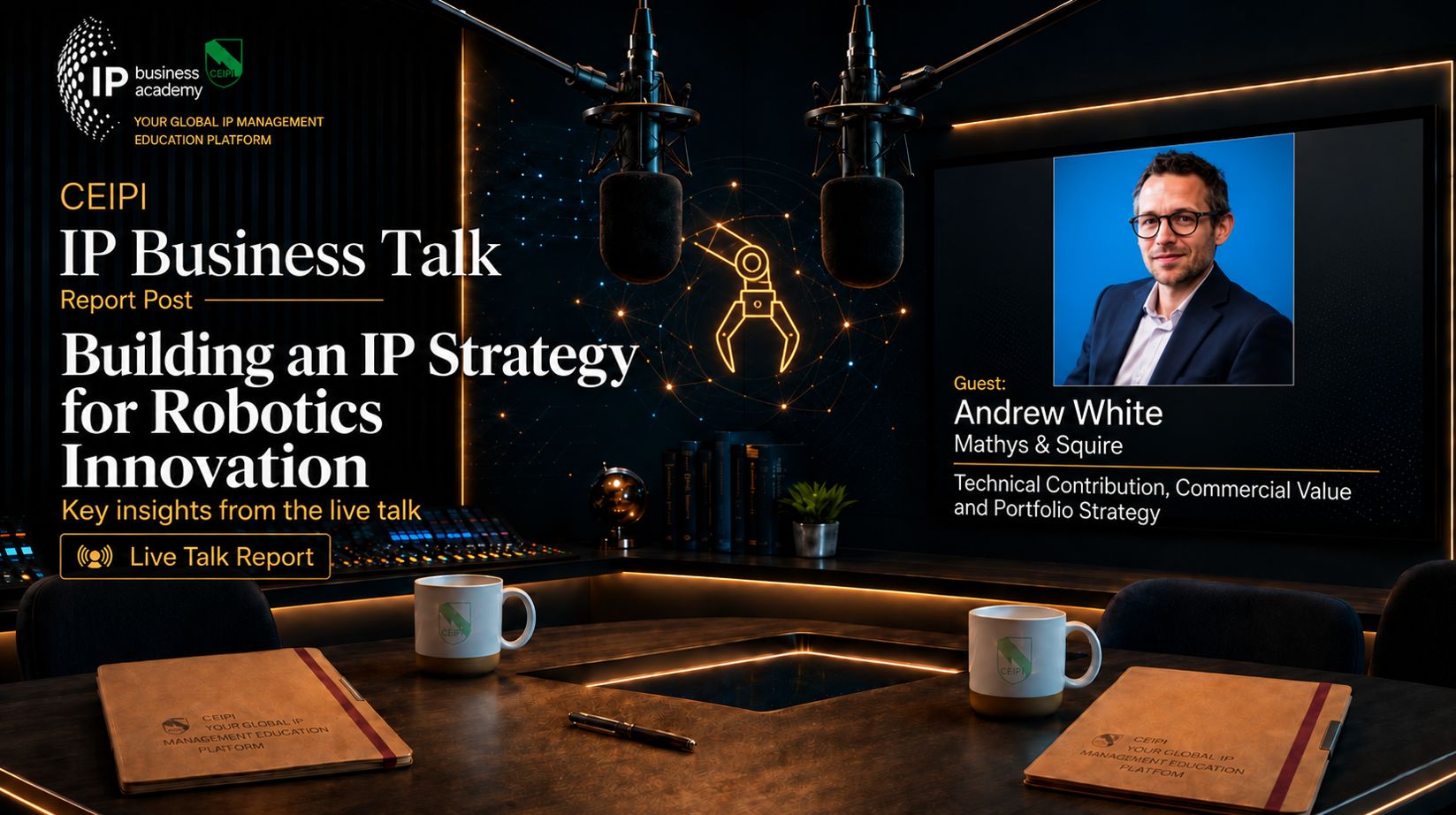
Building an IP Strategy for Robotics Innovation with Andrew White

Robotics brings mechanics, sensors, electronics, control software and artificial intelligence into an integrated technical system. The commercial advantage often emerges from the interaction between these elements. For the companies developing them, this creates a demanding IP management task: identifying the contribution that deserves protection and understanding how that protection can support a viable business.
In the CEIPI IP Business Talk on 30 September 2026, Andrew White, Partner at Mathys & Squire, joined Prof. Dr. Alexander J. Wurzer to discuss building an IP strategy for robotics innovation. The conversation connected invention identification, software and AI, patenting and confidentiality, interoperability and competitor information. A recurring question was how companies can connect the technical capabilities of a robot with the customer benefit that makes those capabilities commercially valuable.
The inventive contribution can lie between the components
A robotic system can contain sophisticated engineering across several disciplines. Looking at each component separately may leave the company with an incomplete picture of its innovation. The relevant contribution may concern the way sensing, control and mechanical action work together to produce a useful result.
The discussion opened with this challenge of identifying what, precisely, has been achieved. A robotic hand, for example, raises questions about mechanics, sensors and the coordination of movement. Understanding the contribution requires attention to the relationships between those elements and to the capability they create together.
For IP management, the implication is that invention identification needs a system perspective. Engineers and software developers contribute different parts of the explanation. Bringing those perspectives together helps the company recognise developments that might remain invisible within individual technical disciplines.
Commercial relevance should guide the protection decision
Identifying something potentially patentable opens a strategic decision. The company still needs to establish why protection would matter to its business, which competitive advantage it could help preserve and how that advantage relates to future revenue.
Wurzer repeatedly returned to the distinction between the possibility of obtaining protection and the commercial reasons for pursuing it. Startups and scaleups face this question particularly sharply because their resources are limited and their business models continue to develop. A filing decision needs a rationale that the management team can explain.
The exchange also connected protection with the company’s approach to collaboration. A business may encourage others to adopt selected technologies while retaining control over other parts of its offering. IP strategy needs to reflect where wider adoption supports the business and where exclusivity remains valuable.
Detectability matters when choosing between patents and secrecy
Software within a robotic system can create advantages that are difficult to observe externally. The discussion considered efficient data handling inside an edge device as an example. A competitor might achieve a similar result through an internal implementation that is hard to inspect.
This makes detectability a practical consideration in the protection decision. How would the company recognise that another organisation was using the relevant contribution? Does the robot’s observable behaviour reveal enough about its implementation to make further investigation worthwhile?
Confidentiality brings its own management demands. Wurzer emphasised the effort involved in maintaining trade secrets and the risk that business decision-makers underestimate it. A decision to retain know-how internally therefore requires a credible understanding of how the information will remain controlled as people, partners and projects change.
The management task is to assess the available options deliberately, taking account of commercial relevance, visibility and the practical effort required to maintain the chosen protection.
AI protection depends on explaining the technical contribution
Autonomy gives software a central role in robotics. A machine interprets information, selects an action and responds to its environment. The conversation explored how these capabilities can be described in a way that makes their technical contribution clear.
Wurzer pointed to improvements in how a robot operates, including greater efficiency or lower energy use, as useful starting points for that explanation. The relevant questions concern what changes in the system and which features produce the change.
The EPO’s guidance on artificial intelligence and machine learning provides the legal context: computational models are abstract in themselves, while their contribution to a technical application can be relevant to patentability. An AI label alone does not establish that contribution.
The exchange also touched on how an invention is presented. For a company, the practical lesson is to explain the actual technical relationship between computation and system behaviour. Drafting needs a sound account of the development and its effects; terminology alone cannot supply the underlying contribution.
Invention capture requires a conversation with the development team
A further theme concerned what companies expect of their inventors. Developers may regard a software improvement as routine or assume that their work is unsuitable for patent protection. If the internal process depends on that initial judgement, relevant developments may never reach an IP specialist.
Wurzer questioned the practice of placing the first patentability assessment on the people least familiar with the patent system. The discussion instead highlighted the interaction needed to understand what has changed, why it matters and how the company intends to use it.
This has consequences for the relationship with external advisers. An invention disclosure provides technical input, while strategic decisions also depend on the business model and the intended competitive position. An ongoing dialogue gives both sides a fuller basis for deciding what to protect.
It also helps the company see its portfolio as a coherent set of assets. Individual inventions accumulate over time, but the portfolio needs to support a recognisable commercial direction.
Interoperability creates opportunities around specific uses
Robotic systems operate through connections with equipment, software and their wider environment. Interoperability enables those connections and can make new applications possible. The discussion explored the opportunities that arise from the functionality enabled by that interaction.
Wurzer directed attention to the customer’s reason for paying. A technically sophisticated system becomes commercially relevant when it performs a task that delivers a useful benefit in the customer’s setting. The IP question then concerns the technical contribution that makes that application possible.
For a robotics company, a useful implication is to examine the relationship between connectivity, functionality and customer value. Which interactions enable a commercially attractive task? Where does the company make a distinctive technical contribution? Could protection around that contribution remain relevant when customers or partners implement the system differently?
This perspective connects invention identification with the business case for deployment. It is particularly useful for technology-led teams that need to test how their engineering achievements translate into demand.
Competitor portfolios can inform the company’s own choices
The conversation also addressed patent activity in a rapidly developing robotics market. Competitor filings can prompt questions about the direction of technical development, gaps in the company’s own protection and the positions it may need to consider as its products evolve.
Wurzer framed this as a portfolio question. Understanding the company’s individual inventions provides one view; considering them alongside the positions being built by others adds a strategic dimension.
The management implication is to connect patent information with the development roadmap. Information becomes useful when it helps the team decide where further analysis is needed, which capabilities deserve attention and how the company’s own protection relates to the applications it intends to pursue.
That assessment requires continuing dialogue between technical teams, management and IP advisers. Each contributes a different part of the explanation of why a particular development or competitor position matters.
Freedom to operate belongs within a continuing development process
Robotics remains a field in which successful applications and dominant technical designs are still taking shape. The discussion connected that uncertainty with the need to keep freedom-to-operate considerations active as the business develops.
Wurzer introduced a perspective from an earlier exchange with patent attorney Christian Heubeck: freedom to operate can be organised as a continuing process that also brings opportunities into view. In the robotics discussion, licensing and cross-licensing arose as possible ways of addressing dependencies and preserving room for future development.
A contributor question added the issue of speed. AI models and applications can change quickly, raising the question of whether a particular advantage will remain commercially relevant over the time needed to obtain a patent.
That question reinforced the need to consider the expected life of the contribution. Some implementations may change rapidly, while an underlying technical approach may retain value across several product generations. Assessing that distinction belongs within the company’s protection decisions.
IP strategy develops alongside the robotics business
The discussion brought the management challenge back to the connection between technical achievement and commercial purpose. Companies need to understand where their contribution sits within the complete system, why customers value the resulting capability and how protection can support their position.
That understanding develops through repeated interaction. Engineers explain the system and its performance. Management supplies the commercial priorities. IP advisers help translate those inputs into protection options and questions for further investigation.
As products, partnerships and applications evolve, the same conversation needs to continue. It gives the company a basis for reviewing its portfolio and keeping IP decisions connected to the business it is building.
Andrew White
 Andrew White is a Partner, UK and European Patent Attorney and European Patent Litigator at Mathys & Squire. He holds a master’s degree in physics and a PhD from the University of Bristol. His practice covers software, telecommunications, medical and automotive technologies, alongside deep tech inventions including artificial intelligence.
His work with startups, scaleups and other technology businesses connects patent protection with commercial objectives. This combination of technical breadth and business perspective is relevant to robotics companies whose advantages extend across hardware, software and system integration.
Explore the wider context in our Industry Focus on Robotics & Autonomous Systems.