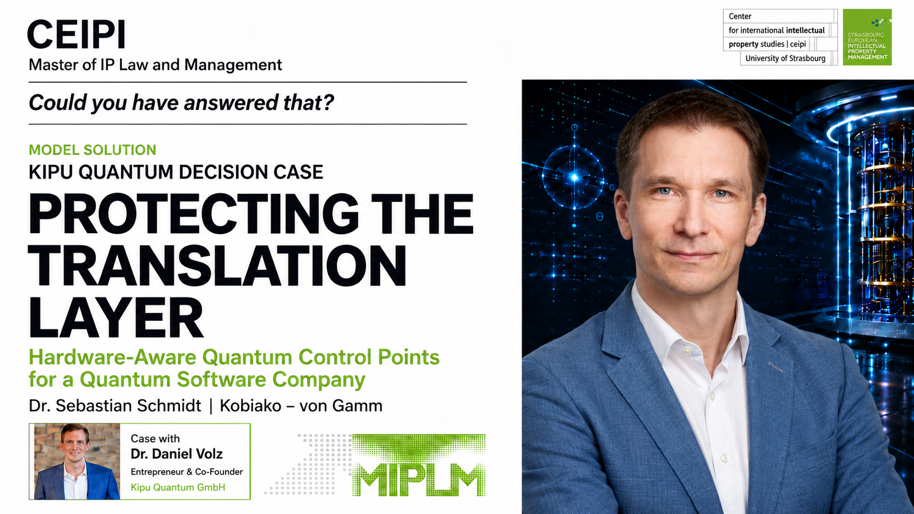
Protecting the Translation Layer: Hardware-Aware Quantum Control Points for a Quantum Software Company with Dr. Sebastian Schmidt

I. Initial Situation and the Core IP Question
The decision case concerns a young quantum technology company that neither develops nor manufactures its own quantum hardware. Its business model consists of making existing quantum hardware usable for industrial applications.
The economic advantage arises from a combination of:
- problem-specific algorithms;
- hardware-adapted implementation;
- workflow integration;
- performance tuning; and
- know-how gained through collaboration with industrial customers.
This structure is precisely what makes the IP question difficult. The economic value does not necessarily reside in one isolated invention, but rather in the interaction of several technical layers, and particularly at the interfaces between them. The original Kipu Quantum decision case therefore deliberately raises a broader IP-management question: what should be patented, what should be kept confidential, and what should be secured through contracts, software control, or the company’s position within the ecosystem?
For the solution proposed here, the question is reframed:
At what exact point does a relatively abstract, mathematically formulated quantum algorithm become a technically and economically relevant solution—and which of those transitions can become strategic IP control points for the company?
II. Solution Position: Protect the Translation Layer
The starting proposition is:
One of the most valuable IP positions may not lie in the quantum algorithm itself, but rather in the translation layer that enables the algorithm to operate efficiently on quantum hardware and within a real industrial workflow.
This is particularly relevant for a quantum software company because it does not itself control the underlying hardware. Quantum hardware may be supplied by different manufacturers and be based on different platforms. Possible qubit types, connectivity, topology, control architecture, performance parameters, error behavior, and other technical boundary conditions often span a broad range of physical systems and components.
This creates a strategic dependency:
A company that does not control its own hardware must assess whether it can control the technical layer that makes different hardware platforms usable for specific industrial applications, thereby also shifting the focus towards the technical dependencies among the various system components.
Further reading: The analysis Quantum Technologies in Motion: Why IP Becomes a Decision System Before the Market Is Fully Defined explains why quantum-IP decisions must take account of evolving architectures, uncertain commercialisation paths, and potential control points across multiple technology layers.
III. Three Relevant Translation Layers
Layer 1: Industrial Problem → Quantum Representation
The starting point is an industrial problem. It must be structured in such a way that it can be addressed using a quantum or quantum-classical hybrid method. Relevant aspects may include problem-specific modelling approaches, the decomposition of complex problems into feasible sub-problems, pre-processing and post-processing steps, and hybrid classical/quantum processes. A strategic question is:
Does this translation constitute reusable technical know-how, or is it merely customer-specific project work?
In particular, where this translation gives rise to generalizable solutions, a scalable IP control point may emerge.
Layer 2: Quantum Method → Real Quantum Hardware
This is a particularly interesting layer for the proposed model solution. A suitable algorithm as such does not yet generate immediate industrial value. It must operate on real hardware under specific technical constraints and must be scalable. Relevant aspects may include, for example:
- hardware-related adaptation and optimization (e.g., Optimization of gate sequences);
- efficient resource allocation and initialization;
- routing and mapping strategies;
- error handling and correction;
- optimal control (e.g., optimized control pulse shaping);
- calibration methods and error-mitigation protocols; and
- hybrid system architectures and co-processors.
Technical solutions in these areas are neither purely software nor purely hardware. They arise at the interface between the two. An IP strategy focused on precisely this interface can create one of the strongest competitive advantages from both a strategic and legal perspective.
Layer 3: Quantum Result → Industrial Workflow
The result of a quantum computation does not automatically create economic value either. It must typically be integrated into existing IT systems, data structures, decision-making processes, and industrial processes. This creates a further potential control point:
Not only the quantum method itself, but also its technical integration into a productive workflow, can become difficult to substitute.
Where integration patterns recur, the company should examine whether systematic IP positions can be developed at the boundary between quantum processes and conventional industrial IT. This can include, for example, the protectability of synthesis data such as calibration data and measurement results, data validation, post-processing and compression, as well as security-related and cryptographic aspects.
Further reading: The deep dive IP in Business Ecosystems provides a framework for analysing interfaces, dependencies, bargaining power, and strategic control positions in networked value-creation structures.
IV. How to Identify a Strategic Control Point
Not every technical feature at these interfaces should necessarily be protected by a patent. Rather, for every potential control point, the following questions should be asked:
1 . Technical Dependency
Does the performance of the overall system substantially depend on a particular element of an invention?
2 . Reusability
Can the solution be reused across multiple customers, applications, or projects?
3 . Hardware Portability
Does the technical core remain relevant even if the hardware architecture changes?
This is central for a hardware-independent quantum software company. A position tied exclusively to a certain hardware configuration that is only temporarily relevant may quickly lose economic significance. In particular, during the current late-NISQ phase and the transition to error correction, the quantum market is undergoing a technological transition. Since no single qubit technology has yet conclusively established itself as the dominant platform of quantum technology , the development of hardware-agnostic IP solutions at the interface between software and hardware is likely to be the most important safeguard against market disruption.
4 . Substitutability
How easily can a competitor technically design around the control point?
For a growing quantum software company, continuous monitoring of, and active participation in, standardization bodies—such as IEEE, ETSI, Horizon, CEN and CENELEC—can be among the most effective methods of long-term IP protection. A company that shapes standardized technical protocols at the interface between software and hardware can promote the emergence of so-called standard-essential patents (SEPs). This helps ensure that competitors cannot simply design around the company’s technological control point, because doing so would otherwise jeopardize compatibility with the global market standard.
5 . Detectability
Can it be determined by straightforward means whether a competitor is actually using the protected technical teaching?
6 . Future Leverage
Could the position become relevant in the future for partnerships, platform access, licensing, investment, or negotiations?
Addressing these questions transform the patenting decision into a strategic portfolio decision.
Further reading: The IP Roadmapping with the SAILS Methodology explains how technological developments, market requirements, and portfolio positions can be translated into forward-looking IP priorities and verifiable decision areas.
V . From Invention Disclosure to a Control-Point Map
This calls for a re-organisation of patent work within the company. In particular, not every new technical idea should only be evaluated in isolation by asking:
“Can this, in principle, be patented?”
Instead, this question should be assessed in conjunction with the control points of the value-creation architecture.
| Level | Strategic question |
| Industrial problem | How can expert knowledge in certain domains be encoded in software so that the solution can be seamlessly reused for many customers across different industries? |
| Problem representation | Which technical transformation makes the problem quantum-ready? |
| Algorithmic layer | Which method steps have a technical character and produce an independent technical advantage? |
| Hardware translation | Which mechanisms and adaptations enable better use of specific quantum hardware? |
| Performance layer | Which measures and subprocesses materially determine speed, quality, or resource efficiency? |
| Hybrid integration | How are quantum and classical systems technically combined within a workflow? |
| Customer workflow | Where, exactly, does the solution become permanently integrated into the customer’s process? |
Invention disclosures and the processes described therein should be assessed with reagrds to these strategic positions.
Such an approach changes the structure of the patent portfolio:
The portfolio no longer merely documents what the company has invented. It should specifically secure those points at which the company intends to establish long-term control over its value-creation architecture.
Further reading: The glossary entry IP Design explains how portfolios can be deliberately developed from business, technology, and innovation objectives, and how invention disclosures can thereby be assigned to strategic protection functions.
VI . Avoiding Hardware Dependency
From a technical perspective, a hardware-adapted solution may be particularly interesting precisely because it addresses the properties of a specific quantum platform. At the same time, the long-term IP portfolio must not rely exclusively on technical features that may disappear with the next generation of hardware. When formulating potential patent positions, a distinction should therefore be made between two layers:
Specific technical implementation: What works today on a particular hardware platform?
Generalisable technical mechanism: Which underlying technical principle could remain relevant for other or future hardware architectures as well?
The task is not simply to formulate claims as broadly as possible. It is to identify the technically credible core in a manner that prevents the protection position from being unnecessarily tied to one current implementation.
This is particularly relevant in quantum technology because dominant architectures and commercial applications have not yet been fully established.
Further reading: The deep dive Making Quantum IP Legible: Portfolios, Roadmaps and Market Signals in an Emerging Field connects evolving quantum architectures with technology roadmaps and portfolio decisions under conditions of high market uncertainty.
VII. Portfolio Rather Than a Single Patent
From this perspective, patent families should not be developed solely along individual R&D projects. A vertical portfolio architecture may be more attractive. An economically important control point may, for example, be supported by several related positions covering:
- the underlying technical method;
- the hardware-related implementation;
- the hybrid system architecture;
- the technical integration; and
- the application-specific and functional configuration.
The objective is to build strategic redundancy around selected, particularly important positions, so that the technological control point remains unavoidable for competitors even if the underlying hardware implementations change.
Further reading: The glossary entry IP Function Deployment (IPFD) describes how related protection positions can be systematically built around strategic functions, platform roles, and modular portfolio architectures.
VIII. Taking the Due Diligence approach
The strategic quality of the portfolio can be evaluated using the following question:
What would an investor or potential acquirer ideally want to see in an IP due diligence ?
What matters is not only how many patents exist, but also:
- which part of the value creation they address;
- which technical dependency they create;
- which positions remain relevant when the hardware changes;
- which IP rights jointly protect a control point; and
- where substantial gaps exist.
Accordingly, the portfolio should provide a comprehensible answer to the question:
Why will this company remain difficult to replace?
IP thereby also becomes intelligible to management and investors.
Further reading: The article Quantum IP Management: The Terra Quantum Case examines the due-diligence perspective on ownership, validity, scope of protection, detectability, and freedom to operate for quantum companies.
Result
The proposed strategy is to Protect the Translation Layer.
For a quantum software company without its own hardware, the IP strategy should not end with the algorithm.
Particularly interesting strategic positions can arise where:
- industrial processes can be addressed by quantum methods;
- quantum methods can be executed on different hardware platforms; and
- results obtained using those methods can be efficiently integrated into industrial workflows.
At these transition points, technical solutions should be systematically assessed for technical dependency, reusability, hardware portability, substitutability, detectability, and future economic leverage.
On that basis, the company can develop a Hardware-Aware Control-Point Map and concentrate patent positions specifically where technical differentiation can become long-term economic control.
Here you will find the lecture “Quantum Software IP Strategy – Protecting Reusable Capabilities and Market Access” regarding this exam question:
Expert Profile: Dr Sebastian Schmidt
 Dr Sebastian Schmidt is a German and European Patent Attorney. He heads the Dresden office of the IP boutique Law Firm Kobiako – von Gamm (website). Before entering the field of intellectual property, he worked as a theoretical physicist on the development and practical implementation of quantum technologies at various international institutions.
He received his PhD in Physics from Yale University and subsequently served as a Fellow at the Princeton Center for Theoretical Science. At ETH Zurich, he led a research group in quantum technology. A quantum simulator based on superconducting electronic circuits proposed by him was experimentally realised at Princeton University. Together with IBM Research, he also developed a prototype quantum computer for applications in AI and machine learning.
Since 2018, Sebastian Schmidt has supported start-ups, research institutions, medium-sized companies, and international corporations in protecting complex and deep technologies. His practice includes, among other matters, patent filing and prosecution, freedom-to-operate analyses, IP due diligence, opposition and nullity proceedings, as well as technical and reverse engineering support in infringement analyses and licensing negotiations. He has particular hands-on experience in the patenting and commercialisation of standard-essential patents (SEPs) in the mobile communications sector.