Building IP That Survives the Transition from Clean-Tech R&D to Market

A successful pilot project opens new opportunities for a cleantech company. It also creates new IP decisions. Potential partners want technical details, industrial deployment introduces further improvements, and competitors may hold rights relevant to the intended product. As the technology moves towards commercial use, companies need to understand how their IP position supports the next stage of development.
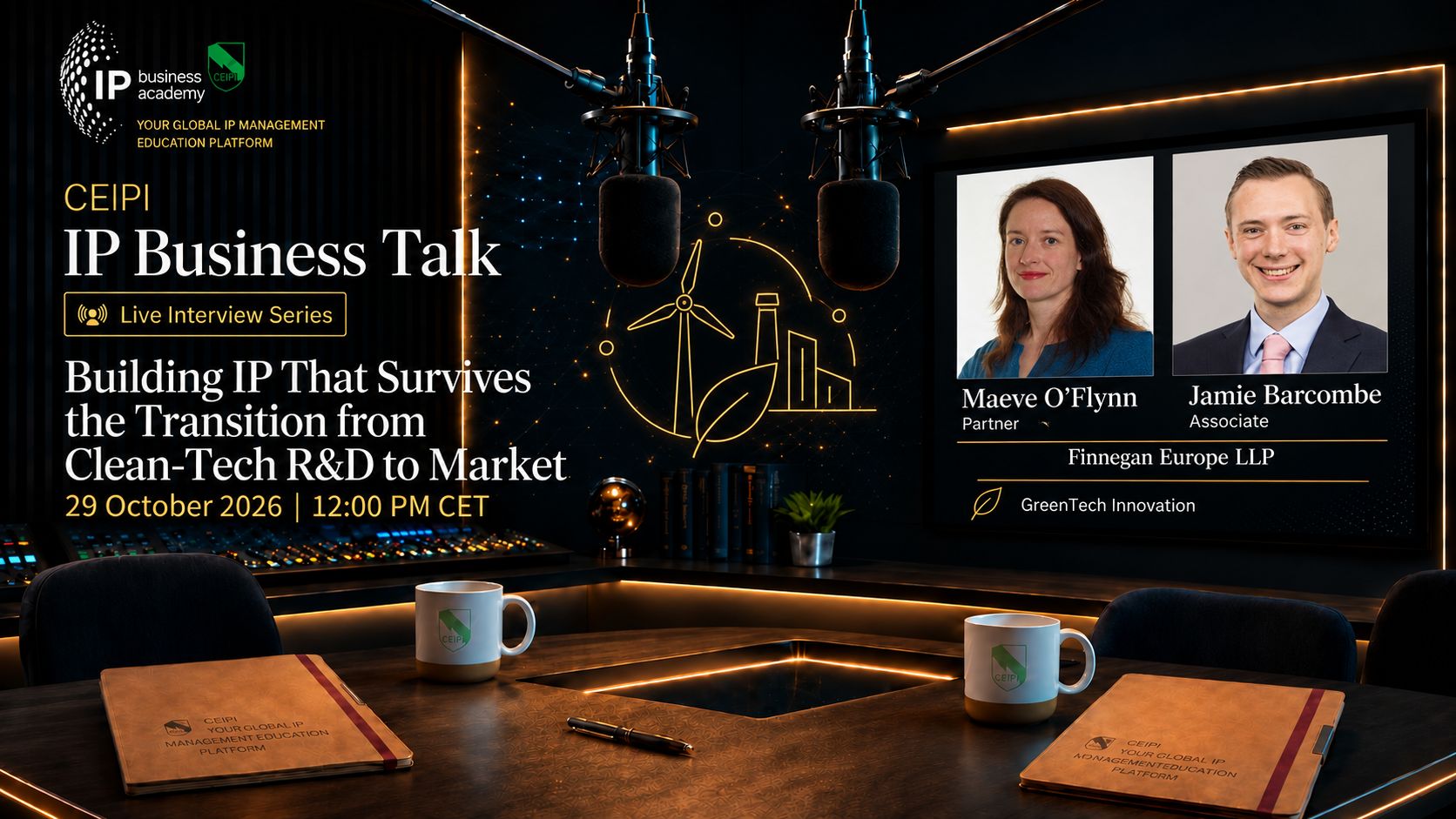
On Thursday, 29 October 2026, at 12:00 PM CET, Maeve O’Flynn, Partner at Finnegan Europe LLP, and Jamie Barcombe, Associate at Finnegan Europe LLP, will join Prof. Dr. Alexander J. Wurzer for a live CEIPI IP Business Talk on Building IP That Survives the Transition from Clean-Tech R&D to Market. The conversation will explore how companies can connect protection decisions with the practical demands of developing, scaling and defending sustainable technologies.
👉 Join the live conversation on LinkedIn
Coordinating patent filings and external disclosure
The first theme concerns the timing of patent filings as cleantech companies move into demonstrations, pilot projects, certification processes and discussions with commercial partners.
Consider a team preparing to demonstrate a new production process at a partner’s facility. The demonstration may involve presentations, technical documentation and access to equipment. Each interaction raises questions about what information needs to be shared, with whom and under which conditions. For management, this creates a coordination task across R&D, business development and the patent team. Which technical developments are ready for review? What will the demonstration reveal? Who needs to be involved before information leaves the company? The discussion will examine how protection decisions can be integrated into the commercial timetable.
Keeping the portfolio connected to competitive advantage
The second theme examines how an IP portfolio can evolve as innovation shifts towards manufacturing, system integration, optimisation and implementation.
An illustrative example is a company developing a sustainable material. Its initial breakthrough might concern the material’s composition. During scale-up, the team could discover that consistent quality depends on a particular production sequence, treatment step or monitoring method. The capabilities supporting customer adoption may therefore extend well beyond the original laboratory result. This suggests a useful question for portfolio reviews: what has the company learned since its first filings, and which of those developments now matters commercially? Connecting that discussion with engineering milestones can help teams identify emerging protection priorities.
Using freedom to operate analysis in development decisions
The third theme explores how freedom-to-operate analysis can inform R&D priorities, design choices and business strategy.
Imagine a development team comparing two technical routes for a new energy system. Alongside performance, cost and reliability, it needs to understand the patent questions associated with each route. Addressing those questions while alternatives remain available creates a different decision situation from investigating them after the design has been fixed. The conversation will consider how companies can bring this perspective into development planning. What should trigger a closer review? How should findings reach the people responsible for technical and commercial choices? And how can teams translate the analysis into specific next steps?
Building portfolios with future competition in mind
The fourth theme connects patent prosecution, opposition and litigation. What makes a cleantech portfolio commercially robust when competitors eventually test it?
A practical starting point is to consider the activities a company expects to matter in its future market. Which features could competitors adopt? Which parts of the technology will be visible in a commercial product? How might the business change between filing and deployment? These questions encourage an ongoing conversation between inventors, portfolio managers and advisers with experience in disputes. They also help frame the relationship between today’s drafting decisions and the competitive situations the company may face later.
Connecting IP with the wider GreenTech ecosystem
These themes connect with our Industry Focus on GreenTech on the IPBA Plattform, which examines how IP shapes collaboration, investment readiness, industrial scale-up and market access. Sustainable technologies often depend on several connected capabilities. Materials, equipment, software, production knowledge and partner relationships can all contribute to the eventual business position. Understanding those connections helps companies identify what they need to control and where they depend on others. The upcoming talk offers founders, R&D leaders, IP managers and advisers an opportunity to explore these decisions across the journey from development to commercial competition.
👉 Explore our Industry Focus on IP in GreenTech
Maeve O’Flynn
 Maeve O’Flynn is a Partner and European and UK Patent Attorney at Finnegan. She brings more than a decade of in-house experience in the oil and chemical industries and advises clients ranging from startups to multinational companies.
Her work includes global patent portfolios, commercially focused IP strategies, trade secrets, collaboration and licensing agreements, and European Patent Office opposition proceedings. Her technical experience encompasses sustainable chemistry and catalysis. Maeve holds a first-class chemistry degree from the University of Oxford.
👉 Read Maeve O’Flynn’s profile at Finnegan
Jamie Barcombe
 Jamie Barcombe is an Associate, Solicitor, Patent Attorney and Unified Patent Court representative in Finnegan’s London office. His practice spans patent strategy, prosecution, freedom-to-operate analysis and litigation in the UK and at the UPC.
With a background in biochemistry and pharmaceutical R&D, Jamie works across clean technology, sustainable fuels and life sciences. He also advises on IP questions arising in collaborations and acquisitions, bringing a perspective that connects portfolio development with commercial transactions and enforcement.
👉 Read Jamie Barcombe’s profile at Finnegan
Join Maeve O’Flynn, Jamie Barcombe and Prof. Dr. Alexander J. Wurzer on Thursday, 29 October 2026, at 12:00 PM CET for this live CEIPI IP Business Talk on Building IP That Survives the Transition from Clean-Tech R&D to Market
👉 View the event details and join the conversation on LinkedIn