20 Years of MIPLM: Bringing IP Strategy to Life

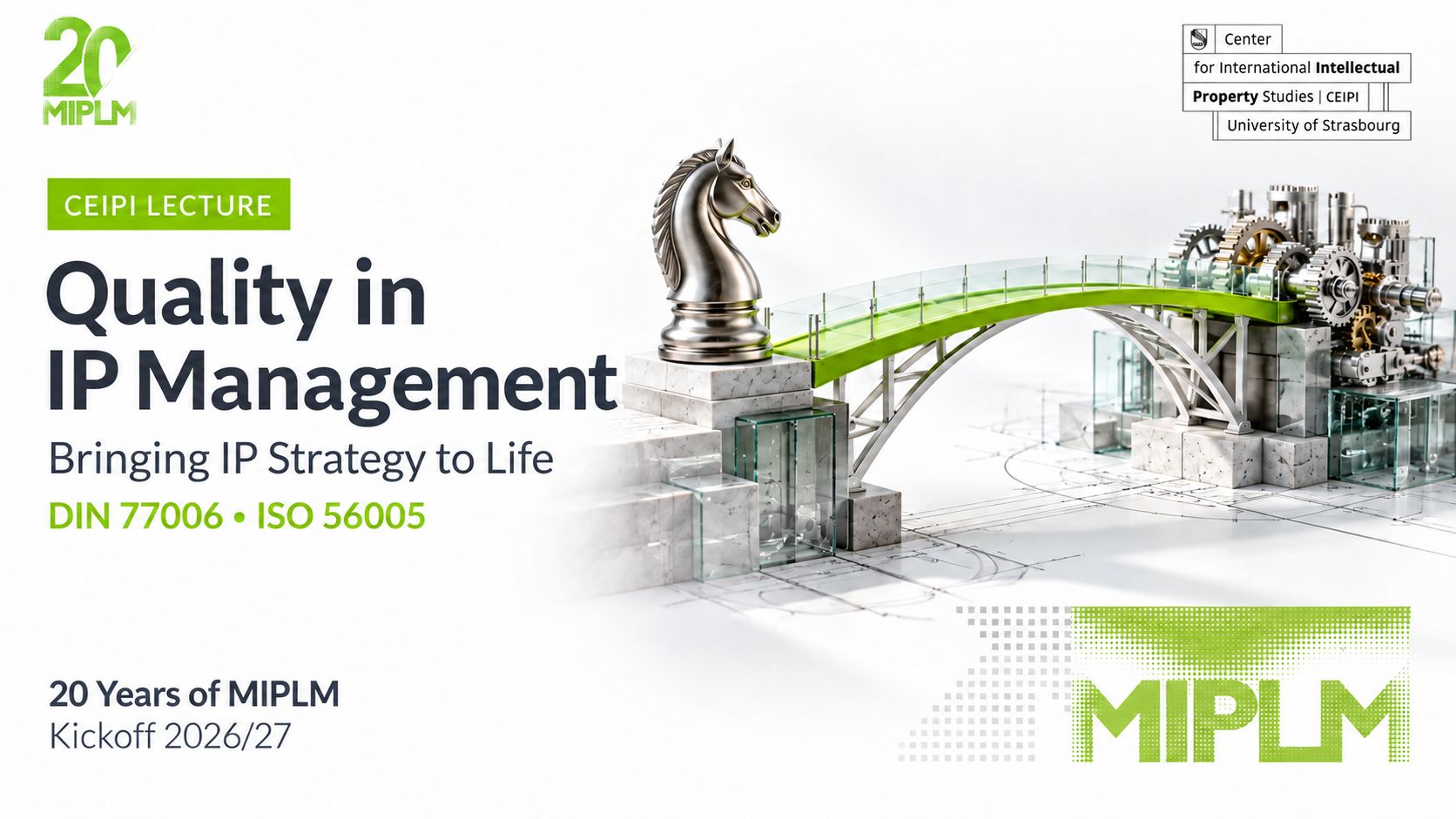
The 2026/27 academic year marks a special occasion for the CEIPI Master in Intellectual Property Law and Management: its twentieth edition. This anniversary celebrates twenty years of connecting legal expertise, technological understanding and business management. It also opens a new learning journey around a question that continues to shape the programme: how can intellectual property contribute effectively to the success of an organization?
The kickoff lecture, “Quality in IP Management,” provides a foundation for answering that question. Delivered by Prof. Dr. Alexander J. Wurzer, it explores how business objectives become practical IP responsibilities, processes and decisions. Together with a sector-based group homework assignment, it invites participants to examine what makes IP management relevant, reliable and effective.
An Anniversary with a Forward-Looking Purpose
An academic anniversary offers an opportunity to reflect on the purpose of a programme and the needs it addresses. For MIPLM, the relationship between intellectual property and business management remains central. Companies need professionals who understand how legal rights, knowledge, technology and organizational capabilities interact in creating and securing competitive advantage.
The anniversary kickoff places this relationship in a contemporary business context. Digital services, connected products and collaborative innovation create dependencies that extend across departments and company boundaries. Decisions about software, data, confidential knowledge and access to technology can influence whether a business model works as intended. For participants, this creates a demanding and rewarding learning agenda. They need to connect their existing expertise with unfamiliar perspectives, understand the priorities of other functions and develop judgement across disciplinary boundaries. The twentieth edition carries this ambition into a new academic year.
Quality Begins with the Business Purpose
The kickoff lecture approaches quality through a concrete example: a machinery manufacturer begins offering guaranteed uptime alongside its equipment. This changes the customer promise. Reliable operation now depends on a combination of machinery, monitoring software, operational data, maintenance knowledge and service delivery. The company may already have a well-established patent process for mechanical inventions. Yet the new offering introduces additional questions. Who can use the machine data? Which software contributions create differentiation? What knowledge must remain confidential? Which partner dependencies could affect the service?
The example illustrates why quality in IP management depends on the intended business use. The lecture develops three criteria: relevance, reliability and timeliness. IP activities must address the intended customer benefit, produce results the business can rely on and inform decisions when those decisions are due. These criteria encourage participants to examine familiar activities from a management perspective. An invention disclosure, portfolio review or risk assessment gains its direction from the business purpose it serves. Understanding that purpose becomes part of the professional task.
Making Structure–Strategy Fit Work
A central concept of the lecture is Structure–Strategy Fit. An IP strategy needs an organizational structure capable of implementing it. Responsibilities, authority, resources and decision processes must support the contribution that IP is expected to make. Returning to the uptime example, a strategic commitment to protecting the service business needs practical consequences. Someone must identify its IP requirements. Development teams need review points. Procurement must consider rights and dependencies when selecting suppliers. Commercial teams need clarity about what customers and partners may access or use.
This makes IP management an enterprise-wide task. Leadership establishes objectives and resources; research and development contribute technical knowledge; marketing and sales explain customer value; procurement manages supplier relationships; operations and service teams encounter changes during delivery. IP and legal specialists contribute expertise across these interfaces. Participants are therefore encouraged to ask precise organizational questions: who must do what, at which point, and with which authority? The answers reveal whether strategic intent has become an operational capability and where gaps require attention.
Understanding the Contribution of DIN and ISO
DIN 77006 and ISO 56005 provide the lecture with two frameworks for examining this organizational challenge. Their different functions help participants understand how standards support the connection between business objectives and IP practice. As presented in the lecture, DIN 77006 specifies requirements for an IP management system. It connects strategic alignment with responsibilities, processes, evaluation and improvement. Its requirements provide a basis for assessing whether the organization has established and implemented the relevant arrangements.
ISO 56005 provides guidance for managing IP within innovation activities. It connects organizational foundations with IP strategy, practical activities, tools and methods. Participants explore how IP questions accompany the identification of opportunities, development of concepts and implementation of innovative solutions. The educational value lies in understanding how these frameworks inform action. An organization must translate their content into decisions appropriate to its own context. The lecture consequently connects the standards with development, procurement, market launch and service processes, showing where IP work enters the business value chain.
Evidence, Review and Organizational Learning
Effective IP management also requires evidence. A company needs to understand whether its processes operate as intended and whether their results support relevant business decisions. The lecture asks participants to follow a decision through the organization and examine the resulting records, responsibilities and follow-up. For example, a review before a development milestone should have a defined purpose, an owner and clear criteria. Evidence should show what was assessed, when the assessment occurred and how it informed the decision. Management can then examine exceptions and identify necessary improvements.
The Plan–Do–Check–Act cycle gives this learning process a recurring structure. Objectives and requirements guide implementation; evaluation examines outcomes; corrective action improves the system. Changes in software, partnerships or data use can trigger renewed consideration. This perspective is particularly useful in evolving businesses. IP management needs the capacity to learn as technologies and commercial relationships change. Participants explore how review and adaptation can become regular organizational activities.
Participant Feedback That Gives the Anniversary Meaning
The enthusiasm expressed by the 2025/26 cohort gives the anniversary a personal dimension. Their reflections describe how the programme broadened professional perspectives and created connections across disciplines and national backgrounds. Tomislav Hadzija highlights practical methods, academic quality and a professional community that exceeded his expectations. Dr. Alihan Kaya emphasizes his deeper understanding of managing IP within a business context. Lana Mrsa values the connections with psychology, economics, marketing and innovation management. Alejandra Gutierrez points to value creation, corporate strategy and the international network.
These accounts suggest that the programme’s value includes both intellectual development and professional exchange. Participants gain opportunities to reconsider familiar questions through the experience of colleagues with different backgrounds. The feedback is collected in our review of the MIPLM 2025/26 across its six modules.
For the anniversary cohort, this provides an encouraging starting point. The programme invites active participation in a learning community where professional experience becomes a resource for shared understanding.
A Homework Assignment Built Around Industry Needs
The group homework takes the kickoff’s core ideas into five technology sectors: GreenTech, Industrial IoT, Photonics and Optical Technologies, MedTech, and Robotics and Autonomous Systems. Each group investigates how DIN 77006 can help address the IP market needs identified for its sector. Preparation begins with the relevant IP Business Academy blog post, Industry Focus and Market Report. Participants use these materials to understand the technological and commercial context before examining the specified market needs.
The assignment then requires a structured translation into organizational practice. For each need, groups identify relevant DIN elements and clauses, propose a process, assign responsibility and explain what evidence would demonstrate fulfilment. They must also articulate the resulting business benefit. This combination makes the case study demanding. Recognizing an IP issue is the beginning of the work. Participants must develop a credible response and explain how an organization could implement and evaluate it.
GreenTech and Industrial IoT: Managing Shared Resources
The GreenTech assignment illustrates the role of IP management in collaboration. Its short example concerns a battery-recycling pilot in which rights to improvements and data need clarification before the partners commit to working together. Participants consider how a review owner, agreed rights and documented decisions can support cooperation. A rights matrix and an approved agreement provide examples of evidence. The business question concerns the conditions under which the collaboration can develop while responsibilities and permitted uses remain clear.
You can find the Industry Focus GreeTech here
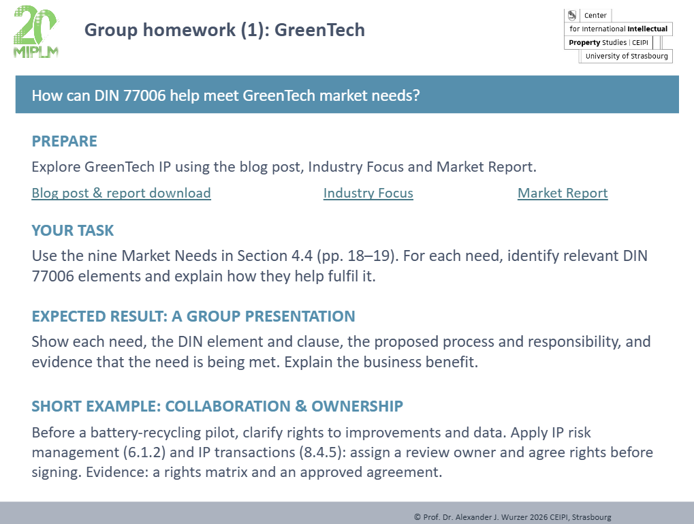
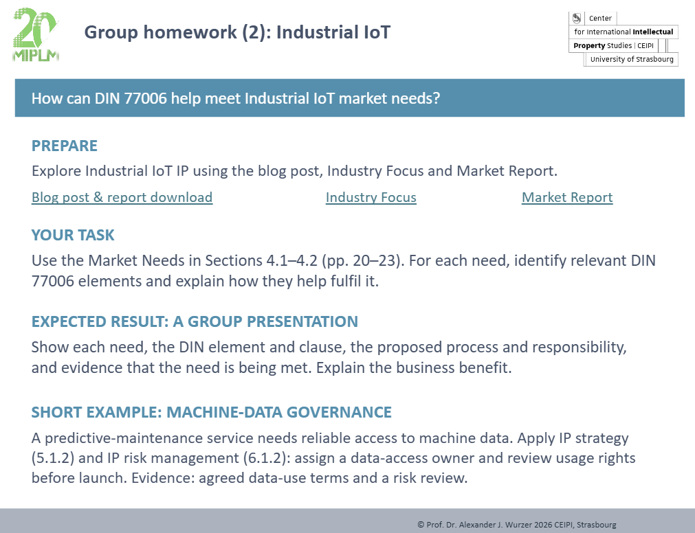
The Industrial IoT example focuses on a predictive-maintenance service that requires reliable access to machine data. Here, the group examines responsibility for data access and the review of usage rights before launch. Agreed data-use terms and a risk review illustrate the expected evidence. Together, these examples show how commercial delivery depends on access to resources and knowledge. The task is to connect that dependency with a process that addresses it before commitments become difficult to change.
You can find the Industry Focus Industrial IoT here
Photonics, MedTech and Robotics: Different Decision Points
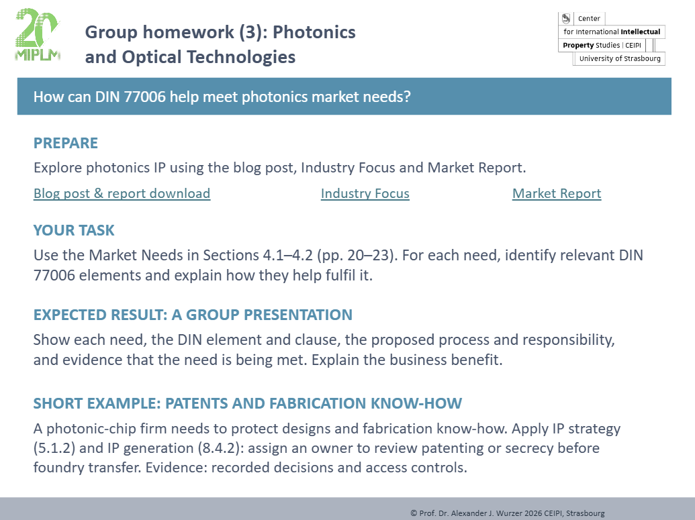
The photonics example examines a company that needs to protect photonic-chip designs and fabrication know-how before transferring technology to a foundry. Participants consider how responsibility for patenting and secrecy decisions can be assigned, with recorded decisions and access controls supporting implementation.
You can find the Industry Focus Photonics here
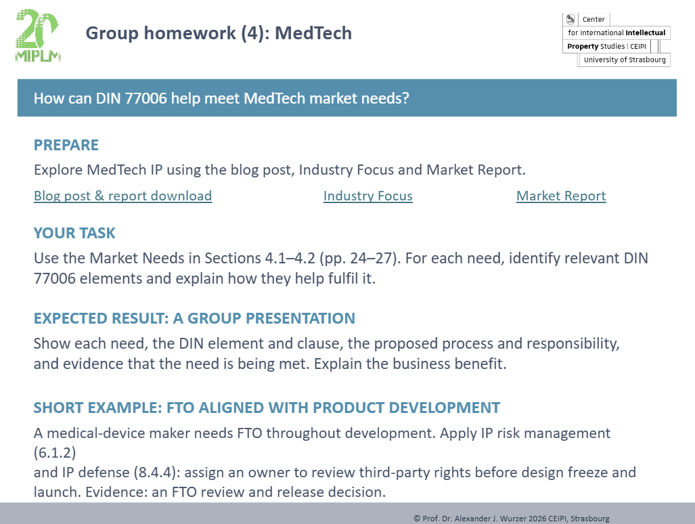
In MedTech, the illustrative need concerns freedom to operate throughout product development. The assignment connects reviews of third-party rights with design freeze and launch, asking groups to consider ownership of the review and evidence supporting release decisions.
You can find the Industry Focus MedTech here
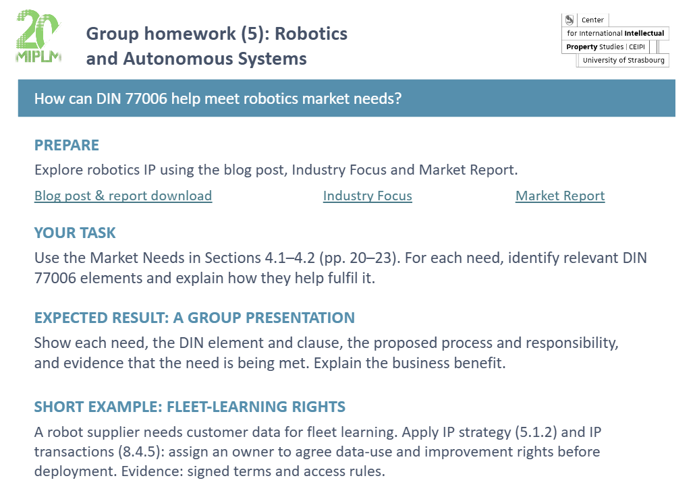
The robotics example addresses customer data used for fleet learning. A supplier needs clarity about data-use and improvement rights before deployment. Signed terms and access rules illustrate how the proposed arrangements could become visible in practice.
You can find the Industry Focus Robotics here
These examples give each group a distinctive context while preserving a common analytical task. Participants must identify when action is needed, who should take responsibility and how the resulting decision supports the offering.
Turning Analysis into a Group Presentation
The expected group presentation brings these elements together. Each identified market need must be connected with a relevant standard provision, an organizational response and an explanation of business value. The format makes the reasoning available for discussion and comparison. This is also an exercise in professional communication. Participants must explain their proposals clearly enough for others to understand the relationship between the industry situation and the suggested management process. Choosing evidence requires equal care: a document or record must demonstrate something relevant about implementation.
Group work adds another dimension. Different professional backgrounds may produce different interpretations of a market need, a risk or a suitable responsibility. Working towards a shared presentation encourages participants to examine those assumptions and develop a coherent response. Across the five sectors, the assignment creates an opportunity to explore how the same management framework can support different organizational choices. Context remains central to the quality of each proposal.
Looking Ahead to the Results in October
At the end of October, a follow-up post will report on the homework and the participants’ approaches. It will provide an opportunity to examine how the groups connect sector-specific needs with processes, responsibilities and evidence. The kickoff has established the questions that guide this work. What business objective should IP support? Which organizational arrangements make that contribution possible? How can effectiveness be evaluated as circumstances change?
These questions give the twentieth MIPLM edition a practical direction. The anniversary celebrates a continuing educational ambition: enabling professionals to connect legal understanding, technological insight and management judgement.
We look forward to the new cohort’s perspectives, the discussions generated by the homework and the learning that will emerge throughout this anniversary year.