
IP Strategy for Quantum Technology: Partnerships, Scaling and Long-Term Value

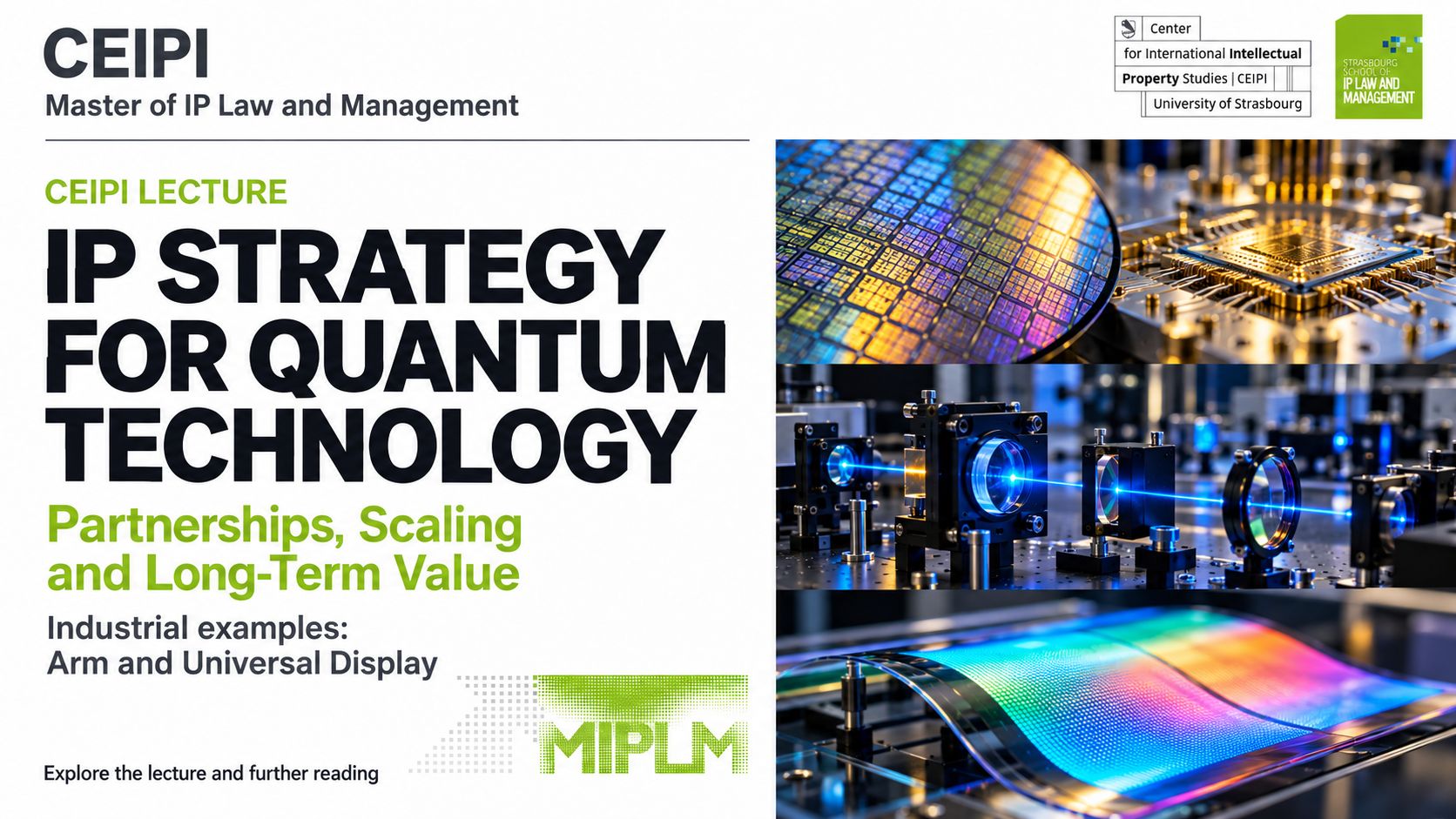
A quantum technology company can develop a capability that matters across several hardware platforms or applications. A photonics business can face a similar situation with an optical design, calibration method or manufacturing process. Bringing that capability into industrial use may require a partner’s engineering, production capacity and customer access. The resulting collaboration raises a central management question: how can the company support the first deployment while keeping its technology available for future business?
The CEIPI lecture “IP Strategy for Quantum Technology: Partnerships, Scaling and Long-Term Value” examines this question through four connected topics: reusable capabilities, partnership rights, the combination of patents and confidential know-how, and portfolio alignment with technology roadmaps. It provides a general framework for analysing quantum and photonics partnerships, with industrial comparisons from semiconductor design and OLED technology.
What the project agreement needs to resolve
A project deliverable rarely tells the whole story of the knowledge behind it. An interface may be specific to one customer, while a control method or optical design remains useful elsewhere. Students therefore begin by separating the reusable technical capability, project adaptations, application-specific positions and implementation know-how. Johannes Trapp’s “Protect the Transferable Core” contribution on the IPBA Plattform provides a related quantum example for this analysis.
The next step is to specify who may use each asset, for which purpose and under what conditions. Background technology, new results and later improvements need explicit treatment. So do sublicensing, disclosure, maintenance and rights after the relationship ends. An exclusivity request adds questions about field, duration, milestones and the opportunities the technology owner would give up. The dIPlex entry on smart licensing models provides further reading on connecting these choices with the commercial model.
The dIPlex entry on know-how management connects the discussion with everyday engineering work. Teams need to know which information they can share, which records they should retain and who approves disclosure. For software, the analysis includes component dependencies and the obligations attached to the relevant proprietary or open-source licences.
How strategic theory helps make the choices
Two perspectives organise the lecture, supported by readings on the IPBA Plattform. The contribution on the resource-based view explains which resources underpin competitive advantage. This perspective asks which capabilities can sustain an advantage because they create value and are difficult to replace or reproduce. Applied to a partnership, it directs attention towards the technical resources that should remain available beyond the initial project.
Teece’s Profiting from Innovation framework adds the question of who can capture returns when commercialisation depends on complementary assets. A partner’s manufacturing, qualification or market access can strongly influence the available business model. The IP Management Letters contribution on strategic IP management on the IPBA Plattform connects this reasoning with decisions about protection and commercialisation. Together, the perspectives help students explain why a particular allocation of rights supports a business objective.
Arm and the repeated use of technical designs
Arm provides an industrial comparison for technology that partners incorporate into their own products. Its licensing business combines access to technical designs with royalties associated with their commercial use. Arm Flexible Access also illustrates how access during development can precede a later commercial licensing decision.
Arm’s FY2026 results report US$2.613 billion in royalty revenue for the year ended 31 March 2026. This is evidence of an established commercial revenue stream. The teaching value lies in distinguishing the design package, the partner’s implementation and the basis for payment. Quantum architectures and control software invite similar questions about the licensed unit and verification of use. Arm’s mature ecosystem and its 2026 expansion into silicon products also mark the limits of the comparison. Its results do not establish suitable royalty rates or expected revenues for a quantum company.
Universal Display and a combined technology offer
Universal Display supplies a complementary example from optoelectronics. The company develops OLED technologies and materials. Its 2025 annual report describes a Samsung relationship that combines a patent licence with a materials purchase agreement. This brings a physical technology offer into the discussion alongside permission to use protected inventions.
The full-year 2025 results report US$275.1 million in royalty and licence fees and US$353.0 million in material sales. These are revenue categories, not separate measures of profitability. For photonics businesses, the example prompts an assessment of how licensing, materials, qualification and technical support fit together. For quantum businesses, it raises the broader question of which complementary capabilities the supplier must retain to make a licensed technology usable. The lecture does not infer confidential contractual terms or assume comparable production economics.
From the classroom to an IP management process
Participants finish with three practical outputs: a map of reusable capabilities, a matrix of partner rights and a set of justified portfolio priorities. The priorities connect filing, maintenance, secrecy and access decisions with technical milestones and future markets. Reviews at disclosure, contracting, product release and roadmap changes give these decisions an organisational rhythm. Engineering, commercial, legal and IP responsibilities need to meet at those points.
A short classroom exercise tests the framework: an integrator offers to fund qualification in exchange for exclusivity. Participants specify the proposed scope, milestones and improvement rights, then assess the effect on other applications. This makes the opportunity cost of the agreement visible alongside its immediate funding benefit.
The IPBA Plattform contribution on organisational implementation extends this work into responsibilities and review routines. Together, the linked readings connect strategic theory, licensing, knowledge management and an existing expert solution. Readers can use them to develop the decisions introduced in the lecture.