
From Strategy Project to Organisational Capability: Rolling Out Modern IP Strategy

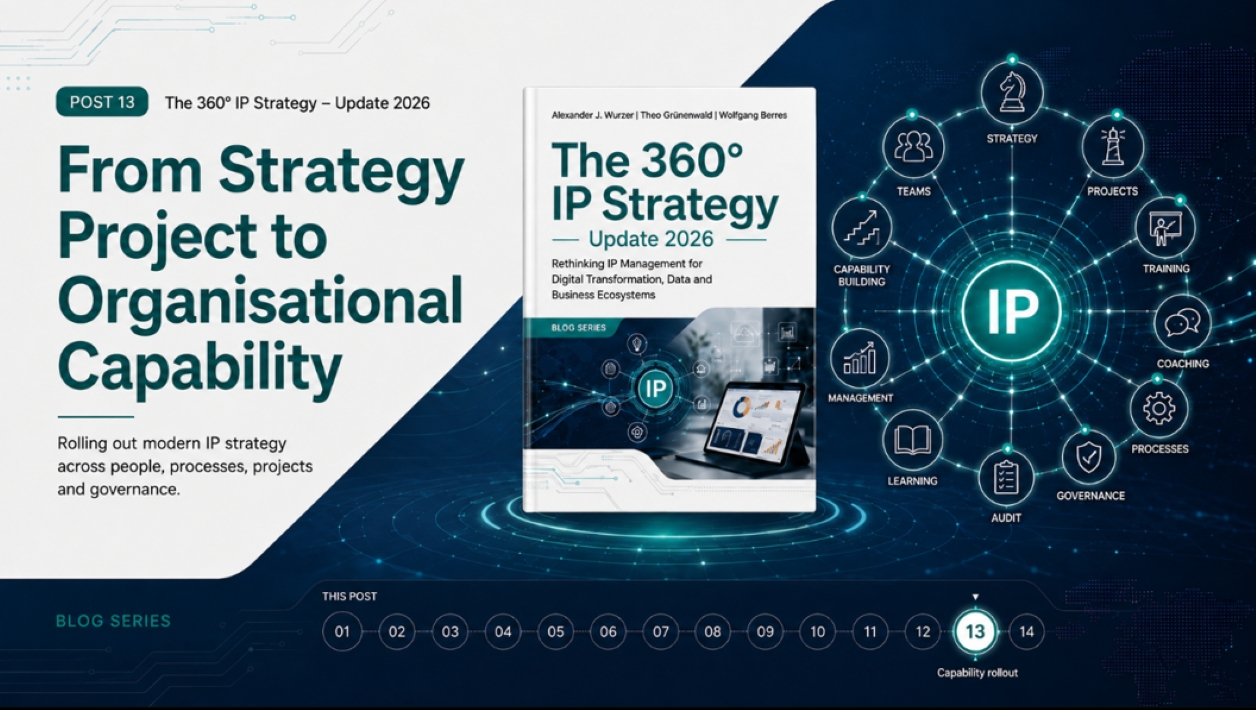
The original 360° IP Strategy did not end with designing a patent portfolio. It devoted an entire internal perspective to the question of how strategic IP thinking becomes repeatable organisational behaviour. A strategy can identify the right customer benefits, control points and protection mechanisms, yet remain ineffective if decisions continue to follow old routines.
Implementation has become more demanding since the book appeared. IP-relevant choices are now distributed across product roadmaps, software development, data governance, procurement, marketing, cybersecurity, collaborations and platform relationships. Many are made quickly by people who do not see themselves as IP decision-makers. A strategy document cannot govern this environment.
Roll-out is therefore not the communication phase at the end of an IP strategy project. It is the transformation through which priorities become decision criteria, roles become accountability, processes become routines and knowledge becomes practical capability. The aim is not to turn everyone into an IP specialist, but to enable people to recognise the IP dimension of their work, involve the right expertise and understand how better IP decisions support their own objectives.
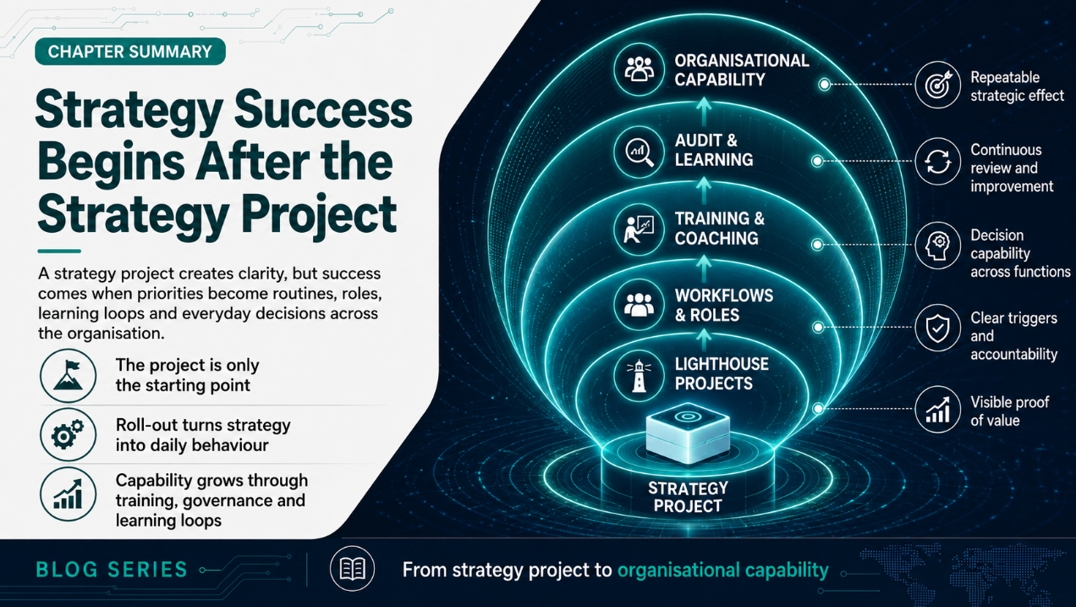
Strategy success begins after the strategy project
A strategy project usually creates clarity. It identifies where customer value arises, which parts of the business model require control, what competitors could copy or bypass, and which combination of patents, trade secrets, contracts, data rights, copyright, trademarks or technical measures should be used. Workshops may generate strong alignment, and management may approve the target architecture. At that moment, the organisation is often tempted to declare success.
Yet the project has only created a prototype of the future management system. Its results may still depend on the people who participated, the experts who facilitated the work and the exceptional attention generated by the initiative. The real test begins when a new product manager joins, a supplier agreement is negotiated under time pressure, a software release changes architecture, or marketing plans a disclosure before an event. Without operational routines, the organisation returns to its previous defaults.
Roll-out must therefore define a target operating model. It should specify recurring triggers, required information, decision owners, documented outputs and escalation paths. Triggers may include roadmap approval, architecture changes, external development, public demonstrations, data-access arrangements, open-source contributions, market entry and portfolio reviews. They should be connected with existing business processes rather than create a separate IP universe.
Implementation also needs priorities. Introducing every method, role, tool and control at once produces overload and superficial compliance. Management should start where weak IP decisions would cause the greatest loss of differentiation, freedom or bargaining power. Scope can expand after the first routines have produced evidence and credibility.
A modern IP strategy has crossed the implementation threshold only when it no longer depends on the project that created it. Its logic must survive changing people, technologies and everyday pressure because triggers, responsibilities, information and decision paths have become part of normal operations.
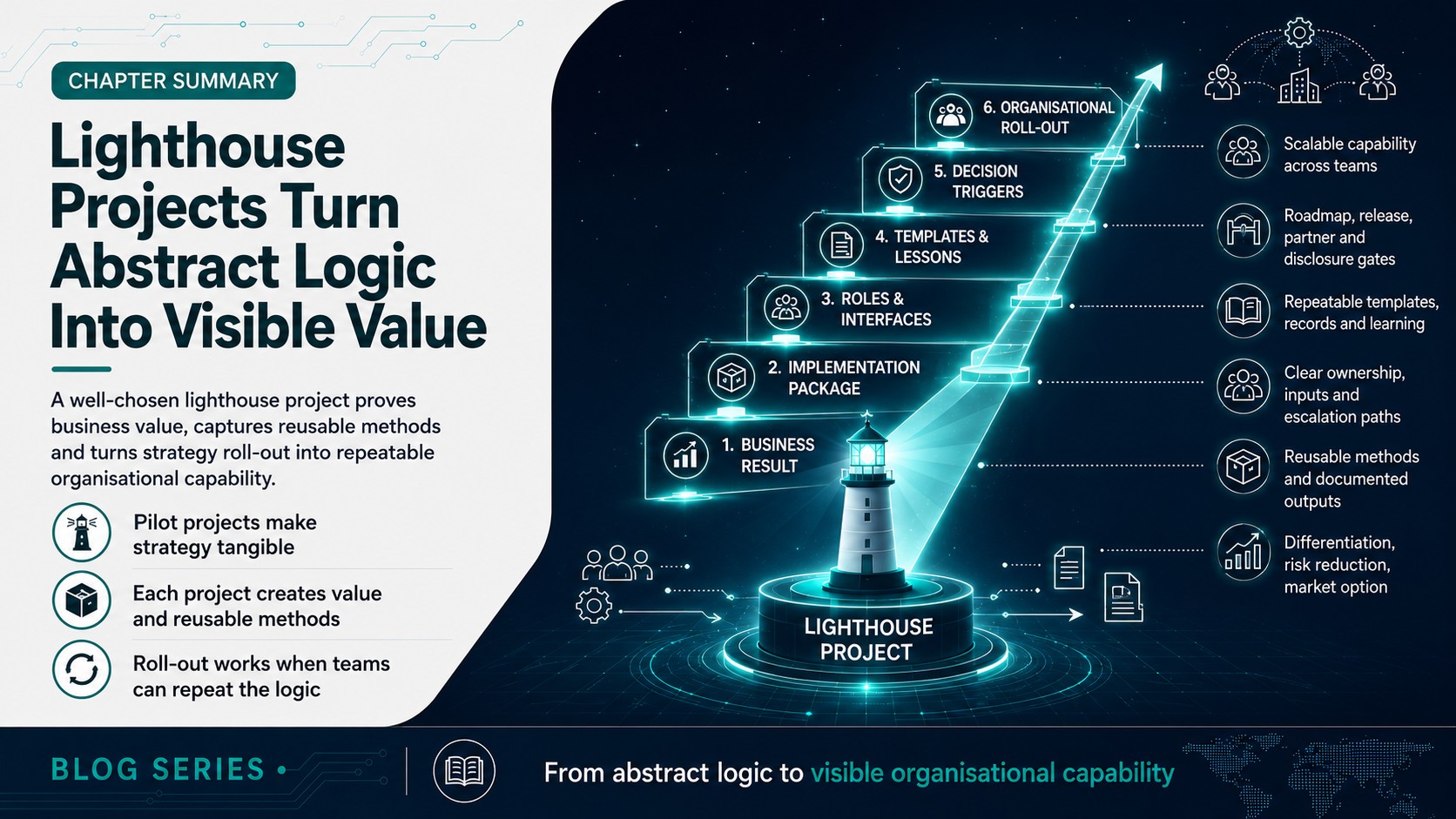
Lighthouse projects turn abstract logic into visible value
The original 360° approach emphasised lighthouse projects because organisational change needs a convincing experience, not only an explanation. Employees rarely change established behaviour because a presentation says that IP is strategically important. They change when a concrete project solves a problem that matters to them: a stronger product position, an avoided redesign, a clearer partner agreement, a credible differentiation claim or a newly created control point.
A suitable lighthouse project is commercially relevant, visible across functions and sufficiently bounded to produce results. It should involve a real customer benefit and enough complexity to demonstrate the broader 360° logic. A connected industrial product, for example, may combine hardware, embedded software, cloud analytics, usage data, service workflows, third-party components and customer integration. It can show why one protected feature is insufficient and how a coordinated IP architecture supports the value proposition.
Selection requires discipline. A peripheral project will not influence the organisation. A politically overloaded, unstable or late-stage project may generate frustration instead of momentum. The best candidate has management sponsorship, a committed business owner, access to relevant experts and enough remaining design freedom to act. It should also offer observable effects, such as closing an ownership gap, developing an invent-around, securing a data position, improving evidence readiness or changing a roadmap choice.
The project must produce two outputs. The first is the business result: protection, risk reduction, a market option or a differentiation effect. The second is the implementation package. Decisions, interfaces, templates, role descriptions, lessons and information requirements should be captured so that another team can repeat the approach. The story should be communicated in stakeholder language: what problem existed, what changed, who benefited and which behaviour made the result possible.
A lighthouse project succeeds when it proves both that modern IP strategy creates business value and that the organisation can reproduce the method. It turns an abstract promise into visible evidence while supplying reusable elements for the wider roll-out.
Roll-out must translate IP into stakeholder-specific work
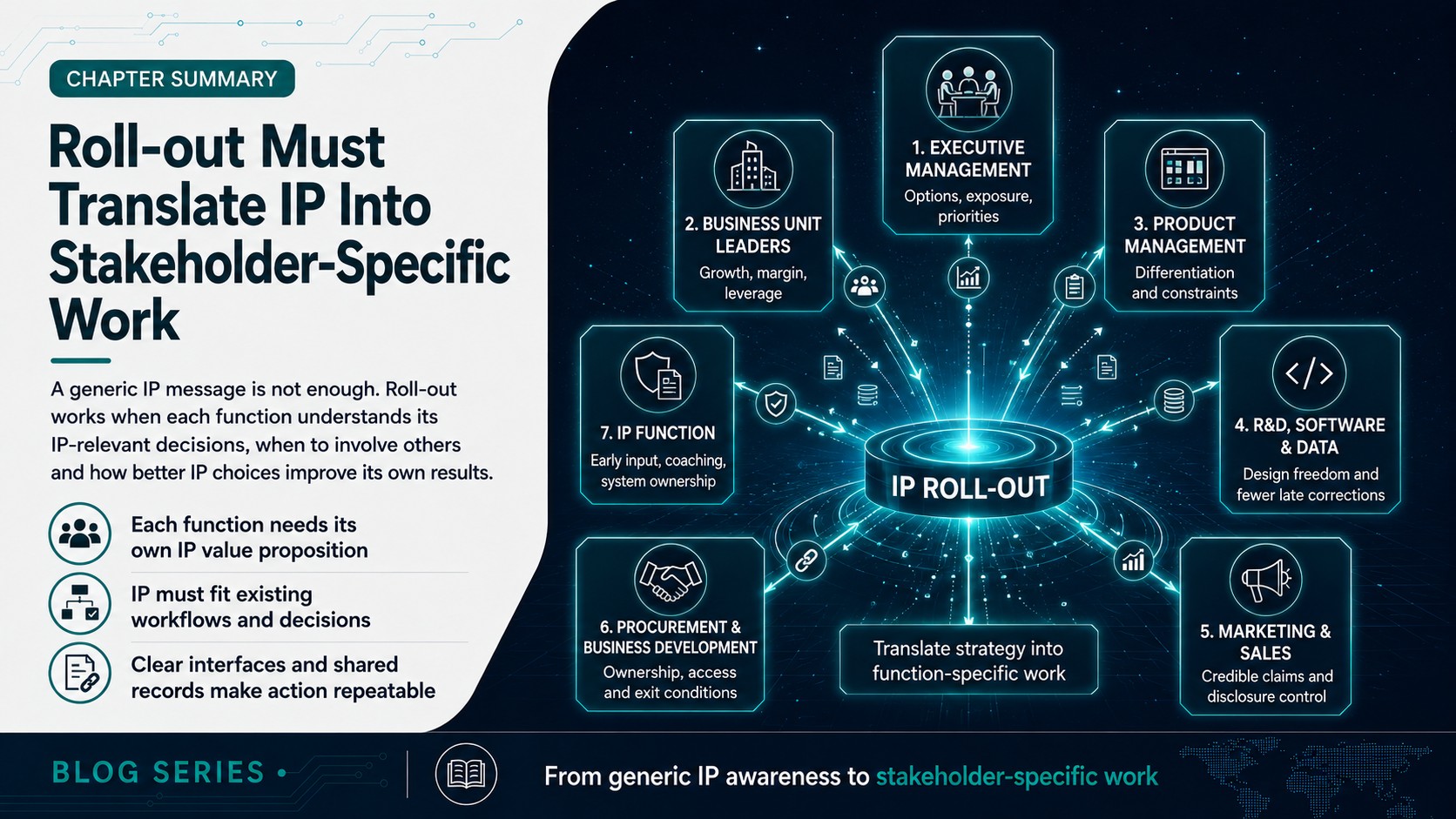
A company-wide message such as “IP is everyone’s responsibility” sounds inclusive but gives little guidance. Responsibility becomes meaningful only when each function understands which decisions it influences, which information it owns and why the new practice improves its performance. Roll-out therefore requires a stakeholder-specific value proposition.
Executive management needs a view of strategic options, exposure, priorities and economic effects. Business-unit leaders need to see how IP supports growth, margin and negotiating leverage. Product management needs earlier visibility of competitive constraints and clearer differentiation choices. R&D, software and data teams need room to design and fewer late corrections. Marketing and sales need credible, defensible claims. Procurement and business development need ownership, access and exit conditions that preserve flexibility. The IP function needs earlier, better-structured information instead of urgent questions after commitments have been made.
These benefits must be translated into existing workflows. A roadmap review can include control-point and freedom questions. Supplier onboarding can clarify ownership, permitted use, confidentiality and dependency before integration. A release process can connect software provenance, third-party rights and technical risk. Marketing approval can test whether a claim is supportable and whether disclosure destroys an option. A partnership gate can define background IP, results, data rights, publication and termination consequences.
Shared information is equally important. The organisation does not need one enormous database containing every document. It needs connected decision records preserving the business objective, affected asset, chosen control mechanism, evidence, owner, residual risk and review trigger. This creates continuity and prevents assumptions from becoming invisible constraints later. Digital tools should reduce search and coordination effort, not merely reproduce paper forms.
Leadership must remove conflicting signals. Teams will not involve IP early if they are rewarded only for launch speed, while the costs of late IP problems remain elsewhere. Nor will functions share information if every interaction feels like an approval hurdle. Decision rights, performance expectations and resources must support the behaviour the roll-out requests.
The roll-out becomes real when each stakeholder can answer three questions: Which IP-relevant choices belong to my work, when must I involve others, and how does doing so improve my result? Strategy becomes operational through function-specific benefits, clear interfaces and shared records rather than undifferentiated awareness.
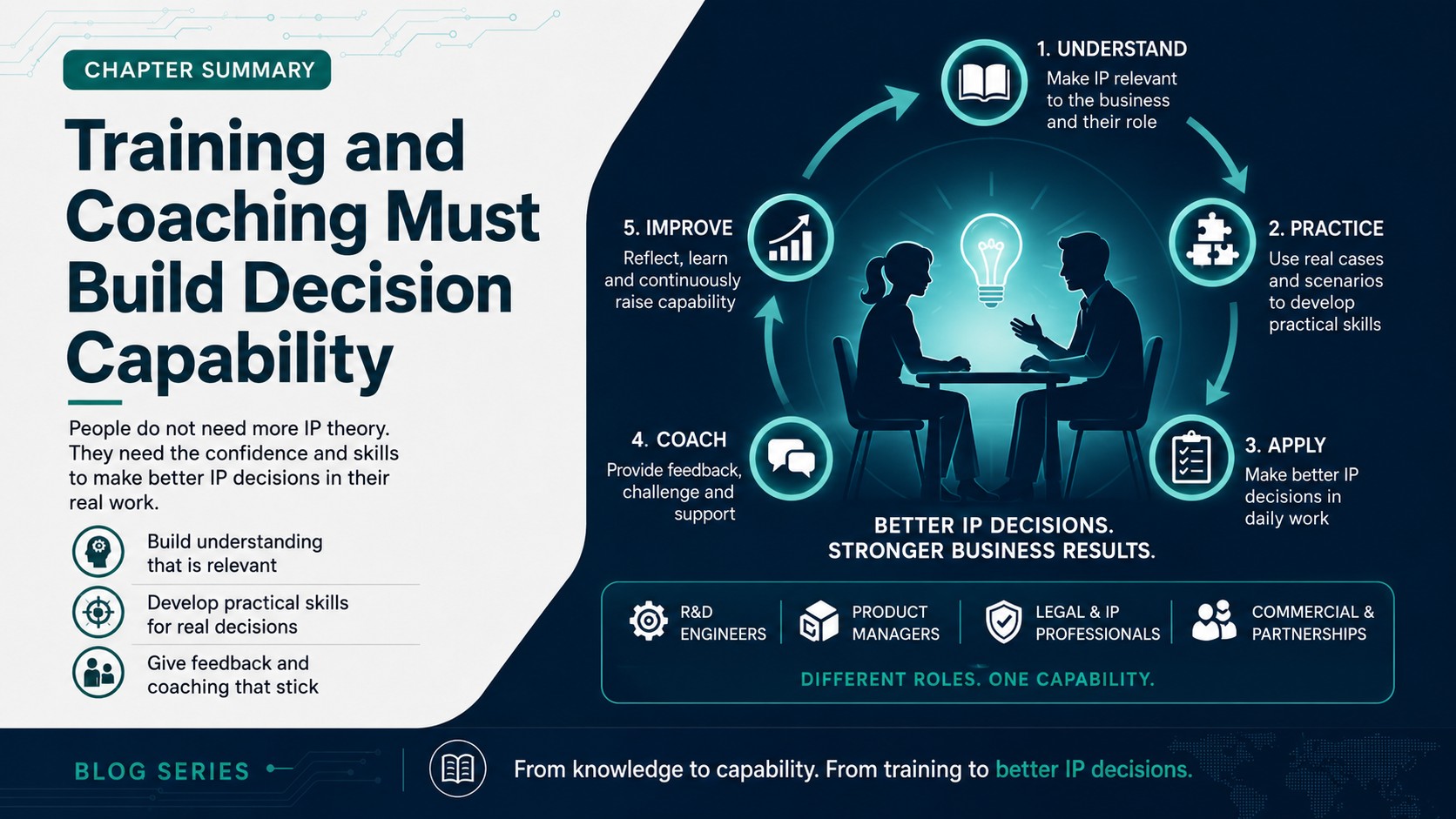
Training and coaching must build decision capability
Generic IP training often begins with categories of rights and ends with legal examples. That knowledge has value, but it rarely changes behaviour by itself. Employees need different depth because they encounter IP in different situations. Effective roll-out therefore treats training as capability design rather than information transfer.
Senior leaders need to understand the business effects of IP, the decisions they own and the meaning of residual risk. Product managers need to connect customer value, control points, roadmaps and competitive alternatives. Engineers and software teams need practical guidance on invention recognition, confidentiality, documentation, open-source use, third-party components and design-around options. Data and AI teams need provenance, access, permitted-use and evidence disciplines. Marketing and sales need to recognise protectable communication assets, disclosure risks and unsupported promises. Procurement and partnership teams need negotiation logic that protects the operating model rather than merely completing a checklist.
The most effective learning takes place around real work. A short foundation module can create common language, but workshops should use current projects, actual decisions and company-specific materials. Coaching then accompanies participants as they apply the method. This closes the gap between knowing a rule and exercising judgement while revealing unclear processes.
Capability should be distributed without dissolving expertise. IP coordinators, patent liaisons or trained champions can help teams identify triggers, prepare information and connect with specialists. They should not become amateur lawyers or hidden approval levels. Their role is translation and early recognition. The central IP function retains legal and methodological depth while increasingly acting as coach, sparring partner and system owner.
External support may accelerate the first projects, but sustainable implementation requires internal trainers, reusable learning assets, communities of practice and succession planning. New employees and acquired units must enter the system without depending on the original team.
Training has succeeded when participants can make better choices in their own context, not when they can repeat legal definitions. Role-specific learning, application to real projects and continued coaching turn IP awareness into distributed decision capability.
Audits and learning loops make the change sustainable
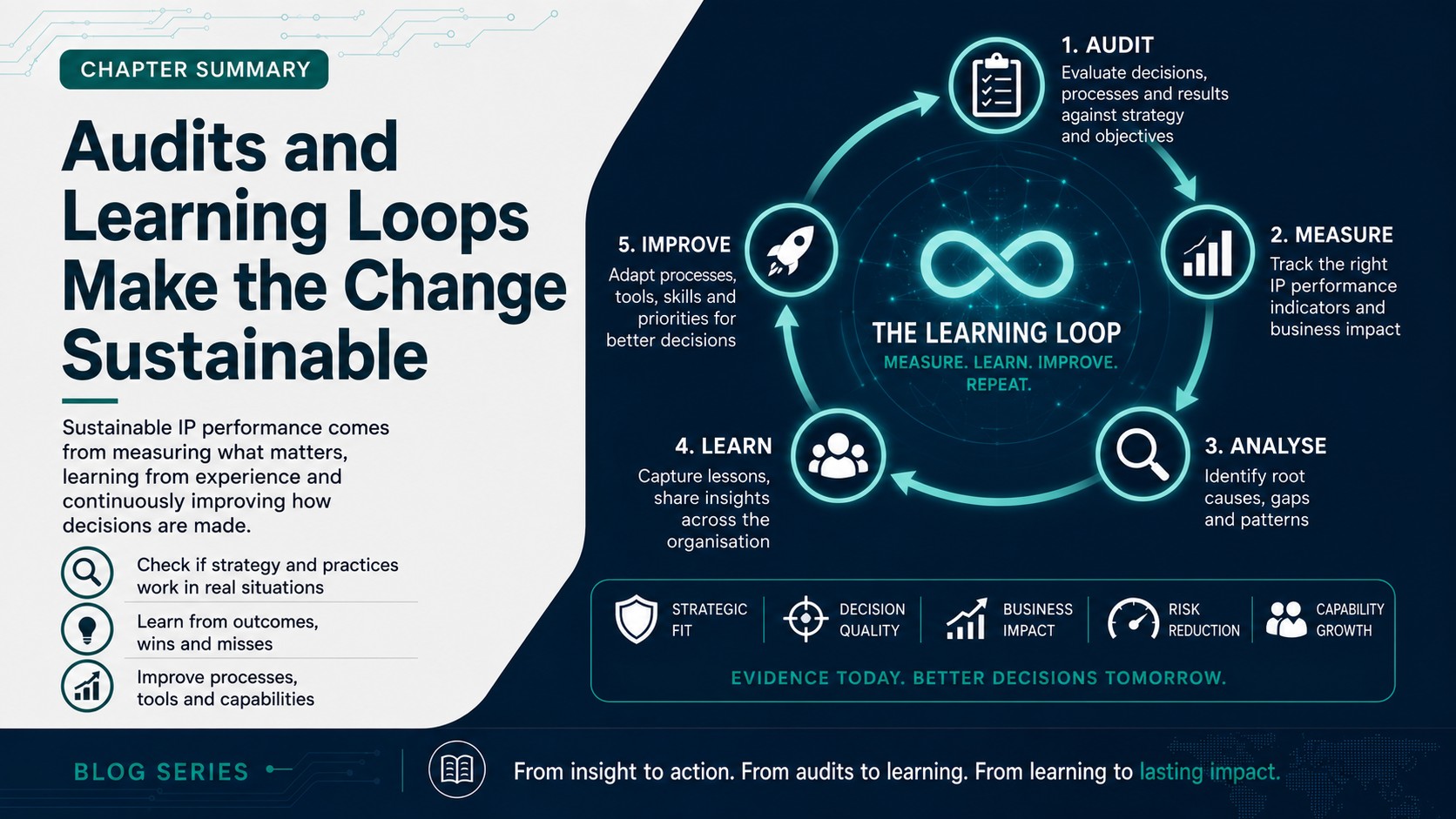
Roll-out is not a campaign with a fixed end date. Products, technologies, regulations, partners and employees change continuously. A process designed for a mechanical product may fail for an AI-enabled service, while training can become obsolete as tools and sourcing models change. Sustainability therefore depends on review, learning and adaptation.
The organisation should begin with a practical maturity baseline. It can assess whether strategic IP objectives are understood, critical workflows contain suitable triggers, responsibilities are clear, decisions create usable evidence and stakeholders experience the system as helpful. The purpose is to identify weaknesses that threaten business outcomes and sequence improvement work.
Audits should test behaviour and decision quality rather than document volume. A reviewer might sample a product initiative and ask when IP entered the roadmap, how control needs were identified, whether supplier and software rights were clarified, who accepted remaining risk and whether agreed measures were completed. The audit can then distinguish a missing document from a missing capability. Corrective action may require a better template, clearer authority, training, tooling or management attention.
Useful indicators combine adoption and effect. They may include early IP involvement in priority projects, time to resolve recurring questions, closure of critical control gaps, completeness of ownership and provenance records, implementation of agreed mitigation, use of strategically relevant inventions, stakeholder satisfaction and decisions changed by IP intelligence. Metrics should generate management conversations and resource decisions.
Retrospectives, management reviews and audits should feed one improvement backlog. Lessons from a failed disclosure review, a difficult collaboration or a successful design-around can refine processes and training. The IP function should report not only compliance gaps but also where the system creates friction, where teams invent workarounds and where new business models require different controls. Quality assurance then becomes a source of organisational intelligence.
Sustainable roll-out is the continuous renewal of the organisation’s ability to make IP-informed decisions. Audits, indicators and learning loops keep the system proportionate, useful and aligned with changing business reality, turning a temporary change programme into a durable management capability.
Supplementary content on the IPBA® platform:
Organizational Implementation of a Patent Strategy – Example Vorwerk Thermomix
Demonstrates how strategy, organisational structure, processes, responsibilities and IP culture were aligned in a concrete differentiation project. It provides a particularly strong illustration of a lighthouse project becoming an organisational model.
👉 Read more
How to Implement an IP Management Quality Standard with a Digital Content Portal
Shows how company-specific processes, guidance and digital knowledge resources can support implementation instead of leaving standards and strategy as abstract requirements.
👉 Read more
Operational IP Processes
Explains how IP can be embedded in R&D planning, innovation workflows and everyday development activities through structured and repeatable processes.
👉 Read more
Digital Business Transformation & Change Management
Connects organisational transformation with coordinated changes in people, processes and tools, providing a broader change-management frame for the IP roll-out.
👉 Read more
Change Management
Provides the conceptual basis for treating IP implementation as a structured transition in strategy, operations, processes, technology and organisational culture.
👉 Read more
IP Awareness Building under New Work Conditions: Framing of Content
Supports the design of stakeholder-specific communication and learning content, particularly where employees work across distributed, digital and hybrid organisational settings.
👉 Read more
Coaching, Training and Mentoring in IP Management
Distinguishes different forms of capability development and explains how practical guidance, feedback and continuous learning strengthen strategic judgement beyond one-off training.
👉 Read more
From Lenses to Leverage
Uses the ZEISS case to illustrate distributed IP coordination, integration with R&D roadmaps and the organisational orchestration of IP across a large and complex company.
👉 Read more
Firm Performance and IP Management
Connects the maturity and formalisation of management practices with organisational productivity, supporting the economic case for developing IP from isolated expertise into a managed capability.
👉 Read more
Leadership in IP Management
Examines the leadership responsibility for strategic direction, business alignment, capability building, digital transformation and the organisational changes required to make IP effective.
👉 Read more