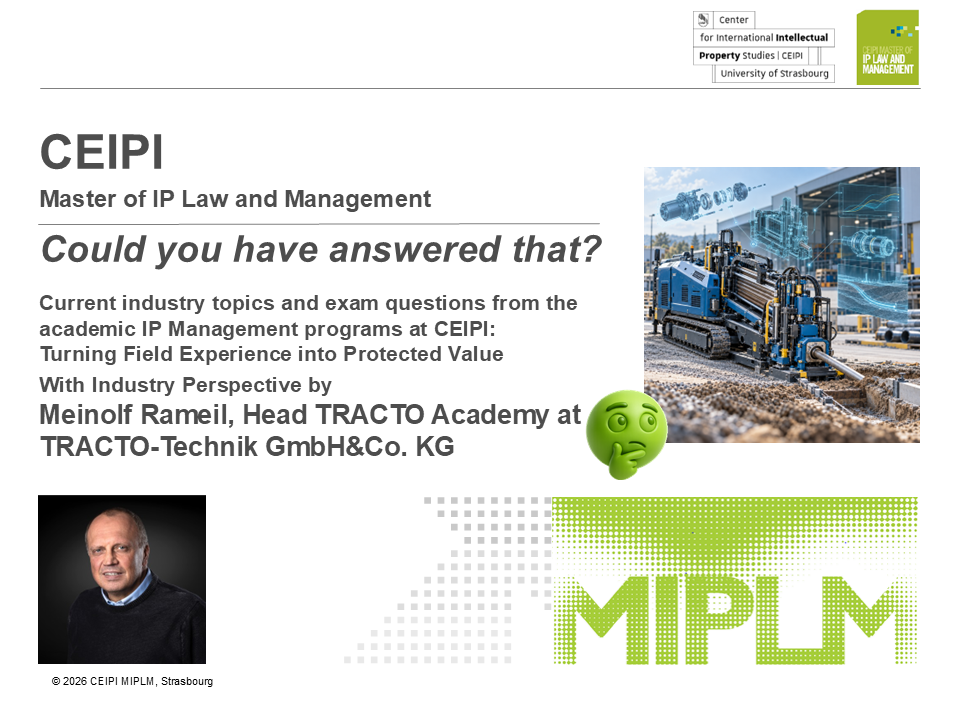
Turning Field Experience into Protected Value. With Industry Perspective by Meinolf Rameil

In specialist machinery, competitive advantage develops through the interaction of engineering, practical application and accumulated experience. A component modification, an improved operating procedure or a solution developed during a service intervention may create value well beyond its original application. Recognising this wider potential allows companies to turn individual improvements into capabilities that support future products, customer projects and technical services.
Making that knowledge transferable requires deliberate choices. Engineers need to understand which conditions made an improvement successful and whether it can deliver comparable benefits elsewhere. Management must assess its commercial relevance and decide where further development or protection justifies the investment. Knowledge gained through collaboration may also require clarification of contributions, permissions and the conditions for subsequent use.
Sharing knowledge is itself part of the business model. Customers need guidance to operate equipment effectively, service teams need access to technical experience, and development teams need feedback from real operating conditions. At the same time, companies must determine which technical solutions warrant patent assessment, which knowledge should remain restricted and which information can be shared to strengthen customer relationships and support adoption. These choices influence both the value created through knowledge transfer and the company’s ability to retain a competitive advantage.
This challenge connects directly to the CEIPI lecture “AI Supported IP Management in Industrial Engineering”. The lecture examines how identification, evaluation, decision-making, protection and reuse can form a practical management process. AI may help organise authorised records and identify related developments. Its contribution depends on reliable evidence, appropriate verification and clear responsibilities for the decisions that follow.
Practice-based questions give students in CEIPI’s IP management programmes an opportunity to explore these relationships in a concrete business setting. We are therefore pleased to include this practical question with the industry perspective by Meinolf Rameil of TRACTO. The case examines how a specialist machinery manufacturer can translate experience from development, application and service into protected, reusable technical knowledge. It asks how internal teams and external IP advisers can work together through a proportionate process that supports timely decisions and effective knowledge transfer.
Meinolf Rameil explains the practical relevance of the case: “In mechanical engineering, valuable technical knowledge emerges from development and, to a substantial extent, from application, service and experience gained under real operating conditions. The key is to recognise this knowledge early, assess its value and then make deliberate decisions about which knowledge should be protected, safeguarded internally or shared selectively.”
Mini case study
An established machinery manufacturer supplies specialist equipment for infrastructure applications. Customers value reliable performance, efficient operation and the ability to work under demanding site conditions. The company creates value through the combination of machine design, application expertise and technical support throughout the equipment’s operating life.
As its product range evolves, management sees opportunities to use improvements from individual applications across several machine variants and customer groups. Experience from development, field service and operator feedback can inform changes to components, operating procedures and machine settings. Some improvements address a specific operating condition; others may provide a repeatable performance advantage.
Transferring this knowledge creates a strategic choice. Incorporating an improvement into a standard product can broaden its commercial impact while making aspects of the solution visible to competitors. Sharing operating guidance can improve customer results and support adoption. Retaining selected knowledge internally may preserve differentiation, while requiring continued investment in documentation, access controls and specialist support.
Management therefore needs to decide which improvements justify further development and protection, which should become part of customer-facing guidance, and which should remain restricted know-how. These decisions must account for the expected customer benefit, applicability across products, ease of imitation and contributions made by customers or suppliers. Engineering time and protection budgets are limited.
The company wants a practical decision process connecting its internal identification of improvements with external IP assessment. Internal teams would remain responsible for gathering technical evidence and explaining the intended business use. The process must establish when an improvement should be referred for specialist review, what information that review requires and who authorises subsequent protection and disclosure decisions.
Question
How should the company organise a lean IP decision process that turns selected improvements from development and field experience into commercially valuable, reusable solutions while enabling effective knowledge transfer?
1 . Which technical and commercial criteria should determine whether an improvement merits specialist IP assessment, and how should management prioritise candidates across products and applications?
2 . How should the company choose and combine patent protection, restricted know-how and controlled sharing, taking account of imitation risks, customer adoption and contributions from external parties?
3 . What minimum information, responsibilities and review points should connect internal identification with external IP advice, so that protection and disclosure decisions can be made without creating disproportionate administrative work?
Why this is a highly practice relevant question
Specialist machinery businesses accumulate valuable knowledge through the interaction of engineering and practical use. An adjustment developed for one application may become relevant across a product family. Recognising that potential requires technical evidence and an understanding of how the improvement affects customer performance, service requirements and future sales.
Different protection and sharing decisions produce different economic outcomes. A patent may support differentiation where an invention can be identified and its use monitored. Retained know-how may support advantages rooted in operating experience, provided confidentiality can be maintained in practice. Sharing selected knowledge can improve equipment utilisation and customer confidence. Each approach involves costs, organisational requirements and consequences for future flexibility.
The quality of the decision also depends on the information available. An external adviser needs a sufficiently clear account of the technical contribution, its origin, intended use and any previous or planned disclosure. Internal teams need recommendations that explain available options, unresolved questions and the next decision required. A workable interface helps both sides direct their effort towards improvements with meaningful business potential.
Future IP managers must be able to connect these choices with product strategy and organisational capability. They need to structure proportionate reviews, distinguish application-specific adaptations from reusable advantages and support knowledge transfer across development, service and customers. This makes the case a practical exercise in aligning protection expenditure and everyday working processes with long-term competitive value.
Here you can find the lecture: “AI Supported IP Management in Industrial Engineering” regarding this exam question.
Meinolf Rameil
 Meinolf Rameil is a civil engineer whose career at TRACTO spans nearly four decades of work in specialist machinery and trenchless infrastructure technology. He joined the company in 1987 as a technical application adviser, became assistant to the management in 1997 and served as Technical Managing Director from 2010 until August 2025. During this period, he helped shape the company’s technological development and contributed to the introduction of numerous innovations. His professional experience connects machinery development with the practical demands of installing and renewing underground infrastructure, where equipment performance depends on the interaction of engineering design, operating methods and site conditions.
In September 2025, Rameil took over the leadership of the TRACTO Academy, focusing on training, professional qualification and the next generation of industry professionals, while continuing to advise on research and development. This combination of technical leadership, application experience and knowledge transfer provides a relevant perspective for the present examination case. His contribution draws attention to the knowledge generated through equipment use, service and real operating conditions, and to the management decisions required to make that knowledge valuable across further applications. For future IP managers, this perspective helps connect the identification of technical improvements with their commercial evaluation, appropriate protection and selective dissemination to employees, customers and partners.