IP Strategies for Digital MedTech with Camille Terfve

Digital MedTech connects medical knowledge, software and data analysis in products that can improve diagnosis, monitoring and treatment decisions. The underlying technologies develop rapidly, while clinical adoption and regulatory approval follow their own timelines. For companies working at this intersection, IP strategy needs to connect technical innovation with the commercial realities of bringing a medical product into use.
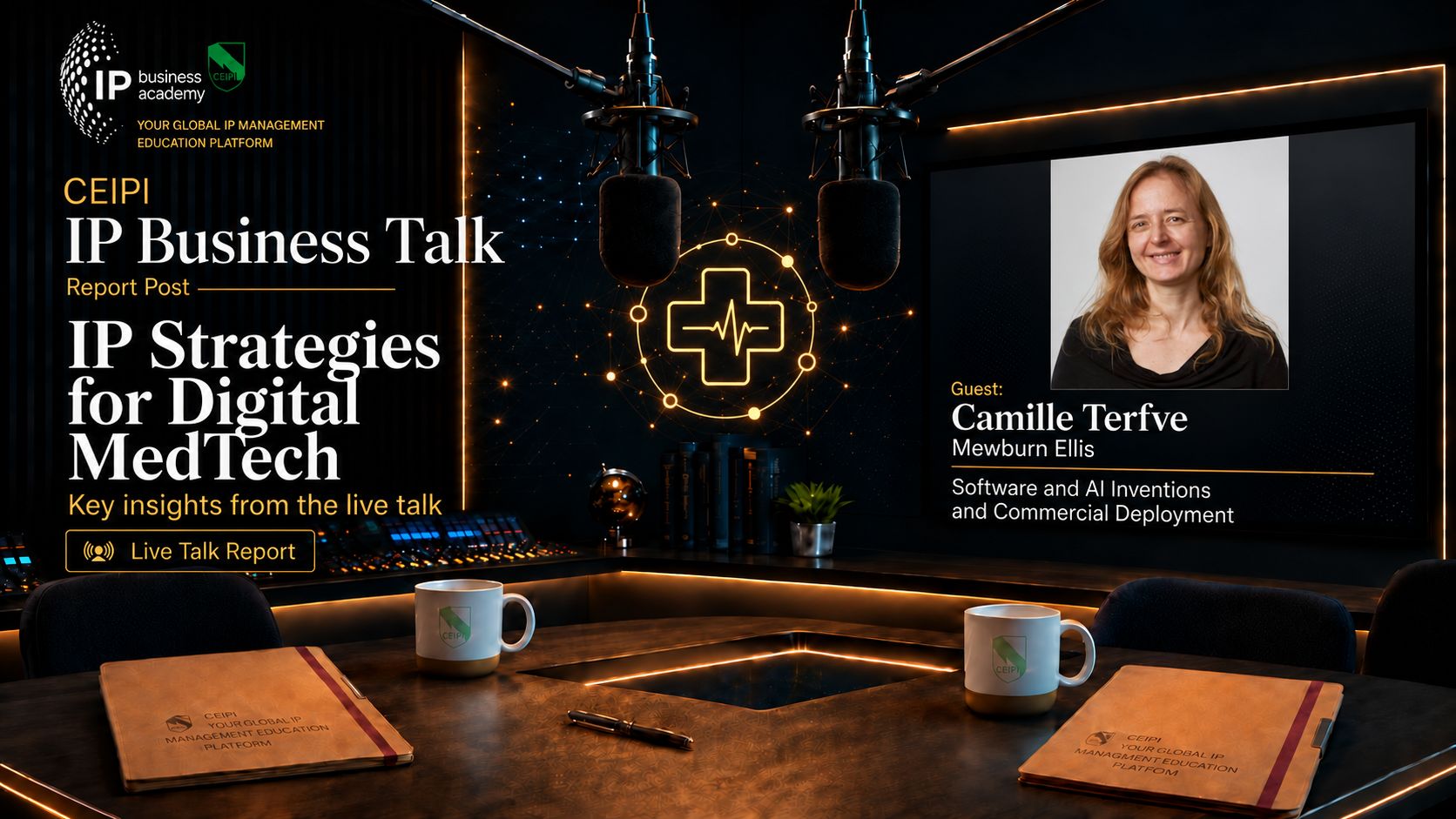
In the CEIPI IP Business Talk on 14 October 2026, Camille Terfve, Partner at Mewburn Ellis, joined Prof. Dr. Alexander J. Wurzer to discuss these challenges. The conversation explored invention identification, protection for evolving AI applications, international patent drafting and the management of software and technology dependencies. A recurring theme was the need to involve IP expertise early enough to influence development and support a commercially useful position.
Software inventions deserve a proper assessment
Terfve addressed a misconception that can prevent relevant developments from reaching an IP adviser: the assumption that software cannot be patented. In digital medical technologies, that assumption can exclude precisely the contributions on which a company’s competitive advantage depends. The discussion focused on computational methods that solve practical problems in medicine and biology. A method for analysing medical information may generate an actionable result concerning a patient’s condition or help a medical system perform its function. Understanding the technical contribution requires examining what the method does, how it works and which problem it addresses.
The EPO’s guidance on artificial intelligence and machine learning provides a useful reference point. AI models and algorithms are abstract mathematical methods in themselves, while their application to a technical purpose can contribute to patentability. This makes the relationship between the computation and its practical function central to the assessment. For companies, the first management task is to ensure that software developments receive an informed review. Broad assumptions about an entire category of technology provide little guidance for deciding whether a particular contribution deserves attention.
Invention identification starts with the development conversation
A second theme concerned the responsibility placed on inventors. Researchers and software developers understand their work, yet they may have limited experience of how patentability is assessed. They may also regard a difficult achievement as obvious once they have solved the problem.
Terfve described the value of asking concrete questions: What was the team trying to achieve? Which part was technically difficult? How did they overcome that difficulty? Which aspects of the result are they particularly pleased with?
These questions help uncover the contribution behind the finished implementation. The inventor’s explanation supplies essential technical detail, while the patent adviser brings experience in identifying and assessing potentially protectable subject matter. Wurzer connected this with the organisation of invention capture. A process that depends on developers first deciding whether something is patentable can lose relevant contributions before the discussion begins. Close cooperation gives the company a stronger basis for identifying inventions and explaining their significance. The conversation also highlighted the limits of relying on general-purpose AI tools for these judgements. An assessment needs an accurate understanding of the technology, the applicable requirements and the company’s context.
The business model gives protection its purpose
The possibility of obtaining a patent opens a further question: why would that right matter commercially?
Wurzer emphasised the economic role of exclusivity. A company needs to understand which position it wants to establish, whose activities it may wish to exclude and how that position supports value creation and value capture. Terfve connected filing decisions with the company’s business model, competitive environment and available resources. Digital MedTech businesses can generate numerous software improvements. Their strategic importance varies, and a limited budget makes prioritisation essential.
The discussion therefore directed attention towards capabilities likely to remain central to the business. Which contribution supports the company’s distinctive offering? Which development could remain valuable as the product evolves? Which position would justify continued investment?
Patents, confidential know-how and other rights can then be considered together. Terfve encouraged companies to examine the different assets within their technology and choose suitable ways of managing each. A coherent strategy may combine several forms of protection across the same product.
Rapid AI development calls for active portfolio management
Changes in models, datasets and applications create a demanding environment for patent strategy. A company may replace an implementation within months, while another technical contribution remains important across several product generations. Terfve argued that this requires a more agile approach than businesses may associate with traditional pharmaceutical patent portfolios. Applications need to be drafted with an understanding of where the technology and the business are heading.
That involves discussing future development with the technical team. How might the method change? Where could it be used next? Which alternatives are already foreseeable? Those conversations can help the adviser describe a contribution in a way that remains relevant as the software develops. The same reasoning applies to portfolio review. Where a patent or application has lost its commercial purpose, continued expenditure needs to be reconsidered. Resources can then support positions that remain useful. Terfve also challenged the assumption that fast development makes patents commercially irrelevant. Protection that helps preserve an advantage for several important years can serve a substantial purpose. The relevant assessment concerns the value of that period to the business.
Clinical use creates a different timeline from research
The conversation distinguished rapid research progress from the pace of commercial deployment. A medical product operates within a regulated environment, where changes to the deployed solution can involve further validation and approval considerations. This creates an important connection between IP strategy and the actual product roadmap. The version attracting attention in research may differ from the version being prepared for clinical use. Protection priorities need to reflect the technology the company expects to deploy and the period over which it will remain relevant.
Wurzer brought the discussion back to the use case. A technical capability acquires commercial significance through the benefit it delivers in a particular setting. Understanding that setting helps identify which contributions the company needs to control. Terfve also raised selective acceleration of patent prosecution as an option where timing matters. Such decisions need to reflect the importance of the contribution, the commercial schedule and the available budget.
AI assisted invention requires attention to human contributions
The talk distinguished inventions developed with AI assistance from inventions concerning AI technology itself. For AI-assisted development, Terfve highlighted the importance of understanding and documenting the human contributions to the inventive process. Researchers may use AI to explore possibilities, while contributing to the formulation of the problem, the direction of the work and the development of the resulting solution.
Documentation helps preserve an account of how an invention emerged and who contributed to it. This becomes relevant when inventorship needs to be assessed or explained. The current USPTO guidance on AI-assisted inventions confirms that the same inventorship standard applies whether AI was used or not, and that only natural persons can be named as inventors. Terfve also encouraged teams to use effective tools in their research. The practical task is to understand the resulting invention and its human contributions as part of a well-managed development process.
Existing AI tools can contribute to new inventions
Turning to inventions involving AI, Terfve explained that companies can create potentially patentable contributions using established models. Developing an entirely new model architecture is one possible route, while applying known computational tools in a new and inventive technical way can also warrant assessment.
The discussion returned to the importance of explaining the actual contribution. What does the system achieve? Which technical choices enable that result? How does the approach differ from what was already known?
A crowded research field makes those questions particularly important. Extensive publication and widespread experimentation can increase the prior art relevant to a particular development. For invention capture, the implication is to look beyond the name of the model being used. The team needs to explain the problem, the implementation and the technical result clearly enough for a meaningful assessment.
International drafting needs flexibility from the beginning
Digital MedTech combines software patentability questions with issues specific to medical activities. Terfve explained that differences between jurisdictions should influence the original drafting process. The discussion used computational diagnostics to illustrate why context matters. A patent application may need to describe the computational analysis alongside surrounding activities such as obtaining inputs, generating a report and using the result in a medical workflow. Providing that detail can create a basis for different claim approaches in different jurisdictions. Missing disclosure can be difficult to address later.
Terfve identified Europe and the United States as important reference points for planning this flexibility. Their different approaches make it valuable to consider both when preparing the application, while retaining attention to the requirements of the intended markets. The management implication is to discuss international ambitions early. A well-prepared initial application gives the company a stronger basis for adapting its claims as the filing strategy develops.
Commercial deployment depends on managing technology dependencies
The closing discussion addressed products combining proprietary algorithms, sensitive health data, open-source software and third-party technologies. Terfve described IP strategy as a multifaceted activity involving patents, software licences, agreements and other rights. Obtaining exclusivity over a company’s own contribution forms one part of making a product commercially deployable.
A practical starting point is to understand what enters the product. Which external software components are incorporated? What rights permit their use? Which conditions accompany those rights? What requires further investigation before deployment?
The discussion emphasised processes that make these decisions manageable for development teams. Companies need visibility into the software being used and a clear route for assessing proposed additions, with appropriate scrutiny of components entering the commercial product. Terfve’s closing management point concerned usability: a process works better when it makes the appropriate action easy. Developers need accessible guidance and support for decisions that carry legal and commercial consequences.
IP expertise can help shape the innovation project
Across the discussion, early involvement emerged as a connecting theme. IP advisers can contribute while the company is still deciding what to develop, how to implement it and where it intends to compete. That interaction brings together technical feasibility, commercial priorities, opportunities for exclusivity and questions about third-party rights. It gives the company a basis for making deliberate choices as the product takes shape.
For digital MedTech businesses, the ongoing dialogue is especially valuable because software development, clinical deployment and international expansion proceed at different speeds. Keeping IP decisions connected to those developments helps the portfolio support the business the company is building.
Camille Terfve
 Camille Terfve is a Partner and UK and European Patent Attorney at Mewburn Ellis. She specialises in bioinformatics, digital health, artificial intelligence and computational approaches in the life sciences. Her work covers patent drafting and prosecution, IP strategy, freedom to operate and oppositions.
She holds master’s degrees in bioengineering and computational biology, alongside a PhD undertaken at the University of Cambridge and the EMBL-European Bioinformatics Institute. Her combination of computational and biological expertise is particularly relevant to companies translating data-driven research into medical applications.
Explore the wider context in our Industry Focus on MedTech and Digital Health Systems.