Making IP Management Work for Industrial Innovation at the CTO Forum: DIN77006 with Dr. Jörn Plettig

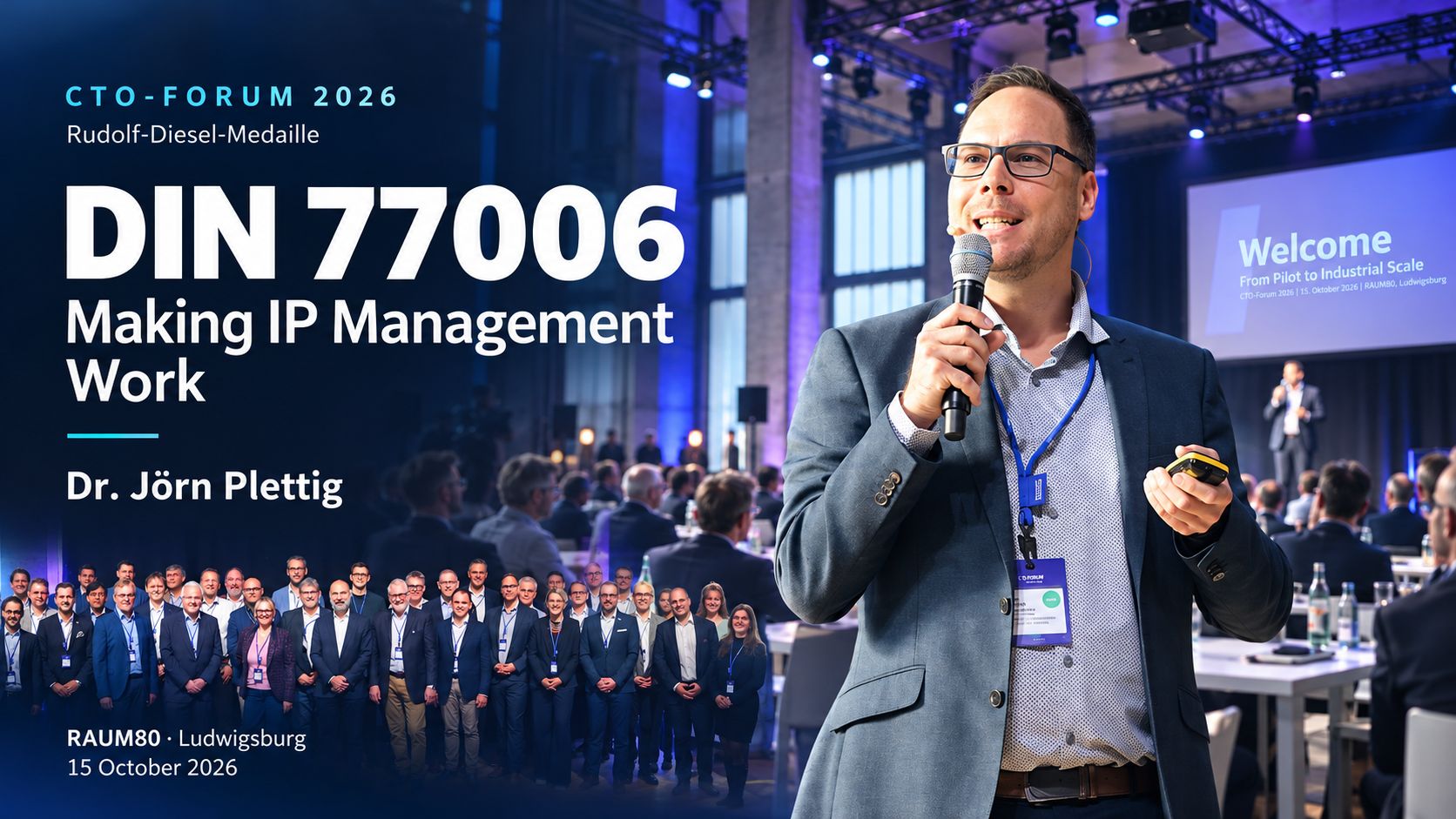
How does technological potential become lasting industrial advantage? This question shaped the CTO Autumn Forum on 15 October 2026 in Ludwigsburg. It also provided the context for a particularly well-received contribution by Dr. Jörn Plettig: an approach to IP management that starts with the challenges companies actually face and uses DIN 77006 to turn them into manageable, reviewable processes.
Together with Dr. Diana Taubert, Plettig represents the Industrierat Wettbewerb, the CTO Forum’s Industry Council on Competitiveness. Their shared focus is on connecting IP more closely with the business challenges and decision processes that determine industrial competitiveness. His presentation brought this work directly into the conversation among technology leaders. Under the title “From IP Challenges to Effective Solutions: DIN 77006 as a Common Denominator,” Plettig addressed a question relevant across the industries represented in the room: how can companies organise IP management so that it supports business objectives, protects valuable knowledge and preserves room for future development?
The CTO Forum of the Rudolf Diesel Medal provides a fitting setting for this discussion. Developed from the community surrounding the innovation award, it brings technical executives together for personal, practical exchange across industry boundaries. Its purpose includes making the contribution of technology and entrepreneurship to society visible. The technical and digital vision of a company carries responsibility for investment, employment and future competitiveness.
The scale of the businesses represented at the meeting underlined that responsibility. Just eleven of the participating corporate groups together account for more than 200,000 employees worldwide. Among them are TE Connectivity, Heraeus, Festo, TRUMPF, Kärcher, CLAAS, ebm-papst, HENSOLDT, Wilo, Vorwerk and LAPP. Decisions about technology and innovation in this community have consequences far beyond individual development projects.
The programme, bringing together MHP, the Rudolf Diesel Medal community and AWS, centred on the transition from promising technology to industrial impact. AI, autonomous production, robotics, quantum computing and software defined manufacturing featured alongside questions about scalability, economic viability and resilience. The agenda connected an opening keynote by MHP Group CEO Federico Magno with a TRUMPF peer case presented by Marcel Schaefer and executive sessions on production, AI and intelligent product development. Plettig’s contribution added a management dimension to this scaling agenda. As technologies move into products, production environments and partnerships, companies make decisions about knowledge, access, dependencies and future commercial opportunities. IP management needs to become part of those decisions early enough to influence their outcome.
This connection is explored in the IPBA Plattform article “DIN 77006 and ISO 56005: Why IP Needs a Management System.” It explains how strategy becomes operational through responsibilities, decision triggers, workflows and review routines. In digital businesses, many decisions with IP consequences arise in engineering, procurement, software development and partnerships. A management system connects these decisions with the company’s objectives and specialist IP expertise.
Plettig’s starting point was the company’s situation. A proactive IP management system begins with an understanding of its value drivers, decision pathways and risks. The next step is to examine these against a systematic framework, identify gaps and assess whether the resulting measures work. For this purpose, he drew on a qualitative synthesis of published CEIPI Practical Use Cases on the IPBA Plattform. These cases cover different technologies and business environments, including robotics and AI, Industrial IoT, GreenTech, quantum technologies and photonics. Across this variety, they reveal recurring management questions.
Who controls the value created by the combination of software, data and machinery? How are rights to models and service interfaces allocated? How can IP support financing and scaling? How can a company establish enforceable protection when its contribution sits within a complex technical system?
These questions connect IP directly with the CTO’s agenda. A technically successful development can create dependencies that affect later market access. A partnership can accelerate implementation while leaving uncertainty over the reuse of jointly developed knowledge. A valuable contribution can remain difficult to protect because nobody has recognised it or documented its origin.
The platform’s earlier contribution “Controlled Openness Needs an IP Management System: Applying DIN 77006 and ISO 56005 in GreenTech with Dr. Jörn Plettig” illustrates this challenge in an industrial context. Scaling sustainable technologies requires cooperation across suppliers, engineering partners, investors and customers. Companies need clear processes for deciding which knowledge to share, which contributions to protect and how access and improvement rights should be allocated. This provides a direct connection between the forum’s scaling agenda and Plettig’s work on systematic IP management. In his presentation, Plettig organised the challenges into five recurring fields of action. The first concerns the connection between IP strategy, business models and markets. The second addresses responsibilities and interfaces between research and development, business functions, IP specialists and partners. The third concerns identifying and securing valuable knowledge. The fourth covers IP risks, third-party rights and freedom to operate. The fifth asks whether objectives, reviews and learning processes provide a basis for assessing effectiveness.
Their relevance extends across company sizes and sectors. Rising costs increase the pressure to explain the economic contribution of IP activities. Software, AI and data change where value is created. Cooperation and external development expand the number of interfaces through which knowledge moves. Management therefore needs a clear basis for deciding where to act, which resources to commit and how to review the result. The organisational dimension is developed further in “Towards an Integrated IP Function for Companies: Role-Specific IP Needs According to DIN 77006 and ISO 56005.” Its focus on different functions within a company complements the presentation’s emphasis on interfaces. Effective implementation requires departments to understand how IP relates to their own tasks and decisions.
In Plettig’s approach, DIN 77006 provides a common management framework for addressing these questions. Business objectives connect with IP policy, goals and strategy. Organisational requirements translate into roles, competencies and processes. Value creation requires procedures for identifying, protecting and using IP. Monitoring, audits and corrective action support continuous improvement. The framework leaves companies responsible for designing an implementation suited to their circumstances. Plettig emphasised integration with existing management structures and described DIN 77006 as a benchmark for systematic assessment and improvement. Its practical value depends on how well it helps the organisation make and execute decisions.
The concern about implementation effort is familiar. The platform article “IP Management via the DIN 77006 Standard: Helpful Tool or Administrative Monster?” addresses this question directly. It offers useful background for executives considering how a structured approach can support their organisation while keeping implementation proportionate to its needs.
That led to a particularly relevant distinction in the presentation: demonstrating feasibility does not yet demonstrate effectiveness.
An IP audit can establish the current position, examine roles and processes, and identify gaps against defined requirements. A focused improvement period can then address the most significant findings. Evidence is still needed to show whether these measures have changed organisational practice and reduced the identified gaps.
Readers looking for a practical implementation sequence can turn to Plettig’s own article “Step by Step: How to Implement DIN 77006.” It describes current-state assessment, comparison with relevant requirements, development of an action plan and implementation towards a defined target state. Existing practices provide the starting point, allowing companies to preserve what works and improve the areas that need attention.
At the CTO Forum, Plettig illustrated his implementation logic through practical audit experience, particularly an IP audit at Accelleron. The presentation introduced a sequence of assessment, gap analysis, a 90-day focus and subsequent verification. A more detailed Accelleron case study, covering the approach, findings and effectiveness review, was announced for the CTO Spring Forum in 2027, with publication planned beforehand. This gives the CTO community a concrete opportunity to follow the discussion from management principles into documented practice. It also reflects the purpose of the Industry Council on Competition: connecting the challenges experienced by companies with approaches that can be examined, implemented and improved.
The strong reception of Plettig’s presentation showed how closely this perspective resonated with the audience. For technology leaders working to scale innovation, questions about ownership, knowledge protection, cooperation and freedom to operate belong within the same decision processes as architecture, investment and industrialisation. The contribution by Jörn Plettig, within the council work he shares with Diana Taubert, made this connection tangible. Effective IP management gives companies a systematic way to address these questions as their technologies and business models develop. Within the CTO Forum’s wider discussion of industrial transformation, it provided a practical basis for turning innovation into sustainable competitive advantage.
Dr. Jörn Plettig
 Dr. Jörn Plettig is a German and European Patent Attorney, Senior IP Counsel and auditor at ETL IP Patentanwaltsgesellschaft mbH. He holds a doctorate in biology from Charité in Berlin and combines experience in the medical technology industry with work in international IP law firms. His professional focus includes systematic IP management, organisational responsibilities and the practical implementation of DIN 77006. Together with Dr. Diana Taubert, he represents the Industry Council on Competition within the CTO Forum of the Rudolf Diesel Medal, connecting IP management with companies’ business challenges and decision processes.
On the IPBA Plattform, Plettig contributes practical guidance on translating IP management standards into company processes. His articles “How DIN 77006 Can Help with Current Challenges” and “Step by Step: How to Implement DIN 77006” connect the reasons for systematic IP management with concrete implementation steps. His approach is also featured in “Controlled Openness Needs an IP Management System: Applying DIN 77006 and ISO 56005 in GreenTech with Dr. Jörn Plettig”, which explores how structured IP processes support collaboration, knowledge protection and industrial scaling.