
Building IP Around Next-Generation Batteries

A promising battery formulation can demonstrate impressive performance in the laboratory. Turning that result into a competitive product involves a much wider set of decisions. Electrodes, electrolytes, interfaces and production methods may all contribute to the technical advantage, while further development can change which features matter most. Companies need an IP strategy that protects valuable innovation without limiting their options as the technology moves towards manufacture.
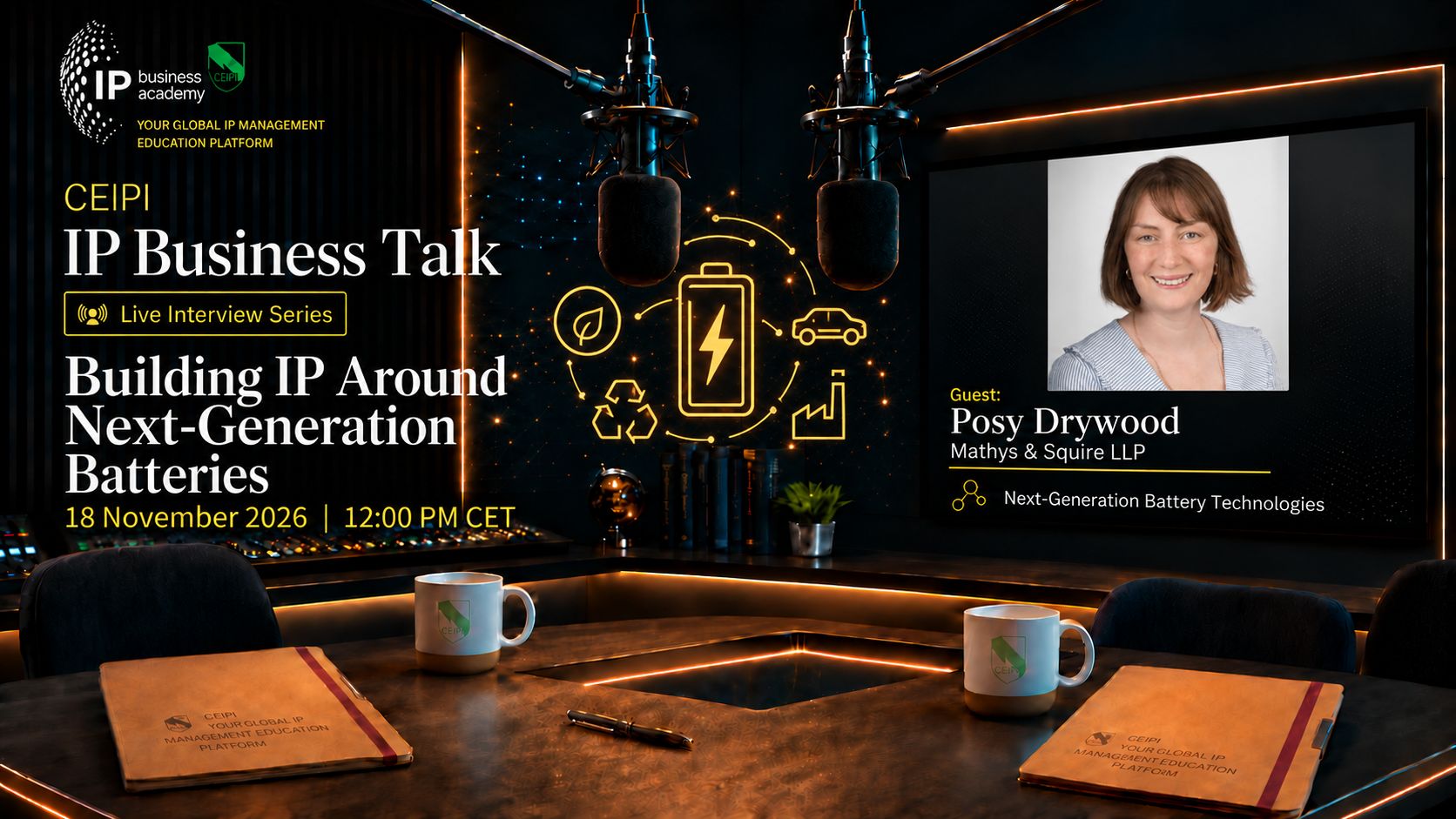
On Wednesday, 18 November 2026, at 12:00 PM CET, Posy Drywood, Partner at Mathys & Squire LLP, will join Prof. Dr. Alexander J. Wurzer for a live CEIPI IP Business Talk on Building IP Around Next-Generation Batteries. The conversation will explore how innovators can identify patentable contributions, balance patents with confidential know-how, prepare for scale-up and preserve freedom to operate in an increasingly crowded battery landscape.
👉 Join the live conversation on LinkedIn
Identifying the invention behind battery performance
The first theme concerns how companies locate the core invention when a battery improvement results from interactions between several technical elements. A change to an electrolyte additive, for example, may only produce the desired effect in combination with a particular electrode material or interface. For the development team, the practical question is what has actually created the improvement and how that contribution can be demonstrated. Is the valuable feature the material itself, a specific combination, or the electrochemical effect under defined conditions? The discussion will examine how technical evidence can guide patent claims towards the aspect that gives the innovation its competitive value.
Choosing between patents and confidential know-how
The second theme looks at the many incremental advances that emerge during battery R&D. Improvements in composition, cycle life, safety, yield or manufacturing consistency can be commercially important even when the surrounding patent landscape is already dense. Consider a team that has refined a processing parameter to improve cell lifetime. Protecting the result through a patent may offer advantages if the relevant feature can be claimed and competitors could discover it. Keeping a hard-to-detect production detail confidential may lead to a different decision. The talk will explore how companies can assess which developments merit filings and which are better managed as know-how, taking account of disclosure, detectability and long-term business relevance.
Protecting early discoveries while preparing for scale-up
The third theme addresses the gap between promising electrochemical results and industrially manufacturable cells. At the laboratory stage, researchers may know that a formulation works without yet knowing which production conditions will deliver the same performance consistently at scale. An early patent application can secure a filing date, but later development may reveal changes in ingredient ranges, processing steps or cell architecture. What should be documented and supported at the initial filing stage? How can a filing strategy accommodate subsequent improvements without assuming that new technical matter can simply be added later? The conversation will consider how patent planning can stay connected to the changing evidence and milestones of battery development.
Combining patent portfolios with freedom to operate
The fourth theme examines the layers of rights surrounding lithium-ion, sodium-ion, solid-state and other emerging battery technologies. A company may develop its own valuable inventions while still relying on materials, manufacturing techniques or cell designs covered by third-party patents. Imagine a team selecting between two technical routes for a future cell platform. Performance and cost are central considerations, but the relevant patent landscape may also affect which route can be developed and commercialised. The talk will explore how portfolio development and freedom-to-operate analysis can inform one another early enough to support design choices, partnerships and future product evolution.
Connecting battery innovation with the wider GreenTech ecosystem
These themes connect with our Industry Focus on GreenTech on dIPlex. Battery technologies depend on more than the chemistry of a single cell. Materials supply, manufacturing know-how, system integration, recycling processes and industrial partnerships can all influence how a technology reaches the market and where competitive advantage can be sustained.
The upcoming talk offers founders, R&D leaders, IP managers and advisers an opportunity to examine how patent decisions can support the development of next-generation batteries from initial technical results towards commercial deployment.
👉 Explore our Industry Focus on IP in GreenTech
Posy Drywood
 Posy (Rosalind) Drywood is a Partner, UK and European Patent Attorney and European Patent Litigator at Mathys & Squire LLP. As part of the firm’s Chemistry team, she advises clients on patent drafting, prosecution and global portfolio management, with particular experience in batteries, green technology and chemistry-based innovation. Her work includes examining how developments in battery chemistry can be protected and commercialised in a field characterised by rapid technological progress, extensive existing patent activity and competing approaches to future energy storage.
👉 Read Posy Drywood’s profile at Mathys & Squire
Join Posy Drywood and Prof. Dr. Alexander J. Wurzer on Wednesday, 18 November 2026, at 12:00 PM CET for this live CEIPI IP Business Talk on Building IP Around Next-Generation Batteries.
👉 View the event details and join the conversation on LinkedIn