
Industrial IoT IP and the journey from machine data to scalable services

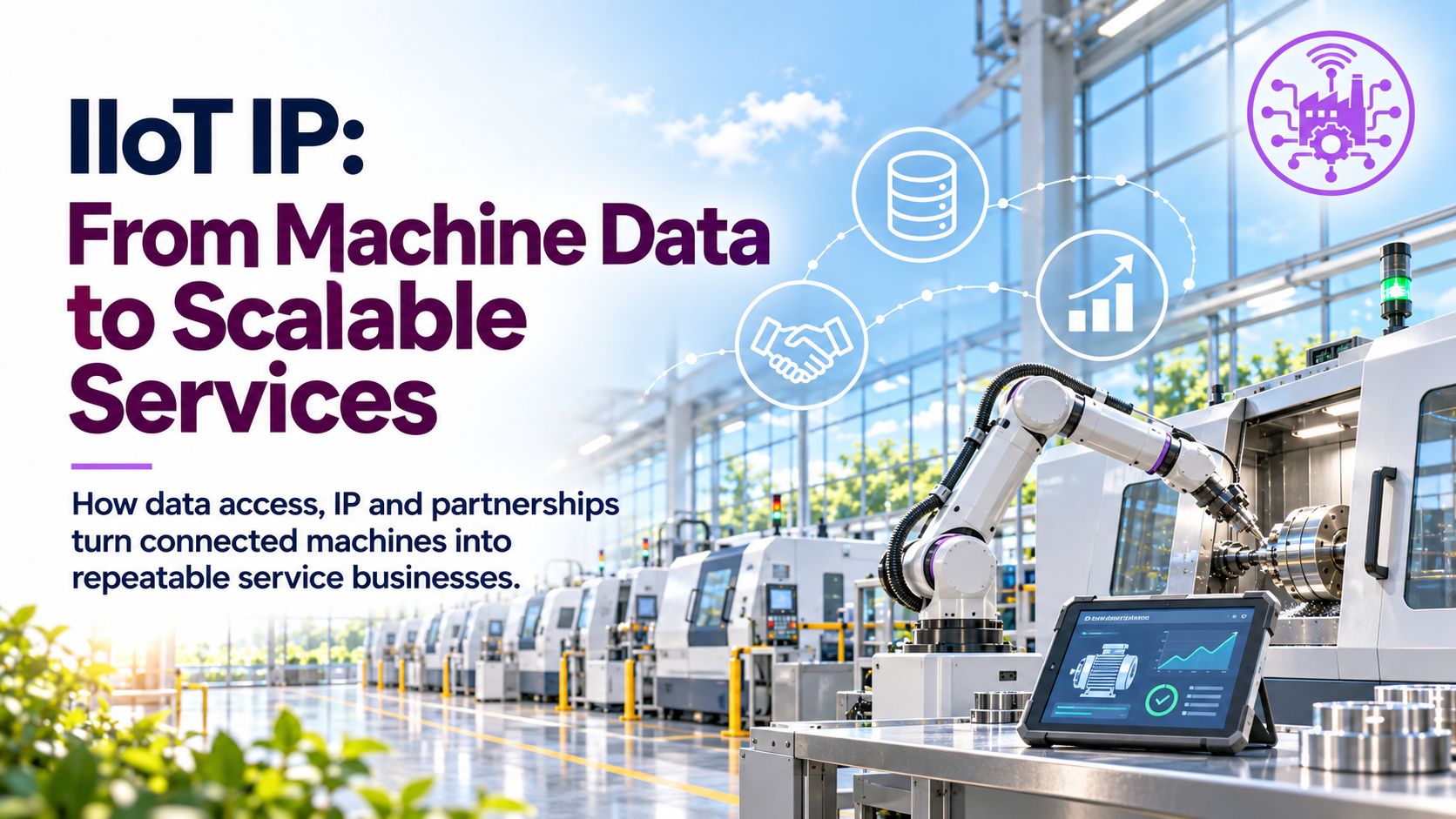
A connected machine can help its operator reduce downtime while allowing its manufacturer to develop better maintenance services. As more machines become connected, the commercial opportunity depends on how information moves between equipment suppliers, customers and service partners. Each participant needs to understand what it can access, use and contribute to the next stage of development.
Julia Kaufmann, Partner at Osborne Clarke, provides a useful starting point through the firm’s Data Act article series, to which she contributes as a co-author. The series examines the legal framework for data access and use, including the roles of data holders and users, cloud switching and the interaction with data protection law.
Two instalments are particularly relevant to Industrial IoT. Part 6, published on 26 June 2025, examines how to identify the data holder and user. Part 7, published on 2 September 2025, addresses which product and related service data qualify as readily available data for access claims. These questions open a wider management discussion. What must a company put in place so that access to machine data can support a repeatable, commercially sustainable service? Four voices from the IIoT ecosystem help develop that discussion. The IP implications below are our editorial interpretation of their published contributions.
Dimitrios Spiliopoulos and the service built around the machine
Dimitrios Spiliopoulos makes the application tangible in Maximizing the value of Smart Machines with generative AI and IoT, co-authored with Gabriel Verreault and Gary Emmerton and published in July 2025. Their examples combine operating data with manuals, maintenance histories and other information to support diagnosis, field service and fleet analysis. For a machine builder, this connects the data discussion with a customer outcome. A maintenance service can become more useful when it helps a technician understand a fault and prepare an effective repair. The service depends on several sources of information and on the ability to combine them reliably.
Our IP interpretation concerns the permissions and capabilities behind that combination. A team should establish whether its arrangements allow it to use customer operating data for the proposed service, incorporate third-party documentation and develop improvements for future deployments. These uses deserve separate consideration because the permissions required may differ. The resulting IP position may include software rights, confidential diagnostic knowledge and technical inventions. Management needs to identify which capabilities distinguish its service and ensure that its collaboration arrangements support their continued development.
Madeleine Mickeleit and the customer relationship behind digital services
Madeleine Mickeleit brings the customer’s operating environment into the discussion through her IoT Use Case podcast conversation about digital services and after sales in special-purpose machinery. Her guests, Sandra Oerter from HESS GROUP and Martin Falsner from Kontron AIS, describe the development of a customer portal connecting machine information with maintenance and service. Mickeleit draws attention to the manufacturer’s machine-specific expertise and its contribution to data analysis. The conversation gives the data-access question a practical setting. A machine builder contributes engineering knowledge, a software partner supplies platform capabilities, and the operator provides the environment in which the service must prove useful. Their contributions need to work together throughout the machine’s life.
Our IP interpretation concerns the arrangements supporting that relationship, without assuming anything about the participants’ actual contracts. Which knowledge does each partner bring? Who may use a jointly developed diagnostic function? Can implementation improvements be carried into another customer’s installation?
This extends the Osborne Clarke series’ discussion of data holders and users into service design. A leadership team should identify the participants’ legal roles and agree how the service can develop over time. That preparation helps preserve both a workable customer relationship and the supplier’s capacity to serve further customers.
Knud Lasse Lueth and the business value of integrated data
Knud Lasse Lueth adds the adoption and integration perspective in The evolution of enterprise IoT asset tracking: From locating assets to optimizing operations, published in April 2025. Drawing on IoT Analytics research, he describes the development of tracking solutions across dimensions including enterprise application integration, the intelligence provided and solution flexibility. He also identifies persistent integration challenges and a fragmented market. Although asset tracking is a different application from machine maintenance, the management connection is useful. Industrial customers need information that supports an operating decision. A supplier must understand how its service fits existing systems and what improvement makes the investment worthwhile.
Our IP inference is that protection priorities should follow the capabilities delivering that improvement. A connector, analytical method or accumulated implementation knowledge may help turn accessible data into a useful service. Teams should examine what is distinctive, what depends on third-party rights and which developments can be reused across installations. The distinction matters when considering data-access obligations. Access to product data is one element of the service proposition; integration and analytical capabilities also deserve explicit attention. Management can then explain how its IP position supports the customer’s reason to buy and the economics of repeated deployment.
Matt Hatton and the conditions for international deployment
Matt Hatton brings the deployment perspective in What does greater localisation mean for IoT delivery?, published in January 2026. His analysis describes how regulation, data governance and operational requirements influence IoT architectures, cloud choices and supplier selection across markets. This matters when an industrial service moves beyond its first customer or country. The proposed expansion may involve different infrastructure providers and requirements for where information is processed and how it can be accessed.
Our IP interpretation is that the growth plan should identify which rights and dependencies travel with the service. Can the supplier deploy its software through a different infrastructure partner? Can it move the information needed to maintain the service? What happens to access and continuity when a platform relationship ends?
These questions connect directly with the Osborne Clarke series’ treatment of cloud switching. For management, an expansion decision should include the contractual and technical work needed to support the intended deployment model. Otherwise, a service that performs well in one setting may prove difficult to reproduce economically elsewhere.
Connecting the ecosystem back to the IP decision
These perspectives connect machine data with the work required to build a scalable service. Spiliopoulos provides concrete smart-machine applications. Mickeleit’s conversation brings the customer and service partnership into focus. Lueth examines the integration needed to make data useful in operations, while Hatton brings international deployment conditions into view.
For an IIoT leadership team, a practical review can begin with six questions:
- Which customer outcome makes our connected service worth buying?
- Which data and technical capabilities are required to deliver it?
- Which legal rights and contractual permissions support each intended use?
- What must we share with partners, and how will sensitive knowledge be handled?
- Can we use developments from the first installation in subsequent deployments?
- Which infrastructure dependencies could constrain expansion or service continuity?
These questions connect with our Industry Focus Industrial IoT on the IPBA Plattform, which examines the shift from protecting individual assets towards managing control across connected industrial systems.
The Osborne Clarke series, with Julia Kaufmann as a contributing co-author, provides the legal starting point. The ecosystem perspective extends the discussion to the service proposition, industrial integration and partnerships through which data becomes useful. For machine builders and industrial operators, the shared task is to establish an IP position that supports the next deployment and preserves the capacity to keep improving the service.