Secure the Improvement Path Keeping quantum partnerships deployable as technology and licensing opportunities evolve

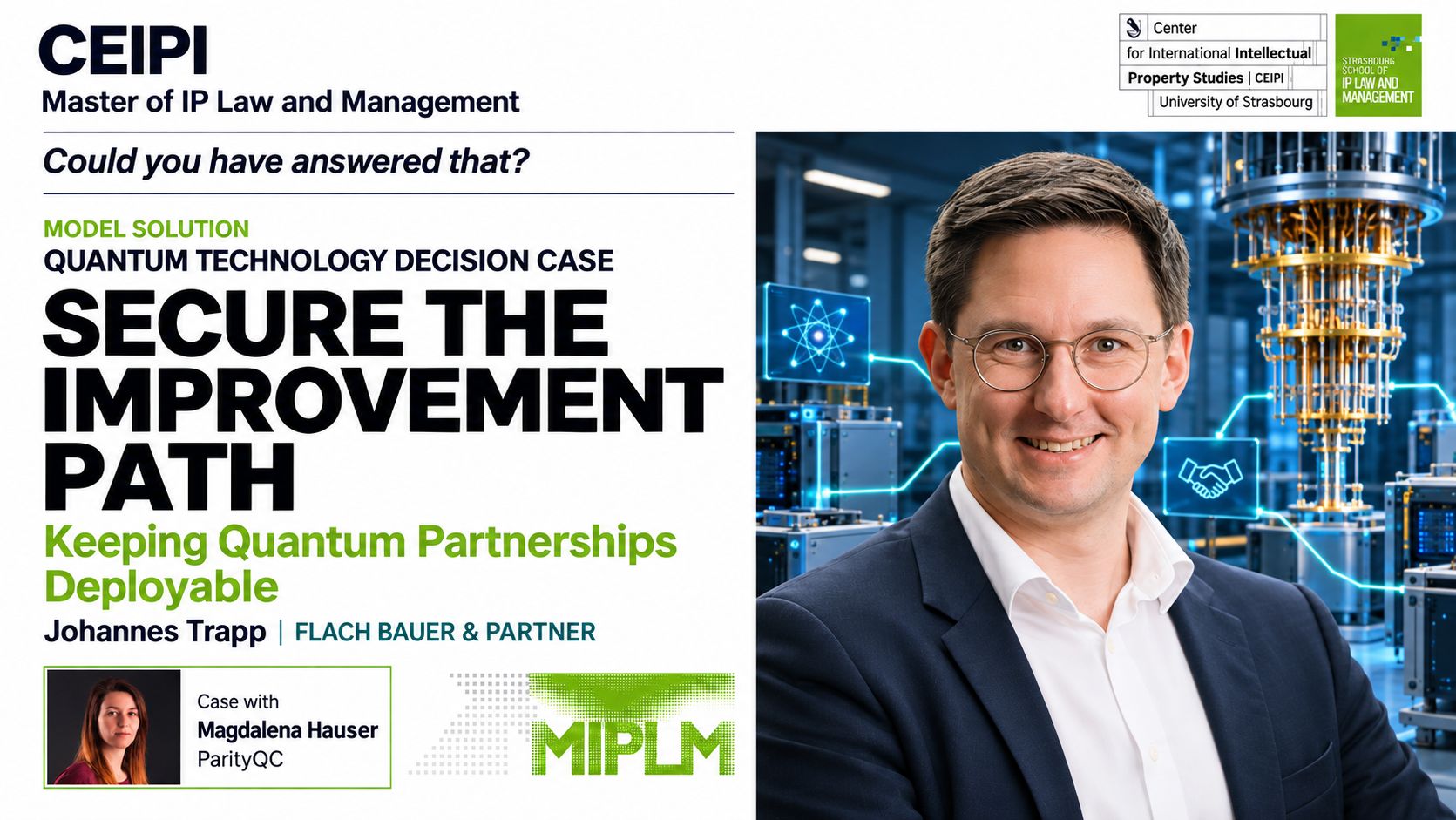
Model solution with Johannes Trapp | FLACH BAUER & PARTNER
A quantum technology partnership can solve an immediate integration problem while shaping the company’s ability to develop and license its next product generation. The decisions reach beyond the current project: which knowledge should be protected before it is shared, how should contributions be documented, and which rights must remain available when another partner joins?
In this model solution to the Decision Case with Magdalena Hauser, Johannes Trapp connects these questions with the company’s long-term objectives. His Improvement Path Review brings together technical contributions, access, improvements and continuity. It translates the strategic challenge into decisions about patent filings, confidential know-how, partner agreements and everyday information sharing.
1. Case context and central IP question
The company in the case licenses technical methods and software for implementing computational tasks on quantum hardware. New hardware environments and applications create opportunities for growth. Pursuing these opportunities requires development work with partners who contribute their own knowledge and seek rights to use the results. At the same time, the company must decide what information to disclose and how to enable subsequent licensing opportunities.
This model solution focuses on improvements developed during and after a collaboration. An integration that works today may depend tomorrow on an improved method, a modified interface or additional partner knowledge. Development planning, protection decisions and agreements should therefore address together whether the next product generation remains technically and legally deployable with further partners.
Scaling Quantum Technology Through Partnerships with Magdalena Hauser
The strategic guiding question is: Which rights and technical access must the company secure today to commercialize tomorrow’s improvements across multiple partnerships?
2. Strategic approach Secure the Improvement Path
A scalable quantum licensing business should secure a usable path from each partnership’s contributions to the deployment and commercialization of subsequent improvements.
This proposal focuses on the connection between technical progress and commercially usable rights. Each partnership should make a defined contribution to product development, enable deployment by the partner and clarify the conditions for subsequent commercialization. This allows the company to prepare negotiations for the next release and incorporate technical dependencies into its investment decisions at an early stage.
The model is called the Improvement Path Review. It comprises four dimensions: Contribution identifies the origin and boundaries of technical contributions. Access examines the access to technology and knowledge actually required. Improvement addresses rights to further developments. Continuity assesses their usability across releases, additional partnerships and the end of the agreement. Each review evaluates a specific technical change and its intended commercialization path.
Further Reading: This glossary entry explains licensing subject matter, licensing models and the significance of their terms. It develops the question of how agreed usage rights align with the intended deployment and commercialization of an improvement.
3. Application to the value creation architecture
Start with defining long-term objectives. A patent lifetime may outlast many technology cycles so the protection desired in five years’ time may differ from the one ten to fifteen years in the future.
While today’s primary business model of the quantum technology company may be more hardware focused, e.g. solving hardware engineering problems to get the software running, the long-term objective may be establishing its software as the go-to platform for the vast majority of use-cases and architectures.
Thus, right now, for the technical translation methods, customer value arises from making computational tasks implementable in a particular hardware environment. Nevertheless, in contract negotiations and IP documentation the long-term objective shall be kept in mind.
For each project, problem or improvement, the development team should document the technical constraint it addresses, the function it changes, the integrations benefiting from it, the knowledge about solutions already known to the company, and the prerequisites for using it. This way it can be ensured that an improvement relevant to several planned integrations receives early attention in protection assessments and contract negotiations.
Concerning prerequisites, a project may require or develop hardware interfaces which may also contain partner knowledge whose use outside the project is restricted. Each interface version therefore receives an assigned owner, technical documentation and an accompanying overview of rights. Before incorporating it into the general software offering – thus building on it towards the long-term objective –, the company checks whether integration is possible without the first partner’s confidential information or requires the necessary additional rights.
Further, the documentation of existing knowledge about the solution reduces the risks when contributions of the company are challenged by the partner. Patents are to be filed on this knowledge strictly before any technical information, i.e. GDSII or CAD file, is exchanged to remove any ambiguity about the origin of prior knowledge.
For securing the long-term software, the company’s knowledge on implementation, testing and integration determine how quickly another customer can put the technology into productive use, i.e. the customer’s success, and thus the added value of the software. To protect this added value, the company should distinguish information a partner needs for implementation from internal development details that are unnecessary for that purpose. Approved documentation, defined application programming interfaces and supported testing can facilitate access. This package must be sufficient in practice as missing implementation knowledge can limit the value of a formally broad licence for the partner, but should not convey any irrelevant knowledge to the partner.
Then, during partnership, the commercial context is recorded for each relevant development contribution: expected additional licensing opportunities, integration effort, required maintenance and remaining dependencies. Early assessments remain testable assumptions that need to be challenged regularly. They are updated after the first integration test, before the company commits to lasting exclusivity or additional development obligations.
Further Reading: This Research Nugget describes the ability to identify opportunities, deploy resources and adapt existing structures. It supports assessing an improvement in terms of the future integrations and business options it actually enables.
David Teece’s Dynamic Capabilities
4. Operational decision model
The Improvement Path Review takes place before technical disclosure, when accepting a significant partner contribution and before approving a new release. A shared decision sheet records the affected function, version, evidence of contributions, required rights, unresolved issues and responsible person. Its four assessments lead to the following decisions:
Contribution: Which existing and new contributions does the change require, and who created them? Development records, invention disclosures and version histories provide the evidence. Technical origins are documented separately from the contractual allocation of rights. Unclear provenance requires targeted clarification before incorporation into the licensable product.
Disputes about the origins of ideas and contributions are more difficult to resolve the further back the contribution lies. This is the point at which patent filings before the first exchange of technical information pays off. A patent application predating the partner’s involvement does not leave room for doubts. When the partner subsequently proposes a refinement to the interface, there is no ambiguity about which parts were already the company’s and which parts are the partner’s new contribution.
Access: Which activities and information are required for development, integration, operation and distribution? The review translates these activities into specific access and usage rights, including any necessary disclosure to integrators. If a required right is missing, the options are to obtain an additional licence, develop an independent alternative or adopt a solution limited to the project.
Improvement: Who may use, modify and make the improvement available to further partners? The proposed negotiating approach is a clear allocation of rights combined with the reciprocal licences each party needs. Grant-back licences have to be limited by subject matter and scope of use. They should enable the necessary subsequent use but not allow blanket access to all future inventions – this would require separate justification and assessment.
Continuity: Will the next version remain deployable if the partner changes or the agreement ends? The team simulates three situations: a second hardware partner, a new product version and the end of the original collaboration. It checks continuing usage rights, access to documentation, maintenance obligations and existing customers’ rights. Agreements covering transition services specify their scope and remuneration.
The outcome is approval, approval for an expressly limited use, or deferral pending clarification. A high revenue forecast cannot compensate for missing essential rights. Where rights are jointly owned – which should be avoided wherever possible –, approval requires explicit rules covering each party’s own use, licensing to third parties, international filings, costs, enforcement and exit. Different jurisdictions may require different rules so their effectiveness is to be assessed for the relevant jurisdictions.
Further Reading: This contribution connects IP decisions with defined development and business milestones. It supports approving an improvement once the information and rights required for its next deployment have been clarified.
5. Implementation in IP management and the portfolio
Decision and responsibilities may be shared over several roles. The development lead is responsible for documenting contributions and technical dependencies. The IP function assesses protection options, chains of title and the consequences of disclosure. Business Development defines the intended licence scope and negotiates partner rights with legal support. Management decides on significant exclusivity commitments, remaining dependencies and resource allocation. In a small company, a few people may fulfil these roles. Nevertheless, each decision still needs an accountable owner.
With these roles, a patenting decision is made and executed before each planned disclosure. The assessment connects technical patentability with expected useful life, licensing relevance, required geographical coverage and cost. If no patent is to be filed, e.g. for internal implementation details that are difficult to observe, the company also assesses whether documented secrecy measures are practicable. Knowledge requiring confidentiality is subject to restricted access, clear labelling, confidentiality agreements and rules for project completion and personnel changes.
In practice, employees receive three disclosure categories populated with concrete examples: approved information, confidential information that may be shared only with named recipients, and material requiring review before disclosure. Examples from ongoing projects, an accessible approval owner and records of information exchanges make these rules usable. New technical solutions and deviations from the agreed project scope trigger a fresh assessment.
Provide clear working rules for every engineer and business developer who meets a partner: before any technical information, presentation or sample code leaves the company, check whether the relevant knowledge or improvement is already filed, covered by an existing filing, or deliberately held as confidential know-how with a named owner and a defined recipient list. If none of the three applies, the meeting is deferred until one of them does. This keeps the Contribution and Access dimensions verifiable once one partnership becomes several.
The portfolio is reviewed against product planning quarterly. Funding prioritizes protection and access rights that support foreseeable releases and several plausible licensing opportunities. Portfolio reporting identifies the offerings these rights enable, unresolved obstacles and upcoming decision dates. Contractual commitments on updates and support are aligned with available development capacity.
Documentation for each software component is vital. The company records whether it comprises its own code, partner code or third-party software, and which licence terms apply. Open-source availability can facilitate integration once its consequences for distribution, modifications and the planned proprietary offering have been assessed. Approving an open-source interface component therefore does not determine whether other components should be published. Proprietary distribution must also comply with the terms governing incorporated third-party software.
Further Reading: This glossary entry considers IP in the context of growth and the development of scalable businesses. It supports prioritizing protection investments according to the partnerships and commercialization steps the company needs to manage next.
6. Strategic development and dependencies
A new hardware approach may change an interface’s importance and require additional rights. A larger system provider may request sublicensing or more extensive documentation. Such changes trigger a new Improvement Path Review before offers or technical commitments become binding. Existing approval applies to the documented scope of deployment.
Freedom to operate is assessed separately from securing own IP rights. The company’s own IP rights and a licence from its development partner do not establish whether other parties’ rights could obstruct the intended deployment. As searches and legal assessments are tailored to specific questions, functions, target markets and deployment dates, new technical features, another market or indications of relevant third-party rights necessitate an update – which may lead to a negative outcome.
Thus, for each significant dependency, management records a realistic alternative in advance: an additional licence, a modified implementation, another supplier or an adjustment to the offering. Cost and delay are compared with the expected business opportunity and the contribution to the long-term objective. The drawback of this alternative then provide an explicit commercial basis for negotiating partner rights if freedom to operate assessments come back negative.
The other way around, exclusivity can motivate a partner to finance an integration. The proposed starting point for granting exclusive licences is a scope limited by application, duration and agreed performance. Even though the licensed right remains formally with the company, an exclusive license drastically reduces the usability of the right, even for the company itself. Thus, continuation and reversion to non-exclusive rights are to be tied to verifiable milestones. A broader commitment requires an assessment of the licensing opportunities an exclusive licence restricts, the restriction of the exclusive licence to the company itself and corresponding consideration.
Further Reading: This contribution explains the importance of assessing third-party IP rights for the intended commercial use of technology. It complements the contractual rights review by addressing potential obstacles originating outside the partnership.
7. Practical decision overview
The overview translates the proposal into typical decision situations arising in the case. Each approval concerns a defined subject matter and scope of use; subsequent changes remain subject to review.
| Subject matter | Proposed decision | Conditions for approval |
| Technical improvements | File for protection before disclosure; secure rights for further integrations. | Contribution and technical effect documented; required partner rights agreed. |
| Hardware interface | Agree implementation access; separately assess broader reuse. | Version, confidential content and permitted recipients defined. |
| Jointly developed result | Negotiate clear ownership with the reciprocal licences required. Avoid shared ownership | Third-party licensing and further development covered; governance agreed for joint rights. |
| Software component for open-source release | Decide on openness after assessing integration benefits and licence implications. | Component provenance and terms compatible with the distribution model. |
| Unpublished integration knowledge | Provide purpose-specific access with appropriate confidentiality measures. | Partner can integrate; access, disclosure and return of information are governed. |
| Next release after project completion | Review continuing rights and committed maintenance before approval. | Rights, knowledge and resources available for the intended deployment. |
The combination of instruments depends on the intended deployment. A patent may secure a technical position, while licensing agreements, access controls and confidential documentation support practical collaboration. Each measure is therefore linked to its specific contribution to approving the next deployment.
Further Reading: This contribution describes the coordinated use of several protection instruments. It supports assigning IP rights, contracts and organizational measures to the different subject matters in the decision overview.
8. Outcome and ongoing governance
Secure the Improvement Path proposes linking each significant improvement to a traceable commercialization path. Contribution, Access, Improvement and Continuity connect technical origins, required uses and future deployment opportunities. The approval decision thereby becomes part of development and licensing work.
Ongoing governance monitors unresolved rights issues before releases, the effort required for additional integrations and instances where contractual terms prevent a new licence. A review investigates the causes and adapts contract clauses, approval rules and portfolio decisions. Management receives a concise overview of the principal obstacles and the measures intended to resolve them.
The intended outcome is a more predictable licensing offering: partners receive defined opportunities for integration and further development, while the company can prepare additional collaborations and direct investment towards technical positions it can actually use. Actual integrations and licensing decisions are used to assess whether this outcome is achieved.
Further Reading: This contribution describes embedding IP strategy in the organization through responsibilities and recurring decisions. It develops the transition from the Improvement Path Review to sustainable routines connecting development, sales and IP management.
From Strategy Project to Organisational Capability: Rolling Out Modern IP Strategy
Which improvements can the company deploy with its next partner, and what must it secure today to make that possible?
About Johannes Trapp
 Johannes Trapp is a German patent attorney, European Patent Attorney and European Trademark & Design Attorney, and has been a partner at FLACH BAUER & PARTNER in Rosenheim since 2021. He holds a Diplom degree in physics and studied at the Technical University of Munich and the University of Auckland, with a diploma thesis focused on laser physics and quantum information processing. He subsequently worked in Professor Theodor W. Hänsch’s group at Ludwig Maximilian University of Munich on plasmonic optical waveguides, including microfabrication, nanofabrication and experimental investigation. Before joining FLACH BAUER & PARTNER, he worked at Prinz & Partner in Munich, most recently as a partner.
His technical practice covers physics and quantum optics, software and control algorithms, electrical engineering and communications technology. His work includes patent applications and patent proceedings, licensing strategies and advice on IP processes. He supports internationally active companies, medium-sized businesses and start-ups in building and maintaining patent portfolios, accompanying innovations from the period before disclosure through patent grant and infringement proceedings. This combination of technical and IP experience connects closely with the challenges of protecting development contributions, structuring technology partnerships and supporting the commercialization of quantum technologies.