Turning UPC Case Law into Litigation Strategy with Tilman Müller-Stoy

When someone asks Prof. Dr. Tilman Müller-Stoy what he does for a living, he sometimes describes himself as a translator. In a patent hearing, he has to explain how a technology works in terms that help a judge decide a legal question. A colleague may then describe the same mechanism in the language an engineer would use. Both accounts have to hold up when the bench starts asking questions.
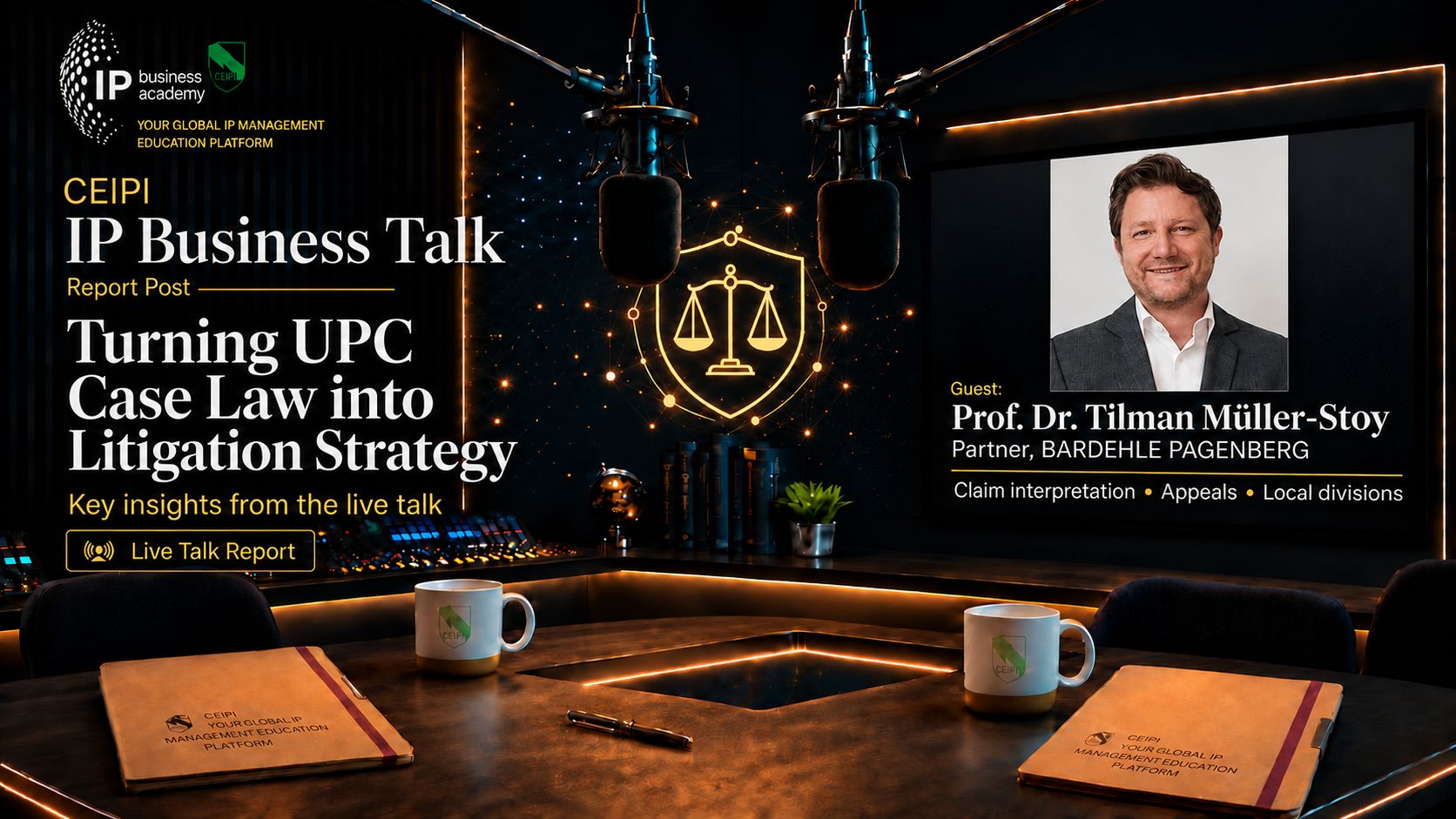
In the CEIPI IP Business Talk on 25 November 2026, Prof. Dr. Alexander J. Wurzer spoke with Prof. Dr. Tilman Müller-Stoy of BARDEHLE PAGENBERG about the choices facing companies as the Unified Patent Court (UPC) develops its own case law. Some of those choices arise years before a hearing, when a company decides where to file a patent or which markets it would need to defend.
Where the UPC is finding its own voice
Müller-Stoy traced his interest in the court to a mismatch he encountered early in practice. A licensing negotiation could cover the world, while enforcing the patents behind it meant going to court country by country. Long before the UPC opened, he and colleagues in Munich brought judges and practitioners together to work through mock cases. Even a shared set of rules left room for different answers to familiar questions.
That experience informed his answer to Wurzer’s first question. Yes, the UPC has developed a recognisable approach of its own. He pointed to the early appeal involving 10x Genomics and NanoString as a reference point for claim interpretation. On added matter, practitioners will recognise the European Patent Office’s test of what the original application discloses directly and unambiguously. The wording may be familiar. The harder question is how the judges apply it to a particular passage, drawing or combination of features.
What an inventive step argument has to explain
An audience member asked what happens to the discipline of the EPO’s problem-solution approach when the UPC assesses inventive step more holistically. Working through the distinguishing features, their technical effect and the resulting problem makes the reasoning visible. How can a reader scrutinise a judgment if those steps are less explicit?
Müller-Stoy answered by looking at the work of each institution. The EPO examines large numbers of applications and needs a method that examiners can apply consistently. A court hears far fewer disputes, with parties arguing over the technical facts of a particular case. For the company drafting an application, both settings matter. Years after grant, someone may have to explain to a panel why a particular feature made a technical difference.
The first pleading already shapes the appeal
Wurzer asked how a team should prepare when it suspects that the decisive question will reach the Court of Appeal. Müller-Stoy started with the timing of the evidence. UPC proceedings are front-loaded. A party that holds back a technical fact or a line of argument risks being too late to introduce it when it needs it. The practical task is to identify early what the court would need to accept for the company to win.
He used infringement by equivalence to illustrate the point. Where the UPC has given limited guidance on the precise issue, counsel can compare how national courts have approached it. The comparison earns its place in the pleading when it explains why one answer fits the patent and the facts before the panel. A list of national decisions leaves that work to the judges.
A smaller company may be on either side of the dispute
Wurzer challenged the economics of that preparation. If a well-resourced company can develop several arguments and coordinate proceedings across courts, what does the system offer an SME? Müller-Stoy drew a distinction between businesses with different markets. A manufacturer selling in three countries may see little value in broader coverage. A specialist supplier building a licensing programme across Europe has a different calculation, even if the two companies have the same headcount.
The more uncomfortable question arises on the receiving end. A company can choose how widely to seek patents. A competitor can still bring a UPC action against it. An injunction reaching several of its markets could disrupt customer supply while management is still working out who understands the accused product. Müller-Stoy’s advice was to establish contact with outside counsel and know which people inside the business can answer technical questions before the short response timetable starts.
Why the oral hearing can still change the case
A written submission gives a team time to refine an analogy. At the hearing, a technically qualified judge can immediately ask where it breaks down. Müller-Stoy described working alongside a colleague who can explain the engineering in its own terms while he connects it to the disputed claim feature. A useful test in rehearsal is whether both can answer the same follow-up question and arrive at the same technical account.
In his experience, even a preliminary indication from the bench leaves room for oral argument to influence the outcome. That is where the translator’s job becomes most demanding. If the explanation omits the detail on which infringement turns, making it easier to follow has cost it its value.
What the choice of local division signals
The final question concerned the concentration of cases in a few local divisions. Müller-Stoy understood the concern of participating states that fund a division and see relatively few cases. The court’s European character matters to its users, too. He cited his own experience appearing in Paris and The Hague and saw scope for experienced judges to sit in less frequently used divisions. He expected filing patterns to broaden as practitioners gained experience across venues.
For a company choosing among divisions with jurisdiction, he was sceptical of labels such as “patentee-friendly”. Counsel cannot select the panel assigned to the case. Management can decide which markets matter, what outcome would justify bringing proceedings and whether the team can prove the point on which that outcome depends.
Explore the Industry Focus on the Unified Patent Court in the Digital IP Lexicon (dIPlex), including The Emerging Strategy Gap in the UPC Market.
About Prof. Dr. Tilman Müller-Stoy
 Tilman Müller-Stoy is a Munich-based partner at BARDEHLE PAGENBERG and a representative before the UPC. He has handled several hundred patent disputes and regularly coordinates European proceedings for clients involved in multinational litigation.
An honorary professor of patent law at the Technical University of Munich and a trained commercial mediator, he also advises on licensing programmes, technology transfer and disputes over standard-essential patents. His work spans sectors including telecommunications, automotive technology and life sciences.