Keeping Biotech Platform Improvements Available for Future Growth with Dr. Reyk Horland

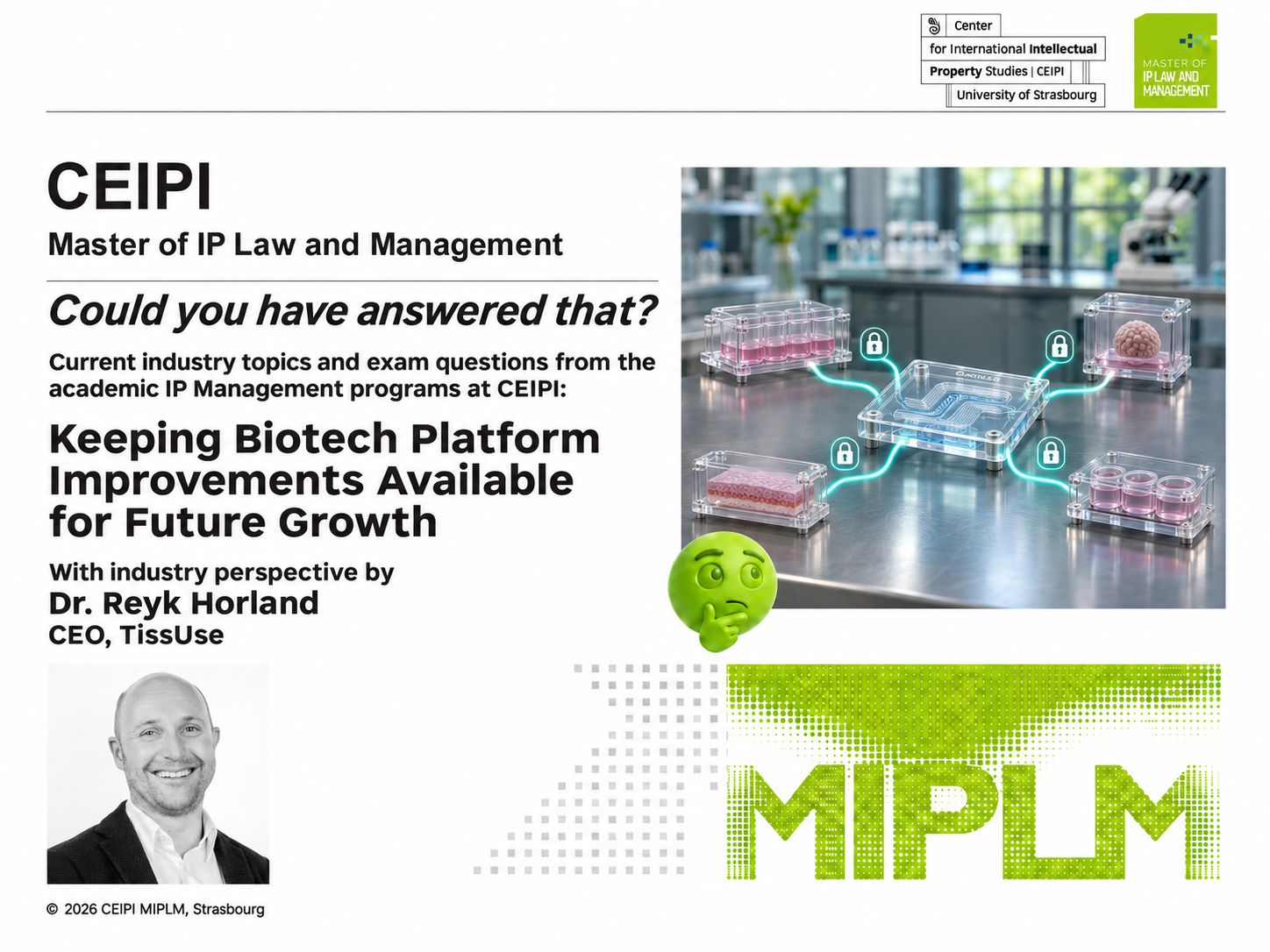
Biotechnology platforms grow through use. A development project can solve a customer’s immediate problem while generating methods, technical know-how or improvements that are valuable in other applications. For the platform provider, the commercial question extends beyond successful delivery: can what the company learns also support its next customer, product or partnership?
This creates a recurring IP management task. Companies need to distinguish application-specific results from improvements to their underlying technology, define the rights available to partners and decide which developments should be patented or kept confidential. These decisions connect the economics of individual projects with the longer-term development of the platform.
Practice-based questions at the CEIPI IP Business Academy allow future IP managers to examine these choices in a business setting. We are pleased to present this practical question with Dr Reyk Horland, CEO of TissUse. He reviewed the question and confirmed that it closely reflects the company’s day-to-day experience.
Reyk Horland explains its practical relevance in the following statement, translated from German:
“At TissUse, we regularly find that an improvement arising from a specific customer project is also valuable for other applications. We therefore specify in the collaboration agreement which usage rights the partner receives for its application and that the rights to all improvements to the platform technology contributed by us belong to TissUse.”
His statement illustrates an established approach to allocating rights. The following fictional mini case study abstracts the underlying management challenge for teaching.
Mini Case Study
A biotechnology company develops a platform used by customers and research partners for different applications. Its business model combines access to existing technology with development services for specific projects. These collaborations generate new methods, technical know-how and improvements to the platform.
Some results are closely tied to an individual customer’s application. Others improve the platform’s overall performance or create opportunities in additional markets. Their wider commercial relevance may only become apparent during development or subsequent use.
In the fictional case, an ongoing collaboration produces an improvement that serves the agreed project objective and also appears useful for other customers. The partner requests exclusive use of the results in its business field. A decision about sharing or publishing technical information is also approaching. Management must coordinate future reuse, possible patent applications and the treatment of confidential knowledge before making commitments.
Practical Question
How should the company organise its IP decisions and processes so that it systematically identifies commercially relevant improvements arising from collaborations, establishes appropriate exclusive positions and retains the ability to use them in future applications while providing partners with reliable usage rights?
Develop a reasoned approach that can be implemented with limited personnel. In your answer, consider the following four areas:
- Distinguish existing platform technology, project-specific results and improvements that can be reused more broadly. What information about their origin, the people involved and existing agreements is needed to support decisions?
- Develop criteria for patenting, confidentiality and publication. Consider commercial relevance, the ability to identify use by third parties, practical enforceability and the loss of secrecy associated with disclosure.
- Compare options for responding to the partner’s request for exclusivity. How do the field of use, duration and rights to improvements affect the collaboration and the company’s ability to commercialise its platform elsewhere?
- Define responsibilities and decision points before a project starts, during development and before results are shared. How can a standards-oriented IP management approach support these processes and make their effectiveness reviewable?
Conclude by identifying which decision should be prepared first in the case and what additional information is required. State any assumptions explicitly. The task is to develop a management concept; a specific patent examination or detailed contract drafting exercise is outside its scope.
Why This Question Matters in Practice
The economic value of a platform depends partly on the ability to carry learning from one application into the next. A project can generate revenue today and capabilities that support future business. Decisions about rights to improvements therefore affect how much of that wider value the platform provider can realise.
Contractual allocation provides a foundation, while operational processes make it usable. Teams need to recognise when an improvement has emerged, document how it relates to the existing platform and involve the right decision-makers before information is disclosed or rights are promised. The exercise asks students to connect these activities rather than treat them as isolated tasks.
Patent and confidentiality decisions also require a commercial perspective. A technically interesting improvement may be difficult to detect in another party’s process, while publishing it could reveal knowledge that contributes to competitive differentiation. Students must justify a coherent choice in light of future applications, partner needs and the company’s capacity to manage its IP.
A standards-oriented approach provides a framework for responsibilities, records and review. Its practical contribution is to make these decisions consistent as the number of projects and partners grows, while keeping the process proportionate to the business.
Accompanying Lecture
This practical question belongs to the CEIPI lecture IP Management for Biotechnological Platforms and Collaborations. The lecture provides the conceptual and managerial foundation for the case through three themes:
- Identifying reusable improvements and choosing appropriate patent, confidentiality and disclosure strategies.
- Structuring usage rights across existing platform technology, collaboration results and subsequent improvements.
- Embedding IP decisions in standards-oriented processes with clear responsibilities, decision points and documentation.
Participants learn to connect patent portfolios, confidential know-how and contractual usage rights with platform development. The objective is an implementable approach that enables repeatable decisions across different projects and applications.
About Dr Reyk Horland
 Dr Reyk Horland is CEO of TissUse, a Berlin-based biotechnology company developing Multi-Organ-Chip systems for applications in drug development and substance testing. He was appointed CEO in October 2020 after eight years leading Business Development. He has been involved in the commercial development of the company since 2010 and led the market launch of its HUMIMIC technology in 2014. His work connects platform development with international partnerships and commercial applications.
He studied Biotechnology at Technische Universität Berlin, specialising in medical biotechnology, and worked on tissue engineering programmes with a focus on commercialisation. His experience spans scientific development, marketing and sales, and relationships with pharmaceutical and consumer product companies, research institutions and regulatory authorities. His contribution to this case brings the perspective of a platform provider that must combine dependable customer