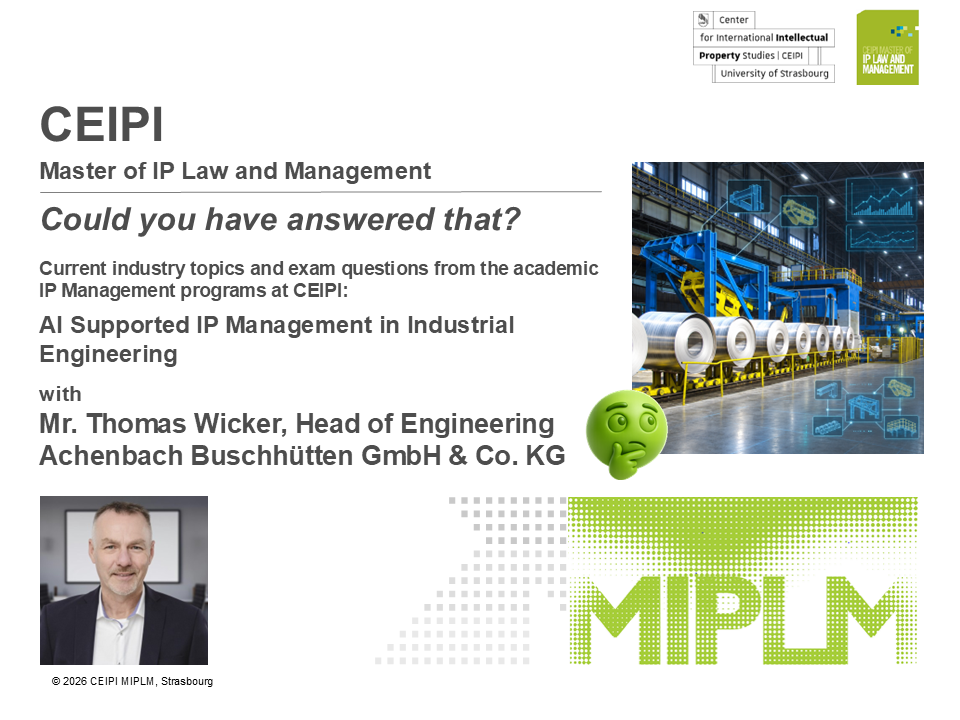
Practical Question: AI Supported IP Management in Industrial Engineering with Thomas Wicker

Industrial machinery and plant engineering companies generate valuable technical knowledge throughout their daily project work. A design modification, an improved control routine or a solution developed during commissioning may have considerable potential for future applications. Recognizing that potential early enough to protect and reuse it is a central challenge for IP management.
In complex production systems, competitive advantage emerges from the interaction of mechanical engineering, automation software, process know-how, industrial data and practical experience. Knowledge is distributed across departments, documents and individual specialists. Solutions developed for one customer can become relevant to an entire product platform, while their wider economic significance may initially remain difficult to recognize.
Artificial intelligence opens up opportunities to make this distributed knowledge more accessible. By examining engineering and project information, AI could help identify potential IP candidates, cluster related developments and support their initial prioritization. This raises a practical management question: how can these capabilities be integrated into a process that produces reliable, timely decisions with an appropriate level of effort?
Such a process needs to connect technical findings with business objectives and expert judgment. The value of a candidate depends on its contribution to customer outcomes, its relevance across future projects and the available options for protection. Engineers, business owners and IP experts therefore need clear responsibilities for validating AI recommendations and deciding how individual developments should be handled.
The connection to standardization and reuse is particularly important. Once a promising solution has been identified, the company needs to determine how it can become available for further projects, which knowledge requires confidentiality and how customer or partner arrangements affect its use. These decisions must fit the pace of project delivery and support the open interfaces required for industrial integration.
Against this background, the CEIPI IP Business Academy brings practical questions from industry into its teaching. Students examine how IP management can support business decisions where engineering, digital technologies and organizational processes meet. The aim is to develop approaches that remain workable under the constraints of everyday industrial operations.
We are therefore pleased to include this practical question contributed by Thomas Wicker of Achenbach Buschhütten. His case explores how an internationally active machinery and plant engineering company can use AI within a lightweight IP process to identify, evaluate, protect and reuse valuable innovations.
The proposed framework follows five stages: Identify, Evaluate, Decide, Protect and Reuse. It invites students to consider how AI-supported analysis can inform human decisions on protection strategy, and how those decisions can strengthen the company’s reusable technology base while supporting fast project execution.
Mini Case Study
An internationally active industrial engineering company develops and modernizes complex production plants for non-ferrous metals. Its offering combines precision machinery, drives and hydraulics, model-based automation, process engineering, media systems and a cloud platform that links data across multiple stages of production. Customers expect complete plants, individual machines, modernization of existing equipment and lifecycle support. The company’s competitive advantage therefore emerges from the precise interaction of physical equipment, control models, process parameters, digital applications and decades of engineering experience.
New technical solutions arise in many places: during platform and product development, customer-specific engineering, commissioning, retrofit projects, service analysis and work with suppliers. Some are visible in a delivered machine and can be reverse-engineered. Others remain embedded in control software, simulation models, parameter sets, diagnostic methods or the experience required to achieve specific quality, productivity and energy outcomes. A project-specific solution may later become reusable across other plants, even when its strategic relevance was not obvious at the moment it was created.
Management now wants a lightweight IP process that uses AI to automatically identify and cluster potentially protectable and reusable innovations across design engineering, automation software, process know-how, industrial data and customer-specific engineering. AI should support an initial assessment and prioritization of their economic, strategic and legal potential. Engineers, business owners and IP experts must then validate the candidates and decide on the appropriate protection strategy. The process must distinguish reusable core technology from customer-specific adaptations and jointly developed improvements, while connecting protection with standardization and reuse in subsequent projects.
The challenge is to capture these opportunities within everyday project work. If the process is too complex, project teams will bypass it. If it focuses only on isolated inventions, the company may leave economically important system architectures exposed. AI support therefore needs to fit existing workflows and preserve confidential knowledge, open interfaces and fast project execution.
Practical Question
How should an internationally active machinery and plant engineering company design a lightweight IP process that uses AI to automatically identify, cluster and prioritize potentially protectable and reusable innovations in design engineering, automation software, process know-how, industrial data and engineering according to their economic, strategic and legal potential? How can this process then be connected to patent and know-how protection, standardization and reuse in project business without impairing open interfaces and fast project execution?
Process Framework to Be Developed
The case follows five stages. AI supports identification and evaluation; people and IP experts retain responsibility for the protection strategy. The practical task is to define how these stages work together with minimal administrative effort.
1 . Identify: AI identifies potential IP candidates in engineering and project information and clusters related solutions across machines, software, processes and data.
2 . Evaluate: AI supports assessment and prioritization according to economic value, strategic relevance, reuse potential and preliminary legal indicators. Experts validate the underlying evidence and legal assessment.
3 . Decide: The responsible business and technical teams, together with IP experts, decide which candidates to pursue and which protection strategy fits the business objectives.
4 . Protect: The company implements the chosen measures for inventions, know-how, software and data, including patent protection, confidentiality, access controls and contractual arrangements as appropriate.
5 . Reuse: Protected solutions and knowledge are made available for subsequent projects through standardized modules, documented know-how and defined rights of use. Experience from reuse feeds back into identification and evaluation.
Why This Question Matters in Practice
This question becomes relevant when a manufacturing company evolves from supplying stand-alone machines to delivering integrated production systems and data-enabled lifecycle services. Competitive advantage is distributed across several technical and organizational layers. AI could help make project knowledge visible and connect related developments across teams. The process must establish how reliably candidates can be detected and assessed before deadlines, disclosures or contractual commitments restrict the available protection options.
It matters especially for medium-sized machinery and plant engineering companies, automation providers, industrial software businesses and technology suppliers whose innovations emerge inside customer projects. These companies often operate without large IP teams. Developers, project managers, service engineers and external patent counsel need a shared process with clear responsibilities, traceable AI recommendations and proportionate expert review.
The issue becomes critical when the same knowledge can serve new-machine business, modernizations, spare parts, software updates and recurring digital services over several decades. A useful IP process connects AI-supported identification and prioritization with protection decisions, customer and partner governance, competitor monitoring and portfolio review. Standardization and reuse must be considered throughout, so that industrial intelligence can create value across projects while supporting open interfaces and long equipment lifecycles.
Here you will find the lecture “AI Supported IP Management in Industrial Engineering” regarding this exam question:
Thomas Wicker
 Thomas Wicker is a graduate mechanical engineer with extensive leadership experience in machinery, industrial automation and automotive production. He joined Achenbach Buschhütten in September 2022 as Head of Operations. His responsibilities have included production planning and control, manufacturing, assembly, intralogistics and shipping, together with the optimization of manufacturing processes for rolling mills and slitting equipment. His work also covers production data analysis, operational efficiency and team development.
Before joining Achenbach, Thomas served as Technical Director at EKRA Automatisierungssysteme, overseeing product management, mechanical and electrical design, and software development. Earlier roles included technical leadership in automotive robotics at FANUC Deutschland, project management leadership at GEDIA, project purchasing at Heinrich Georg and design engineering leadership at Karl Fischer Maschinenbau. He studied mechanical engineering with a focus on design engineering at Märkische Fachhochschule Iserlohn and subsequently completed part-time studies in project management at FH Gießen-Friedberg.