
IP Decision Case: Ian Goodyer. GreenTech IP Funding Readiness

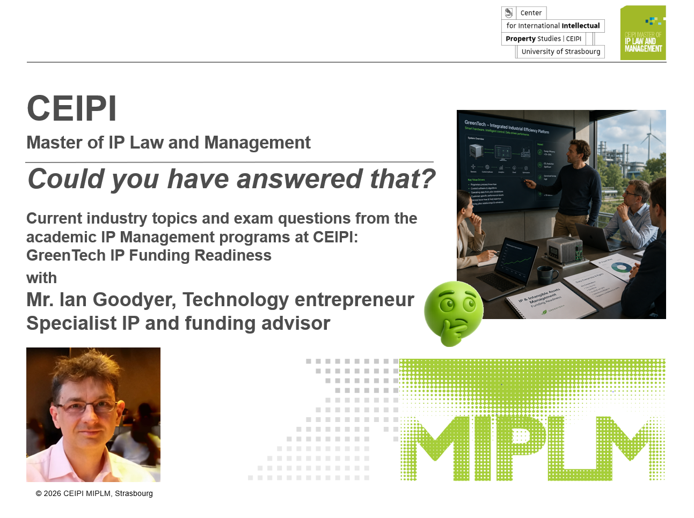
GreenTech is increasingly becoming a question of funding readiness. In many sustainable technology fields, value is no longer created only by a protected invention, a successful prototype or a promising pilot installation. It is created by the way patents, software, trade secrets, operating data, customer evidence, contractual rights and market credibility are combined into an investable business position.
This creates a demanding strategic challenge for GreenTech scaleups. An industrial energy efficiency platform may be highly valuable because it combines smart hardware, proprietary process parameters, control software, field data and service know-how into a solution that can reduce energy consumption in real industrial environments. Yet the same development path that makes the company attractive for investors, customers and industrial partners also creates pressure to disclose information, share technical knowledge, open data rooms and explain the value architecture before all ownership, access and use rights have been fully clarified.
This is exactly the type of shift described in the CEIPI IP Business Academy analysis “The GreenTech Strategy Gap”. The study shows that GreenTech companies increasingly operate in layered transition systems where IP strategy must connect patents, trade secrets, software, data, collaboration models, customer relationships, supply-chain position and market access into one coherent strategic architecture.
Here you find the findings of this study: “The GreenTech Strategy Gap: What Sustainable Innovation Companies Need, and What IP Advice Still Often Fails to Integrate”
Against this background, the CEIPI IP Business Academy integrates practice based questions from industry into its teaching. These questions help students understand IP not only as a legal protection tool, but as a management instrument for strategic decision making in complex innovation systems.
We are therefore pleased to include this industry case study with Ian Goodyer. His practical question focuses on a central issue for GreenTech companies approaching a financing round: how to make the full intangible asset base visible, structured and credible before investors ask what the company truly owns, what can be defended, what can be scaled through partners and what may become a legal or commercial weakness during due diligence.
The case shows that asset transparency is not an optional exercise. Trade secrets, software ownership and data rights must be understood before a company can present a convincing funding story. An IP valuation may be useful, especially where equity or debt funding is being considered, but the more fundamental task is to know where the company stands and whether its valuable knowledge assets are actually under control.
Decision Context
A GreenTech scaleup has developed an integrated technology platform for industrial energy efficiency. The solution combines a physical device, proprietary process parameters, control software, operating data from pilot installations, service know how, early customer references and a growing reputation in a specific industrial niche. The technical results are promising, but the company is approaching a financing round in which investors will not only ask whether the technology works. They will ask what the company truly owns, what can be defended, what can be scaled through partners and what remains valuable if competitors enter the same field.
The management team already holds a small patent portfolio, but the patent position is only one part of the company’s asset picture. The company also depends on confidential methods, software code, accumulated data, pilot relationships, contractual rights, reputation and market specific knowledge. None of these assets is fully investor ready yet. Some may be well controlled, some may be poorly documented and some may carry hidden restrictions that only become visible during investor due diligence.
The immediate challenge is therefore not simply to decide whether to file more patents. The company must first establish a reliable understanding of its full intangible asset base. It needs to know what it owns, what it can use, what it must keep confidential, what third parties may claim and what evidence is available to show that these assets have been managed properly.
The Baseline That Is Not Optional
A basic asset transparency exercise is not a strategic luxury in this situation. Before a funding round, the company must understand its trade secrets, the ownership of its software code and the restrictions attached to its data. Without that understanding, management cannot credibly explain the company’s value position and cannot reliably manage legal, operational or investor risk.
For trade secrets, the company must identify the confidential methods, process parameters, service know how and operational insights that create advantage. It must also document who knows them, how access is controlled, what information has been shared with customers, suppliers, contractors and investors and whether appropriate confidentiality measures were in place. This is not only a governance matter. Since the EU Trade Secrets Directive 2016/943, enforceability depends in practice on showing that reasonable steps were taken to keep information secret.
For software, the company must clarify whether the code and related documentation are actually owned by the company. If external developers, consultants or former employees contributed to the code, the company needs evidence of assignments, contractual rights and confidentiality obligations. A single unclear development relationship can become a serious due diligence issue if investors discover that critical software was created without clean ownership or adequate secrecy protection.
For data, the company must understand where the data came from, who has rights in it, what contractual restrictions apply and whether regulatory requirements such as GDPR limit its use. Pilot installation data, customer performance data and aggregated operating data may be central to future value creation, but only if access, use, aggregation and disclosure are legally and commercially clear.
The Real Decision
The real management decision is therefore not whether the company should investigate these assets at all. It must. The decision is how structured, how deep and how investor oriented the funding readiness work should be before the financing round.
The company can limit itself to a minimum risk clarification exercise that identifies the most urgent gaps in trade secret protection, software ownership and data rights. This may reduce immediate cost and preserve speed, but it may leave the company with a fragmented funding story and unresolved questions in due diligence.
Alternatively, the company can build a structured IP funding readiness package. This would include a portfolio review, a trade secret register, documentation of software ownership, mapping of data rights and restrictions, clarification of customer and partner rights, a disclosure strategy for investors and a clear explanation of how IP supports scaling, licensing, collaboration and market access. An IP valuation can be added as an optional component where it helps to support equity or debt funding, but valuation should not be confused with the more basic need to understand and control the assets.
Why This Decision Is Difficult
The tension is real. A broader patent strategy may make the company more visible and easier to assess, but it may also disclose technical pathways that are difficult to protect once industrial partners understand them. A stronger trade secret strategy may preserve process advantage, but it requires careful documentation, access control and disclosure discipline. Data control may become a major value source, but only if rights, access, use and aggregation are contractually clear.
The company also faces a timing problem. A financing round creates pressure to present a convincing story quickly, while a proper asset review may reveal weaknesses that require mitigation. For example, a contractor may have accessed confidential code without signing an NDA, or pilot data may be subject to customer use restrictions. It is better to discover these issues before investor discussions than to have them exposed by an investor question during due diligence.
The decision also affects enforcement and bargaining power. A portfolio that protects only the physical device may leave competitors free to copy the service model, the operating logic or the data based optimization layer. A secrecy heavy strategy may be difficult to enforce if the company cannot show what the secrets were, who knew them and how they were protected. Too much disclosure can weaken future control. Too little structure can weaken investor trust.
The long term consequence is strategic positioning. If the company presents IP as a short list of patent filings, investors may see a technically interesting but commercially uncertain venture. If it presents IP as an integrated control architecture, investors can understand how the company intends to hold value while scaling through partners, customers and future market access routes.
Practitioner Perspective
From a practitioner perspective inspired by Ian Goodyer’s background, the decisive question is how intangible assets become usable for business decisions. Patents matter, but they are only one part of the asset picture. In a GreenTech funding context, customer data, technical know how, pilot evidence, software, trade secrets, partner contracts, reputation and market specific knowledge may all contribute to enterprise value.
The practical task is therefore to identify, classify and explain these assets in a way that investors, lenders, partners and management can understand. The starting point is asset transparency. The company must know where it stands before it can decide how to protect, disclose, value or use its assets strategically.
This is particularly important for trade secrets. A company cannot enforce a trade secret position merely by saying that important information was confidential. It must be able to show that the information was identified as secret, that access was controlled and that reasonable measures were taken to protect it. A trade secret register, access records and clear confidentiality processes can therefore create legal and commercial value, not merely administrative order.
The same logic applies to software and data. Clean software ownership and clear data use rights are not technical details at the edge of the funding story. They determine whether the company can scale the platform, license parts of it, collaborate with industrial partners and answer investor questions without creating uncertainty around its own core assets.
The Decision Question
How should the company structure its intangible asset base before the financing round so that trade secrets, software ownership, data rights, contracts, customer relationships, reputation and patents become a credible and defensible funding position?
The minimum requirement is to clarify the essential asset position and mitigate immediate risks before investor discussions. The stronger strategic option is to build an investor ready IP control architecture that explains how the company owns, protects and uses its intangible assets to support funding, licensing, collaboration and scalable market access. IP valuation may strengthen that package, especially for equity or debt funding, but it is the optional component. Asset transparency and control are not optional.
Implication for IP Management Education
This case shows why GreenTech IP management cannot be taught as a sequence of isolated legal instruments. The relevant management decision is about where economic control is located and how that control can be made credible under uncertainty.
For IP management education, the case highlights a core competence: translating a complex asset base into an investment ready strategic position. Students must learn to assess patents together with trade secrets, software ownership, data rights, contracts, customer relationships, reputation and business model design. The educational value lies in understanding that funding readiness is not a cosmetic due diligence exercise. It is a strategic IP management process that determines whether a GreenTech company can convert technical promise into investable, scalable and defensible market value.
Ian Goodyer
 Ian Goodyer is a technology entrepreneur, specialist IP and funding advisor, and Head of IP Services at Inngot. His work focuses on intellectual property strategy, intangible asset valuation and the practical use of knowledge assets for business growth, funding and licensing. At Inngot, he supports companies and universities in identifying, classifying, protecting and valuing intangible assets, including patents, trademarks, copyright, customer data, websites, reputation and other under-recognised sources of enterprise value. His experience includes IP research, international IP consulting, intellectual property assessment, business development and training, with projects ranging from university technology valuation and biotech assessments to patent portfolio analysis for major engineering companies.
Ian also brings a strong background in technology commercialisation and scientific entrepreneurship. He is Director of ZiNIR Ltd, a scientific consultancy specialising in photonics, and Business Advisor at Reydoog Consultancy Services, where he supports businesses with business planning, fund raising, IP guidance and commercialisation of new ideas. Earlier in his career, he worked in research and product development at Amersham Biosciences, now GE Healthcare, and held postdoctoral research roles at the Wellcome Trust Centre for Human Genetics at the University of Oxford and Thomas Jefferson University. He holds a PhD in Parasitology and Molecular Cell Biology from the University of Bath, an MBA from Henley Business School and a PGCert in Intellectual Property Law from Brunel University.