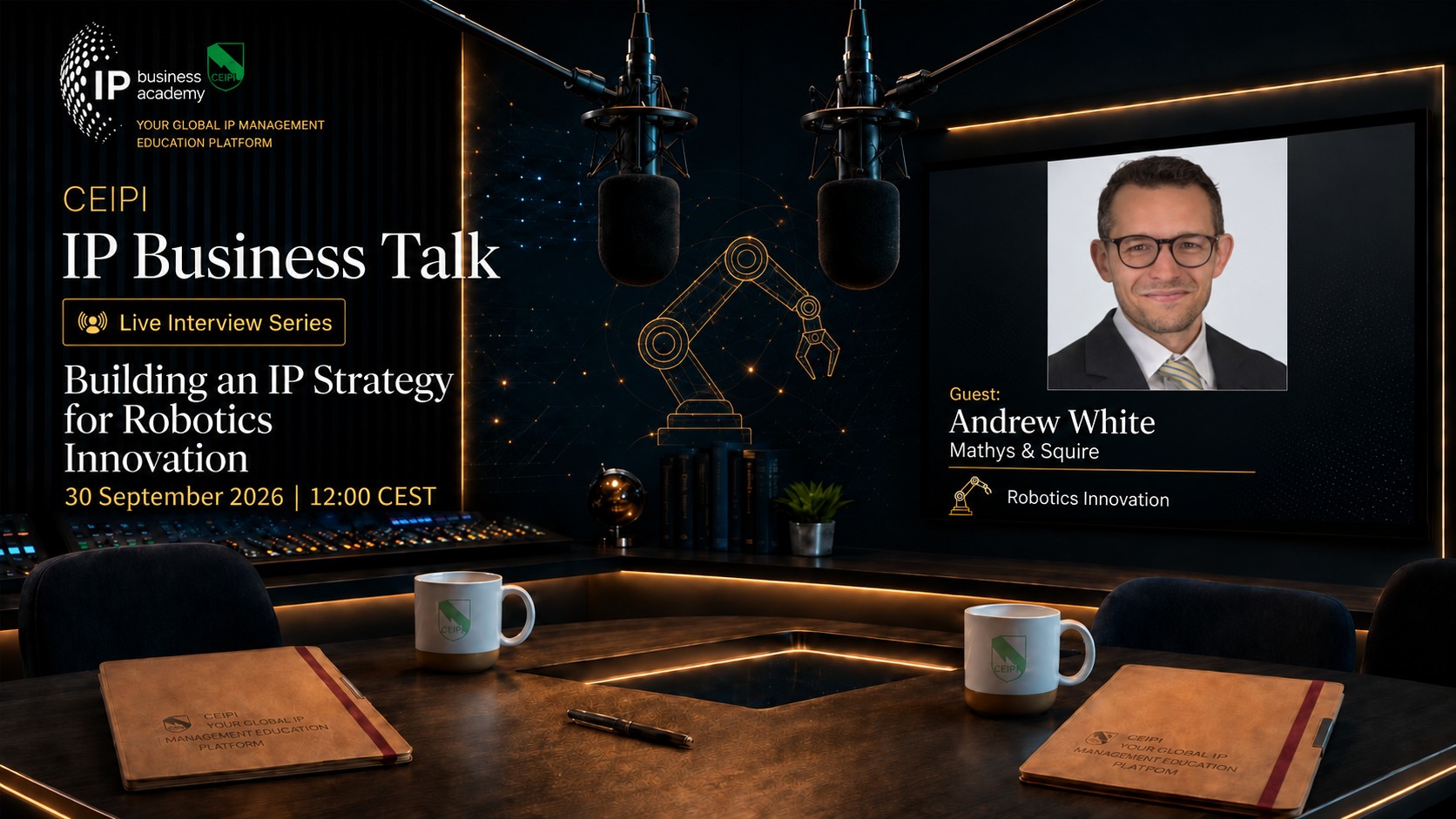
CEIPI IP Business Talk with Andrew White: Building an IP Strategy for Robotics Innovation

Robotics innovation brings mechanical engineering, sensors, electronics, control software and artificial intelligence into an integrated technical system. Its commercial value often emerges from the way these elements work together: how a machine interprets its surroundings, adapts its movements and performs a task reliably. For companies developing robotic systems, this creates a demanding IP question. Where does the protectable technical contribution lie, and how can protection remain relevant as the system develops?
On Wednesday, 30 September 2026, at 12:00 CEST, Andrew White, Partner at Mathys & Squire, will join Prof. Dr. Alexander J. Wurzer for a live CEIPI IP Business Talk on Building an IP Strategy for Robotics Innovation. The discussion will connect technical contribution and European patentability with ownership, freedom to operate, licensing and the strategic use of patent information.
Join the event via our LinkedIn invitation.
Identifying the invention within the robotic system
A robotic product can contain many technically sophisticated features. Some originate within the company, some come from suppliers and others emerge through collaboration. A new gripper, a sensing arrangement or a control method may each contribute to performance. In other cases, the important advance lies in how these elements interact.
Consider a robot that handles fragile objects under changing conditions. Its advantage could depend on the relationship between sensor feedback, motion control and the mechanical behaviour of the gripper. Understanding that relationship is essential to explaining what the development team has actually achieved and which technical features deserve attention in the patent strategy.
The first part of the discussion will examine how companies can identify such contributions and build protection around them. This requires a shared understanding between engineers, software developers and patent specialists. Each may see a different part of the system, while the commercially relevant invention crosses those boundaries.
For management, the practical issue is how to organise invention identification around the product’s sources of differentiation. An effective process needs to capture developments at component level and developments that become visible when the components operate together.
Protecting control software and AI functionality
Autonomous systems depend on software to turn information into physical action. Perception, navigation, control and adaptation can all influence how a robot performs in its environment. Machine learning adds further complexity because the resulting capability may depend on model design, training and the way the model is used within the system.
The European patentability framework makes the technical role of these developments particularly important. The EPO’s guidance on artificial intelligence and machine learning addresses the distinction between underlying mathematical methods and their contribution to a technical application. For robotics companies, describing the relationship between computational functionality and the technical task is therefore a central drafting consideration.
The talk will explore how companies can approach these requirements while seeking protection with meaningful commercial scope. A useful starting point is to understand what the software changes in the operation of the machine, which features produce that change and how the application can explain their relationship.
This question also connects patent drafting with product development. The implementation used in an early prototype may evolve as the company changes sensors, updates software or adapts the system for a new customer. Protection needs to be considered against that development path, with sufficient technical support for the scope being sought.
Managing ownership and dependencies across the ecosystem
Robotics companies frequently depend on technologies developed by other organisations. A product may combine purchased hardware, external software, a licensed platform and functionality created jointly with a development partner. The company’s ability to commercialise the complete system depends on the rights and permissions associated with these contributions.
The third part of the interview will address ownership, freedom to operate and licensing in this setting. These issues are closely connected in business decisions, while answering different questions. Ownership concerns the rights the company holds. Licences establish permissions to use technology under agreed conditions. Freedom-to-operate analysis examines whether relevant third-party rights could affect the planned activity.
For a growing business, these questions can become urgent when a pilot turns into a commercial rollout. An agreement developed for an initial project may need to accommodate additional customers, territories or applications. Joint development can also raise questions about the use of improvements in subsequent products.
A practical IP strategy therefore needs to follow the relationships through which the product is built and supplied. Companies need clarity about their existing technology, partner contributions and the permissions required for future development. This helps connect technical integration with the commercial arrangements supporting deployment.
Using patent information to guide future protection
Patent activity offers a further perspective on how robotics markets are developing. Competitor portfolios can reveal areas of sustained technical attention, while filing trends may help a company identify questions that deserve closer investigation. The management challenge is to translate that information into decisions about its own technology and portfolio.
Andrew’s recent commentary on the growth in anti-drone patent applications provides a relevant example. Mathys & Squire’s research reports 126 applications worldwide in the year ending 31 March 2025, compared with 99 in the preceding period. The analysis connects this activity with demand for counter-drone technologies and the protection of sensitive sites and infrastructure.
For a robotics company, a filing trend can prompt a more detailed review: which developments overlap with its roadmap, where might competitors be building relevant positions, and which parts of its own technology remain insufficiently protected?
The final discussion theme will consider how companies can use patent information to identify emerging risks, assess portfolio gaps and prioritise future protection. Application counts provide context; individual claims, legal status, geographical coverage and the company’s intended activities require closer examination before commercial conclusions can be drawn.
Connecting protection with business development
The four themes meet in a shared management task: building an IP strategy around the way the business develops and delivers its technology. Identifying inventions, preparing applications, managing external dependencies and reviewing competitor activity all benefit from a clear view of the product roadmap.
For founders and technical teams, this means making IP decisions while there is still scope to shape the development. For IP managers and advisers, it means understanding the customer proposition and the partnerships required to deliver it. The upcoming talk will offer a practical setting for exploring how these perspectives can be brought together.
The discussion forms part of our wider Industry Focus on Robotics & Autonomous Systems, which examines the role of IP in bringing autonomous technologies into commercial use.
Andrew White
 Andrew White is a Partner, UK and European Patent Attorney and European Patent Litigator at Mathys & Squire. He holds a master’s degree in physics and a PhD from the University of Bristol. His practice includes international patent portfolios in software, telecommunications, medical technologies and automotive technologies, alongside advice on deep tech inventions, including artificial intelligence.
Andrew works with businesses and their technical teams to align IP with commercial objectives. His experience includes supporting startups and scaleups, advising on commercially relevant patent protection and helping companies consider the role of IP in investment, supply relationships and business growth. This combination of technical and commercial perspectives provides the foundation for the upcoming discussion on robotics innovation.
Join Andrew White and Prof. Dr. Alexander J. Wurzer on Wednesday, 30 September 2026, at 12:00 CEST, for this live CEIPI IP Business Talk.
Register via the LinkedIn invitation and join the conversation.