
CEIPI IP Business Talk with Camille Terfve: IP Strategies for Digital MedTech

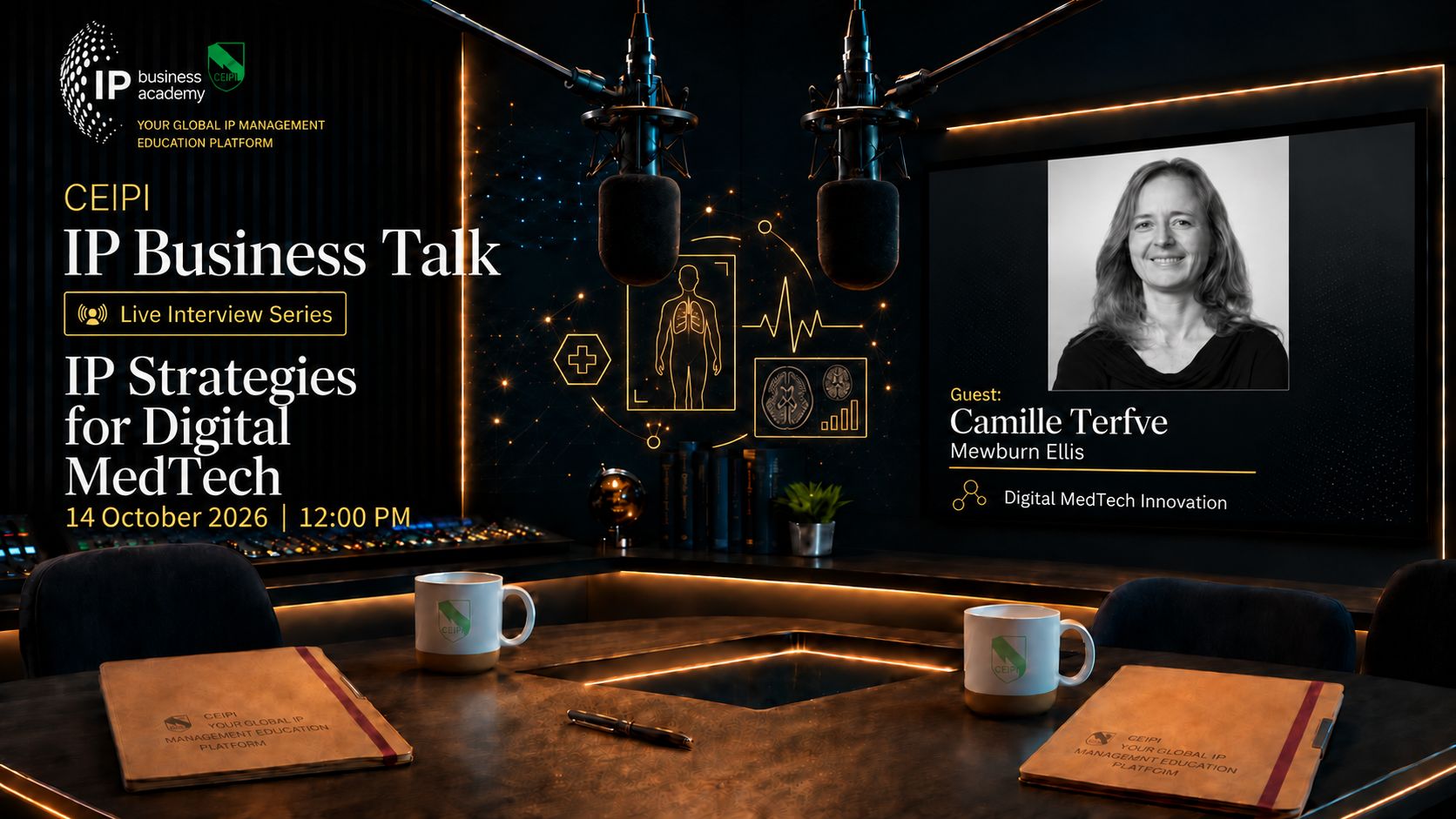
Digital MedTech brings medical knowledge, software and data analysis into increasingly connected products. A diagnostic application, an imaging tool or a patient-monitoring solution may derive its value from several interacting developments. For the companies building these technologies, IP strategy begins with understanding how those contributions support the product and its future commercial use.
On Wednesday, 14 October 2026, at 12:00 PM Camille Terfve, Partner and Patent Attorney at Mewburn Ellis, will join Prof. Dr. Alexander J. Wurzer for a live CEIPI IP Business Talk on IP Strategies for Digital MedTech. The conversation will explore invention identification, protection for evolving AI applications, international patent strategy and the management of technology dependencies.
👉 Join the live conversation on LinkedIn.
Identifying the technical contribution
The first theme concerns inventions that combine biological or medical insights with algorithms and data processing. Where should companies look for the technical contribution around which to build patent protection?
Consider a development team working on medical image analysis. Its progress might involve preparing images for analysis, recognising relevant features or connecting several sources of information. A useful invention discussion would examine what changed, how it changed the system’s performance and which features made that improvement possible. This creates a practical task for multidisciplinary teams. Clinicians, data scientists and software engineers may describe the same development from different perspectives. Bringing those perspectives together can help establish a clearer account of the invention and its relevance to the intended product.
Keeping protection relevant as AI applications evolve
The second theme will examine how IP strategy can reflect changes in models, datasets and clinical applications. An illustrative example is a monitoring application initially developed for one setting and subsequently adapted for another. The team might change its inputs, retrain its model or redesign how the output is generated. Each development milestone offers an opportunity to ask whether the company’s protection priorities still reflect the technology being prepared for customers.
For management, this suggests connecting invention reviews with product development. Which capabilities are becoming central to the business? Which improvements are likely to be reused? What should the next discussion between the development team and its IP advisers address?
Planning protection across international markets
Software as a medical device raises questions at the intersection of software patentability and restrictions relating to medical activities. The third part of the talk will consider how companies should approach an international patent strategy for diagnostic, monitoring and treatment-related functionality. A useful starting point for that conversation is a concrete description of the intended product: what it does, where processing takes place, how its output is used and which markets matter commercially. These details give the patent team a basis for examining the relevant requirements in each jurisdiction.
The management challenge is to connect international protection decisions with a realistic route to market. Priorities can then be discussed alongside development resources, prospective partners and the company’s plans for expansion.
Combining protection with commercial deployability
The fourth theme brings patents, freedom-to-operate analysis and broader IP management together. Digital MedTech products may combine proprietary algorithms, health data, open-source software and third-party technologies. The discussion will explore how companies can manage that combination while supporting scale and deployment.
For an illustrative product review, a company could trace the steps from data input to customer-facing output. At each step, it could identify its own contribution, external dependencies and questions requiring further investigation. This would help teams formulate specific issues for their advisers before entering a new partnership or committing to a rollout.
Connecting IP with the development of connected healthcare
These questions connect with our Industry Focus on MedTech and Digital Health Systems, which examines how software, data and system integration are changing the role of IP. The upcoming talk offers founders, R&D leaders, IP managers and advisers an opportunity to explore these issues through the practical challenges of digital medical technologies.
👉 Explore our Industry Focus on IP in MedTech.
Camille Terfve
 Camille Terfve is a Partner and UK and European Patent Attorney at Mewburn Ellis, specialising in computational biology, bioinformatics and AI in the life sciences. Her practice includes digital health, software-based companion diagnostics, medical image analysis and data-driven approaches in biotechnology and pharmaceuticals. She advises on patentability, drafting, IP strategy, freedom to operate and oppositions.
Camille holds a PhD from the University of Cambridge and the EMBL-European Bioinformatics Institute, alongside master’s degrees in bioengineering and computational biology. Her research examined computational approaches to reconstructing signalling networks in diseased cells. She became a partner at Mewburn Ellis in 2022.
👉 Read Camille Terfve’s profile at Mewburn Ellis.
Join Camille Terfve and Prof. Dr. Alexander J. Wurzer for this live CEIPI IP Business Talk on IP Strategies for Digital MedTech.
👉 View the event details and join the conversation on LinkedIn.