
CEIPI IP Business Talk with Niles Beadman and Eleanor Maciver: IP for Sustainable Innovation

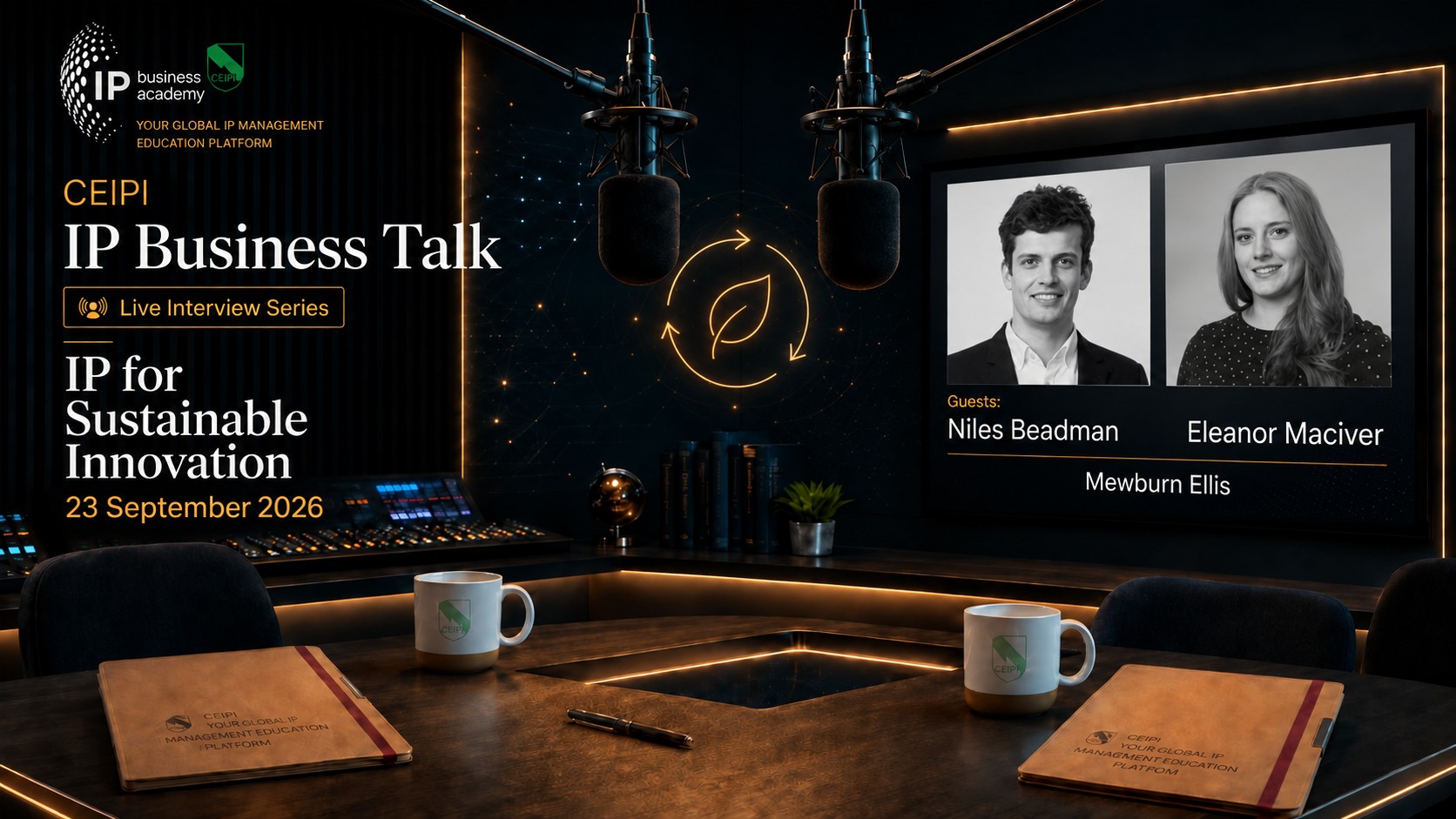
Sustainable technologies need a route from scientific progress to practical adoption. A new material, an energy-storage solution or a recycling process must work within an industrial value chain, attract resources and reach customers. Intellectual property influences this journey through the information it provides, the protection it creates and the conditions it establishes for collaboration.
On Wednesday, 23 September 2026, Niles Beadman and Eleanor Maciver from Mewburn Ellis will join Prof. Dr. Alexander J. Wurzer for a live CEIPI IP Business Talk on IP for Sustainable Innovation. The discussion will explore how patent intelligence, circular value chains and commercial IP strategy can support sustainable technologies. It will also address how IP firms can make sustainability part of their own operations through measurable commitments and responsible business practices.
Join the event via our LinkedIn invitation.
Using patent landscapes to understand technological change
Companies working on sustainable innovation face choices about which technical approaches to pursue, which markets to enter and which partners to involve. These decisions often need to be made while technologies and customer requirements are still developing. Patent information can provide a useful source of evidence for examining the available options.
The first part of the talk will consider how patent landscaping can help companies identify emerging technology trends, potential partners and investment opportunities. A landscape can reveal where applicants are concentrating their inventive activity and how different approaches relate to one another. It can also bring relevant organisations into view beyond a company’s established network.
The management value comes from connecting this information with a concrete decision. A materials company might investigate who is working on a particular recycling challenge. An energy-storage developer might examine the technologies that could complement its own solution. An investor might use patent information to formulate more precise questions about the technical position of a prospective investment.
Interpretation remains essential. Filing activity needs to be considered alongside technical evidence, market knowledge and the status and scope of individual rights. The discussion will explore how companies can turn a landscape into a useful basis for further investigation and strategic choices.
Locating IP value across circular value chains
Circular innovation connects decisions made at different stages of a product’s life. Material selection can influence whether a product can be repaired, separated or recycled. A recovery process may depend on how the original product was manufactured. Commercial success can therefore require coordination between organisations that contribute different technologies and capabilities.
This creates a wider field for IP management. The relevant technical contribution may concern a material composition, a manufacturing method, a separation process or the reuse of recovered material. Understanding where value is created requires following the technology through its intended applications and identifying the relationships on which those applications depend.
Consider a material designed for recovery at the end of a product’s useful life. Its business case may depend on manufacturers adopting it, collection systems delivering suitable feedstock and processors being able to recover material of sufficient quality. Each stage can introduce a technical contribution, a dependency or a potential licensing relationship.
The second theme of the interview will examine how companies can identify commercially relevant IP across these connected activities. The practical question is how protection and access arrangements can support a viable circular business model while allowing the participating organisations to retain value from their contributions.
Preparing IP for investment and partnerships
Many sustainability-focused businesses need substantial resources before they can supply customers at commercial scale. Pilot facilities, industrial validation and manufacturing capacity can require investment well before recurring revenues are established. Strategic partners may also be needed to provide capabilities that a young company cannot develop independently.
An IP strategy becomes relevant to these discussions when it explains the company’s contribution in commercially understandable terms. Investors and partners need to assess what the company controls, how that position supports the proposed product and what dependencies could affect expansion.
For a technology business, this can involve reviewing the relationship between its patent portfolio, confidential know-how and the permissions supporting its operations. It also involves understanding how collaboration may change that position. A development agreement can influence who may use project results, how subsequent improvements are handled and whether technology can be offered to additional customers.
The third part of the talk will explore how companies can strengthen their position in funding, licensing and collaboration discussions. The focus is on making IP relevant to the decisions being taken: which capabilities a partner needs, which rights an investor expects the company to hold and which arrangements support the next stage of growth.
This perspective helps connect IP planning with commercial milestones. The questions raised during an early research collaboration may differ from those arising during a licensing negotiation or an industrial rollout. A useful strategy evolves with these changes and gives management a clear basis for explaining the company’s position.
Making sustainability credible within the IP profession
The discussion will also turn to the organisations advising sustainable innovators. An IP firm’s sustainability strategy concerns its own environmental impact, the way it manages its business and the evidence supporting its public commitments. This gives the profession an opportunity to examine how responsible operations can accompany advice on sustainable technologies.
The fourth theme will address what makes such a strategy credible. Measurable targets require a defined starting point and a clear understanding of what is being measured. Transparent reporting needs to show progress over time and explain the areas where further work is required. Responsibility within the firm helps connect these commitments with everyday decisions.
Practical questions include how to assess the impact of travel, procurement and office operations, how to involve colleagues and how to maintain accountability as the business develops. These are organisational choices that require implementation, review and continuing attention.
Eleanor’s role as Sustainability Champion at Mewburn Ellis brings a direct operational perspective to this part of the conversation. Alongside the discussion of client technologies and commercialisation, the interview will consider how an IP firm can structure its own contribution to a more sustainable economy.
Connecting technology choices with commercial adoption
The four themes place IP within the wider process of bringing sustainable innovation into use. Patent landscapes can inform where a company directs its attention. Analysis of circular value chains can clarify how different contributions fit together. An IP strategy can support negotiations over investment and collaboration. The profession’s own practices add a further dimension of responsibility and credibility.
For founders, R&D teams, investors and IP professionals, the shared challenge is to connect these perspectives with decisions that shape development and adoption. A promising technology needs partners who can implement it, resources that support its progress and arrangements that allow those involved to benefit from its success.
The upcoming CEIPI IP Business Talk will provide a setting for exploring these connections. It also continues the discussion in our GreenTech Industry Focus, where IP is examined in relation to sustainable innovation, commercialisation and strategic control.
Eleanor Maciver
 Eleanor Maciver is a Partner, UK and European Patent Attorney and Sustainability Champion at Mewburn Ellis. Her work includes protecting and commercialising sustainable chemical and materials technologies, with experience in areas such as sustainable polymers, nature-based materials, battery electrode materials and carbon capture. She also handles oppositions and appeals before the European Patent Office.
Eleanor holds a master’s degree in natural sciences from the University of Cambridge and a DPhil in organic chemistry from the University of Oxford. As Sustainability Champion, she leads the firm’s environmental strategy and sustainability collaboration group. Her combination of client advisory work and internal sustainability responsibilities brings both perspectives into the upcoming talk.
Niles Beadman
 Niles Beadman is a Senior Associate and Patent Attorney in Mewburn Ellis’s Chemistry team. He advises on chemical and materials innovation, with particular experience in energy storage, cleantech and bio-derived materials. His work spans invention capture, patent drafting, international portfolio management and freedom-to-operate advice. Working with universities, startups and established businesses, he connects patent strategy with commercial objectives, including investment, licensing and product launches. He also specialises in innovation at the interfaces between chemistry, electronics, software and cheminformatics.
Niles holds a first-class chemistry degree from the University of Oxford, where he researched molecular structures for anion recognition and sensing applications. He joined Mewburn Ellis in 2018, qualified as a Chartered Patent Attorney in 2021 and a European Patent Attorney in 2022, and became a Senior Associate in 2025. His international experience includes a secondment to US law firm Wolf Greenfield. Alongside his client work, he contributes to professional training and the development of Mewburn Ellis’s patent examination training programme.
Join Niles Beadman, Eleanor Maciver and Prof. Dr. Alexander J. Wurzer on Wednesday, 23 September 2026, for this live CEIPI IP Business Talk on IP for Sustainable Innovation.
Register via the LinkedIn invitation and join the conversation.