Practical Question Frederik Golks: The Role of IP in Industrial Strategy under the UPC

The introduction of the Unified Patent Court creates new strategic options for industrial companies in Europe. This is especially relevant for mechanical engineering and mechatronics, where products combine hardware, software, control technologies, long product lifecycles and complex supply chains. Frederik Golks’ practical question shows that the UPC is not automatically strategic for every company. Its relevance depends on how IP is understood internally: as l egal protection, as a strategic asset or as part of business decision-making.
The CEIPI IP Business Academy recently addressed the UPC Strategy Gap in Europe, showing that companies increasingly recognize the strategic relevance of the Unified Patent Court, while much of the market still frames UPC support mainly as procedural or litigation expertise.
Here you find the Findings of this study: “The UPC Strategy Gap in Europa”
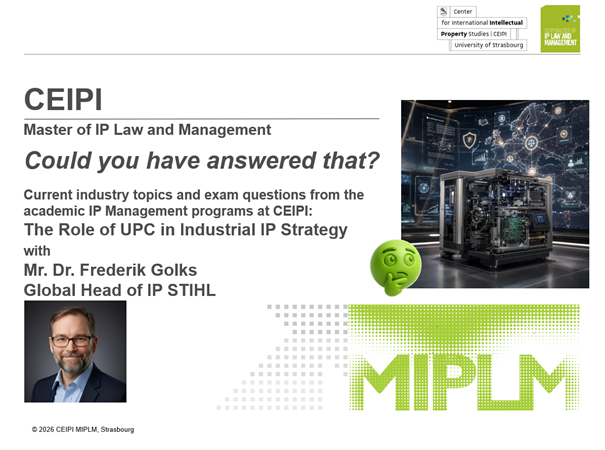
Against the background of the UPC Strategy Gap in Europe, the key question is therefore not only how companies use the UPC, but whether they have defined the organizational role of IP clearly enough to make UPC-related decisions meaningful. We are therefore particularly pleased to collaborate with experts from industrial practice. The following practical question was evaluated by Dr. Frederik Golks, Head if IP at STIHL:
“This practical question is highly relevant, as it illustrates that not every company is compelled by the same internal imperatives to pursue an active UPC strategy: a compelling need to systematically evaluate the UPC’s central structures for protection, enforcement, and risk management arises only when IP is utilized as a strategic management tool for steering market and competitive positioning. Thus, the question underscores that the relevance of the UPC is grounded less in legal considerations than in organizational and strategic ones.” Dr. Frederik Golks, Global Head of IP, VP at STIHL
Mini Case Study
A globally operating mechanical engineering company with a strong focus on mechatronic systems develops integrated products combining hardware, software, and control technologies. Its innovations are embedded in long product lifecycles, complex supply chains, and incremental improvement processes.
The company maintains a substantial European patent portfolio that supports both product differentiation and long-term market positioning. At the same time, increasing digitalization introduces new layers of complexity, as software-driven functionalities become more central to the value proposition.
With the introduction of the Unitary Patent and the Unified Patent Court (UPC), the company is confronted with new strategic options regarding how its IP is structured, enforced, and integrated into broader business decisions across Europe.
However, the implications of these options depend heavily on the role IP plays within the organization itself — whether it is primarily seen as a protective function, a strategic asset, or an integrated element of business decision-making.
Practical Question
How should companies in mechanical engineering and mechatronics define the role of IP within their organization in order to determine how and to what extent UPC-related considerations should influence their strategic decisions?
Why This Question Matters in Practice
This question becomes particularly relevant for industrial companies with established product portfolios, long development cycles, and increasing integration of digital components into traditionally hardware-driven systems.
In such environments, IP decisions are closely linked to how companies position themselves in terms of innovation, competition, and market control. The UPC does not introduce relevance on its own. Its strategic importance depends on how IP is embedded within the organization’s broader decision-making structure.
For companies where IP is primarily operational or defensive, UPC-related decisions may remain limited to specific cases or external advice. In contrast, organizations that treat IP as a strategic management tool must actively assess how centralized protection, enforcement options, and risk structures influence their competitive positioning in Europe.
The question is therefore not only about understanding the UPC, but about clarifying the internal function of IP. It becomes especially critical in organizations undergoing transformation, where IP must align with digitalization strategies, cross-functional decision-making, and evolving business models.
Dr. Frederik Golks
 Dr. Frederik Golks, LL.M., is Global Head of Intellectual Property and Vice President at STIHL, where he leads IP strategy and transformation. He is a German and European Patent Attorney, Representative before the Unified Patent Court, and combines expertise in patent law, IP management, and protection of digital business models.
Before joining STIHL, he worked for more than ten years at Bosch as IP Counsel and as Team Leader in Research & Development. His background includes physics, electrochemistry, synchrotron X-ray diffraction, software development, and management education, enabling him to connect technology, law, business, and organizational change.