
From Customer Benefit to the Digital Control Point

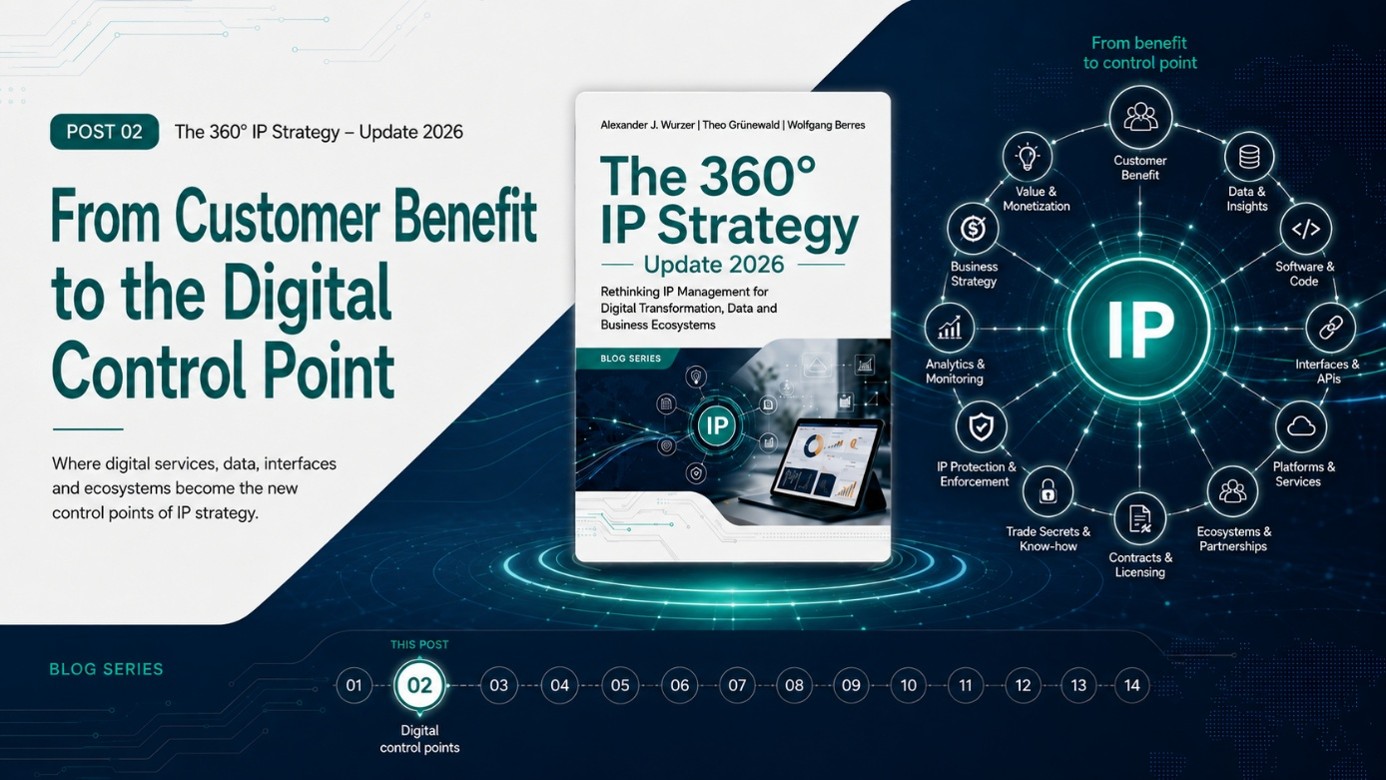
The original logic of the 360° IP strategy starts with a simple but demanding idea: IP must be designed from the customer benefit backwards. The question is not first “What have we invented?” or “What can we file?” The better question is: “What does the customer value so much that it influences the buying decision, creates willingness to pay, and makes the offer meaningfully different from competing alternatives?”
That logic has not become weaker in the digital economy. It has become more important. Digital transformation has multiplied the number of places where customer benefit can arise. In the past, a customer benefit was often visible in the product itself: better performance, higher durability, easier handling, lower energy consumption, safer operation, or superior design. Today, the decisive benefit may still be connected to the product, but it may be delivered through something less visible: a predictive maintenance service, a software update, an analytics layer, a digital workflow, a configuration tool, an API, a cloud dashboard, a training dataset, or an ecosystem of partners.
This changes the way IP strategy must be built. A customer may buy a machine, but remain loyal because the machine is embedded in a digital service environment. A customer may choose a medical device, not only because of the sensor, but because of the validated data flow and the confidence created by the interface. A customer may subscribe to a software platform, not because of one feature, but because the system becomes part of everyday work and accumulates useful knowledge over time.
The decisive shift is that customer benefit is no longer only embodied in a product feature. It is often produced by the interaction between product, software, data, service, user experience and ecosystem access. Therefore, IP strategy must no longer ask only which technical elements can be protected. It must ask where the customer benefit is generated, communicated, reinforced and made difficult to replace.
The customer remains the starting point, but the object of analysis has expanded. Modern IP strategy must identify the full architecture through which customer benefit is created and then determine which elements of that architecture can become protectable, controllable or strategically difficult to imitate.
Digital value no longer lives only in the product
In many traditional innovation settings, the product was the obvious carrier of value. Engineers developed a technical solution, the company turned it into a product, marketing communicated its advantages, and IP tried to protect the relevant technical differentiation. That model still exists, but it no longer describes many of the most important competitive situations.
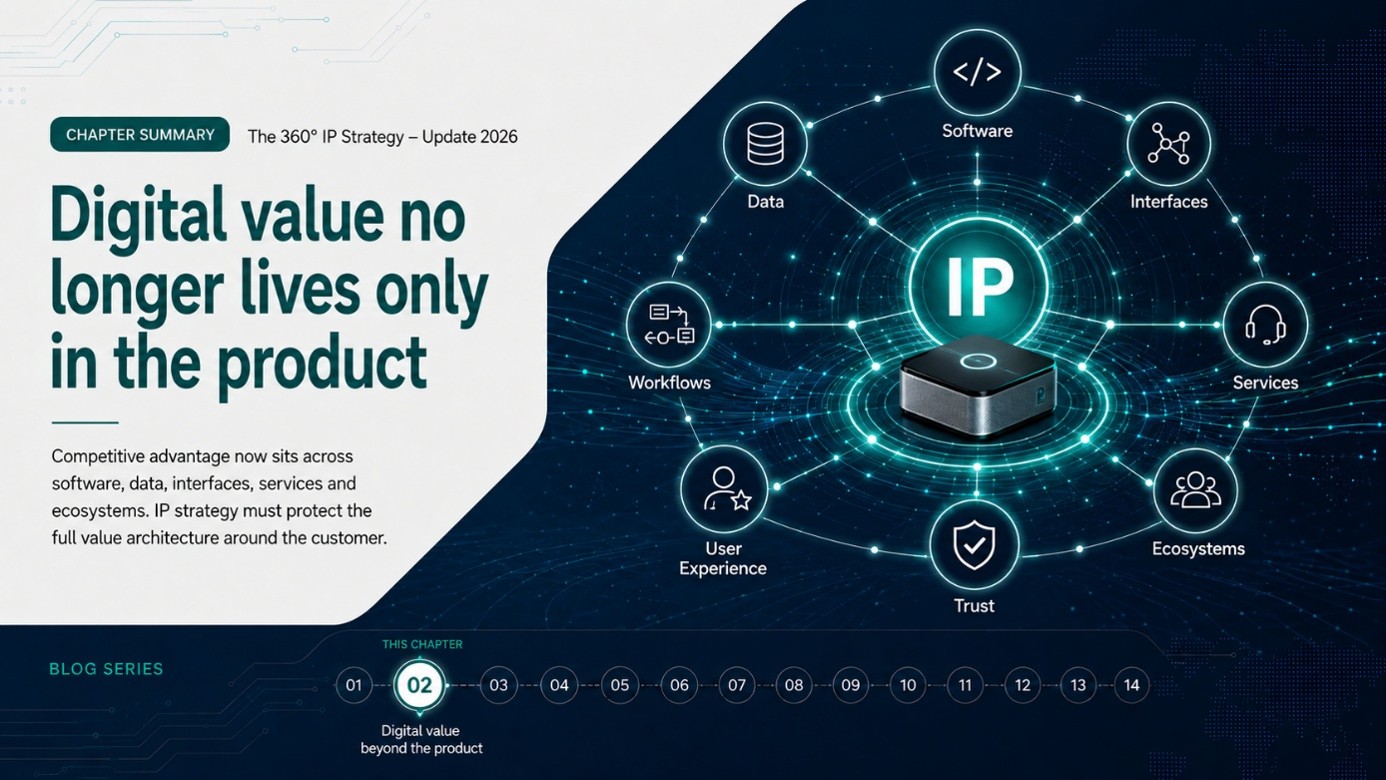
Digital value is distributed. It may sit in software logic, in the data generated during use, in the feedback loop between user behaviour and product improvement, in the integration with other systems, in the user interface, in workflow automation, in interoperability, in cybersecurity, in compliance evidence, or in the accumulated learning of a platform. The value may also arise from availability rather than ownership. Customers increasingly pay for uptime, access, outcomes, reliability, convenience and continuous improvement.
This has major implications for IP strategy. If the company continues to protect only the physical product, while the actual competitive advantage moves into data, service and integration, the IP portfolio gradually loses strategic relevance. It may still contain valid rights. It may still be expensive to maintain. It may still look impressive in numbers. But it may no longer control what matters most in the business model.
The same problem appears in reverse. A company may own software, data and process know-how that are commercially decisive, but fail to treat them as IP-relevant assets. Code may be stored, but not strategically classified. Data may be generated, but not governed as a source of competitive advantage. Interfaces may become customer lock-in mechanisms, but remain outside the IP discussion. Algorithms may improve service quality, but their protectability, secrecy, documentation and dependency risks are not systematically assessed.
The 360° perspective helps to overcome this gap. It does not reduce IP to patents, and it does not reduce strategy to legal rights. It looks at the business model and asks where exclusivity, control, differentiation and bargaining power can be created. In digital business models, this means looking beyond the product into the system that surrounds it.
Digital value must be mapped before it can be protected. The relevant unit of analysis is no longer only the product, but the value architecture around the customer: product, service, data, software, interface, process, trust and ecosystem role.
The digital control point as the new strategic object
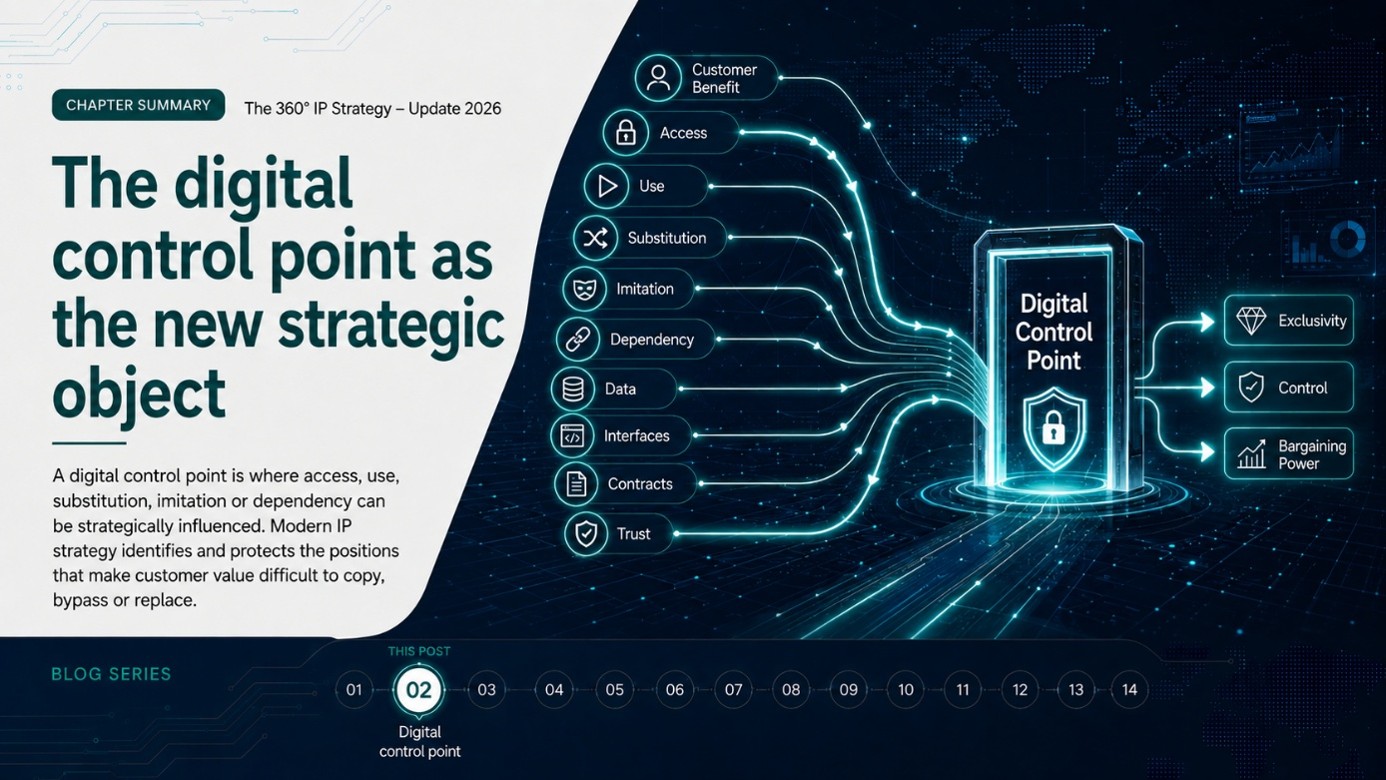
A digital control point is a place in the business model where access, use, substitution, imitation, dependency or economic participation can be influenced. It is not necessarily a patentable invention. It is not necessarily a legal right. It is a strategic position from which the company can shape the behaviour of customers, competitors, partners or complementors.
This concept is useful because it translates customer benefit into strategic manageability. If customers value predictive maintenance, the control point may lie in the sensor data, the diagnostic model, the service workflow, the installed base, the connectivity architecture or the trust in the prediction. If customers value seamless integration, the control point may lie in APIs, certifications, interface specifications, documentation, developer tools or ecosystem governance. If customers value compliance, the control point may lie in validated datasets, audit trails, regulatory evidence, cybersecurity documentation or quality-controlled update processes.
The key question is therefore not: “Can we patent this?” The key question is: “Which element must remain difficult for competitors to copy, access, replace or bypass if the customer benefit is to remain economically defensible?” Sometimes the answer will be a patent. Sometimes it will be a trade secret. Sometimes it will be copyright in software, database protection, trademark trust, design protection, contract architecture, technical access control, platform rules, confidentiality governance or a combination of all of these.
This is why the digital control point becomes the bridge between business model thinking and IP architecture. It forces management to become specific. It is not enough to say that “data is important” or that “software is strategic.” The question is which data, which software element, which interface, which user interaction, which partner dependency and which process step actually influences the customer’s decision and the competitor’s ability to offer an equivalent alternative.
Control points also help to avoid a common misunderstanding. IP does not need to create a market monopoly to be valuable. It needs to create a relevant zone of exclusivity, friction or bargaining power around something that matters economically. In digital models, that zone may be narrow but decisive. It may concern a data pipeline, an update routine, a certification layer or a specific customer workflow. The smaller and more precise the control point, the more important it becomes to understand its business function.
The digital control point is the modern translation of customer-oriented exclusivity. It identifies where the business model can be made less copyable, less replaceable and less exposed to direct price competition.
Hybrid protection replaces the single-right mindset
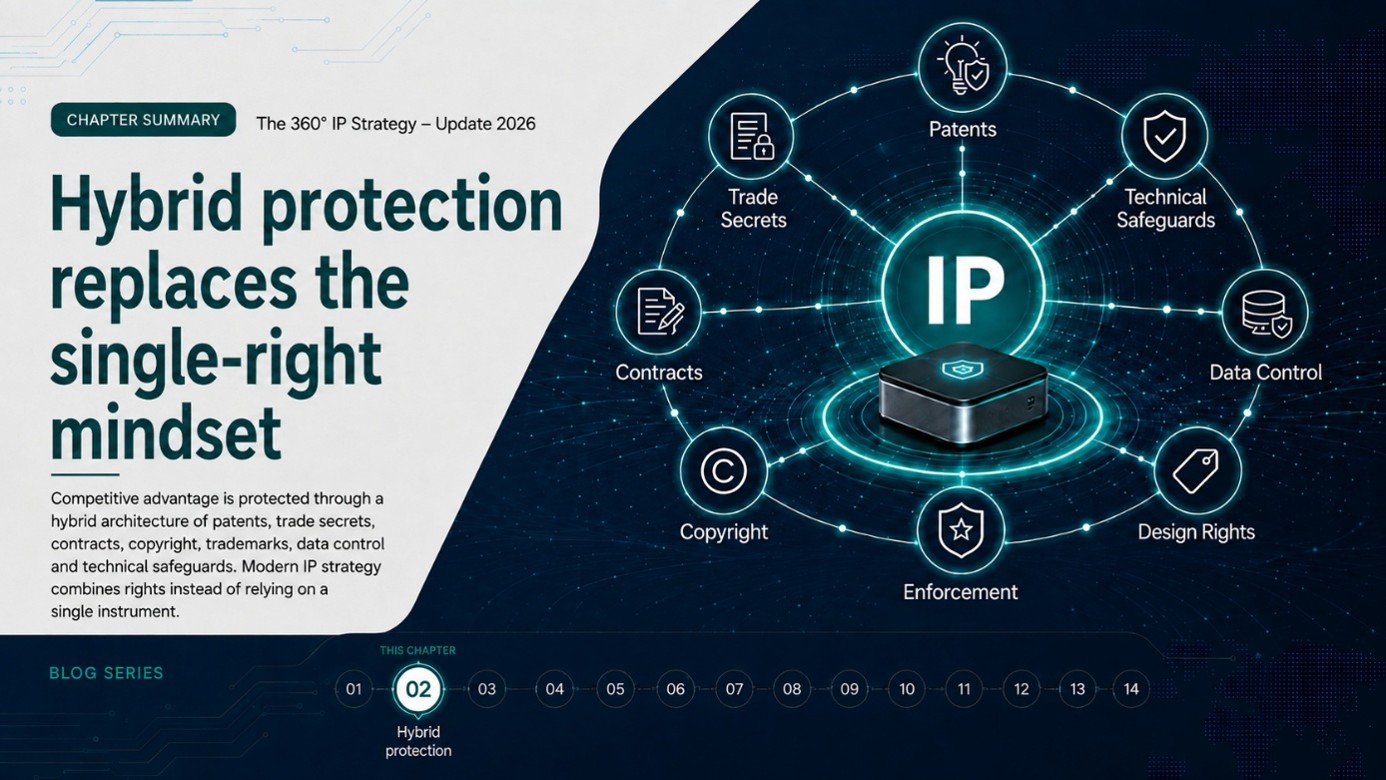
Once control points are identified, the next question is how they can be protected. In digital business models, a single IP right is rarely sufficient. The relevant competitive advantage is often layered across technical functions, software components, data structures, brand trust, user experience, contractual relationships and operational know-how. This requires a hybrid protection architecture.
A patent may protect a technical implementation of a digital function. Copyright may protect software code, documentation and digital content. Trade secrets may protect algorithms, training processes, data preparation methods, parameters, business rules or operational workflows. Database rights and data governance may influence who can access and reuse structured information. Trademarks may protect trust signals in digital markets where customers need orientation. Design rights may protect interface elements, visual interaction patterns or product appearance. Contracts may define access, use, confidentiality, interoperability and partner obligations. Technical architecture may enforce control through authentication, encryption, APIs, access tiers, logs and permission systems.
The strategic task is not to choose one of these instruments in isolation. The task is to combine them around the control point. For example, a digital service may require patents for selected technical mechanisms, trade secret protection for the analytics pipeline, copyright governance for software, contracts for customer data access, cybersecurity measures for confidentiality, and branding to communicate reliability. None of these measures alone captures the whole advantage. Together, they create a defensible position.
This also changes the role of IP work in the company. IP strategy can no longer be a late-stage filing decision after development has already fixed the architecture. Protection choices must influence architecture choices. If a company wants to protect a data-driven control point, it must decide early how data is collected, stored, documented, accessed and separated. If a company wants to rely on trade secrets, it must ensure that the knowledge can actually be kept secret. If it wants to rely on patents, it must identify technical contributions early enough to file before disclosure. If it wants to use contracts, it must understand which business relationships define access to value.
Hybrid protection is not complexity for its own sake. It is the necessary response to hybrid value creation. When the customer benefit is produced by a system, the protection logic must also become systemic.
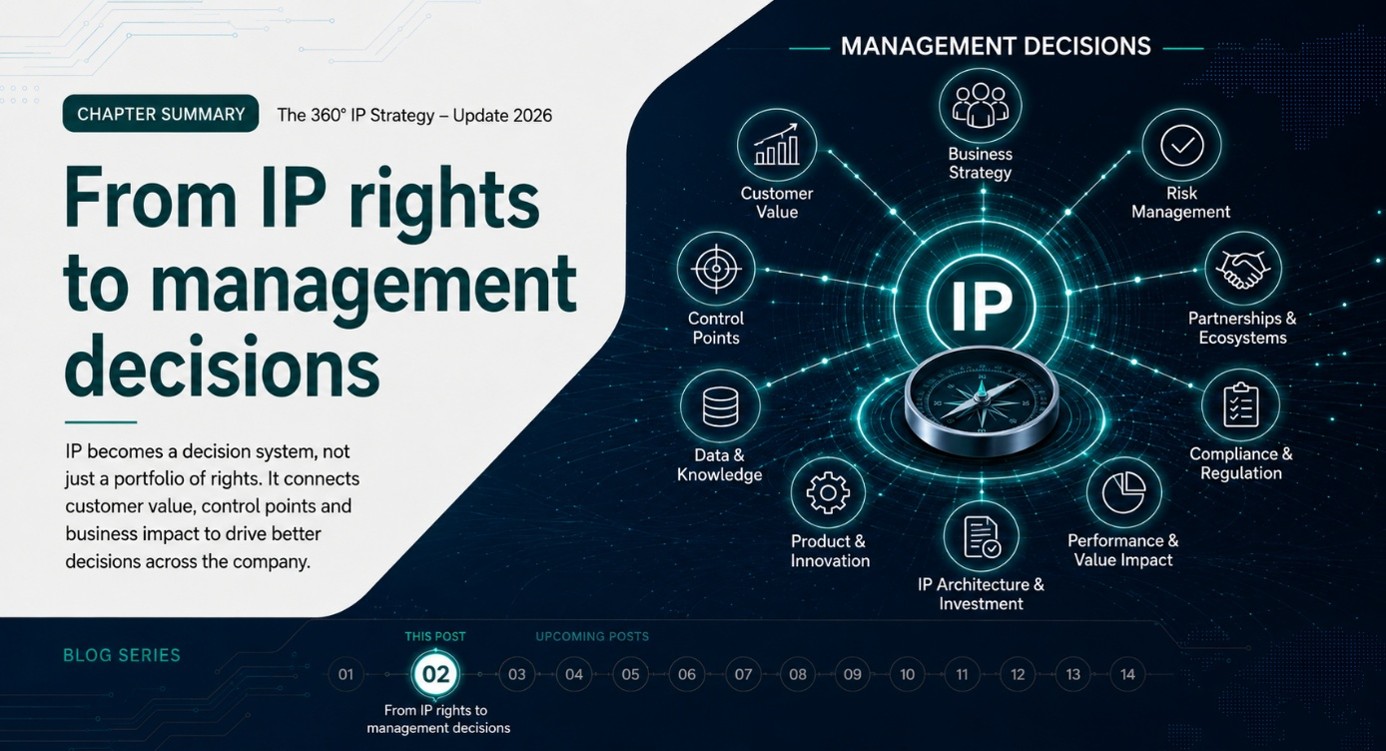
From IP rights to management decisions
The move from customer benefit to digital control point changes the management conversation. IP is no longer only a portfolio of rights. It becomes a decision system for controlling immaterial value drivers. This requires new questions, new stakeholders and new routines.
The first management question is where the business model creates customer-relevant differentiation. The second is which elements of that differentiation competitors could copy, imitate, access, bypass or replace. The third is which of these elements can become control points. The fourth is which protection architecture fits each control point. The fifth is how the company measures whether the chosen IP measures actually support margin, market access, customer loyalty, partner control, negotiation power or risk reduction.
This cannot be answered by the IP department alone. Product management understands customer value. Sales sees competitive substitution. Marketing shapes communication and trust. Software teams understand architecture. Data teams understand datasets, models and access. Legal understands contracts and rights. Compliance understands regulatory evidence. Cybersecurity understands technical protection. Business development understands ecosystem dependencies. A modern 360° IP strategy connects these perspectives and turns them into structured decisions.
The management challenge is to make these decisions early enough. Digital business models evolve quickly. Releases, updates, APIs, open-source components, AI models, data partnerships and service layers change the competitive position continuously. Therefore, the identification of control points must become part of innovation management, roadmap planning and business model development. It must not be reduced to an occasional legal review.
This is also where the old 360° logic proves its continuing strength. Its core idea was never that patents alone secure innovation success. Its core idea was that IP must be linked to customer benefit, business model impact and economic effect. The digital update does not replace that logic. It extends it into the places where value now emerges: software, data, interfaces, services, platforms and ecosystems.
Modern IP strategy begins with customer benefit, translates it into digital control points, and builds a hybrid protection architecture around the elements that make the business model economically defensible. That is how IP becomes a management instrument for digital competitive advantage.
Supplementary content on the IPBA® platform:
A 360-Degree IP Strategy
Explains the original holistic logic of aligning IP creation, protection and exploitation with business objectives and provides the conceptual anchor for this updated series.
👉 Read more
Proof of success: Empirical study of the 360° IP strategy for the Thermomix and its digital ecosystem
Shows how customer-relevant benefits can be translated into a proprietary IP portfolio and how a product can become protected as part of a broader ecosystem.
👉 Read more
IP in the Digital Transformation
Provides the broader context for why software, platforms, data, digital content, trade secrets and digital enforcement challenges must be integrated into IP strategy.
👉 Read more
Digital Business Models
Explores how digital models shift value creation from single transactions to ongoing customer relationships, data-driven improvement, network effects and subscription logic.
👉 Read more
IP Protection of Digital Business Models
Connects IP protection with customer journeys, value-adding architectures, digital patents and synthetic invention design for digital business models.
👉 Read more
Digital Ecosystems and the Evolution of Digital Transformation in Industries
Adds the ecosystem perspective and explains why IP must be understood as a tool for creating exclusivity in digital, collaborative and platform-based environments.
👉 Read more
Certified University Course IP in the Industry 4.0
Offers a structured learning path on digital transformation, digital business models, ecosystems, customer journeys, value-added architectures and digital patents.
👉 Read more
Developing IP Strategies for the digital transformation: CEIPI MIPLM 2021-22
Shows how the 360° IP strategy and objectives matrix can be applied to digital transformation cases and business-model-based IP strategy work.
👉 Read more
Adobe’s Shift to SaaS: Creative Cloud as a Case Study in IP-Backed Transformation
Illustrates how IP can protect an entire digital ecosystem, support recurring revenue, create switching costs and secure platform-based customer value.
👉 Read more
From power tools to uptime: Hilti’s business model transformation and the IP logic behind it
Demonstrates how a product business can shift towards service, availability and customer outcomes, making the business model itself the object of IP analysis.
👉 Read more