
From One-Off FTO to Continuous Freedom of Action in Agile Software Development

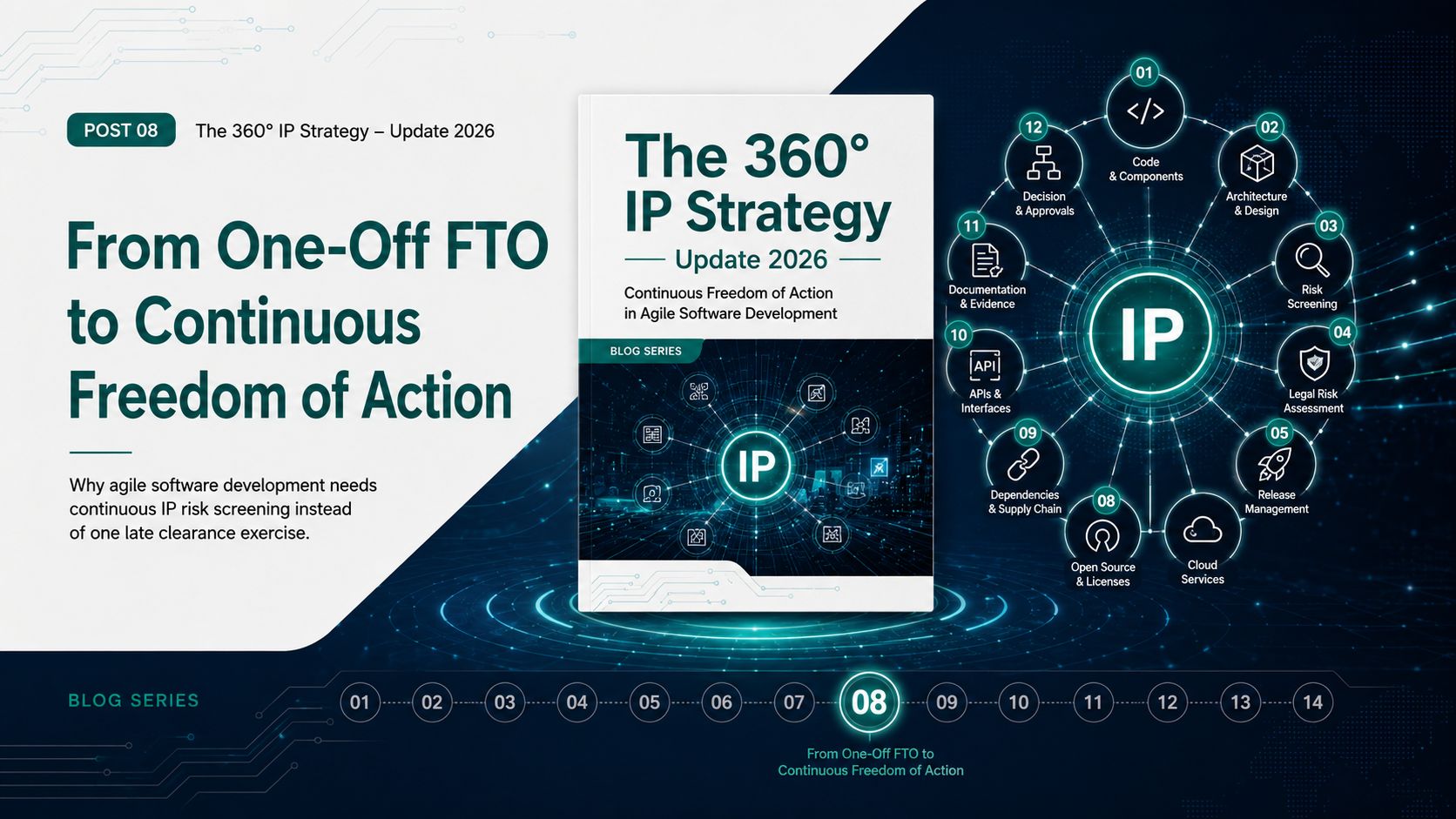
The original 360° IP Strategy argued that freedom of action should accompany innovation from the first idea through development, launch and later product adaptation. That principle becomes even more important when an offering is continuously updated and assembled from internal code, open-source components, cloud services, data, models and third-party interfaces.
In this environment, the object that must remain commercially usable is never completely finished. Freedom to Operate can therefore no longer be treated as a static legal certificate. It must become a continuous management process that protects strategic options while the product and its risk profile are still being shaped.
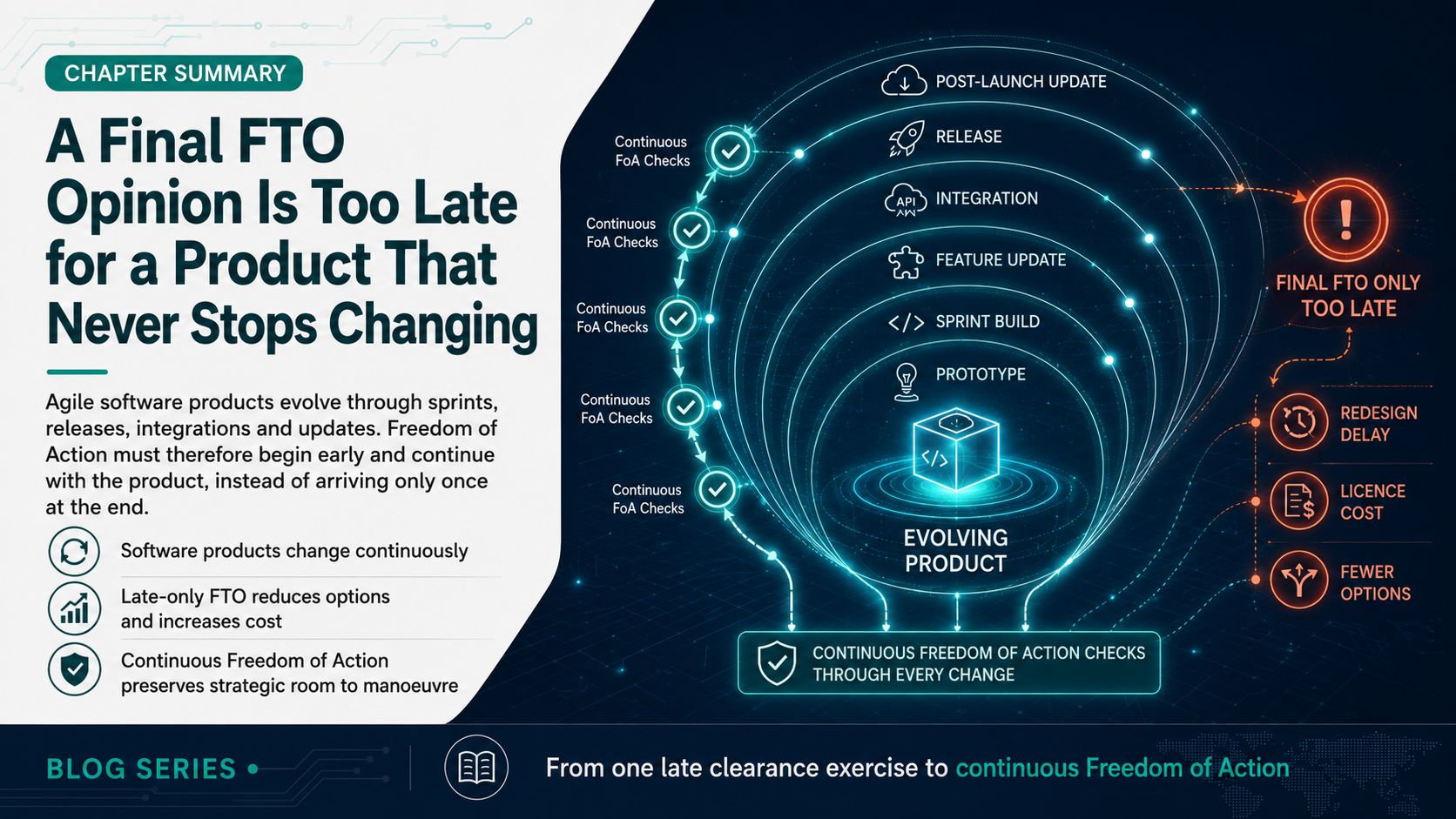
A final FTO opinion is too late for a product that never stops changing
A traditional Freedom-to-Operate analysis usually addresses a defined commercial activity: a particular product or process, in specified jurisdictions, at a particular point in time. That analysis remains necessary before a major launch, investment, licence negotiation or transaction. Management still needs a sufficiently precise assessment of whether relevant third-party rights may obstruct the intended activity.
Agile software development, however, does not produce one stable technical object that can be examined once and then released unchanged. A function may begin as an experiment, become an epic, be divided into services, use a third-party library, move from the cloud to the edge and later be extended through an AI component. Each decision can alter which patent claims, copyright positions, licence conditions, contractual restrictions or data-use rights matter.
When the first serious review takes place shortly before launch, the company has already accumulated commitments. Interfaces may have been published, suppliers selected and customer promises made. A newly identified conflict then becomes expensive because the remaining options are narrower. Redesign can delay the roadmap, a licence can weaken the negotiating position, and withdrawal from a market can destroy expected scale.
Continuous Freedom of Action shifts the timing of the question. Early in development, the objective is not a definitive infringement opinion about an unfinished product. It is to identify crowded technical fields, potentially blocking positions, sensitive architectural choices and routes that preserve room to manoeuvre. As the product becomes more concrete, the analysis becomes more specific and the evidence more detailed.
The strategic benefit is not the impossible promise of zero risk. It is the preservation of choices: another technical route, a replaceable component, an early licensing approach, a different deployment model or a deliberately developed invent-around solution.
Freedom of Action therefore begins before a legally complete FTO analysis is possible. It reduces avoidable commitment to risky paths and keeps technical, commercial and negotiating alternatives open until informed decisions can be made.
The object of analysis is the release architecture, not the product name
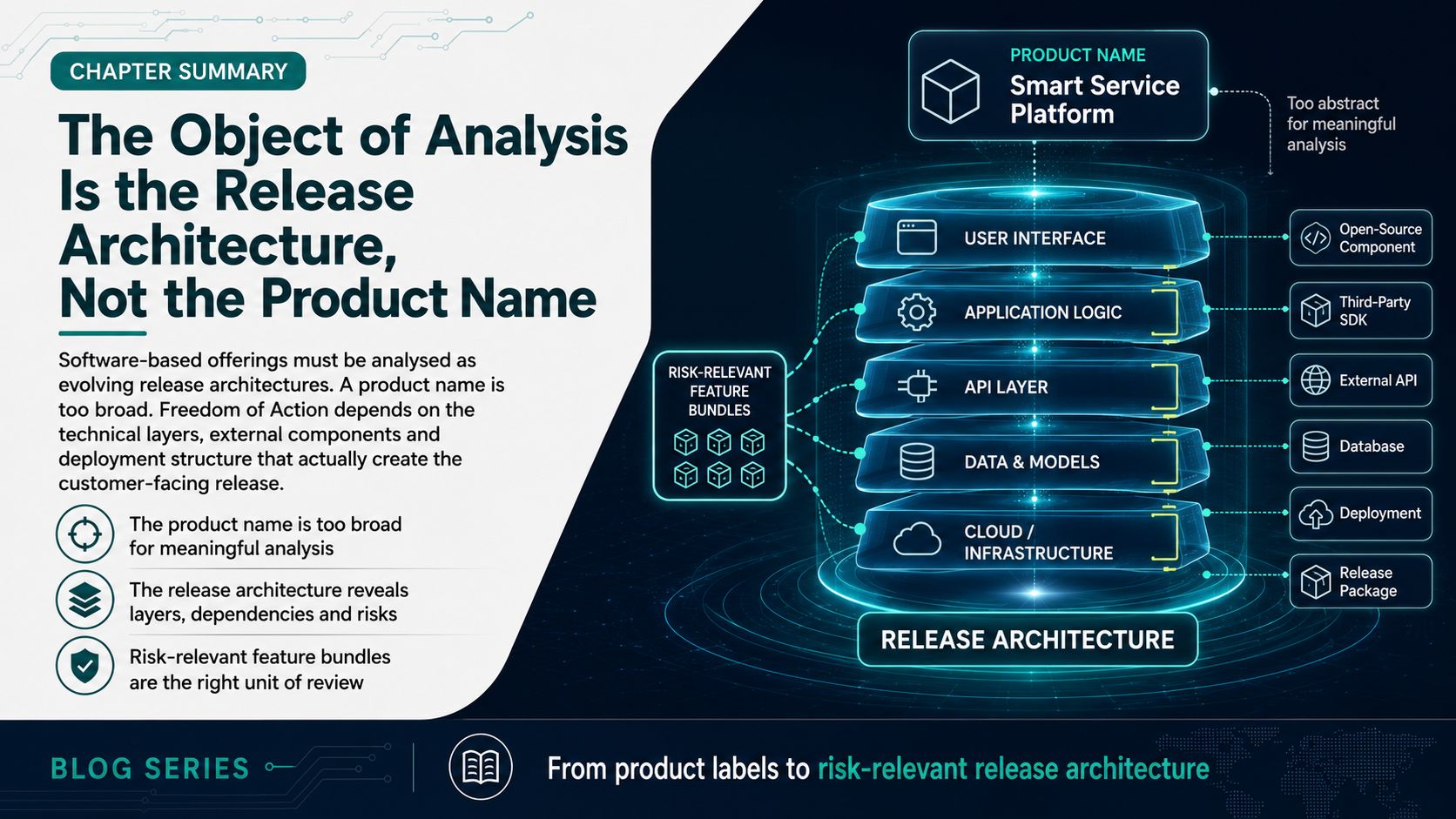
Software-based offerings must be decomposed differently from conventional products. Labels such as “analytics platform”, “connected device” or “AI assistant” are far too broad for meaningful risk analysis. The relevant object is the release architecture through which the promised customer outcome is produced.
That architecture may include device functions, control logic, backend services, mobile applications, databases, APIs, model pipelines, user interfaces, authentication mechanisms and externally sourced components. The customer experiences one service, but different rights and dependencies attach to different layers. Patents may concern signal processing or system control. Copyright and open-source obligations may affect code distribution. Contracts may determine whether data, models or cloud services can be used commercially.
The analysis should follow the chain from customer benefit to technical function, from technical function to implementation, and from implementation to external dependency. A predictive-maintenance function, for example, may depend on sensor placement, edge preprocessing, transmission, anomaly detection, model thresholds, a dashboard and an intervention workflow. Reviewing only the visible application would miss most of the system.
Agile teams also need a workable level of granularity. Screening every commit as a separate legal object would paralyse development, while reviewing only the finished product would be too late. A useful middle level is the risk-relevant feature bundle: a technical function or architectural change that materially affects how the system operates, which external assets it uses, where it is deployed or what is promised to customers.
Each bundle should have a current description of its purpose, system context, principal technical mechanisms, external components, intended markets and commercial importance. Architecture decision records, product requirements, repository metadata and dependency inventories can supply much of this evidence when they are connected rather than stored in isolated systems.
The unit of analysis must therefore be neither the entire branded product nor every line of code. Continuous Freedom of Action works when customer-relevant feature bundles are mapped to the evolving release architecture and to the rights, licences and dependencies that can constrain them.
Build the risk loop around roadmaps, architecture decisions and releases
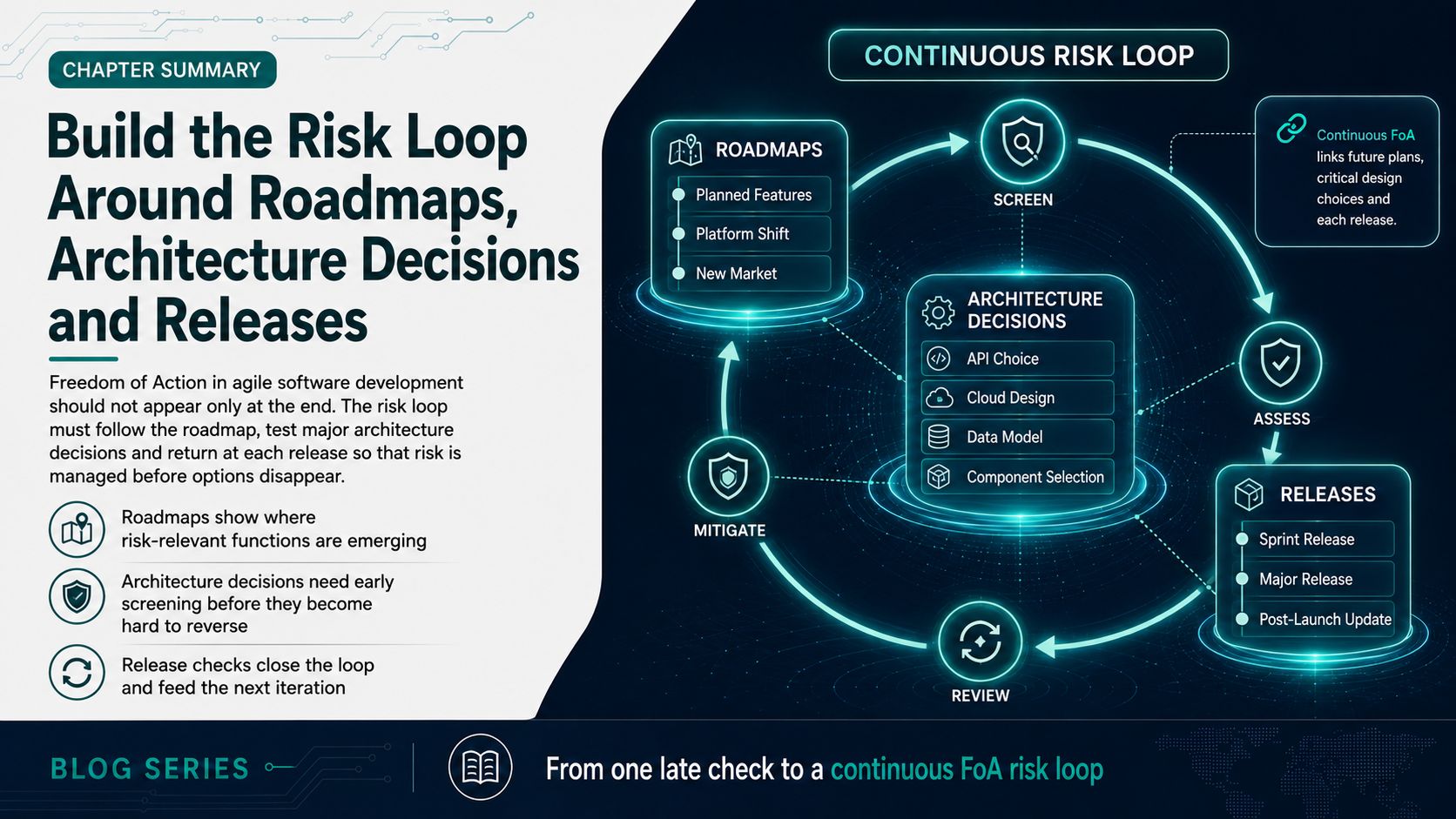
A continuous process does not mean conducting a complete FTO search during every sprint. It means matching the depth of analysis to the maturity, importance and change intensity of the development object. As implementation becomes more concrete, research criteria and legal evaluation can become more focused.
At roadmap level, the company should identify strategic technology fields and future functions that may become commercially decisive. Patent landscapes and competitor activity can reveal dense areas, emerging claim patterns and potential white spaces before detailed engineering choices are fixed. This is broad orientation, not final clearance.
At architecture level, screening should focus on technical principles and dependencies that are difficult to reverse. A new communication protocol, control method, model architecture, data pipeline or platform interface may shape several future releases. These decisions deserve early attention because later redesign would affect many teams and customers.
At sprint and release level, the process should be triggered by meaningful deltas. Relevant triggers include a new technical mechanism, a major feature, a new open-source or commercial component, a change in model or training data, entry into another jurisdiction, a new distribution method or a customer commitment that narrows future design freedom. Routine bug fixes should not automatically receive the same treatment.
Before release, earlier findings can be consolidated into a focused decision. Open questions are updated, high-risk features are compared with relevant claims or licence terms, mitigation measures are verified and responsibilities are recorded. After release, monitoring continues because third-party rights, functionality and market use can all change.
Reusable search profiles, technology taxonomies, claim mappings and known-risk registers prevent every review from starting from zero. Automation can support dependency detection, version comparison and search updates, but it cannot replace legal and business interpretation. The output must support a product decision, not merely produce a document list.
A workable agile Freedom of Action process is event-driven, not bureaucratically continuous. It links the right depth of analysis to roadmap choices, irreversible architecture decisions, risk-relevant changes and release gates while carrying knowledge forward from one iteration to the next.
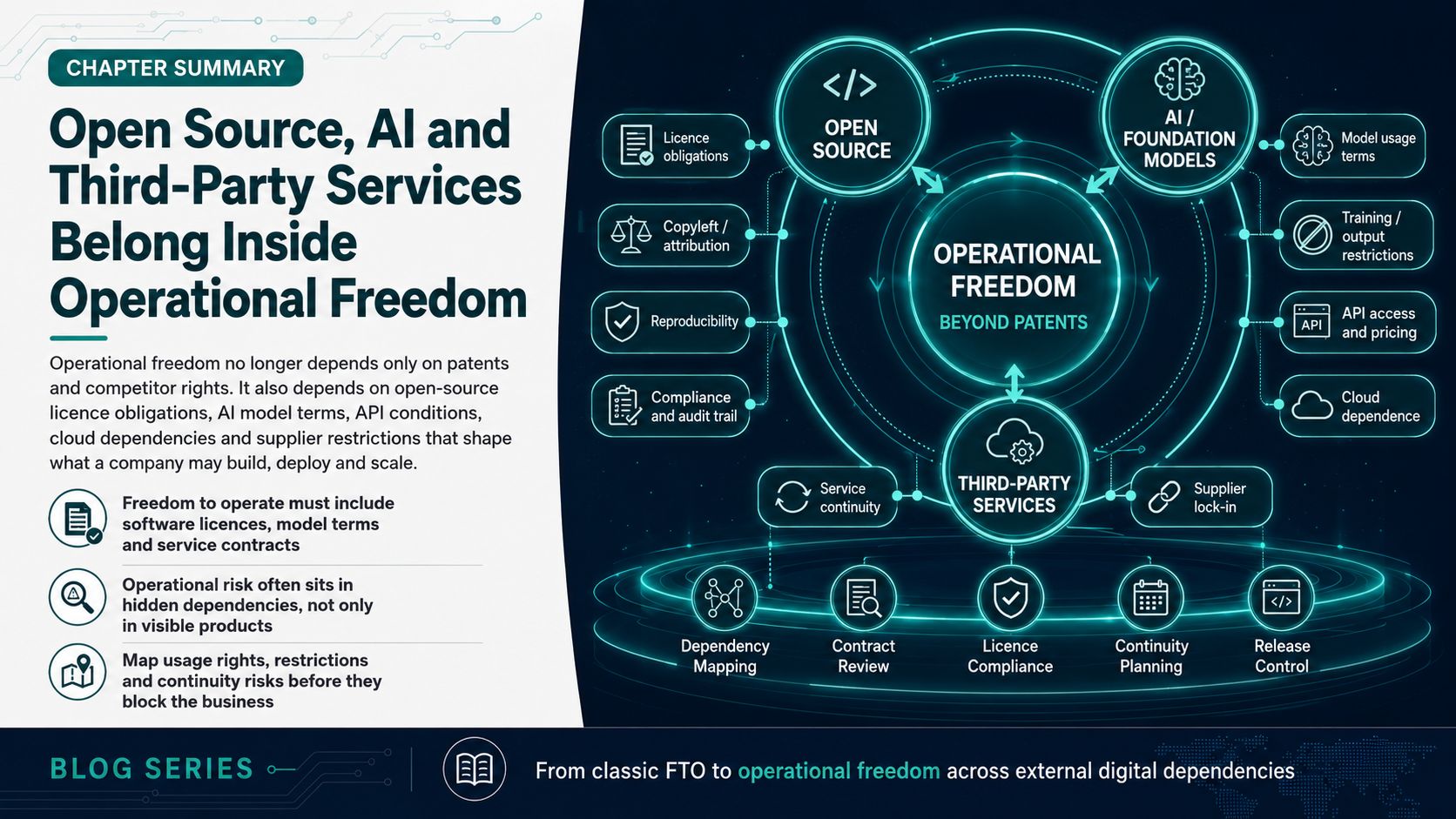
Open source, AI and third-party services belong inside operational freedom
Patent clearance alone does not establish freedom of action for a modern software product. A technically non-infringing implementation may still be commercially unusable because the company lacks sufficient rights in code, data, models or external services. The updated process must therefore assess the complete dependency structure of the offering.
Open-source software illustrates the point. The strategic question is not whether open source is good or bad, but whether the selected component, version, licence and distribution model are compatible with the intended business model. A component used internally may create different obligations from one embedded in a device or distributed to customers. A later version change can also alter the applicable conditions.
AI components add further layers. Teams may use external model weights, training data, generated code, embedding services, prompt libraries or hosted APIs. Freedom of action depends on provenance, permitted use, modification rights, output terms, confidentiality, retraining restrictions and the ability to continue operating when a provider changes its service. A model can be replaceable in theory but operationally indispensable because validation and customer workflows have accumulated around it.
Third-party services create similar dependencies. SDKs, cloud functions, mapping services, identity providers and industrial data interfaces may be integrated rapidly, yet their terms can affect sublicensing, data use, territorial availability and termination. Procurement review after technical integration is too late because the supplier has already acquired leverage through switching costs.
The practical foundation is a trustworthy component and dependency record. A software bill of materials should be connected to ownership, licence, version, use context, responsible team and release status. AI assets need comparable lineage. Critical suppliers and interfaces should be linked to fallback options, contractual protections and architectural isolation where feasible.
In software-intensive development, operational freedom is produced by the combined position in patents, copyright, open-source licences, data rights, model terms and supplier contracts. Continuous Freedom of Action must follow these dependencies through the real build, deployment and update process rather than treating them as separate legal checklists.
Turn risk screening into a cross-functional decision system
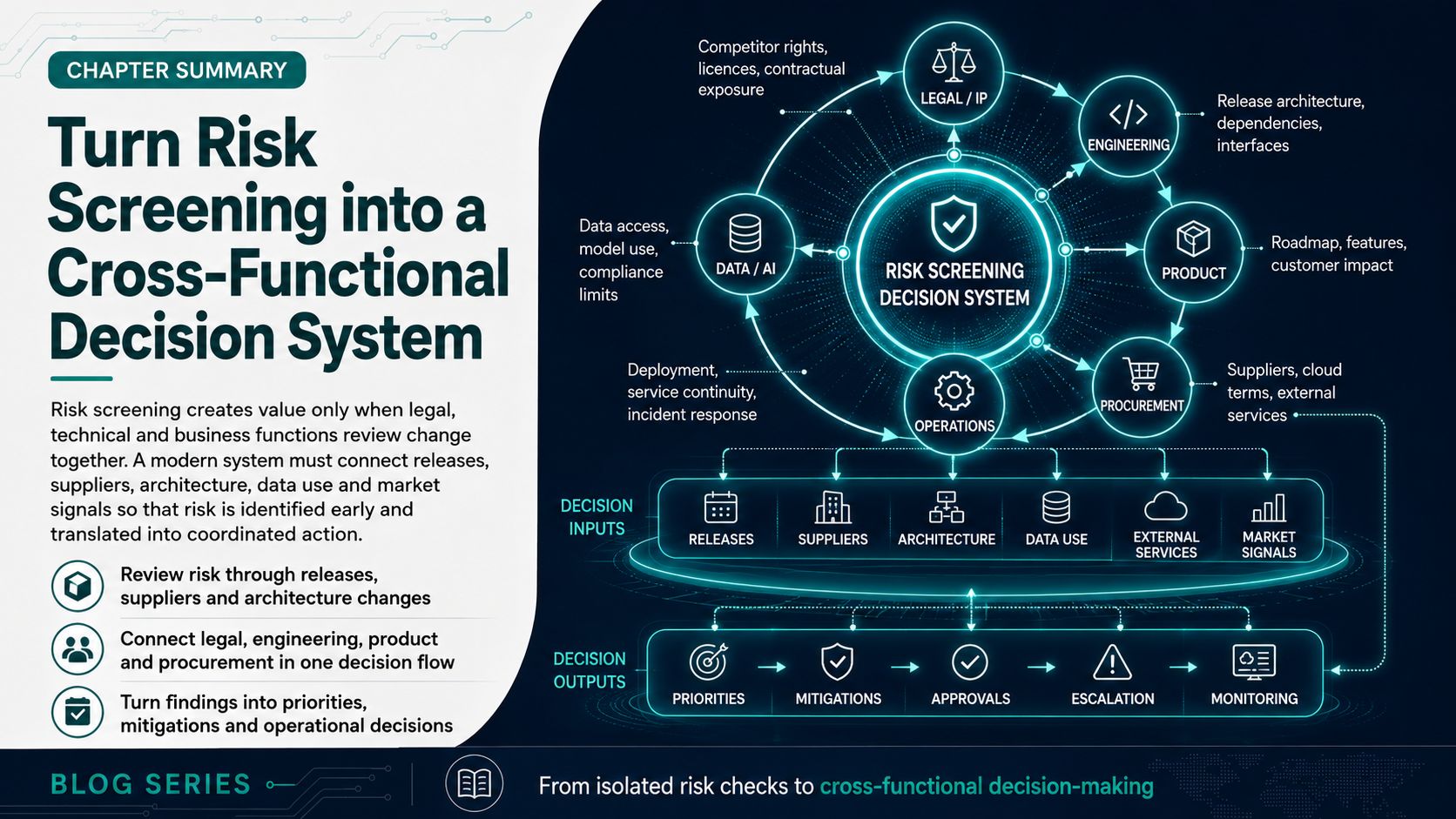
Freedom of Action becomes effective only when its outputs change decisions. A sophisticated search report that arrives without a clear owner, deadline or business consequence is information, not risk management. The process must connect IP expertise with product governance.
Product management should identify which customer outcomes, markets and roadmap commitments are commercially critical. Engineering and architecture teams should explain how those outcomes are technically realised and which alternatives remain possible. IP specialists should translate the architecture into searchable and legally assessable features. Open-source, data, security, procurement and compliance experts should evaluate the dependencies within their scope. Business leadership must decide which residual risks are acceptable.
The result should be a living risk record for each material issue. It should state the affected feature, relevant right or restriction, jurisdictions, current evidence, business exposure, uncertainty, available responses, decision owner and next review trigger. This creates continuity when staff change and prevents old assumptions from being mistaken for current conclusions.
Management responses are broader than “launch” or “stop”. The company can redesign, invent around, substitute a component, negotiate a licence, obtain an indemnity, challenge validity, restrict a feature, change the deployment model, avoid a territory, postpone activation or accept a documented residual risk. The earlier the issue becomes visible, the more of these options remain realistic.
The process should also create positive strategic output. Repeated screening reveals where competitors concentrate, where the company’s architecture is distinctive and where a workaround could become a patentable improvement. Freedom of Action can therefore guide synthetic inventing and show where the company should build its own control points.
Clear decision rights are essential. Teams need to know which risks can be accepted by a product owner, which require the business unit and which must be escalated to executive management. Defined release criteria and evidence that agreed mitigation has been implemented allow speed without reducing IP risk to informal judgement or a last-minute legal veto.
Continuous Freedom of Action ultimately turns FTO from a late clearance exercise into an organisational capability. It combines iterative analysis, architectural transparency, documented evidence and cross-functional decisions so that the company can innovate quickly without becoming unknowingly trapped by its own technology choices.
Supplementary content on the IPBA® platform:
IP Infringement Risks in Agile Software Development
Examines how software features can be assessed as layered bundles of IP rights and why risk prediction must develop alongside agile product evolution rather than wait for a finished release.
👉 Read more
Freedom to Operate
Provides the legal and strategic foundation for FTO searches, including product definition, patent-landscape analysis, design-around opportunities and the limits of relying on one late clearance exercise.
👉 Read more
IP Risk Management in Digital Business Model Creation
Connects late FTO problems with avoidable development waste and develops the idea of continuous, quality-oriented IP risk management for digital innovation projects.
👉 Read more
Milestone-Based IP Management
Shows how IP reviews, protection decisions and risk assessments can be tied to development and commercialisation milestones so that the depth of analysis increases with project maturity.
👉 Read more
Stage-Gate-Process
Explains how structured decision points in innovation processes can be used to integrate FTO findings, IP risks and mitigation measures before further resources are committed.
👉 Read more
Open-Source Software
Clarifies licence identification, compatibility, distribution obligations and documentation requirements that must be connected to the actual software build and release process.
👉 Read more
Interview with Stefan Brehm about AI-Based Patent Search
Adds a practical search perspective by explaining the scope of FTO research and how AI-supported tools can improve patent searching without replacing expert evaluation.
👉 Read more
Operational IP Management: Turning Protection into Growth
Places continuous FTO, proactive searching, licensing options, engineering awareness and responsible open-source use within the broader discipline of operational IP management.
👉 Read more
IP Process Management: Turning Organizational Structures into Business Resilience
Demonstrates why FTO analysis and monitoring become preventive tools only when they are embedded in standard product-development, risk-management and launch procedures.
👉 Read more
Understanding the New Role of IP Management within the Digital Transformation in Industry and Commerce
Offers an early industrial view of risk-based FTO for IT and crossover inventions, including open-source compliance and the need to align IP risk decisions with business impact.
👉 Read more