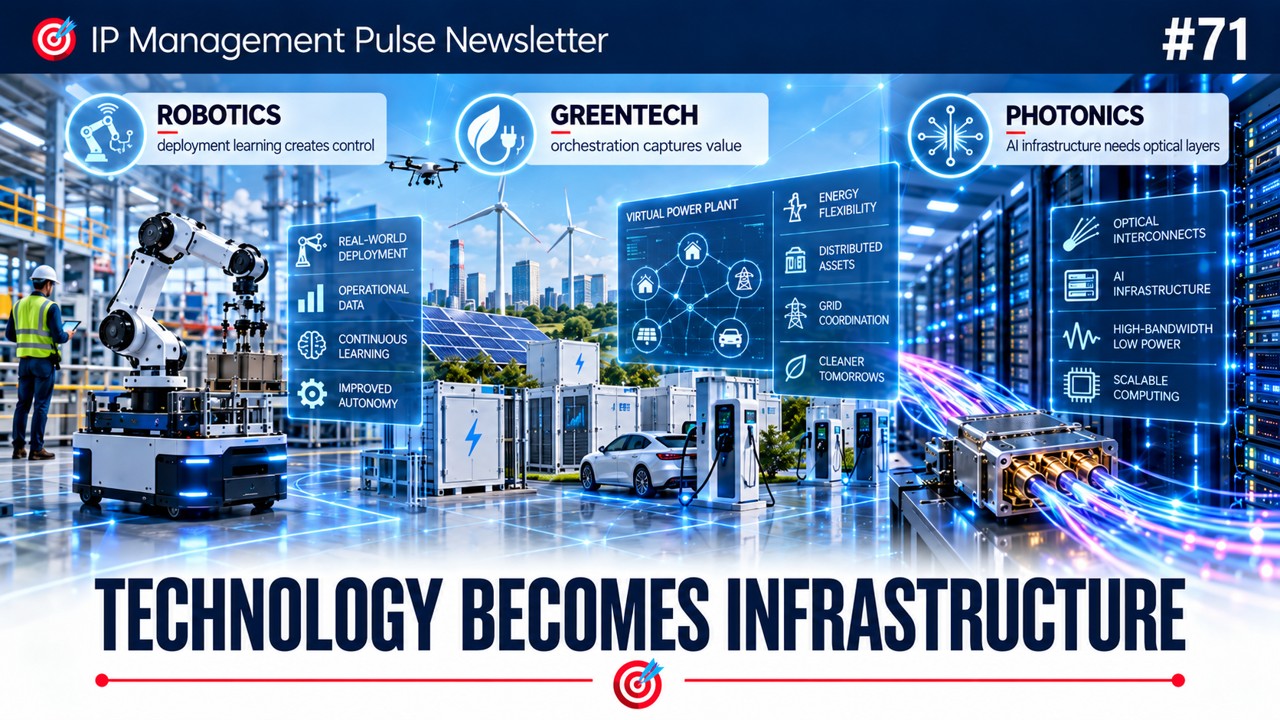
When technology becomes infrastructure, IP has to follow 🎯IP Management Pulse #71

Subscribe for compact, in-depth IP intelligence: trends, cases and research curated by the team of the IP Business Academy and the IPBA Connect Platform. Get practical insights into current developments in IP management and learn from leading experts in the context of business models, innovation and R&D.
Explore previous editions in the newsletter archive and subscribe to 🎯IP Management Pulse for a fresh read every two weeks.
The next newsletter will cover the following topics:
Robotics Turns Operational Learning into Industrial Capability
Marc A. Wietfeld highlighted the establishment of ARX Industries, a joint venture between ARX Robotics and Roboneers to manufacture unmanned ground vehicles at industrial scale. The development shows how experience from real-world deployment can feed directly into manufacturing and future product generations. For IP management, this raises questions about ownership of operational data, software improvements, field-generated know-how and rights to reuse learning across manufacturing and technology partnerships.
Virtual Power Plants Change Where GreenTech Value Is Created
David Voxlin, co-founder of Axle Energy, announced a $25 million Series A financing round to expand the company’s virtual power plant platform. By connecting batteries, electric vehicles and heat pumps, Axle illustrates how value is shifting from individual energy devices towards the software infrastructure that coordinates them. The newsletter examines why algorithms, data access, technical interfaces and contractual integration rights are becoming strategically important IP assets in the energy transition.
Photonics Becomes a Strategic Layer of AI Infrastructure
Aldo Kamper, CEO of ams OSRAM, highlighted advances in Thin-Film microVCSEL technology for optical interconnects at ECOC 2026. As AI data centres require greater bandwidth and energy efficiency, optical technologies are becoming increasingly important to computing architecture. This creates an IP-management challenge that extends beyond individual optical components to manufacturing know-how, packaging, integration capabilities and control over strategically relevant system interfaces.
GreenTech IP and the Journey from Sustainable Processes to Industrial Scale
A sustainable production process can create substantial competitive advantage even when the resulting product resembles its conventional alternative. This IP Business Academy article examines how companies can retain that advantage as they move from pilot projects towards industrial production. Drawing on perspectives from the GreenTech ecosystem, it connects patents, confidential process knowledge, financing, commercial partnerships and the rights to use improvements across future facilities.

Turning Field Experience into Protected Value
Industrial innovation often emerges outside formal R&D, when engineers solve operating problems, service teams adapt equipment or customers reveal new technical requirements. The practical case with Meinolf Rameil explores how companies can identify commercially valuable improvements and decide whether they should be patented, protected as confidential know-how or shared with customers. It provides a practical perspective on turning everyday engineering experience into reusable business assets.
Open Innovation Needs IP Architecture Before Collaboration Starts
Complex technologies increasingly depend on collaboration between manufacturers, software developers, research organisations and industrial customers. But joint development also creates questions about background IP, improvement ownership, information exchange and future exploitation rights. Our dIPlex Deep Dive examines how companies can structure these relationships before valuable knowledge begins to move between partners. The aim is to enable collaboration without unintentionally transferring the capabilities that underpin long-term competitive advantage.
Good Positioning Requires a Choice
IP professionals often possess a much broader range of expertise than they can effectively communicate to the market. In her latest Visible Council column, Giulia Donato explains why strong expert positioning requires deliberate choices about which capabilities, client problems and future opportunities should define professional recognition. Rather than presenting every service equally, experts need to make clear what they particularly want to be chosen for.

Competitive Patent Strategy in Semiconductor Equipment
Semiconductor equipment companies operate in markets where competitors may deliver similar technical functions through different engineering solutions. Our latest IP Management Learning examines why patent portfolios should be reviewed against evolving competitor technologies and commercially important functions, rather than only against a company’s existing products. It connects claim strategy, prosecution opportunities, evidence of infringement and confidential manufacturing know-how to a more dynamic approach to competitive IP management.