
IP Market Study Green Tech 2026: How IP Becomes the Control Layer of Sustainable Industrial Innovation

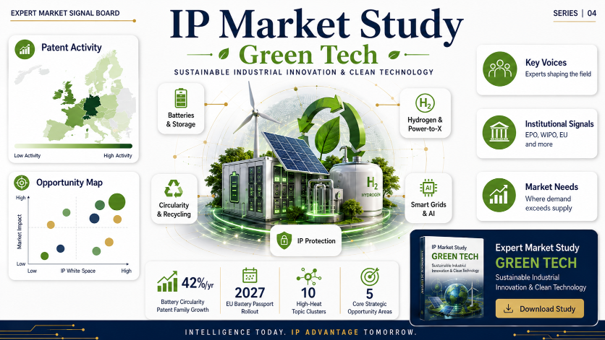
Green Tech is no longer only a field of “green inventions.” It is becoming one of the most important industrial transformation environments in Europe — and intellectual property is moving into the centre of that transformation.
Batteries, recycling, hydrogen, smart grids, sustainable aviation, maritime decarbonisation, AI-based energy optimisation, charging infrastructure and circular economy systems all raise IP questions. But these questions no longer sit neatly inside the old categories of patent drafting, freedom to operate, trade secrets, licensing or contracts.
The real question is becoming broader: what must a Green Tech company control in order to scale, collaborate, attract capital, access markets and keep room to act?
That is the starting point of the new IP Market Report on Green Tech. The report was prepared as a market intelligence and business development resource for IP experts — patent attorneys and adjacent IP service providers — who want to understand where the European market for Green Tech IP services is forming.
Its core message is clear: Green Tech IP is becoming a control layer of sustainable industrial innovation.
This means that IP advice in Green Tech cannot stop at the question: “Can we protect this invention?” The stronger question is: “Where does strategic control actually sit — in a material, a process, a software layer, a data flow, a standard, a supply relationship, a regulatory disclosure system or a combination of these?”
For IP experts, this creates a major opportunity. Green Tech companies do need patents. But more importantly, they need advisers who can translate patents, trade secrets, data rights, standards, contracts and regulatory disclosure into business decisions.
Green Tech has become one strategic environment
The report shows that the current Green Tech IP conversation has moved well beyond a narrow focus on clean-energy patenting.
Recent developments are appearing at the interfaces of critical raw materials, battery circularity, digital product transparency, AI-driven energy demand, clean mobility, charging infrastructure, sustainable propulsion, financing and patent-data intelligence.
The common thread is not simply “more green innovation.” The common thread is control.
Battery circularity is a good example. Recycling and reuse are no longer only environmental topics. They are becoming strategic control points for access to lithium, nickel, cobalt, graphite and other critical materials. Much of the decisive value sits in process know-how: separation methods, recovery chemistry, purification steps, yield optimisation, energy efficiency and scale-up parameters.
That makes the patent-versus-trade-secret decision much harder. A company may need patents to attract investors and signal technological credibility. But if it discloses critical process parameters too early, it may destroy the very advantage that makes the technology valuable.
The EU Battery Passport adds another layer. From 2027, certain batteries placed on the EU market will require structured digital product information. For companies, this is not only a compliance task. It is an IP-management event. They will need to decide what can be public, what should be restricted, and what must be kept out of disclosure workflows entirely.
This is why the report treats the Battery Passport and broader Digital Product Passport regime as a strategic IP issue. Transparency and proprietary control are beginning to collide.
Green Tech IP is becoming software- and data-driven
Another important shift is the connection between Green Tech, AI infrastructure and digital energy.
AI is increasing demand for computing power, cloud infrastructure and data-centre capacity. That raises questions about energy use, cooling systems, grid load, renewable-power integration, efficiency technologies and digital sovereignty. In parallel, Green Tech solutions themselves increasingly rely on software, optimisation systems, digital twins, control platforms, data infrastructure and energy-management tools.
This changes the IP work.
A clean-energy solution may now involve a physical device, a control algorithm, a training dataset, a data-processing pipeline, a user interface, a cloud architecture and operational know-how. Traditional patent advice alone is no longer enough. Companies need combined strategies for computer-implemented inventions, data access, trade secrets, copyright, contracts, cybersecurity and regulatory compliance.
The same pattern appears in smart grids, charging infrastructure and clean mobility. These are system markets. The decisive IP position may not sit in one patent on one device. It may sit in an interface, a standard contribution, a software layer, a data model, a network architecture or a platform position.
That is why standardisation, interoperability and potential SEP/FRAND questions are becoming more relevant in Green Tech. Charging systems, hydrogen systems, grids, battery passports and data spaces all depend on shared interfaces. Whoever shapes the interface may shape who can access the market.
The most important gap is not legal competence, but translation
One of the strongest insights of the report is that the Green Tech IP market is not primarily suffering from a lack of legal or technical expertise.
Many European IP experts can draft strong patents for chemistry, engineering, software, batteries, materials, electronics or energy systems. Many firms already have the underlying capability.
The problem is that this capability is often communicated in the wrong language.
Green Tech companies do not experience their challenges as separate legal categories. They experience them as one decision environment: control, dependency, scalability, investment readiness, standardisation, collaboration and market access.
A battery company does not only ask whether a cell chemistry is patentable. It asks whether it can protect the manufacturing process, keep recycling know-how secret, satisfy Battery Passport disclosure requirements, avoid blocking rights, convince investors and negotiate from strength with industrial partners.
A hydrogen company does not only ask whether an electrolyser invention can be filed. It asks how catalysts, plant configuration, safety standards, infrastructure partners, offtake agreements and financing timelines fit together.
A smart-grid company does not only ask whether a software invention is patentable. It asks how sensors, algorithms, cybersecurity, interoperability standards and platform governance shape its bargaining power.
The report therefore frames Green Tech IP as a translation problem. The expertise exists, but the market does not always see it. IP experts who can translate legal capability into control, leverage, dependency and investment language will be easier to recognise for founders, CTOs, investors, general counsel, business-development teams and industrial partners.
Patent landscapes become market maps
The report also identifies a major shift in patent analytics.
In Green Tech, patent data is increasingly being used not only to describe technical activity, but to interpret market direction. Patent landscapes can show where competition is concentrating, where fields are becoming congested, where regional strengths are emerging, where future dependencies may arise and where white space remains.
This is particularly valuable because Green Tech companies often face long development cycles, capital intensity and collaboration dependence. Investors and industrial partners need evidence that a company controls a defensible position. That evidence cannot be reduced to the number of patent filings.
A strong IP narrative answers more relevant questions: What does the company control? How hard is it to design around? Where is the freedom-to-operate risk? How does the portfolio support the roadmap? Where are competitors building? Which parts of the system create bargaining power?
For IP experts, this turns patent landscaping into a strategic service. It can support investment readiness, FTO planning, competitive strategy, acquisition screening, partnership negotiation and business-development targeting.
In other words, patent analytics becomes market intelligence.
The experts already shaping the European conversation
The report maps a set of European voices and specialist Green Tech groups that are already shaping the public discussion.
Andrew Cockerell and the D Young & Co Green Tech group stand for a data-driven approach to green-technology patenting. Their work connects patent statistics, public policy, green fast-track schemes, Y02 classifications, funding signals and the role of SMEs in sustainable innovation.
Chris Mason and the Appleyard Lees Green Tech group represent one of the more consistent examples of Green Tech IP thought leadership in Europe. Their “Inside Green Innovation” work tracks patent-filing trends across batteries, wind, AI power management for data centres, biodegradable materials, sustainable chemical feedstocks, plastics recycling, biomass, ammonia, methanol and alternative proteins.
Jamie E. Barcombe and the Finnegan Green Tech group show how the discussion is moving from patenting activity into portfolio quality, freedom to operate, litigation readiness and claim scope. This matters because Green Tech IP is not only a prosecution market. As sustainable technologies become more crowded and more valuable, enforcement and commercial-risk questions become more important.
Posy Drywood and the Mathys & Squire Green Tech group are particularly relevant for batteries, clean-energy storage and the strategic use of patent data in fast-moving cleantech markets. Their work illustrates how patents can be used not only as protection tools, but also as a way to understand the technological landscape.
Andrew Pearson and the Potter Clarkson Green Tech group bring a strong sustainable-mobility perspective, connecting sustainability, digitalisation and patent activity across future transport. This is important because clean mobility is a multi-layer innovation system, spanning propulsion, fuels, certification, infrastructure, data and circularity.
Janine Swarbrick and the HGF Green Tech group contribute a cross-rights view of Green Tech IP. Their work connects patent statistics, energy-market volatility, renewables, storage, grid technologies, litigation risk, UPC considerations and green branding. This reflects one of the report’s wider findings: Green Tech IP is becoming a cross-rights strategy problem.
The report also highlights institutional voices. The European Patent Office is becoming an infrastructure layer for patent-data-as-market-intelligence through its Patent Index, EPO–IEA and EPO–EIB studies, the Deep Tech Finder and Observatory data. WIPO GREEN positions IP as an enabler of green-technology transfer and scaling through matchmaking, acceleration projects, the Green Technology Book and IP Management Clinics.
Together, these voices show that the Green Tech IP conversation in Europe is active — but still not saturated. That makes the timing attractive for IP experts who want to build a visible position.
Where the strongest service opportunities sit
The opportunity map in the report translates market needs into concrete services that IP experts can productise and sell.
The first opportunity is a Green Tech IP control mapping or strategy workshop. This is designed for systemic deep-tech scale-ups in fields such as batteries, hydrogen and grids, especially companies raising Series A to C funding or facing their first serious investor or competitive test. The purpose is to create a board-level view of where control and dependency actually sit.
The second opportunity is portfolio architecture across patents, trade secrets, data and contracts. This is particularly relevant for process- and materials-heavy companies — for example in battery recycling, catalysts, membranes, green chemistry or industrial decarbonisation — where the most valuable know-how may not be fully visible in the final product.
The third opportunity is FTO and competitive landscape work framed as a market map. In congested fields such as lithium-ion batteries, EVs and electrolysis, companies need more than a legal clearance view. They need to understand where competitors are building, where blocking rights may arise, and how to design around strategic congestion.
The fourth opportunity is IP-for-investment and diligence-readiness. Green Tech start-ups and university spin-outs need to convert technical substance into an investable asset narrative. Investors do not want only a patent list. They want to understand protectability, imitation delay, FTO posture and portfolio-to-roadmap fit.
The fifth opportunity is collaboration and ownership structuring. Green Tech companies rarely scale alone. They work with manufacturers, utilities, OEMs, universities, public institutions, infrastructure operators, suppliers and investors. Every pilot, consortium, joint development or offtake agreement creates questions of background IP, foreground IP, improvement ownership, data-use rights, sublicensing and third-party risk.
The sixth opportunity is standardisation and SEP strategy. Charging, hydrogen systems, smart grids, battery passports and data spaces all depend on interoperability. Companies need to know whether they should participate in standards development, how to protect contributions, how to manage SEP/FRAND exposure and how to avoid becoming dependent on infrastructure controlled by others.
The seventh opportunity is regulation-linked IP advisory around Digital Product Passports, the Battery Passport and the EU sustainability framework. This is one of the most important emerging service areas because it connects disclosure obligations with trade-secret protection, patent strategy, supplier contracts and compliance design.
Across all these services, the report makes the same point: the market does not only need more IP work. It needs IP work packaged around the decisions Green Tech companies actually face.
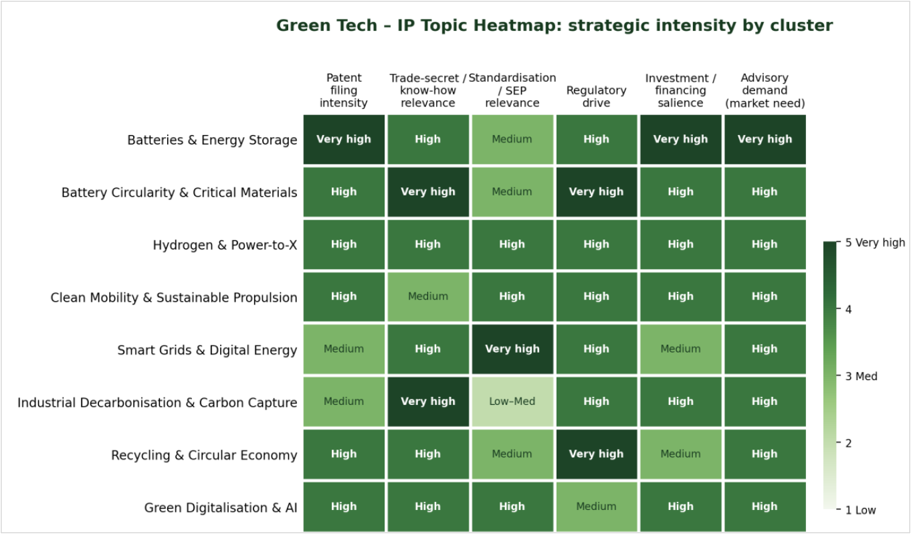
Fig. 1: Excerpt from the IP Market Report IP in Green Tech Topic Intensity
What this means for private practice
For IP experts, the implication is direct: Green Tech should not be presented only as one technical item in a long list of sectors. It should be translated into concrete problems that clients recognise: control mapping, patent-versus-trade-secret decisions, disclosure strategy, collaboration architecture, investment readiness, standards exposure and market intelligence.
This requires a shift in public communication. Many IP experts still present Green Tech capability through legal categories: patent drafting, FTO, oppositions, licensing, trade secrets, contracts. Those categories are necessary, but they are not the language of the client’s strategic problem.
The stronger positioning is to show how IP helps a Green Tech company answer questions such as:
- Where is the defensible control point in our system?
- What should we patent, what should we keep secret, and what will regulation force us to disclose?
- How do we collaborate with industrial partners without losing the upside?
- How do we make our IP position credible to investors?
- Where are we dependent on standards, suppliers, data flows or infrastructure we do not control?
- How do we use patent landscapes as market intelligence?
Firms that answer these questions clearly will be more visible to the market than firms that only state that they protect green inventions.
Why this Market Study is worth downloading
The full IP Market Report on Green Tech provides a structured view of the European Green Tech IP market. It covers current developments, key voices, topic clusters, market needs, opportunity areas for IP experts, implications for private practice and the outlook for the next 18 to 36 months.
For anyone offering IP services to companies in batteries, hydrogen, clean mobility, smart grids, sustainable fuels, circular economy, industrial decarbonisation or Green AI, this is not only background reading. It is a practical map of where demand is emerging, where service offerings are still underdeveloped, and where first movers can build a visible position.
The central lesson is simple: Green Tech companies do not only need stronger IP rights. They need IP advice that helps them understand what they must control.
The full IP Market Report on Green Tech is available here free of charge:
👉 https://profwurzer.com/diplex/docs/green-tech/ip-market-report-ip-in-green-tech/
More background on the structural market logic behind the study is available in the Industry Focus on the digital IP lexicon dIPlex:
👉 https://profwurzer.com/diplex/docs/green-tech/
There is also an overview episode in the podcast IP Management Voice explaining the key findings of the Market Report and what they mean for IP experts, advisory firms and the wider Green Tech innovation ecosystem:
👉 https://ip-management-voice.podigee.io/93-ip-and-green-patents
Expert voices and source references
Andrew Cockerell and the D Young & Co Green Tech Group. The report highlights their work on green-technology patent statistics, policy signals, Y02 classifications, green fast-track schemes and the role of SMEs in sustainable innovation.
Source: https://www.dyoung.com/en/knowledgebank/articles/greentech-worldwide-patent-statistics
Chris Mason and the Appleyard Lees Green Tech Group. The report highlights the “Inside Green Innovation” work and Greenshoots podcast as one of the more consistent Green Tech IP thought-leadership platforms in Europe, covering batteries, wind, AI power management, sustainable feedstocks, plastics recycling and other green innovation fields.
Jamie E. Barcombe and the Finnegan Green Tech Group. The report highlights their contribution to cleantech patent statistics, sustainable patenting and sustainable-technology litigation, showing how Green Tech IP is moving from filing activity into portfolio quality, enforcement and commercial risk.
Posy Drywood and the Mathys & Squire Green Tech Group. The report highlights their battery-patent and clean-energy commentary, especially the use of patent data to understand fast-moving battery and energy-storage markets.
Andrew Pearson and the Potter Clarkson Green Tech Group. The report highlights their work on sustainable transportation innovation and the way future mobility combines propulsion, fuels, automation, circularity, infrastructure and data.
Janine Swarbrick and the HGF Green Tech Group. The report highlights their interpretation of EPO filing trends in computer technology, AI, electrical machinery, energy, battery innovation and transport, as well as HGF’s wider “Fuelling IP” work on green branding, energy IP and cleantech strategy.
Source: https://www.hgf.com/knowledge-hub/legal-updates/european-innovation-remains-strong-epo-patent-index/