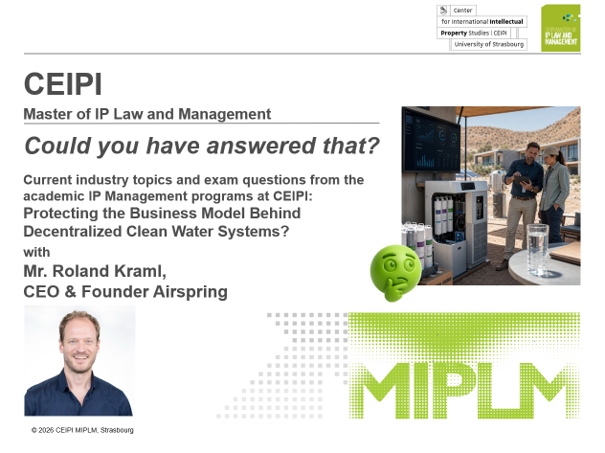
Practical Question Roland Kraml: Protecting the Business Model Behind Decentralized Clean Water Systems

GreenTech is changing the logic of IP strategy. In many sustainable innovation systems, the decisive value is no longer located in one isolated invention. It emerges across several layers: hardware, process know-how, software, field data, consumables, production partnerships, regulatory approvals, service relationships and the trust required for deployment in critical infrastructure.
This creates a new strategic challenge for GreenTech companies. A company may have a technically convincing prototype and still remain exposed if its IP position protects only the visible technical solution. In decentralized clean water systems, for example, the economic bottleneck may lie in the purification sequence, the consumable materials, the quality data, the maintenance logic, the partner network or the recurring service model around the system.
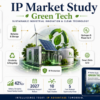
This is exactly the type of shift described in the CEIPI IP Business Academy analysis “The GreenTech Strategy Gap”. The study shows that GreenTech companies increasingly operate in layered industrial transition systems rather than in isolated technology categories. They need IP support that connects patents, trade secrets, data control, contracts, supply chains, public stakeholders, financing and market access into one strategic control architecture.
Here you find the findings of this study: “The GreenTech Strategy Gap: What Sustainable Innovation Companies Need, and What IP Advice Still Often Fails to Integrate”
Against this background, the CEIPI IP Business Academy integrates practice-based questions from industry into its teaching. These questions help students understand IP not only as a legal protection tool, but as a management instrument for strategic decision-making in complex innovation systems.
We are therefore pleased to include this industry case study with Roland Kraml, CEO & Co-Founder, Airspring GmbH. His practical question focuses on a central issue for GreenTech hardware companies: how to decide which parts of an integrated decentralized clean water ecosystem should be protected through patents, trade secrets, data control, contracts or brand positioning before the company exposes critical information to investors, deployment partners and the market.
Here is the evaluation of this case by Roland Kraml, CEO & Co-Founder, Airspring GmbH:
“Having built and financed GreenTech hardware through exactly this phase, I know this is the question that quietly decides a company’s future. The moment you move from a working prototype to your first paying pilots, the decisive issue is no longer what you can legally protect, but where your bargaining power actually sits — and whether you’ve secured it across the right mix of proprietary expertise, field data, supply relationships, and brand before you have to show your hand to partners and the market. In a business that blends hardware, software, and recurring consumables, you rarely own the whole value chain alone. Production, approvals, reaching customers, and ongoing servicing typically run through third parties, and each of those relationships quietly reopens the question of who owns the upgrades, the data, and the customer. Get that mix right early, and your IP becomes a financing and negotiation asset; get it wrong, and you have effectively handed a larger rival the blueprint. That judgement — which begins well before the first claim is drafted — is what separates IP that drives growth from IP that merely sits in a portfolio.”
Mini Case Study
A GreenTech scaleup has developed a compact water ecosystem that can generate, purify and mineralize drinking water close to the point of use. The technology combines atmospheric water capture, filtration, sensor based quality monitoring, consumable materials, software assisted maintenance and a data layer for system performance.
The company is preparing a first industrial pilot with hotels, remote facilities and municipal partners in water stressed regions. The technical team is under pressure to disclose performance data, process parameters and integration details to convince investors and deployment partners. At the same time, several larger equipment manufacturers are watching the field closely and could reproduce parts of the system once the market potential becomes visible.
The management team faces a difficult decision. Filing broadly on every technical element would consume budget and may reveal sensitive know how too early. Keeping too much confidential could weaken investor confidence and make partner negotiations harder. The real challenge is not whether the invention is “protectable” in principle. The challenge is deciding which elements create future control over the business model.
Practical Question
Which parts of a decentralized clean water ecosystem should be protected through patents, trade secrets, data control, contracts or brand positioning in order to support scaling, partnerships and investment without losing strategic control too early?
Why This Question Matters in Practice
This question becomes relevant when a GreenTech company moves from prototype to pilot deployment and must share technical information with investors, manufacturing partners, infrastructure operators or public stakeholders. At that point, IP is no longer an administrative filing issue. It becomes part of the commercial architecture of the company.
The question is especially important for founders, CTOs, IP managers, investors and business development teams in water technology, decentralized infrastructure, climate adaptation and resource efficiency. These companies often depend on partnerships because they cannot manufacture, certify, distribute and maintain complex systems alone. Every partnership creates a control question around improvements, operating data, consumables, service models and market access.
The issue becomes strategically critical when the product is not a single device but an integrated system. Economic value may sit in a sensor algorithm, a purification sequence, a consumable material, a maintenance dataset, a process parameter or the trust created by reliable water quality. If these elements are protected in isolation, the company may still lose leverage. If they are protected as a coordinated IP architecture, IP can support financing, partner selection, pricing power and long term competitive positioning.
Roland Kraml
 Roland Kraml is CEO and Co-Founder of Airspring GmbH, where he leads the development of what the company describes as the world’s first independent drinking water ecosystem, generating, purifying and enriching water directly from air. His current work combines GreenTech, clean water infrastructure, technology strategy and business development. In addition to his role at Airspring, he advises Hydrofy on growth and strategy in hydrogen mobility and leads FutureTech 108, focusing on advisory work, technology innovation and strategy across generative AI, the patent industry, aerospace, advanced propulsion, plasma physics, clean water and GreenTech.
Before founding and building his current ventures, Roland held senior leadership and advisory roles in the IP and technology sector. He served as Counsel at ABP Patent Network GmbH, working on strategic consultancy and generative AI solutions for the patent industry, including the co-creation of patentbutler.ai with IBM. Earlier, he was Executive Director at WR Intellectual Property and held Managing Director and Senior Manager roles at Morningside, where he was responsible for Continental European business development, strategic account management, patents and IP related services. Roland studied at the University of Vienna, where he earned a Magister degree, and his professional background combines entrepreneurship, strategic advisory, IP industry experience and technology commercialization.