GreenTech IP in Europe: How Regimbeau and Zacco Frame Sustainable Innovation Differently

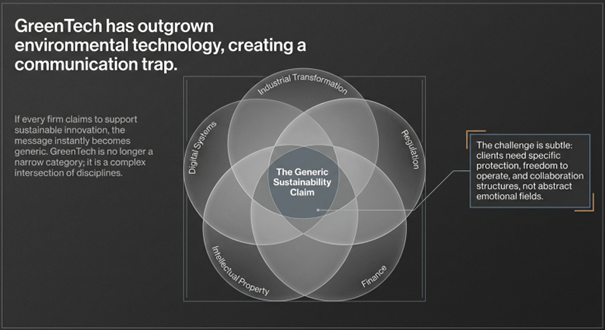
GreenTech is no longer a narrow category of environmental technology. It has become a broader field in which sustainable innovation, digital systems, industrial transformation, regulation, finance, collaboration and intellectual property increasingly intersect. For IP practice groups, this creates both an opportunity and a communication challenge. The opportunity is obvious: GreenTech companies need protection, freedom to operate, collaboration structures, portfolio decisions, investor readiness and market access. The challenge is more subtle: if every firm says it supports sustainable innovation, the message can quickly become generic.
This is why it is useful to compare how different European IP firms frame the same topic. The purpose of such a comparison is not to decide who is better. It is to understand how different practice groups make GreenTech legible to the market. Some firms communicate GreenTech primarily as a technology field. Others present it as a strategic asset-management issue. Others place it within regulatory, digital or societal transformation. These differences matter, because positioning is not just about what a firm can do. It is about the problem frame through which potential clients understand why the firm may be relevant.
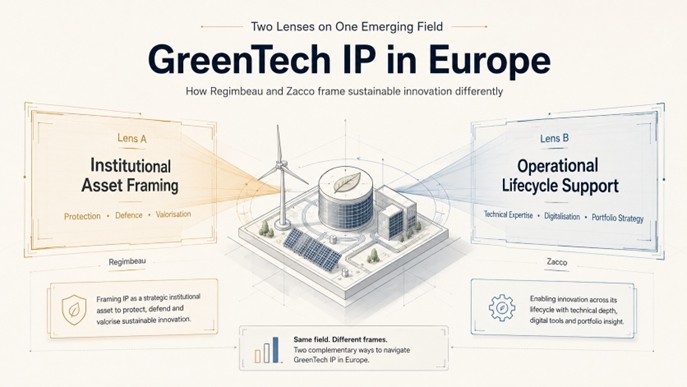
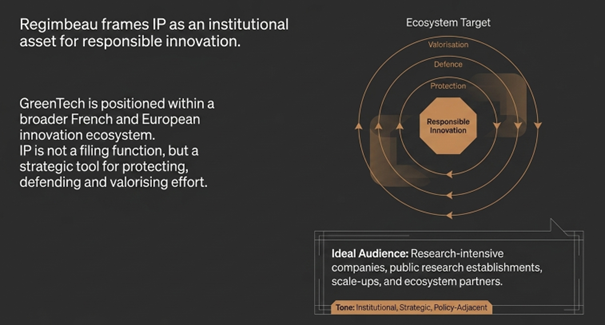
Regimbeau and Zacco offer an interesting European pairing. Both are IP-focused firms with visible public references to GreenTech or sustainable innovation. Both appear to understand that GreenTech is not only about obtaining patents for environmentally beneficial inventions. Yet they seem to frame the subject differently. Regimbeau’s communication appears to place GreenTech within a French and European innovation ecosystem, with intellectual property presented as a strategic tool for protecting, defending and valorising responsible innovation. Zacco’s communication appears more Nordic, operational and lifecycle-oriented, with GreenTech linked to technical expertise, collaboration, digitalisation, portfolio management and practical IP strategy across the full IP lifecycle.
This difference is worth examining because it shows how GreenTech can be made credible in two distinct ways. One route is to connect IP to the development and dissemination of responsible innovation within a broader sustainability ecosystem. The other route is to connect IP to practical, market-oriented portfolio work, where technical, digital, commercial and enforcement capabilities support companies as they turn sustainable technologies into protected and manageable assets.
Regimbeau: Positioning GreenTech as responsible innovation and strategic asset valorisation
Regimbeau’s GreenTech positioning appears to be closely connected to the idea that intellectual property can become a strategic asset in the development of companies. This is not a minor wording choice. It places IP beyond the filing function and closer to the business logic of protection, defence and valorisation. In the GreenTech context, this matters because sustainable innovation often requires more than technical protection. It requires credibility, partnerships, investment, diffusion and a structured way to turn innovative effort into recognised value.
The public GreenTech references from Regimbeau suggest a communication frame in which IP supports the development and dissemination of responsible innovations. Its participation in the Green Tech Forum in Paris is particularly telling. The Green Tech Forum is positioned as a meeting place for digital and environmental professionals, with conferences, workshops, exhibitions and networking around the challenges and opportunities of the GreenTech sector. Regimbeau’s communication around the event does not simply say that the firm advises on green patents. It presents intellectual property as a strategic tool that can support development, dissemination and value creation for responsible innovations.
This gives Regimbeau’s positioning a distinctly ecosystem-oriented quality. The GreenTech topic is not framed only as a list of technologies. It is framed as a field in which innovators, institutions, environmental actors and digital professionals need to exchange expertise and build responsible futures. That is a broader and more public-facing frame than a conventional patent practice description. It suggests that the firm wants to be seen as part of the conversation around sustainable digital transformation, not merely as a service provider at the end of the invention process.
At the same time, Regimbeau’s core message remains recognisably IP-based. The firm’s language around protection, defence and valorisation keeps the topic anchored in strategic asset management. This is important because GreenTech communication can easily become too abstract. Words such as sustainability, responsibility and transformation may create a positive emotional field, but they do not automatically explain what an IP practice group does. Regimbeau’s framing seems to avoid that weakness by connecting the sustainability narrative to the management of strategic assets.
The result is a positioning logic that could be described as institutional and strategic. Regimbeau appears to speak to companies and innovation actors that want their GreenTech work to be protected, recognised, disseminated and converted into durable value. The tone is less startup-marketing-driven and less litigation-heavy. It is closer to a European innovation-policy environment in which sustainability, responsible digitalisation and asset valorisation belong together.
For IP business development, this is a strong frame when the intended audience includes research-intensive companies, public research establishments, technology-transfer actors, scale-ups, large companies and ecosystem partners. It says: GreenTech innovation needs more than technical creativity. It needs an IP structure that supports responsible growth and value recognition in a complex innovation environment.
Zacco: Positioning GreenTech through full-service IP, technical expertise and practical lifecycle support
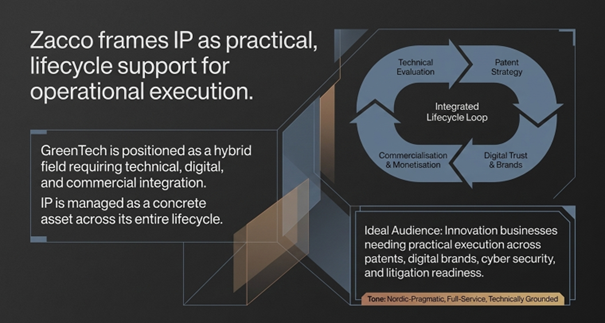
Zacco’s GreenTech positioning appears to follow a different logic. The firm presents itself as one of Europe’s leading full-service IP firms, with services across patents, trademarks, designs, IP litigation, digital brands, digital trust, IP operations and monetisation. This is already a different communication frame. GreenTech is not primarily presented as a public sustainability conversation. It is placed within a broad lifecycle model of intellectual property, where ideas, innovations, brands, digital assets and enforcement issues are managed in an integrated way.
This broader full-service frame is relevant because many GreenTech companies do not face only one IP question. They may need patent strategy, freedom-to-operate work, portfolio development, competitor monitoring, due diligence, licensing, trademark protection, digital brand protection, domain management, cybersecurity-related support and litigation readiness. Zacco’s communication appears to make this complexity visible. It does not reduce GreenTech to a single right or a single procedural step.
The firm’s public profile also suggests a strong technical and operational orientation. Zacco identifies itself as focused on collaboration, technical expertise and practical IP strategies. In the GreenTech context, that wording matters. It implies that IP advice should be close to the way the client’s business and technology actually function. This is reinforced by individual expert profiles. For example, Zacco identifies a project manager for its Green Tech Expert Group, with experience in patent prosecution, invalidity and infringement matters, market-oriented invent-around work, pre-patenting investigations, clean tech and advice to companies on building and commercialising strong patent portfolios in cooperation with research and development and management.
That expert-level framing gives Zacco’s positioning a concrete operational dimension. GreenTech is not only a sector label. It becomes a practical field of portfolio work, technical evaluation, infringement risk, patent strategy, market orientation and cooperation between IP experts, engineers and management. This is a powerful message for companies that need to move from invention to commercialisation without losing control of their IP position.
Zacco also seems to connect GreenTech with digitalisation. Its public insight archive includes a Green Innovation reference around the idea that digitalisation and computer technology are enablers for green innovations. Even if this is an older item, the communication logic remains noteworthy. Many GreenTech fields are now partly digital: smart grids, battery management systems, mobility platforms, energy optimisation software, industrial process monitoring, circular economy tracking, emissions data, water systems, sensor networks and AI-supported resource management. A firm that already connects IP, digital brands, cybersecurity and technical patent work can plausibly frame GreenTech as a hybrid field of physical technology, software, data and market implementation.
This gives Zacco’s positioning a Nordic-pragmatic character. The message is not primarily about symbolic sustainability or institutional visibility. It is about building practical IP strategies that secure ideas and innovations across their lifecycle. The firm’s public testimonials also include references to GreenTech companies and to the use of IP as a tool for generating value. This supports a communication frame in which GreenTech clients are not treated as a special category requiring a separate moral vocabulary, but as innovation businesses with specific technical, commercial and IP-management needs.
The connecting element
The connecting element between Regimbeau and Zacco is that both appear to frame GreenTech as more than conventional patent protection. Each firm connects sustainable innovation with strategic use of intellectual property. Both recognise, at least in their public communication, that GreenTech raises questions of development, value creation, dissemination, portfolio control and market relevance.
This shared foundation makes the comparison useful. If one firm merely had a generic environmental reference and the other had a developed GreenTech practice narrative, the comparison would be weak. Here, both firms provide enough substance to analyse how the topic is framed. Both can credibly be read as European IP firms trying to translate GreenTech into a business-relevant IP conversation.
The deeper connection is that both firms implicitly respond to the same structural change. Sustainable innovation increasingly depends on ecosystems. GreenTech companies often need to work with industrial partners, public research actors, investors, suppliers, regulators, data providers and downstream users. IP must therefore support not only exclusion, but also collaboration, diffusion, risk management and value capture. Both Regimbeau and Zacco touch this broader function of IP, but they do so through different communication lenses.

The difference
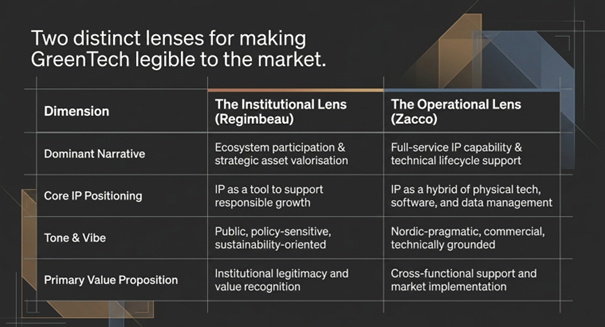
The difference lies in the dominant frame. Regimbeau appears to frame GreenTech through responsible innovation, ecosystem participation and strategic asset valorisation. The firm’s participation in the Green Tech Forum and its language around the development and dissemination of responsible innovations give the communication a public, institutional and sustainability-oriented quality. IP is positioned as a strategic tool that helps innovators enhance the value of their efforts while contributing to a more responsible future.
Zacco appears to frame GreenTech through full-service IP capability, technical expertise and practical lifecycle support. Its GreenTech logic is embedded in a broader service architecture covering patents, brands, designs, litigation, digital trust, IP operations and monetisation. The emphasis is less on the public sustainability forum and more on practical IP strategies, technical collaboration, portfolio building, freedom to operate, invent-around issues and commercialisation.
Put simply, Regimbeau’s communication seems to begin with the societal and ecosystem relevance of responsible innovation and then connects this to IP as a strategic asset tool. Zacco’s communication seems to begin with the company’s operational need to protect, manage and commercialise innovation and then connects this to GreenTech as one important field among others in which technical and digital expertise are necessary.
Both frames are legitimate. Both can be persuasive. But they speak to slightly different market expectations. Regimbeau’s frame may be particularly effective where the audience values institutional legitimacy, sustainability discourse, innovation-policy proximity and the responsible dissemination of technologies. Zacco’s frame may be particularly effective where the audience values practical implementation, cross-functional IP support, lifecycle management and the integration of technical, commercial and digital dimensions.
What IP practice groups can learn from this
The comparison offers a clear lesson for IP practice groups: GreenTech positioning should not start with the claim that the firm understands sustainability. It should start with a precise explanation of what kind of GreenTech problem the firm helps clients manage. Is the issue protection of technical inventions? Commercialisation? Collaboration? Investor readiness? Data and software layers? Regulatory uncertainty? Enforcement? Standardisation? Portfolio valuation? International expansion? The answer determines the communication frame.
Regimbeau shows the value of linking IP to the broader mission of responsible innovation. This can be especially powerful when GreenTech is not only a commercial field, but also a policy-sensitive and institutionally visible area. IP practice groups can learn from this that participation in relevant ecosystems can strengthen positioning. Being visible where GreenTech actors discuss digital responsibility, environmental transformation and innovation policy can help a firm appear as part of the market conversation rather than as a distant legal supplier.
Zacco shows the value of making GreenTech operational. Its communication suggests that GreenTech companies need integrated, practical and technically grounded IP support across the lifecycle. IP practice groups can learn from this that credibility often comes from showing the practical intersections: IP strategy with management, patent drafting with freedom to operate, technical expertise with commercialisation, brand protection with digital trust, and portfolio work with enforcement readiness.
A further lesson is that GreenTech communication benefits from specificity. General claims about sustainability quickly become interchangeable. A practice group becomes more distinctive when it names the actual strategic tensions: how to protect innovation while enabling partnerships, how to manage digital and physical technology layers, how to secure portfolio value while supporting diffusion, how to translate technical progress into investor confidence, and how to coordinate IP decisions across research, management and market development.
Why this matters for IP business development
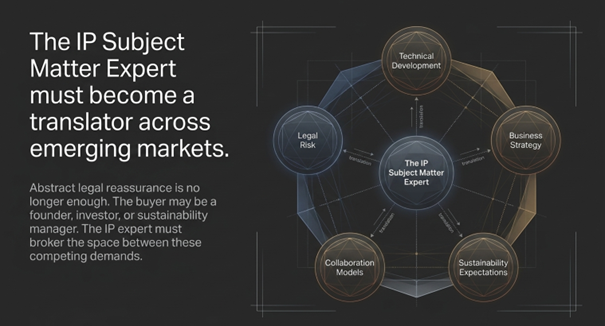
For IP business development, the main point is that GreenTech is not just a promising sector. It is a test of whether IP practice groups can communicate beyond legal competence. Many GreenTech clients do not primarily look for abstract legal reassurance. They need to understand how IP advice helps them manage uncertainty, structure collaboration, attract investment, protect technical differentiation, avoid market-entry risks and convert sustainable innovation into durable business value.
This is where the role of the IP Subject Matter Expert becomes important. In GreenTech, an IP Subject Matter Expert must do more than explain patents. The expert must translate between technical development, business strategy, sustainability expectations, collaboration models and legal risk. That translation function is central because GreenTech markets are often emerging, fragmented and shaped by multiple actors. The buyer may be a founder, an investor, a head of research and development, a sustainability manager, a corporate IP leader, or a public innovation actor. Each of them needs a different explanation of why IP matters.
Regimbeau and Zacco illustrate two possible routes into that translation role. Regimbeau’s route is to connect IP with responsible innovation and ecosystem value. Zacco’s route is to connect IP with practical lifecycle management and technical-commercial execution. Neither route is inherently superior. The stronger business-development question is whether the chosen frame matches the audience, the firm’s actual capabilities and the market’s current uncertainties.
This also matters because GreenTech is a field where the traditional distinction between protection and openness is often too simple. Sustainable technologies frequently need diffusion, partnerships and scaling. At the same time, companies need incentives, control positions and defensible differentiation. IP communication should therefore avoid the old binary of patents as either accelerators or obstacles. A more sophisticated message is that different GreenTech situations require different IP architectures. Some require strong exclusivity. Some require licensing. Some require trade secrets. Some require standards-related thinking. Some require data governance. Some require a carefully designed mix of rights and collaboration mechanisms.
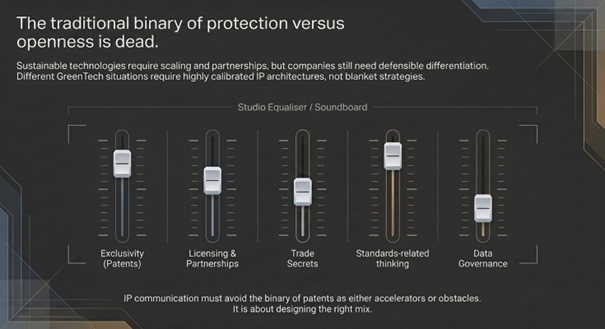
For a practice group, the communication opportunity lies in showing how it helps clients make these choices. That is why GreenTech is such a valuable theme for IP business development. It allows a firm to demonstrate technical understanding, strategic judgment, market awareness and societal relevance at the same time. But this only works if the firm avoids generic sustainability language and instead explains its own distinctive role in the GreenTech innovation journey.
The comparison between Regimbeau and Zacco therefore offers a useful reminder. A GreenTech practice does not become visible simply by naming the sector. It becomes visible when it frames the client’s real decision problem in a way the market recognises. Regimbeau seems to make that problem visible through responsible innovation and strategic asset valorisation.
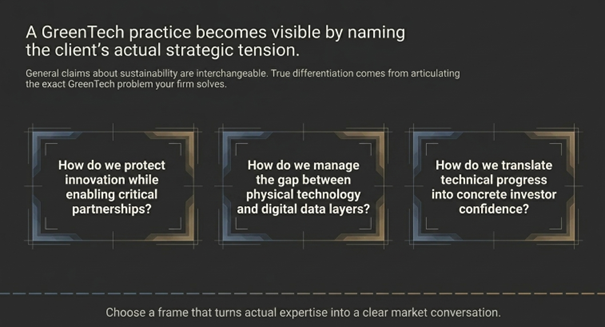
Zacco seems to make it visible through full-service IP capability, technical expertise and practical portfolio work. For IP practice groups, the lesson is not to copy either model, but to choose a frame that turns their actual expertise into a clear market conversation.
This post draws on the following publicly available materials:
Greentech
https://regimbeau.eu/en/secteur/greentech/
Regimbeau takes part in the Green Tech Forum 2024 – November 5 and 6 in Paris
https://regimbeau.eu/en/regimbeau-takes-part-in-the-green-tech-forum-2024-november-5-and-6-in-paris/
World Clean Energy Day – January 26, 2025
https://regimbeau.eu/en/world-clean-energy-day-january-26-2025/
Zacco
https://www.zacco.com/
Dag Petré
https://www.zacco.com/blog/employees/dag-petre/
Digitalisation and computer technology are enablers for green innovations
https://www.zacco.com/blog/news/digitalisation-and-computer-technology-are-enablers-for-green-innovations/