
Quantum IP Is Not Just a Patent Topic: What Wilson Sonsini and EIP Show About Law Firm Positioning in Emerging Technologies

Quantum technology is becoming a useful test case for how law firms communicate expertise in emerging technology fields. The topic is scientifically demanding, commercially uncertain, strategically sensitive and legally fragmented. It touches patent protection, trade secrets, collaboration models, investment readiness, export control, cybersecurity, standardization and long term platform building. This makes quantum technology especially interesting for comparing how law firm practice groups translate a highly complex technology field into a recognizable client conversation.
A practice group cannot simply say that it has patent attorneys with physics backgrounds. That may be necessary, but it is no longer sufficient. The more difficult communication task is to show clients how legal expertise helps them make better decisions in a field where the technology, markets and value chains are still forming. In quantum technology, the question is not only whether an invention can be protected, but also how a company can create defensible value while the commercial environment is still uncertain.
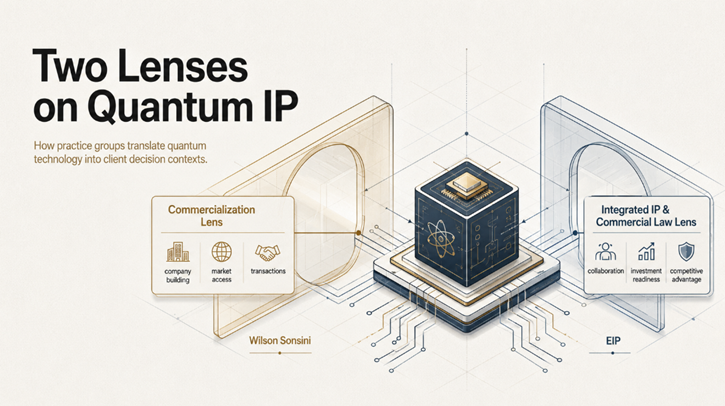
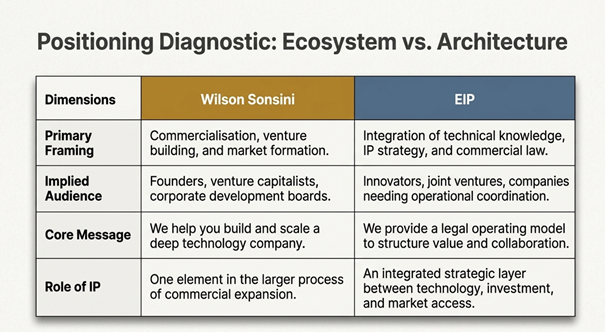
Two strong examples are Wilson Sonsini and EIP. Both position quantum technology beyond classic patent prosecution. But they do so from different angles, and this difference is exactly what makes the comparison useful. Wilson Sonsini frames quantum primarily through commercialization, venture building and market formation. EIP frames it through the integration of technical knowledge, IP strategy and commercial legal advice.
Wilson Sonsini: Quantum as a commercialization problem
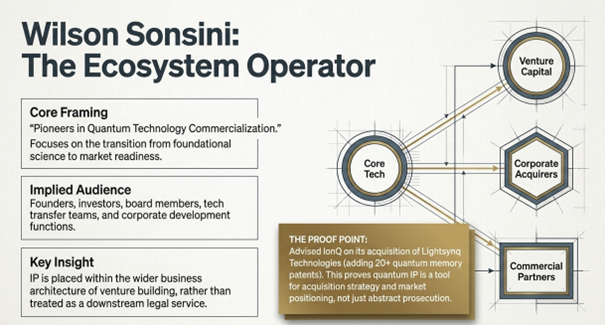
Wilson Sonsini’s quantum computing page is built around the headline “Pioneers in Quantum Technology Commercialization.” That wording matters because it does not start with patents, filings or legal categories. It starts with the transition from science to market. The firm presents its role as legal guidance for companies developing transformative quantum computing technologies, supported by attorneys and patent agents with scientific and engineering experience as well as industry networks.
This is a very specific positioning choice. Wilson Sonsini frames quantum computing as part of the broader deep technology and growth company ecosystem. The page connects legal advice with commercial matters, ventures, corporate governance, intellectual property, industry networks and emerging technology transactions. In other words, the client problem is not merely: “Can we protect this invention?” The client problem is: “How do we build a company, attract capital, structure rights, partner with others and keep strategic control in a rapidly developing technology field?”
That makes the page feel close to the venture and scale up world. The implied audience is not only the patent department of an established company. It is also the founder, investor, board member, technology transfer team or corporate development function trying to understand how quantum assets become business assets. This is a strong marketing position because it places IP within the wider business architecture of quantum commercialization, rather than treating it as a downstream legal service.
This positioning is reinforced by the firm’s visible transactional activity in the quantum space. Wilson Sonsini advised IonQ on its acquisition of Lightsynq Technologies, a quantum networking company founded by former Harvard quantum memory experts and AWS Center for Quantum Networking leaders. The transaction added more than 20 technology patents and patent applications related to quantum memory to IonQ’s portfolio. This is an important proof point because it shows quantum IP not as an abstract prosecution topic, but as part of acquisition strategy, technology roadmaps and market positioning.
EIP: Quantum as an integrated IP and commercial law problem
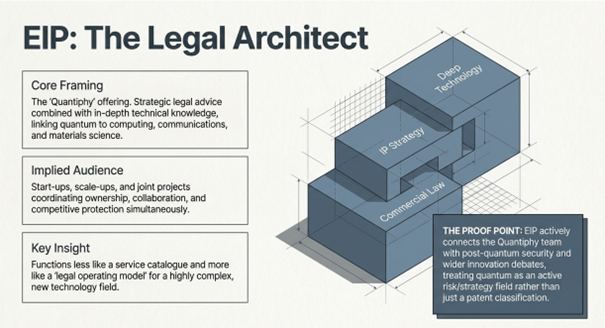
EIP takes a different route. Its Quantiphy offering is presented as strategic legal advice combined with in-depth technical knowledge for quantum innovators. The page explicitly links quantum technology to computing, communications and materials science and states that innovators must navigate complex commercial and IP issues to attract investment, enable collaboration and secure competitive advantage.
This is also far beyond a narrow patent filing message. EIP does not simply communicate: “We understand quantum technology.” It communicates: “We understand how technical knowledge, IP strategy and commercial legal structures interact in quantum innovation.” That is a subtle but important distinction, because quantum companies often operate in collaborative environments where ownership, secrecy, investment readiness and future commercialization cannot be separated.
The strength of this positioning lies in integration. EIP frames the practice as a combined legal and technical offering for innovators who need to turn scientific progress into protectable and commercially usable positions. Its messaging is especially relevant for start ups, scale ups, joint projects and established companies that must coordinate ownership, collaboration, investment and competitive protection at the same time. The result is a positioning that feels less like a service catalogue and more like a legal operating model for a new technology field.
EIP also appears in external contexts as connecting its Quantiphy team with post quantum security and wider quantum innovation debates. This reinforces the impression that the firm is not only treating quantum as a patent classification, but as a field in which technological uncertainty, security risks, commercial timing and IP strategy must be considered together. For clients, this matters because the legal question often emerges before the market category is fully settled.
The connecting element: both firms move from protection to market readiness
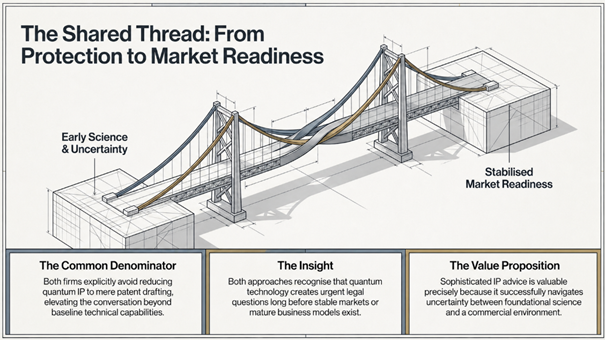
The interesting similarity is that both firms avoid reducing quantum IP to patent drafting. Wilson Sonsini emphasizes commercialization. EIP emphasizes strategic IP and commercial law integration. Both approaches recognize that quantum technology creates legal questions before stable markets and mature business models exist. This is precisely why the communication challenge is so demanding: the practice group must make expertise visible in a field where many clients do not yet know which legal questions they should be asking.
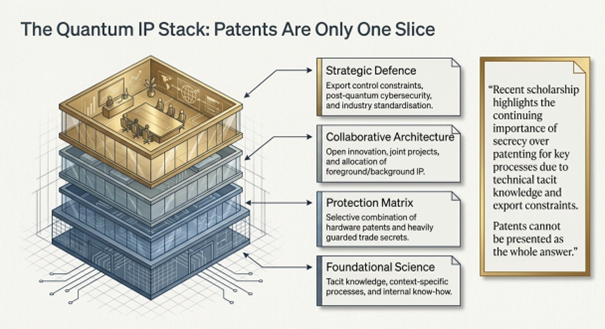
That is exactly where sophisticated IP advice becomes valuable. In quantum technology, the hard question is often not whether a specific invention can be patented. The harder questions are: Which layers of the quantum stack should be protected? Which know how should remain secret? How should collaborations allocate foreground and background IP? How can an investor understand the defensibility of a quantum venture? How does IP support partnerships, licensing, acquisitions and strategic positioning before the market has fully stabilized?
This is also consistent with broader academic and policy discussions around quantum IP. Recent scholarship describes quantum information technologies as requiring a selective combination of patents, trade secrets and open innovation across different layers of the quantum stack, while noting the continuing importance of secrecy because key processes may be tacit, context specific and affected by export control constraints. In this environment, a convincing quantum IP practice group cannot present patents as the whole answer. It must show how different protection and collaboration mechanisms interact.
The difference: ecosystem access versus legal architecture
The main difference lies in the marketing angle. Wilson Sonsini speaks from the perspective of the innovation ecosystem. Its message is shaped by company formation, venture capital, transactions, commercial expansion and growth. Quantum IP appears as one element in the larger process of building and scaling a deep technology company. This creates a strong fit with founders, investors and corporate teams that see quantum primarily as a commercialization journey.
EIP speaks more from the perspective of legal architecture. Its message is about combining technical depth with IP and commercial law to help quantum innovators structure value, collaboration and competitive advantage. Quantum IP appears as an integrated strategic layer between technology, investment and market access. This creates a strong fit with companies that are already facing concrete questions about ownership, partnerships, secrecy, protection scope and commercial contracting.
Both approaches are credible, but they create different client expectations. A founder looking for venture financing and strategic transactions may immediately understand Wilson Sonsini’s commercialization framing. A quantum company working through collaboration agreements, investment readiness, ownership questions and competitive positioning may find EIP’s integrated IP and commercial law framing particularly tangible. The value of the comparison is therefore not to decide which approach is better, but to show how different positioning routes can make the same technology field meaningful to different client situations.
What IP practice groups can learn from this
The central lesson is that emerging technology marketing cannot stay at the level of capability statements. It must translate expertise into decision contexts. A weak quantum practice group page says, in effect, that the firm has attorneys with technical backgrounds in physics, electronics and software. A stronger page explains that quantum innovators face interconnected decisions about patents, trade secrets, collaboration, investment, licensing, cybersecurity and commercialization, and that the firm helps structure these decisions so technical progress can become defensible market value.
Wilson Sonsini and EIP both move in this stronger direction. They do not merely claim competence. They define the kind of uncertainty in which their competence matters. This is important because clients in emerging technology fields rarely buy legal advice because a website lists many technical keywords. They respond when they recognize their own strategic uncertainty in the way the practice group describes the problem.
For IP practice groups, this is the real marketing task in quantum technology. The goal is not to own the word “quantum.” The goal is to make quantum companies recognize their own strategic IP problems in the firm’s language. That requires more than scientific credibility. It requires the ability to connect technology, business model, investment logic and legal structure in a way that feels useful before the client has even picked up the phone.
Why this matters for IP business development
For IP experts, quantum technology is a powerful example of a broader shift. Clients are not looking for abstract legal expertise alone. They are looking for help in situations where technology, investment, collaboration and competitive positioning are difficult to separate. This is why the most effective IP practice group marketing is not built around services alone, but around decision problems that clients immediately recognize as relevant to their own situation.
Wilson Sonsini shows how quantum IP can be framed as part of commercialization and company building. EIP shows how it can be framed as integrated strategic IP and commercial law for innovators. Together, they show that the future of IP practice group marketing in emerging technologies will belong to firms that can translate complexity into client relevant choices. In quantum technology, the most convincing message is therefore not simply that a firm understands the science, but that it understands where the science becomes a business decision and where that business decision becomes an IP decision.
_______________
This post draws on the following publicly available materials:
Wilson Sonsini – Quantum Computing
Main source for Wilson Sonsini’s positioning around “Pioneers in Quantum Technology Commercialization” and for the analysis that the firm frames quantum through commercialization, emerging technologies, scientific and engineering experience, industry networks, commercial matters, and ventures.
👉 https://www.wsgr.com/en/services/industries/quantum-computing.html
Wilson Sonsini – Quantum Computing PDF
Supplementary PDF version of the same positioning, useful for the wording around the commercialization of quantum computing technologies and the broader multidisciplinary context.
👉 https://www.wsgr.com/print/v2/content/49050826/Quantum-Computing.pdf
Wilson Sonsini – Firm Advises IonQ on Acquisition of Lightsynq Technologies
Source for the transaction reference: Wilson Sonsini advised IonQ on its acquisition of Lightsynq Technologies. The acquisition was used in the post as a proof point for quantum IP appearing in acquisition strategy, technology roadmaps, and market positioning.
👉 https://www.wsgr.com/en/insights/firm-advises-ionq-on-acquisition-of-lightsynq-technologies.html
IonQ – IonQ Announces Intention to Acquire Lightsynq
Supplementary source for the reference that the Lightsynq acquisition included a portfolio of more than 20 technology patents and patent applications related to quantum memory.
👉 https://www.ionq.com/news/ionq-announces-intention-to-acquire-lightsynq-expediting-quantum-computing
EIP – Quantum Technology Legal Services / Quantiphy
Main source for EIP’s positioning around strategic IP and legal advice for quantum innovators, including the multidisciplinary combination of patent attorneys and commercial lawyers, and the focus on start-ups, scale-ups, joint ventures, and established companies.
👉 https://eip.com/uk/growth-areas/quantum-technology
EIP LinkedIn Post – Quantiphy / Post-Quantum Security
Supplementary source showing that EIP also connects its Quantiphy positioning with post-quantum security, cybersecurity, and future-proofing digital systems.
👉 https://www.linkedin.com/posts/eip_ip-quantum-quantumsecurity-activity-7371482853399830528-neZV
SSRN – Patents, Trade Secrets and Open Innovation in Quantum Information Technology
Context source for the broader statement that quantum IP should not be reduced to patents alone, but often requires a combination of patents, trade secrets, and open innovation across different layers of the quantum technology stack.
👉 https://papers.ssrn.com/sol3/papers.cfm?abstract_id=5363171