
IP Controlling Beyond Patent Counts

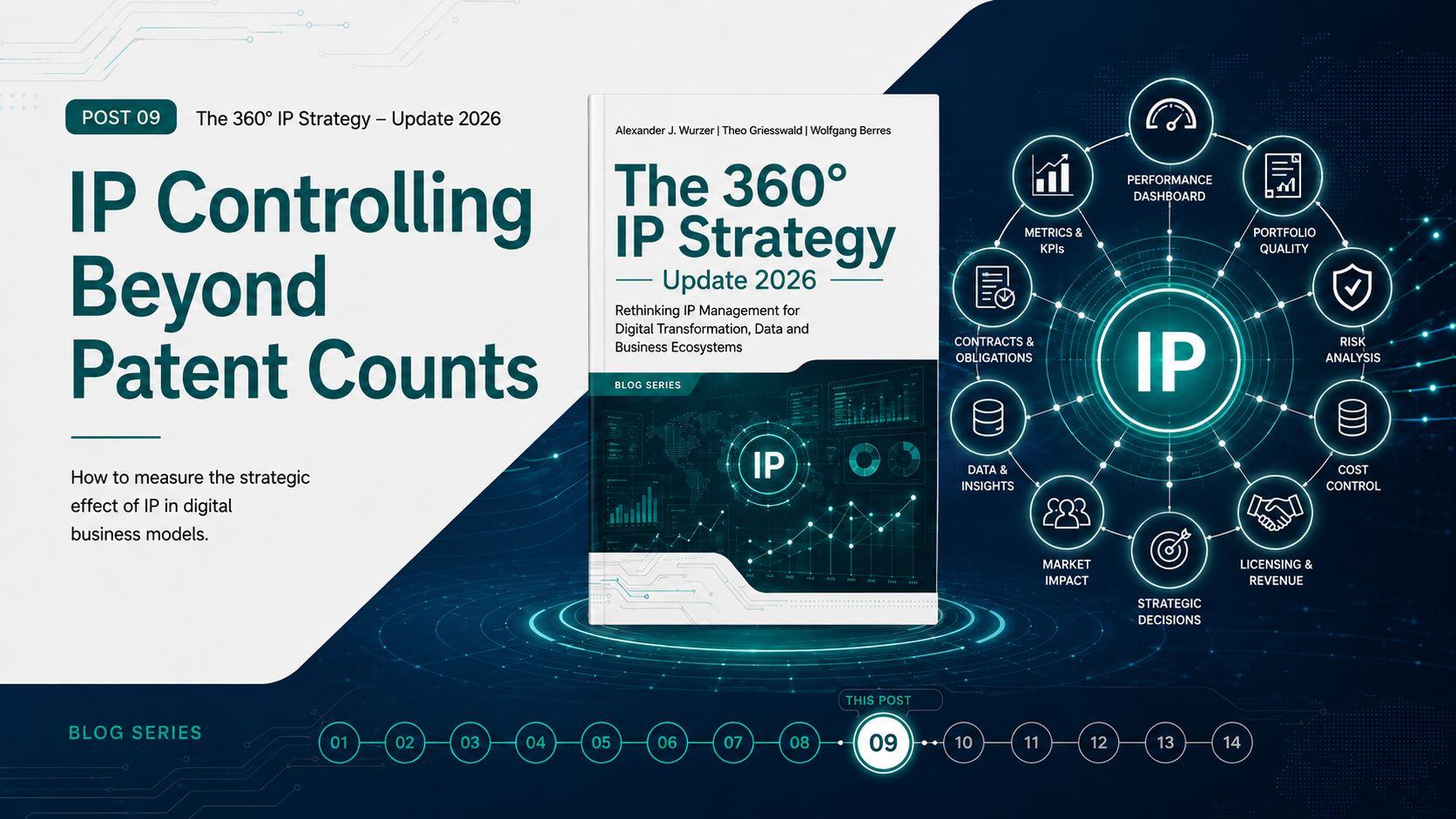
IP controlling must go beyond counting patents, filings or renewals. In digital business models, strategic value often lies in software, data, interfaces, workflows, contracts and ecosystem positions. The key question is therefore not how much IP a company owns, but whether its IP architecture protects what really drives customer value, market differentiation and business performance. Effective IP controlling links business objectives with control points, protection mechanisms and measurable effects. It combines leading indicators, such as evidence readiness and risk coverage, with lagging indicators, such as pricing power, freedom of action and licensing impact. This turns IP controlling into a management tool for better decisions, smarter resource allocation and stronger competitive advantage.
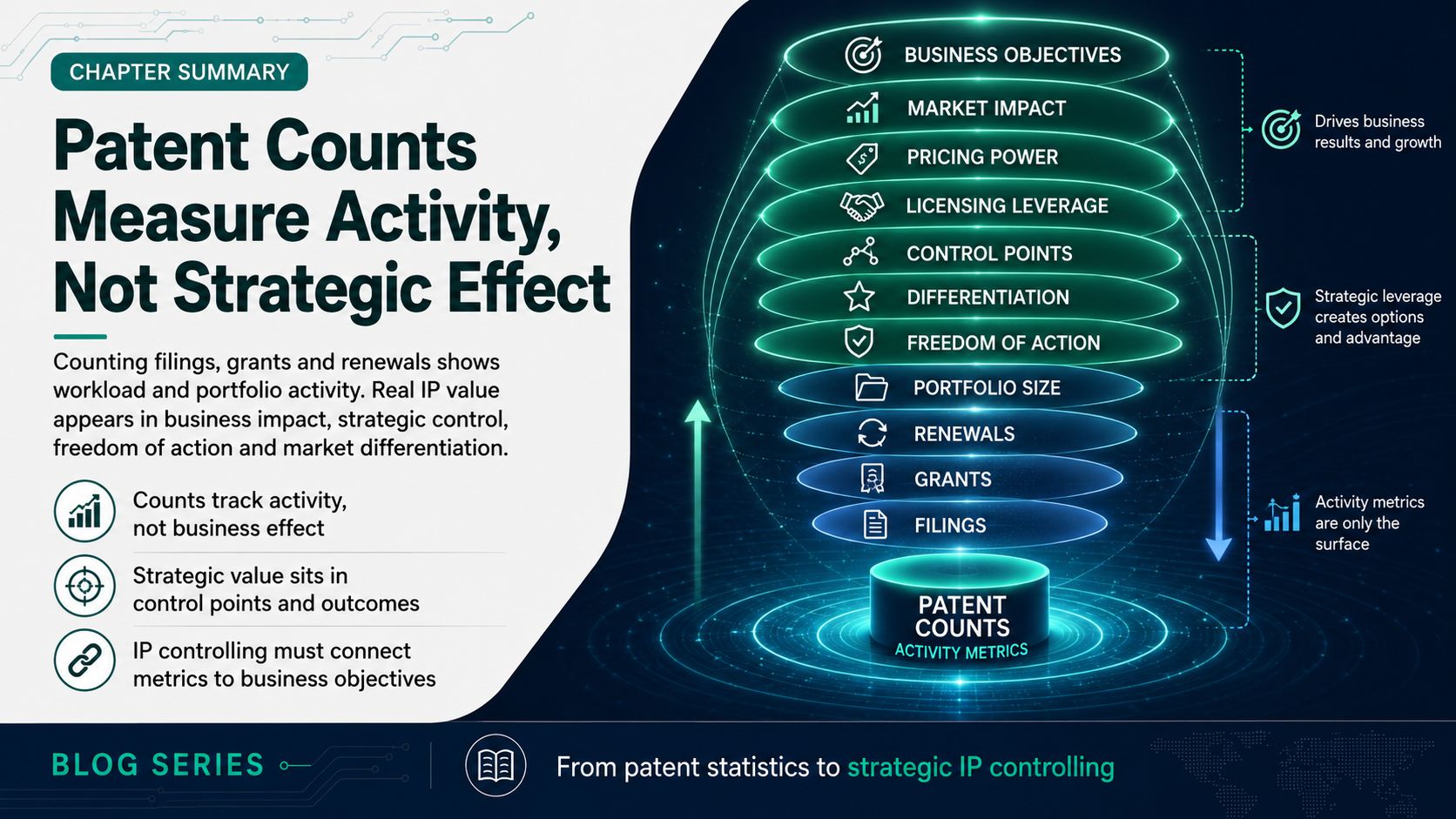
Patent counts measure activity, not strategic effect
The original 360° IP Strategy already made an important distinction between project controlling and asset controlling. Project controlling asks whether agreed IP measures are being implemented with the required result, within the available time and budget. Asset controlling asks whether those measures produce the intended effect in the business model and the market. Both remain necessary. What has changed is the range of assets, dependencies and competitive effects that must now enter the controlling system.
Patent filings, granted rights, invention disclosures, renewal costs and geographical coverage still have administrative value. They show workload, portfolio size and resource consumption. They can reveal bottlenecks in prosecution, escalating maintenance expenditure or an imbalance between business units. But they do not tell management whether the company protects what customers value, whether competitors are effectively constrained, whether a digital service remains operable, or whether IP supports margin, market access and bargaining power.
The weakness of count-based reporting becomes especially visible in digital business models. A company may own hundreds of patents while lacking reliable rights in the data required to run its service. It may report a growing portfolio while critical software is subject to incompatible third-party terms. It may file many applications around a product generation that is already losing strategic relevance, while the decisive control point has moved into an interface, model workflow, certification path or customer integration layer. Activity can increase while strategic protection deteriorates.
This does not mean that every IP contribution can be converted into a precise financial number. Causality is often distributed. A price premium may result from technology, brand, service quality, switching costs and IP-backed exclusivity together. The correct response is not to retreat to what is easiest to count. It is to construct a plausible contribution model that connects IP measures with observable business effects and states the limits of the evidence.
Modern IP controlling therefore begins by separating operational activity from strategic effect. Administrative indicators explain what the IP system is doing; impact indicators explain whether it is protecting differentiation, preserving options and improving the economics of the business model. A management report needs both, but it must never mistake the first category for proof of the second.
Begin with the business effect and build the causal chain
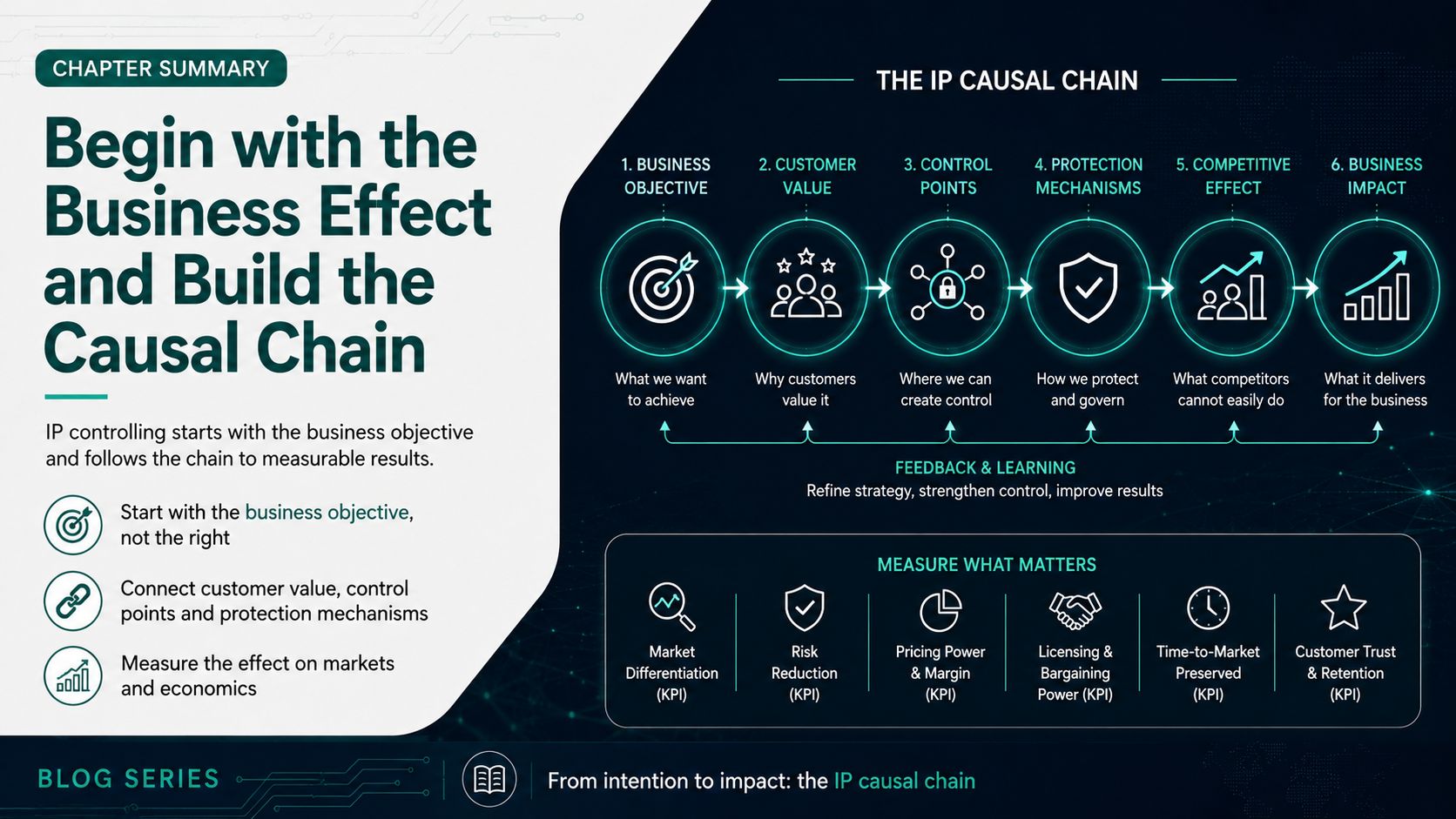
A useful KPI does not start with the right. It starts with an intended business effect. Management may want to protect a service margin, maintain access to a critical dataset, prevent equivalent competitor offerings, preserve freedom to launch in selected markets, strengthen a licensing position or make a performance promise uniquely attributable to the company. Only after that objective is explicit should the controlling design ask which IP mechanisms support it.
The causal chain can be written as: business objective, customer-relevant differentiation, strategic control point, protection mechanism, required evidence, observable competitive behaviour and economic effect. For a predictive-maintenance service, the objective might be to defend recurring service revenue. The control points could include access to machine data, a diagnostic workflow, model-improvement know-how and integration into the customer’s maintenance process. Patents, trade secrets, data-use agreements, copyright, access controls and interface rules may each cover a different part of that architecture. The indicators must test whether this combined position is working.
The four fields of the 360° logic remain a useful structure. Risk control can be measured through exposure, unresolved blocking positions, continuity of third-party rights and the availability of mitigation routes. Suppression of imitation can be measured through competitor equivalence, time-to-copy, workaround difficulty and coverage of differentiating system behaviours. Market shaping can be measured through licensing leverage, control of interfaces, partner dependence, standardisation options or the ability to influence access conditions. Communication of exclusivity can be measured through customer attribution, price realisation, win-loss reasons, trust signals and retention.
Each indicator needs a target, an owner, a data source, a measurement cadence and a decision threshold. “Improve portfolio quality” is not controllable. “By the next portfolio review, every top-tier control point must have an approved protection architecture and sufficient evidence to support the chosen mechanism” is far more useful. Where direct measurement is impossible, a structured expert assessment can be used, provided that the criteria, assumptions and confidence level are documented.
IP controlling becomes strategically meaningful when it tests a chain of contribution rather than an isolated legal event. The objective is not to claim that one patent caused a commercial result, but to show how a defined IP architecture supports a customer promise, changes competitive options and contributes to a measurable business outcome.
Control the whole IP architecture, not only registered rights
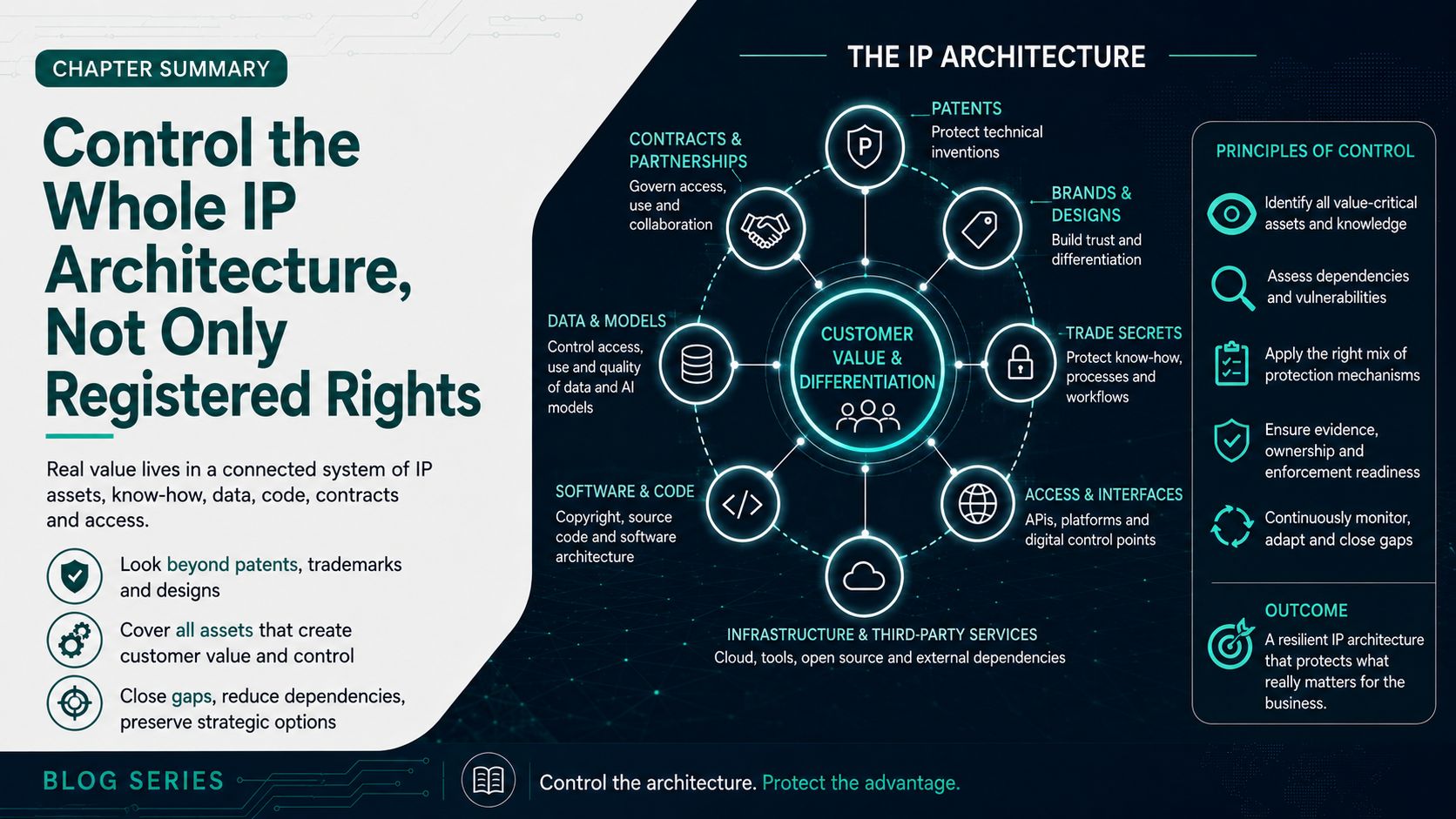
Digital value creation requires a broader object of control. The relevant IP position may include patents, trademarks and designs, but also source code, datasets, model configurations, confidential workflows, open-source components, cloud services, contracts, access rights, regulatory evidence and partner relationships. A dashboard limited to registered rights can therefore present a healthy picture while the actual value architecture contains serious gaps.
Evidence readiness is one of the most important modern dimensions. A company should be able to demonstrate who created an asset, under which contractual conditions, from which inputs, for which permitted purposes and with which protection measures. Useful indicators may include the share of strategically critical code with clear ownership and provenance, the proportion of high-value trade secrets that are identified and covered by documented protection measures, or the percentage of priority AI models for which training inputs, licences, evaluations and deployment versions are traceable.
Operational freedom also needs measurable coverage. Open-source risk should not be represented by the number of components alone. More meaningful indicators include unresolved high-impact licence obligations per release, the proportion of critical components with approved use contexts, and the time required to remediate a detected incompatibility. Data access control can be measured through the share of essential datasets with documented use rights, continuity provisions, exit rights and technical access controls. Supplier and platform dependence can be tracked through replaceability, concentration and the existence of validated alternatives.
Portfolio quality must likewise be separated from portfolio size. Relevant questions include whether claims cover the customer-relevant system behaviour, whether infringement can realistically be detected, whether the chosen jurisdictions match markets and value chains, whether the portfolio addresses foreseeable workarounds, and whether rights remain aligned with the roadmap. A strategically strong portfolio is not the one with the most assets, but the one that creates adequate control around the most important value layers at acceptable cost. These expanded dimensions are central to the proposed update of IP controlling beyond conventional patent statistics.
The expanded controlling object is a hybrid IP architecture rather than a patent inventory. Its health depends on legal position, technical implementation, contractual control, operational evidence and strategic relevance working together. Metrics must reveal where that architecture is complete, where it is fragile and where apparent ownership does not yet create usable control.
Combine leading and lagging indicators in one management cockpit
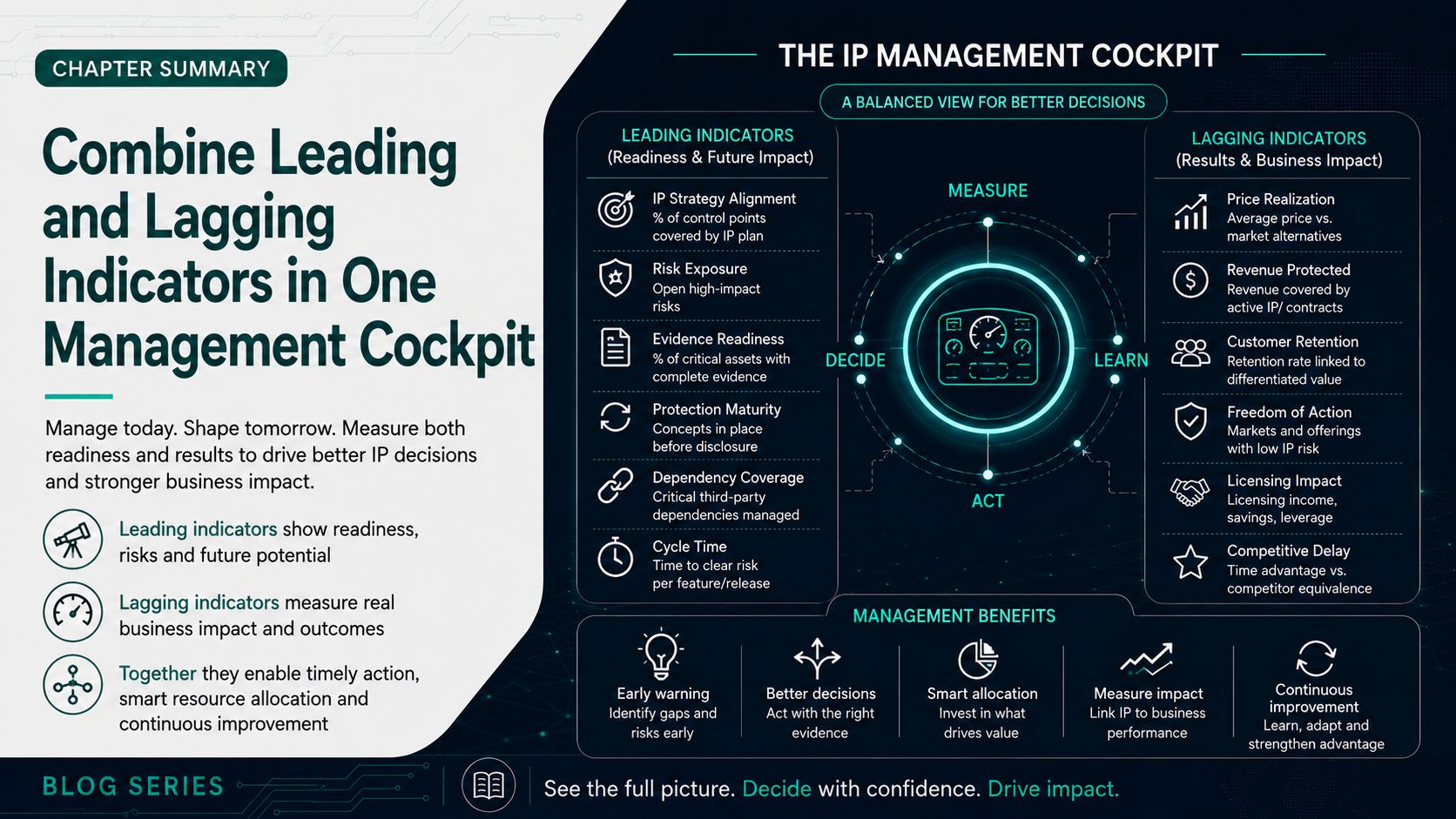
Many of the economic effects of IP appear late. Market share, price premiums, licensing income, avoided litigation costs and delayed competitor entry can become visible only after development and launch. Waiting for these lagging indicators would leave management unable to intervene while the relevant architecture is still being designed. The cockpit must therefore combine outcome indicators with leading indicators that show whether the organisation is building the conditions for future impact.
Leading indicators can include the percentage of strategic control points with assigned owners, the maturity of protection concepts before disclosure, clearance cycle time for risk-relevant features, evidence completeness, trade-secret coverage, claim-to-roadmap alignment, or the number of critical external dependencies without an approved continuity plan. These do not prove commercial success. They show whether the organisation is becoming ready to create and defend it.
Lagging indicators test whether the expected effect materialised. Examples include price realisation compared with relevant alternatives, the share of customers who associate a differentiated benefit primarily with the company, competitor time-to-equivalence, revenue protected by active rights, realised licensing income, reductions in unplanned licence payments, enforcement outcomes, service retention and the frequency with which IP materially influences negotiations. Some indicators will remain qualitative, particularly bargaining power and strategic optionality. A disciplined rating scale with written evidence is more credible than artificial monetary precision.
The cockpit should remain small. Each business model needs a limited set of indicators that cover effect, risk, readiness, portfolio fit and resource use. Every KPI should display its target, current value, trend, confidence in the data and the action triggered by deviation. A red indicator without a defined decision is decoration. A green indicator based on weak evidence is dangerous. The dashboard should also distinguish between information and judgement: a component licence is a fact; the assessment that it threatens the business model is a decision supported by that fact.
A useful management cockpit balances early warning with later proof. Leading indicators keep strategic options open and expose control gaps before they become expensive. Lagging indicators test whether the IP architecture changed customer perception, competitive behaviour or economic performance. Together they make IP steerable without pretending that intangible value is simple.
Use controlling to decide, learn and reallocate
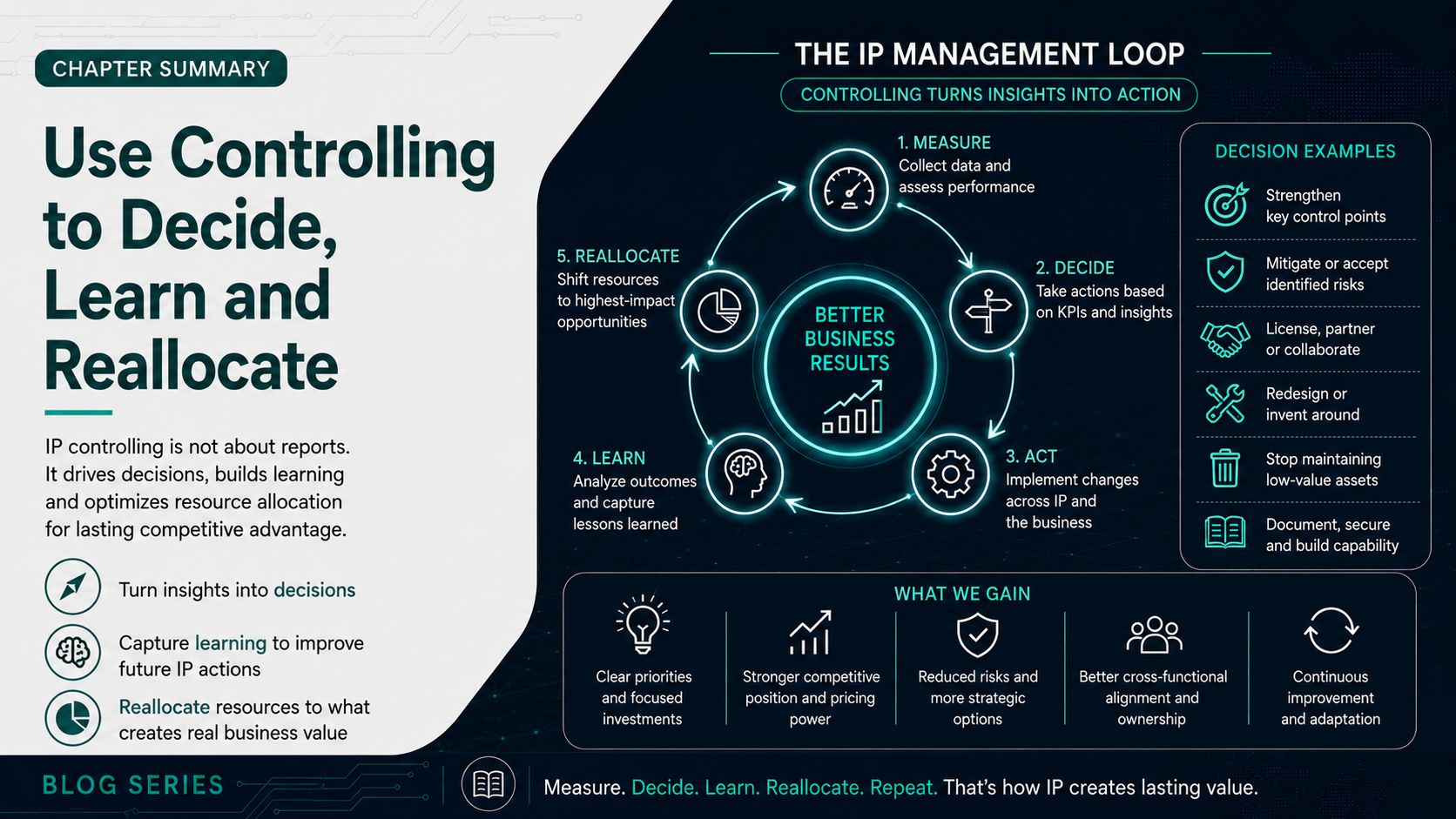
The purpose of the cockpit is not reporting for its own sake. It is to improve decisions. A portfolio review should be able to conclude that a position must be strengthened, redesigned, licensed, enforced, documented, kept secret, opened to partners or abandoned. A risk review should decide whether to change architecture, negotiate access, build an alternative, accept residual exposure or delay a release. A management dashboard that does not influence such choices merely adds administrative work.
Resource allocation becomes more disciplined when indicators are linked to strategic objectives. High expenditure can be justified where a right protects a decisive control point, supports several product lines or creates valuable licensing options. Even modest expenditure should be questioned where an asset has weak business relevance, poor enforceability or no credible connection to the roadmap. The same logic applies beyond patents: documentation, cybersecurity, provenance systems, contract management and trade-secret controls compete for resources and should be prioritised according to the value and vulnerability of the assets they protect.
Controlling also creates organisational learning. When an expected effect is not achieved, management should ask whether the customer benefit was misunderstood, the wrong mechanism was selected, the evidence was insufficient, the right was too narrow, the competitor found an unexpected workaround, or the commercial team failed to communicate the exclusive advantage. When an effect is achieved, the organisation should identify which combination of rights, routines and market actions mattered. These insights improve the next IP-needs analysis, invention programme, contract design and portfolio decision.
A regular review cycle connects the cockpit to product roadmaps, release planning, business reviews, partner governance and budgeting. Product, R&D, software, data, marketing, sales, finance, cybersecurity, procurement and IP contribute different evidence. The IP function becomes the architect of the measurement logic and the moderator of decisions, not the sole producer of every data point.
IP controlling beyond patent counts turns measurement into a management capability. It shows whether intangible assets are ready, whether protection architectures remain aligned with the business model, whether investments create strategic effects and where intervention is required. The result is not a larger report, but a better allocation of attention, evidence and resources to the control points that determine competitive advantage.
Supplementary content on the IPBA® platform:
Balanced Scorecard (BSC)
Translates strategy into objectives, measures, targets and initiatives across financial, customer, process and learning perspectives, providing the conceptual foundation for an IP cockpit that connects assets and capabilities with market and financial effects.
👉 Read more
IP Management Control Systems in Quantum Technology
Provides a current practical model for combining conventional patent data with capability maturity, ecosystem position, strategic readiness and future business options in a field where immediate revenue cannot adequately measure IP performance.
👉 Read more
Patent Value and Patent Quality
Separates legal quality from economic value and introduces a two-axis portfolio perspective that supports better decisions on maintenance, strengthening, licensing, enforcement and abandonment.
👉 Read more
Uneven Patent Value Distribution: The 80–20 Rule in IP
Explains why raw patent counts and portfolio averages can be misleading when a relatively small share of the portfolio generates a disproportionate part of its economic and strategic value.
👉 Read more
Quality Analysis of IP Portfolios
Adds concrete assessment dimensions such as jurisdictional fit, enforceability, commercial relevance, litigation history and licensing activity to the evaluation of portfolio strength.
👉 Read more
Value-Oriented Patent Portfolio Management in the Digital Age
Shows why shorter product lifecycles, new digital business models and data-supported decision-making require continuous alignment between patent portfolios, technology development and business objectives.
👉 Read more
Valuation Standards
Connects patent value to a concrete exploitation scenario under DIN 77100 and explains how technical, legal and economic factors contribute to expected future financial benefits.
👉 Read more
Business Objectives
Provides the objective architecture needed to prevent portfolio sprawl, late IP engagement and mispriced collaborations while linking IP milestones and evidence thresholds to customer outcomes, margins and strategic priorities.
👉 Read more
Capability IP at Dangote: How Controlling Complementary Goods Becomes the Real “IP”
Demonstrates through a practical industry case how uptime, organisational learning, contractual access, operational resilience and reputation can become meaningful IP-controlling dimensions beyond registered rights.
👉 Read more
IP Strategy: Unlocking Value and Driving Innovation in the Global Economy
Presents a holistic measurement framework covering economic value creation, strategic positioning, organisational capabilities and financial outcomes instead of relying on patent counts or licensing income alone.
👉 Read more