
UPC IP: When Does Litigation Leverage Become a Portfolio-Design Issue?

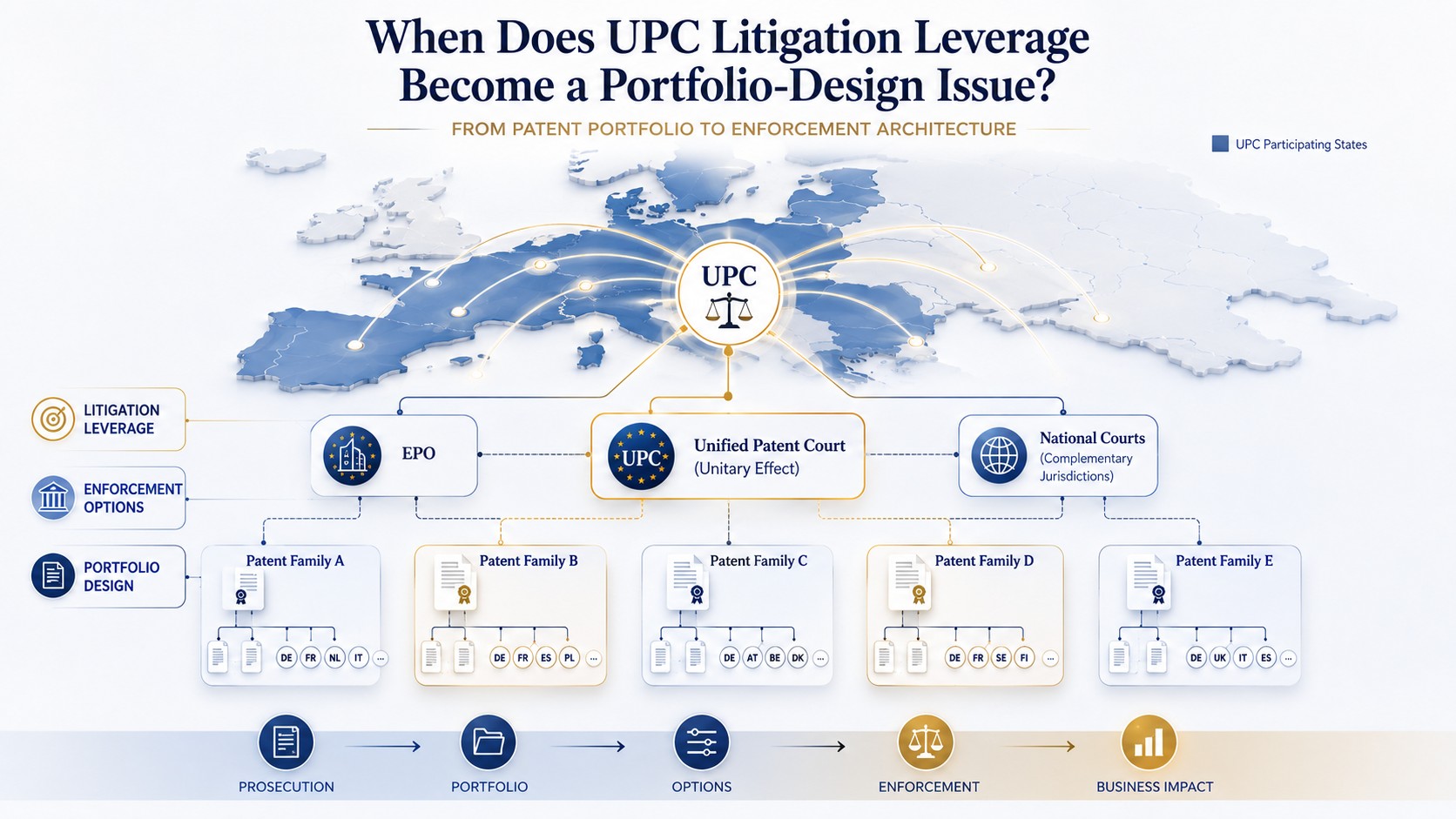
The Unified Patent Court is gradually changing the strategic characteristics of European patent portfolios. What began as a new institutional framework for patent litigation is increasingly influencing decisions that arise much earlier in the life of a patent: during prosecution, portfolio structuring, validation, divisional strategy and the selection of rights that may eventually become commercially relevant enforcement assets.
This development matters because the UPC combines several characteristics that previously existed in a much more fragmented form. A single proceeding can create enforcement leverage across a significant part of the European market. The same institutional structure can expose valuable rights to centralised revocation. UPC proceedings interact with EPO oppositions, national patent systems and, increasingly, litigation strategies extending beyond the territory formally participating in the UPC. The consequence is a gradual convergence of litigation strategy and portfolio strategy.
Christof Augenstein provides an important starting point for understanding this development. Together with Sabine Agé and Alex Wilson, he edited the 2026 commentary Unified Patent Court Procedure, published by C.H. Beck and co-published by Hart Publishing and Nomos. The work integrates the UPC Agreement, the Rules of Procedure and the Statute and deliberately combines different national legal traditions with the emerging case law of the Court.
The preface contains an observation that is particularly relevant from an IP-management perspective. The authors describe the commentary as international in both scope and spirit and argue that, while the UPC is a European institution, its influence will extend globally. Patent holders, licensees and litigants will therefore need to understand “the strategic decisions it entails, and how it interacts with existing national systems and the European Patent Office.”
This observation opens a much larger IP-management question.
Once the use of the UPC involves strategic choices that have to be considered together with national patent systems and the EPO, the relevant unit of analysis becomes the patent portfolio. Decisions concerning individual patents begin to influence the range of litigation options available years later.
Augenstein had already illustrated this logic very concretely in the Deminor interview UPC Podcast Series: ‘The Global Reach of the UPC’ – featuring Christof Augenstein. There he describes what sophisticated companies were already developing as a “mixed litigation” approach: members of the same patent family can deliberately be positioned differently, with some remaining within the UPC system while others preserve access to the existing national system. He also points directly to the question of whether companies will expose their most valuable “crown jewel” patents to a system in which validity across Europe can be at stake. (Deminor)
Viewed from an IP-management perspective, jurisdiction therefore becomes a portfolio-design variable. A patent family can increasingly be understood as an architecture of strategic options. One member may provide broad UPC enforcement leverage. Another may preserve a national route. A divisional may create an additional claim position around a commercially important implementation. The strategic value lies in the combination of these rights and in the choices that remain available when a dispute eventually arises.
The developing debate around the geographic reach of the UPC reinforces this perspective. Tobias Wuttke has examined this development particularly closely. In his analysis Cross-border long-arm jurisdiction of the courts of EU Member States for global patent infringement within centralized infringement proceedings – CJEU Judgement dated February 25, 2025 – C-339/22 BSH / Electrolux, he explores the consequences of the CJEU’s decision for centralised cross-border patent infringement proceedings and the potentially very extensive jurisdictional reach created by it.
The underlying legal turning point is the Court of Justice decision Judgment of the Court (Grand Chamber) of 25 February 2025 – BSH Hausgeräte GmbH v Electrolux AB, Case C-339/22. The Court clarified important questions concerning jurisdiction over infringement disputes involving European patents validated in other Member States and third countries. That judgment has subsequently become a central reference point for the UPC’s evolving long-arm jurisprudence.
Charlie French and Maria Ryan examine the resulting UPC case law in their Bristows analysis The long arm of the law: the UPC’s approach to jurisdiction post-Electrolux. They show how cases such as Fujifilm v Kodak, IMC Creations v Mul-T-Lock, Dainese v Alpinestars and TGI Sport v AIM Sport Development are progressively testing the territorial reach of the new court. Their analysis also highlights the unresolved limits and practical questions surrounding such claims.
➡️ For portfolio management, this development has an important implication. Geographic leverage becomes part of the economic characteristics of a patent.
Two patents covering comparable technologies can therefore have very different strategic values. One may have technically broad claims while offering relatively limited enforcement leverage. Another may map directly onto a commercially important competitor product, cover several relevant markets and fit naturally into a broader UPC enforcement strategy. Conventional indicators of patent quality reveal only part of this difference. The enforcement architecture surrounding the right becomes increasingly important.
The growing use of the Unitary Patent adds another layer to these decisions. The EPO’s Demand for European patents in 2025 exceeded 200 000 for first time shows how quickly the new system is moving into mainstream portfolio practice. Unitary protection was requested for 34,357 European patents granted in 2025, corresponding to 28.7% of all grants; among European patentees, the uptake rate reached 40%.
The choice between unitary effect and the classical bundle of nationally validated European patents therefore determines more than geographic coverage and renewal-fee structures. It shapes future litigation options and the concentration of validity risk. This means that the strategic role of a patent increasingly has to be considered around the time of grant. Some technologies may benefit from the broad geographic efficiency of unitary protection. Others may justify a more differentiated structure in which national rights, European bundle patents, divisionals or parallel national filings preserve additional options.
➡️ The portfolio thus begins to acquire an internal architecture. Different rights perform different strategic functions.
This architecture is also closely connected to the European Patent Office. The EPO explains in Acceleration of opposition proceedings in cases of parallel court actions that opposition proceedings are accelerated when the Office is informed of parallel infringement or revocation proceedings before the UPC or an eligible national court. The Boards of Appeal address the same interaction in the Notice from the Boards of Appeal on accelerating appeal proceedings, under which the UPC may request acceleration and a Board may also accelerate proceedings once it becomes aware of parallel UPC litigation.
➡️ The practical consequence is that future litigation readiness increasingly begins during prosecution.
A patent that may later serve as a major UPC enforcement asset requires more than technically sound claims. Its specification must support commercially useful claim positions. Relevant fallback positions need to remain available. Infringement should ideally be observable in the market. Divisionals may preserve alternative approaches to commercially significant implementations. And a right intended for centralised enforcement has to be assessed with the validity challenges that such enforcement is likely to attract in mind.
➡️ These considerations change the way portfolio quality can be understood.
The strategic question becomes whether a patent can perform a defined role within an enforcement architecture. That role depends on the relationship between claim scope, commercial relevance, geographic coverage, validity resilience and the practical ability to demonstrate infringement.
The remedy side of the UPC reinforces the same pattern. In Bird & Bird’s Webinar series: UPC 360°: Hear from the Experts Litigating Before the UPC, Nicole Jadeja moderated a dedicated discussion of injunctions in which Tjibbe Douma participated. Bird & Bird framed cross-border provisional and permanent injunctions as one of the UPC system’s most powerful tools and asked both how that tactical leverage can be used and how the corresponding risk can be mitigated.
Augenstein reaches a related conclusion from another direction in The Global Reach of the UPC. He argues that UPC decisions can have a much greater impact than the injunctive relief traditionally available through a single European national jurisdiction. That greater impact helps explain why the Court can become attractive to patentees seeking significant enforcement leverage. For IP management, this changes the strategic importance of individual patents within large portfolios.
A company may own thousands of patents while only a small subset covers functions that competitors genuinely depend upon. Some rights protect marginal features. Others cover implementations that can be redesigned relatively easily. A smaller number may relate to technically unavoidable functions embedded in commercially significant products across several European markets. Those rights can become strategic control points.
The portfolio-management challenge is to identify them before litigation reveals their significance. This leads to a broader understanding of the European patent portfolio. It can increasingly be viewed as an enforcement architecture in which different rights preserve different combinations of geographic reach, claim positions, jurisdictional options, validity exposure and commercial leverage. That perspective links technology strategy, prosecution strategy, portfolio management and litigation strategy much more closely.
For IP management, the central question becomes how early these relationships should be designed deliberately. A company needs to understand which patents cover commercially critical functions, which rights could become credible UPC enforcement assets, where national fallback positions remain valuable, which divisionals preserve useful claim alternatives and which patents possess the validity resilience required for centralised enforcement.
The same logic reaches into business-model questions. The value of an enforcement asset depends on the markets in which competitors operate, the technologies customers depend upon, the standards and interfaces that structure an industry and the licensing or collaboration arrangements surrounding the relevant rights.
The patent portfolio therefore becomes part of a much wider system of strategic optionality. This brings the discussion back to Christof Augenstein, Sabine Agé and Alex Wilson. Their Unified Patent Court Procedure begins with the procedural framework of the Unified Patent Court and deliberately places that framework within a landscape of strategic decisions, national patent systems and the European Patent Office.
➡️ From an IP-management perspective, that observation raises a question whose importance will probably grow as the UPC matures:
When does procedural leverage become a portfolio-design issue?
Increasingly, the answer appears to lie years before a statement of claim is filed. The decision to maintain a divisional, the formulation of an observable claim, the choice of protection route, the preservation of national options and the identification of commercially critical patents all influence the strategic choices available later.
The UPC therefore creates a feedback loop between portfolio design, enforcement options, litigation leverage and business impact. Over time, this may become one of the Court’s most important effects on European IP strategy. Companies may discover that their strongest UPC litigation positions were created long before the dispute itself, through ordinary-looking decisions in prosecution and portfolio management.