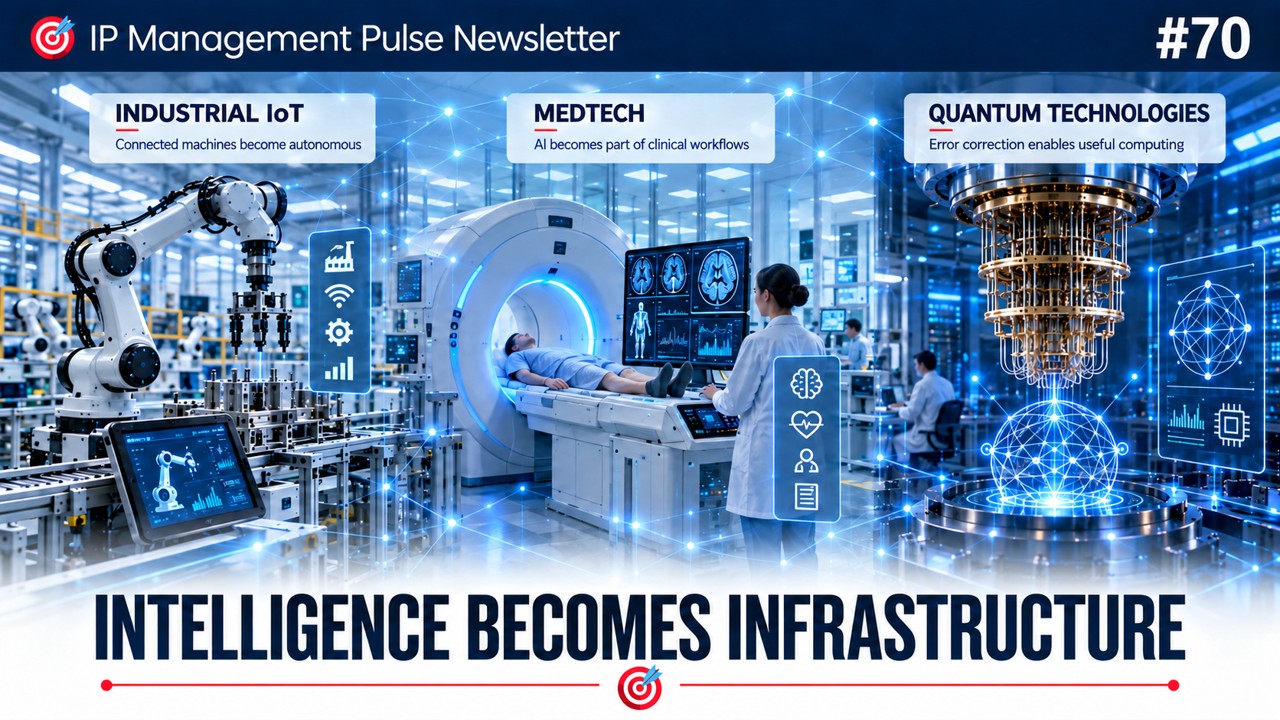
When intelligence becomes infrastructure 🎯IP Management Pulse #70

Subscribe for compact, in-depth IP intelligence: trends, cases and research curated by the team of the IP Business Academy and the IPBA Connect Platform. Get practical insights into current developments in IP management and learn from leading experts in the context of business models, innovation and R&D.
Explore previous editions in the newsletter archive and subscribe to 🎯IP Management Pulse for a fresh read every two weeks.
The next newsletter will cover the following topics:
Industrial IoT Moves Towards Autonomous Machines
Dimitrios Spiliopoulos highlighted the convergence of Industrial IoT, Edge AI, robotics and Physical AI in his preview of IMTS 2026. Demonstrations involving coordinated machines from several vendors make an important IP question tangible: which capabilities create value between the machines? The newsletter examines how orchestration software, operational data and implementation knowledge can shape a supplier’s competitive position—and its ability to reuse learning across customer installations.
Healthcare AI Develops Across Three Layers
Bertalan Meskó distinguishes between general-purpose AI assistants, medical assistants supporting clinical knowledge, and embedded agents supporting everyday workflows. His perspective provides a useful starting point for understanding where digital MedTech applications create value. We explore why protection priorities should reflect the application’s role in clinical work, including the specialised knowledge, validation and integration capabilities behind it.
Quantum Error Correction Becomes a Core Engineering Capability
Steve Brierley identifies error correction as a central engineering challenge on the road to useful quantum computing. His contribution directs attention towards the enabling capabilities within the quantum stack. For IP management, this raises questions about protecting decoding methods, implementation knowledge and hardware integration while providing partners with enough information to assess performance and integrate the technology.
MedTech IP and the Journey from Health Data to Better Patient Care
A new contribution starts from Camille Terfve’s article on how data has changed breast cancer diagnosis and care. It brings together ecosystem perspectives on precision-medicine platforms, clinical validation, data infrastructure, adoption and patient participation. The editorial IP analysis asks what companies need to retain and secure as insights become clinically useful services—particularly through validation partnerships, first deployments and subsequent expansion.
👉 MedTech IP and the journey from health data to better patient care
Choosing Protection That Supports the Robotics Business
The review of the CEIPI IP Business Talk with Andrew White develops the discussion beyond the announcement featured in our previous issue. It examines how commercial relevance, detectability and the practical demands of confidentiality influence protection decisions. Another important theme is invention capture: how ongoing dialogue with developers can reveal valuable contributions that might otherwise be treated as routine engineering.

Interoperability Standard Licensing
This dIPlex Deep Dive examines how standards, interfaces and licensing conditions shape participation in connected markets. Industrial machines and digital healthcare applications depend on access to surrounding systems. Understanding those access conditions early helps companies connect product architecture and market entry with the proprietary capabilities they want to preserve.
What Positioning Actually Means for an Expert-Led Business
Giulia Donato’s latest column explores how experts can connect their capabilities with the situations in which clients need them. Qualifications and service descriptions establish credibility, but prospective clients also need to understand when involving a particular expert makes sense. The article explains why that clarity should guide profiles, thought leadership and professional communication.

Protecting Knowledge While Enabling Data-Driven Growth
Our IP Management Learning distinguishes customer inputs, analytical methods, accumulated learning and delivered results. These layers require different permissions and protection choices. The article shows how companies can make useful insights accessible to customers while retaining the knowledge needed to improve their services and build a sustainable business.