
Where Is the Real IP Value in Quantum Sensing? Important industry topic with Dr. Lena Köhler

The demand for IP services, IP competence, and strategic support in the field of quantum technologies is steadily increasing. To better understand this development, the CEIPI IP Business Academy recently conducted an Open Foresight Board study in Europe, which confirmed the growing need for practical guidance at the interface of quantum technology, business development, and intellectual property management.
Here you find the Findings of this study: “The Quantum IP Gap”
Against this background, the CEIPI IP Business Academy continuously adapts its teaching content in close exchange with practitioners from industry and advisory services. The aim is to ensure that concrete practice-relevant questions and real industrial needs are systematically integrated into the training programs.
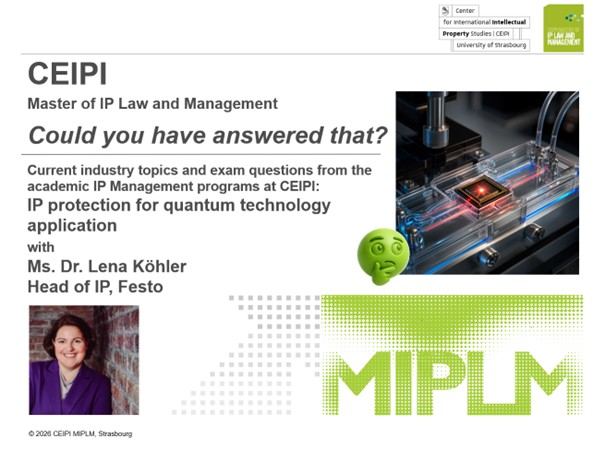
Quantum technology is a dynamically evolving technological and economic field of action. We are therefore particularly pleased to collaborate with experts from industrial practice. The following practice question was contributed by Dr. Lena Köhler and addresses the strategic IP challenge of integrating quantum sensor technology into industrial automation, microfluidic systems, and application-specific process environments. Dr. Lena Köhler is Head of IP and European Patent Attorney at Festo, who is also a member of the Open Foresight Board of the CEIPI IP Business Academy.
Practical Question Dr. Lena Köhler
Mini Case Study
When an industrial automation system integrates an external quantum sensor—for example, for real-time measurement of biomass growth in a bioreactor—where does the truly economically relevant and protectable value contribution lie: in the sensor itself, in the sensor’s connection to the microfluidics, in the calibration and evaluation algorithms, in the process data, or in the validated application for automation?
Why this is an important practical question:
In such quantum applications, the economic advantage often lies not only in the sensor’s core hardware, but especially in its industrial application, that is, in system integration, process control, data interpretation, software, interface logic, and reproducible application in a specific use case. This is particularly relevant for industrial companies because quantum technologies are often explicitly addressed as an application-oriented field.
The underlying strategic IP question is therefore:
What should be patented, what should be protected as a trade secret, and what needs to be contractually secured? If the protection strategy focuses too narrowly on the sensor hardware, the company may overlook the valuable component – namely, the application-specific know-how that makes the quantum sensor industrially viable in the first place. If it is too broad or vague, gaps can easily arise regarding freedom to operate, collaboration with technology partners, and subsequent utilization in platform or OEM contexts.
Dr. Lena Köhler
 Dr. Lena Köhler is Head of IP at Festo, Syndikuspatentanwältin, and European Patent Attorney. Her work focuses on patent portfolio management and strategic patent applications. This positions her at the interface of technology, legal protection, and strategic IP management.
Before joining Festo in January 2024, she held several IP roles at CeramTec, including Head of Patents, Trademarks and Licenses, Patentassessorin, and European Patent Attorney. In this role environment, she gained extensive experience in managing IP rights within an industrial company.
Earlier in her career, she worked at the Karlsruhe Institute of Technology as a patent professional. She studied law for patent attorneys at FernUniversität in Hagen and holds a diploma and doctorate in chemistry from TU Dresden. This scientific background gives her a strong technical foundation for working with complex innovation and patent matters.