What You Learn When IP Stops Being a Legal Department: The MIPLM 2025/26 in Six Modules


What does it take to manage intellectual property as a business function rather than as a collection of legal rights? The 2025/26 Master of Intellectual Property Law and Management at CEIPI answered this across six modules, moving from strategy to valuation, innovation, organizational design, management control and business development.
The program is designed around a fundamental shift in perspective: IP is not treated merely as a legal protection mechanism, but as a strategic business function. Across the six modules, IP is connected with corporate strategy, innovation, valuation, organizational design, management control and business development, creating an integrated framework for understanding how intangible assets contribute to competitive advantage and long term value creation.
This interdisciplinary approach helps participants understand not only which IP rights are available, but why, when and how they should be used in a specific business context. The aim is to develop the ability to connect legal options with managerial decisions, technological development and market opportunities. In this way, IP becomes part of the architecture of corporate decision making rather than a function that is consulted only after important choices have already been made. The MIPLM therefore focuses on building the strategic judgement required to manage intellectual property proactively in increasingly complex and technology driven business environments.
Module 1: Stop Protecting the Past, Start Designing Advantage
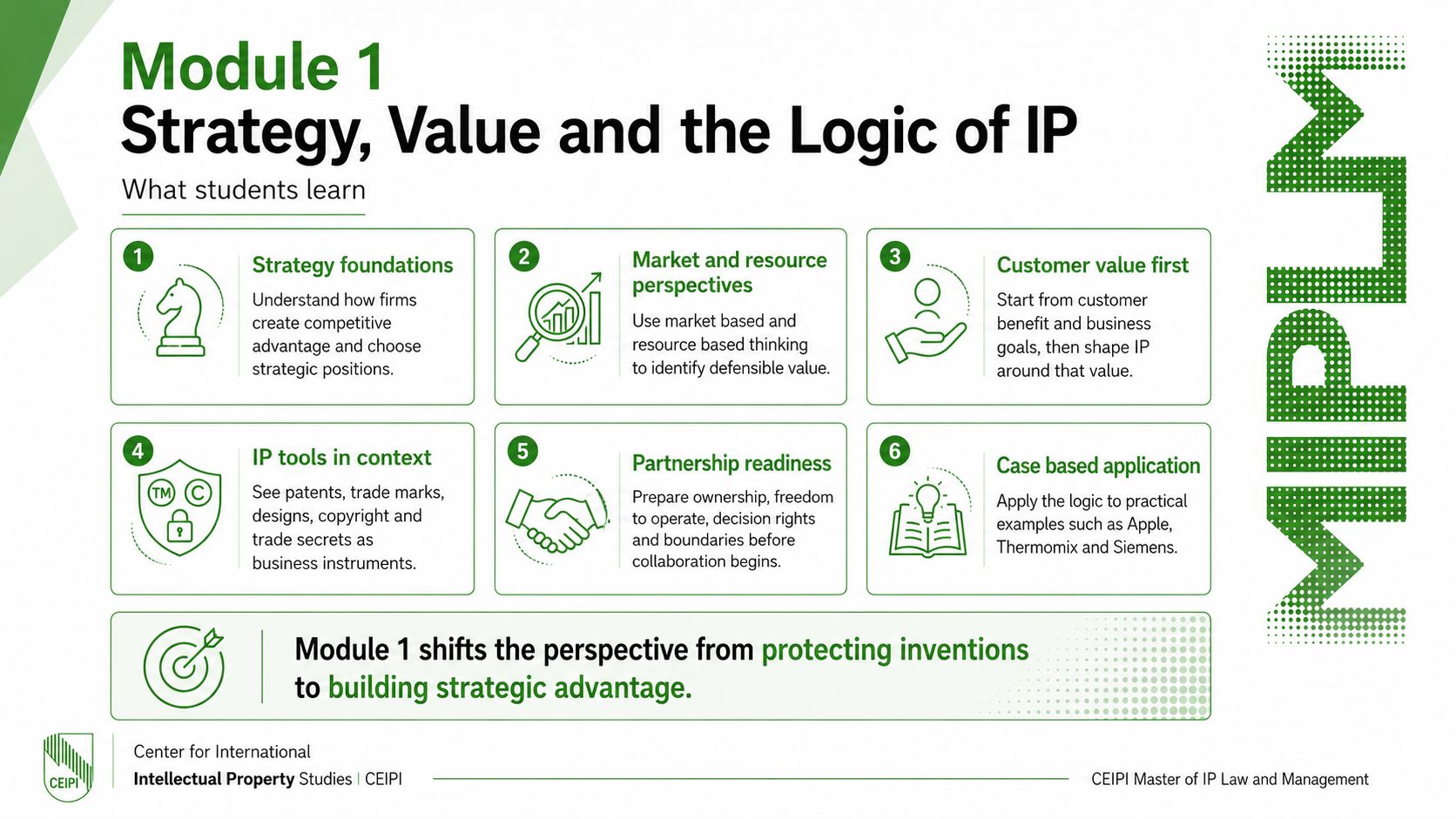
The first module establishes the strategic foundation. Strategy is not a catalogue of actions, but a coherent logic for winning. Market structures, customer power, competitive forces, internal resources and dynamic capabilities are examined together with patents, trademarks, designs, copyright and trade secrets.
This changes the starting point of IP work. Instead of waiting for an invention and asking how to protect it, students begin with customer benefit, business objectives and the position the company wants to defend. Cases such as Apple, Thermomix and Siemens show how IP can shape differentiation, bargaining power, ecosystem control and revenue. Preparation for partnerships follows the same logic. Ownership, freedom to operate, internal alignment, authority and clear boundaries must be established before negotiations begin.
 For Diego Borsetti, the MIPLM taught him to see intellectual property not merely as a legal protection tool, but as a strategic business asset. He particularly valued the focus on customer centricity, proactive portfolio development and the integration of IP with business and market strategy. For him, these insights are directly applicable in practice and especially valuable for in house IP professionals who want to connect innovation, competitive advantage and IP management more systematically.
.
 Konstantinos Tsakiliotis says the MIPLM gave him exactly the perspective he was looking for beyond classical IP law. One of his most important takeaways was the idea of “backwards thinking”: starting with customer benefit and value creation, then building the IP strategy around what needs to be protected. He also valued the international exchange and the practical understanding of strategy, valuation and governance that he can apply directly in his legal practice.
.
_____________________
Module 1 teaches how intellectual property can be aligned with corporate strategy, customer value and competitive positioning from the very beginning. Students learn to move beyond reactive protection and develop proactive IP strategies that support business models, partnerships and sustainable competitive advantage.
_____________________
Module 2: When the Invisible Must Answer to the Numbers
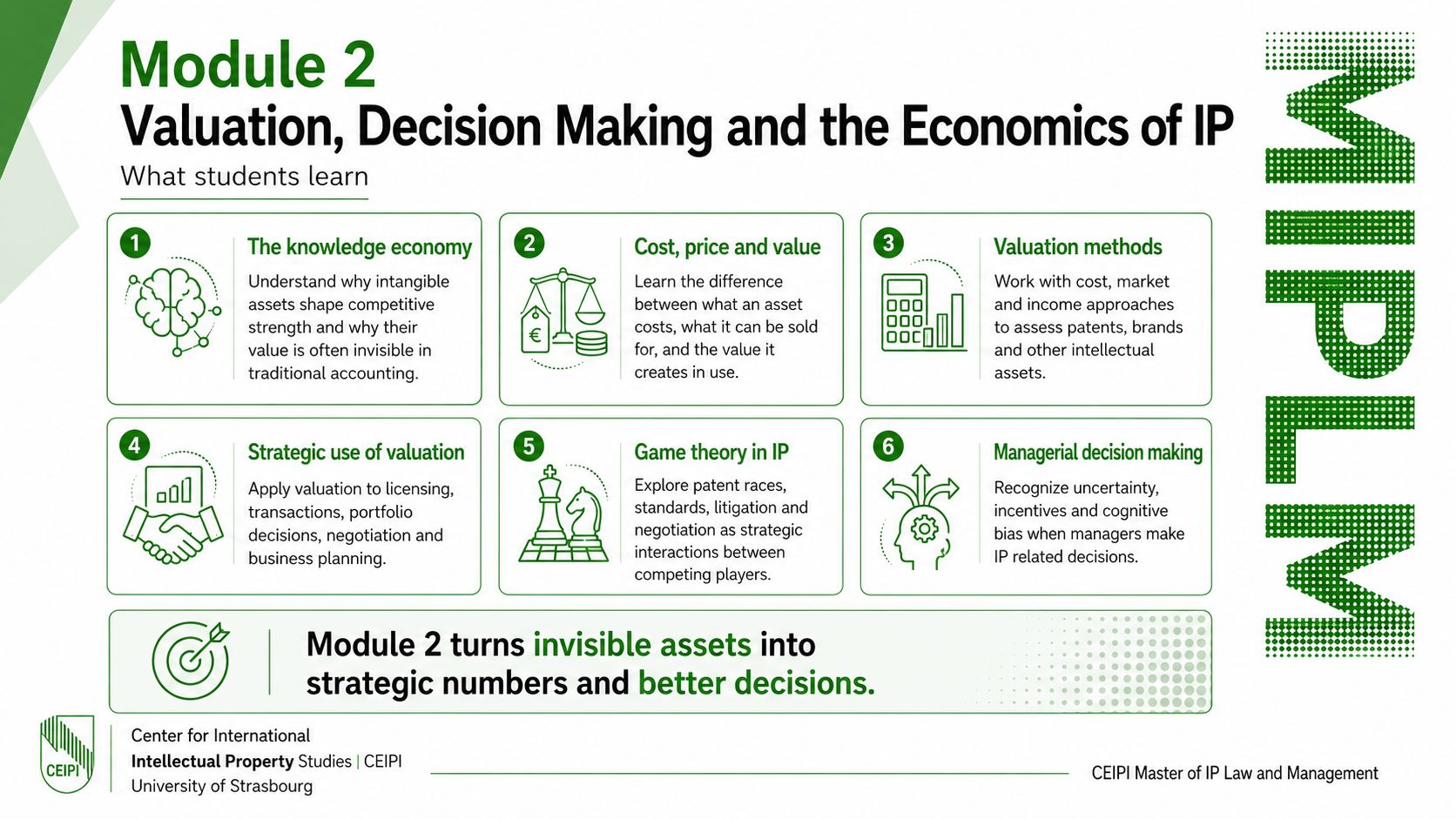
The second module addresses a central question in the knowledge economy: how can managers make decisions about assets that accounting systems often fail to show?
Students learn to distinguish cost, price and value. They examine why a patent or brand has no universal value independent of its owner, business model, market, complementary assets and exploitation scenario. They work with cost, market and income approaches, cash flow logic, royalty methods and structured valuation models. Valuation is not a hunt for one magical number. It is a disciplined explanation of how an intangible asset may create future benefits under defined conditions.
The module also introduces game theory and managerial decision making. Patent races, licensing negotiations, standards and litigation are strategic interactions in which competitors react. Cognitive biases and incomplete information shape decisions even when experienced managers believe they are objective.
 Daniel Pohl says the MIPLM exceeded his expectations and gave him a much broader understanding of the strategic role of IP in innovation and business. As an engineer, he particularly valued the economic concepts and analytical tools, which gave him new ways to approach complex problems systematically. He also highlights the program’s focus on current developments such as AI and the international exchange among participants as key elements of the learning experience.
.
 Tegu Benson describes the MIPLM as a defining moment in his professional development, particularly because it introduced him to IP strategy, valuation and freedom to operate from a completely new perspective. He learned to see IP as a multidisciplinary field that connects legal rights with business value, innovation and even restructuring and insolvency. For him, the international collaboration and the professional relationships formed during the program added an important network that will continue beyond graduation.
_____________________
Module 2 teaches how intangible assets such as patents and brands can be evaluated and translated into strategic business decisions. Students learn how valuation methods, economic reasoning, game theory and decision making under uncertainty help turn IP from an abstract legal asset into a measurable factor for investment, negotiation and corporate strategy.
_____________________
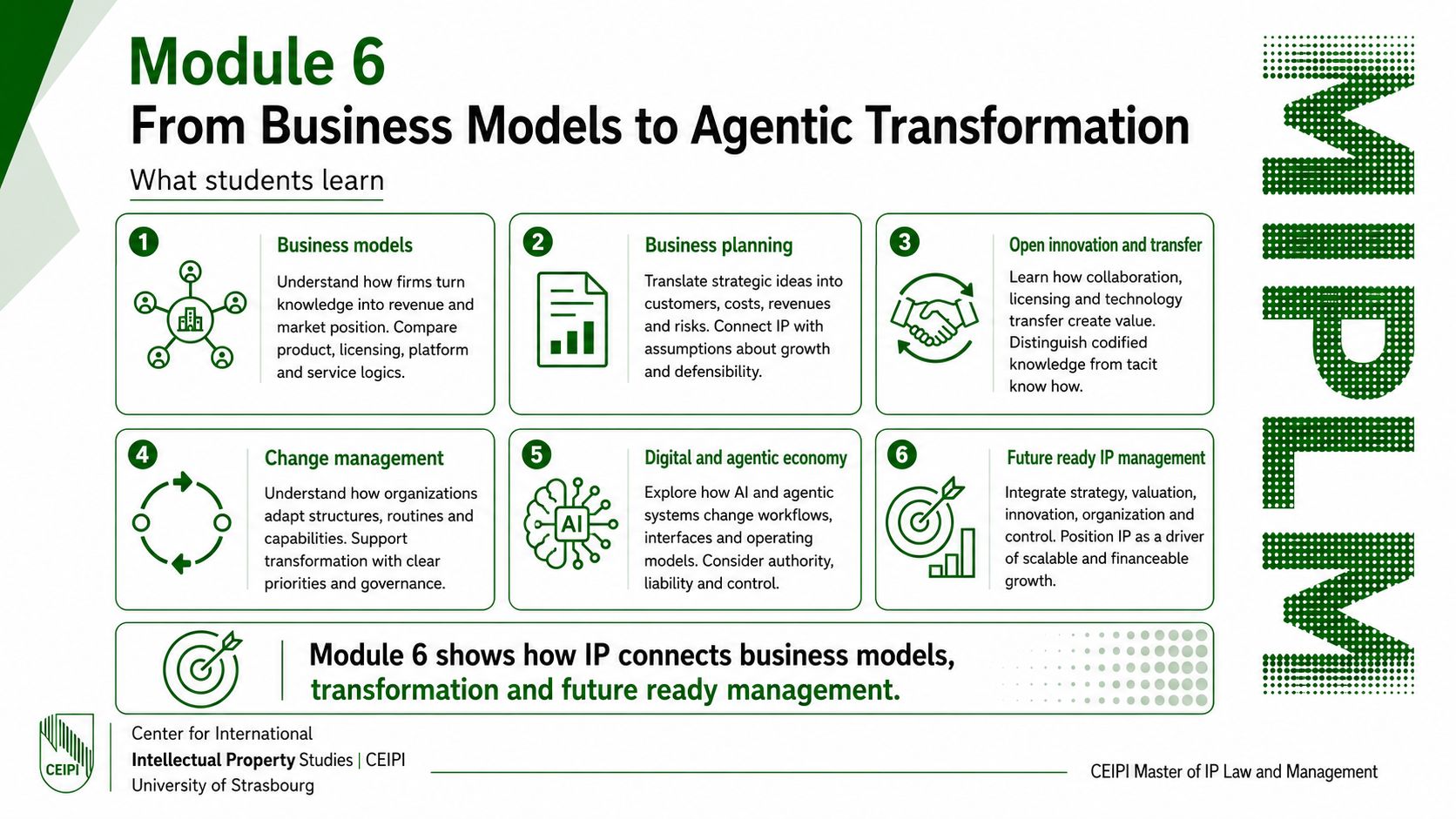
Module 3: Innovation Is Not a Miracle, It Is a Managed Tension
Innovation needs exploration, while organizations need reliability. Module 3 teaches how to manage both.
Participants learn the difference between research and development, technology management and innovation management. They examine market entry, innovation funnels, stage gate systems, technology road maps and collaboration models. IP is integrated throughout these processes, not added shortly before launch. Filing, secrecy, publication, freedom to operate and licensing become milestone decisions linked to technical progress, market learning and strategic intent.
Patent landscapes and artificial intelligence can identify promising spaces, while systematic methods help engineers invent around protected solutions and reveal competitor direction. Cooperation agreements can enable knowledge sharing while preserving ownership and exploitation options.
 Aditya Bhardwaj, an R&D scientist, describes learning about synthetic inventions, design thinking and the importance of directing technological development from the outset. He says the program helped him see how an organization can move from an IP protection centre towards an IP asset centre.
.
.
 Gianluca Magnani Avanzini says the MIPLM helped him regain intellectual motivation and approach intellectual property from a full 360 degree perspective. The program fundamentally changed his view of IP, from a predominantly legal practice into a real lever for value creation. He also highlights the international collaboration as an important experience of personal growth that encouraged him to challenge established assumptions and rethink his professional perspective.
.
.
_____________________
Module 3 teaches how technological innovation can be managed systematically from early exploration to market implementation. Students learn how innovation processes, technology roadmaps, patent intelligence, freedom to operate, collaboration models and IP decisions can be aligned to create defensible innovation.
_____________________
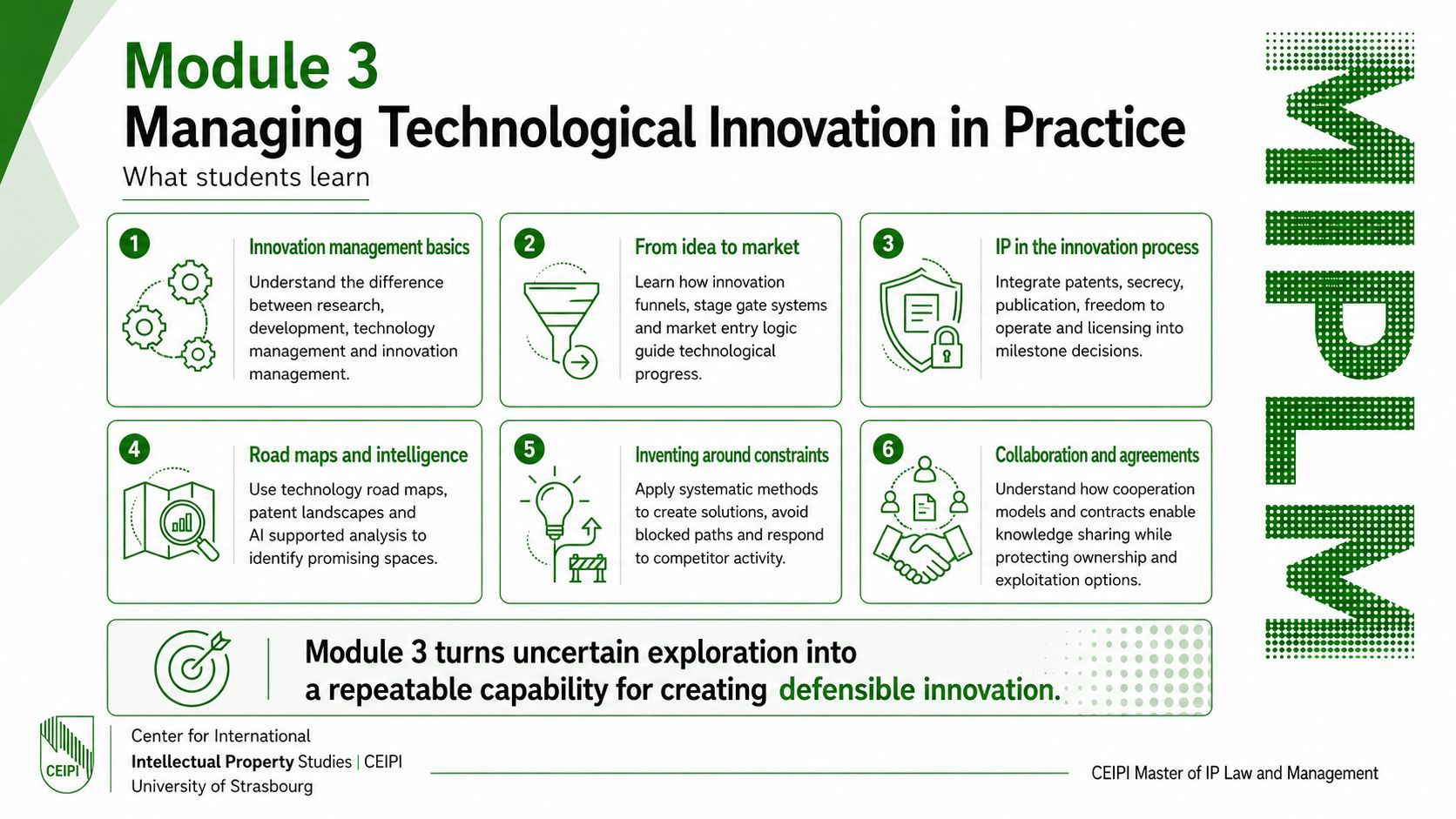
Module 4: The IP Department Is an Operating System, Not a Filing Desk
Even the best strategy fails when the organization cannot execute it. Module 4 focuses on how IP management is designed, governed and improved as a business system.
Students learn how integrated IP management connects research, product management, marketing, legal teams and executive leadership. Process thinking, clear responsibilities and continuous improvement replace fragmented case work. Standards such as DIN 77006 and ISO 56005 help embed IP into management structures, while organizational models must reflect the function’s expected role.
The module also confronts two realities. Outsourcing is not merely a cost decision. It determines which capabilities remain inside the company, where dependency arises and how organizational learning is preserved. Agile innovation also requires agile IP management. Early capture, repeated review, cross functional collaboration and value based prioritization allow IP decisions to keep pace with changing products and markets.
 Tomislav Hadzija describes the MIPLM as a practice oriented program that clearly exceeded his expectations through its combination of academic quality, open exchange and real world relevance. He particularly valued the concrete methods for IP strategy, portfolio management, risk assessment and C level decision making, as well as the integration of AI supported tools and case work. For him, the international cohort developed into a genuine professional community whose network, knowledge sharing and collaborative spirit are among the program’s most valuable outcomes.
.
 Dr. Alihan Kaya says the MIPLM not only broadened his perspective on the IP profession, but also deepened his understanding of its many dimensions. One of his most important insights was the clear distinction between practising IP law and managing IP systematically within a business context. He particularly valued the inspiring lecturers, the international exchange and the professional network created among participants from around the world.
.
_____________________
Module 4 teaches how IP management can be organized as an integrated business function rather than as an isolated legal activity. Students learn how processes, responsibilities, organizational models, outsourcing decisions and agile methods can turn IP strategy into repeatable organizational capability and measurable business impact.
_____________________
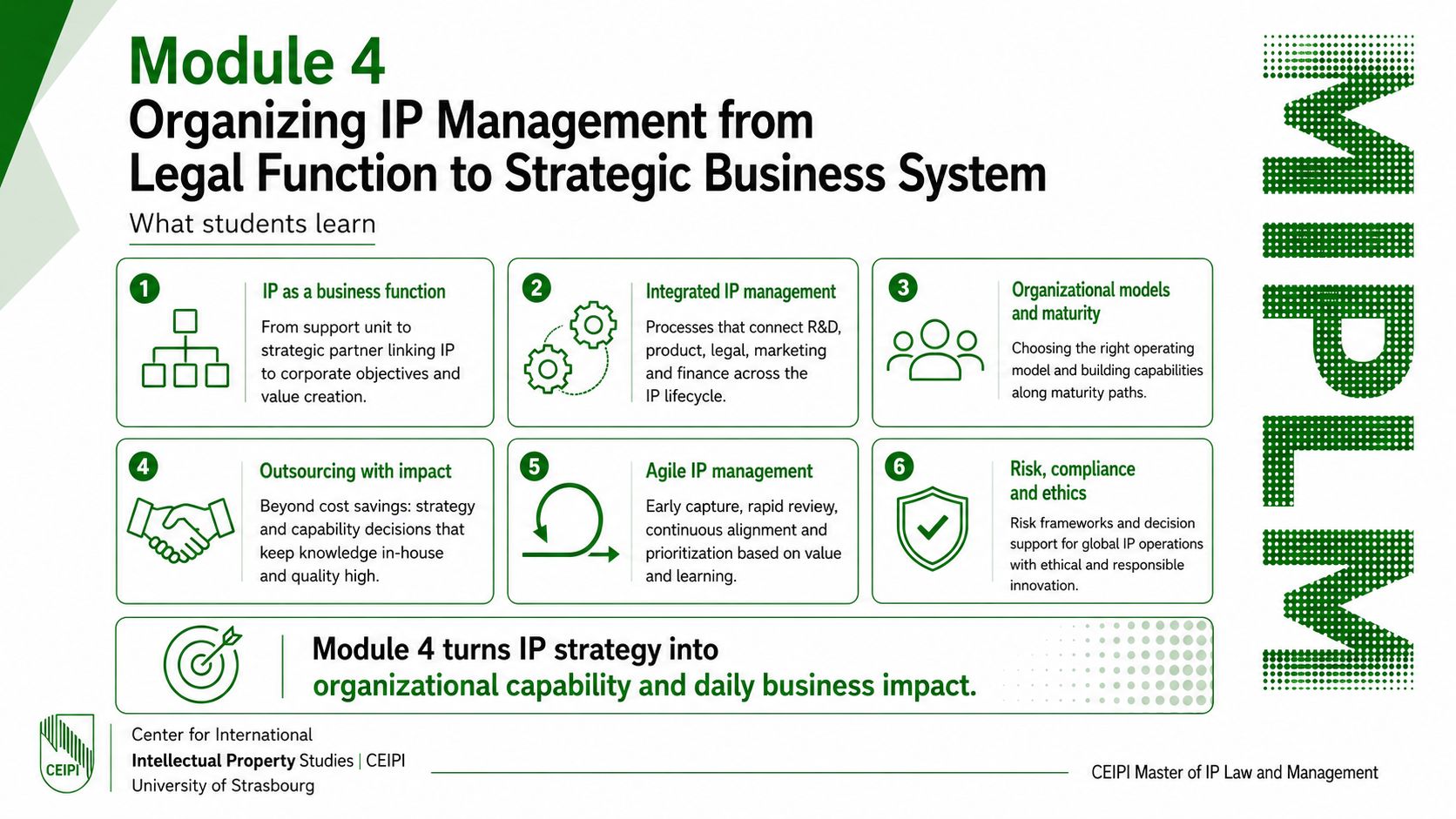
Module 5: The Future Cannot Be Managed with Yesterday’s Metrics
Module 5 asks how managers can steer intangible value when markets, technologies and product meanings are changing.
Through design driven innovation, students learn that innovation is not limited to better performance or new technology. Products also compete through meaning. Sustainability changes what mobility, ownership, repairability and participation in an ecosystem represent. This expands IP strategy beyond technical features towards trademarks, designs, narratives, interfaces and system positions.
Management control adds a second perspective. Patent counts and filing costs are necessary but insufficient. IP controlling must connect strategy, portfolio choices, exploitation and future opportunity. The quantum technology case demonstrates why emerging fields require indicators for capability building, learning, ecosystem access, interdisciplinary cooperation and strategic readiness. A portfolio may be small but decisive if it secures a critical interface or future option.
 Lana Mrsa says the MIPLM showed her that IP management is far more than an extension of legal practice. She particularly valued the connection between IP, psychology, economics, marketing, business strategy and innovation management. For her, the international exchange was one of the strongest elements of the program because every participant contributed a different professional and cultural perspective.
.
 Radka Červenková says the MIPLM changed the way she thinks about intellectual property by showing her that IP is not only a legal subject, but a strategic business asset. She particularly valued the way the program connects law with management, innovation, valuation and business strategy, while also strengthening her analytical and presentation skills. For her, the international collaboration and the professional network created during the program are lasting benefits that extend well beyond graduation.
.
_____________________
Module 5 teaches how to recognize, measure and steer intangible value in dynamic markets and emerging technology fields. Students learn how design driven innovation, IP controlling, valuation, metrics and risk management can be combined to make better strategic decisions and build resilient IP positions.
_____________________
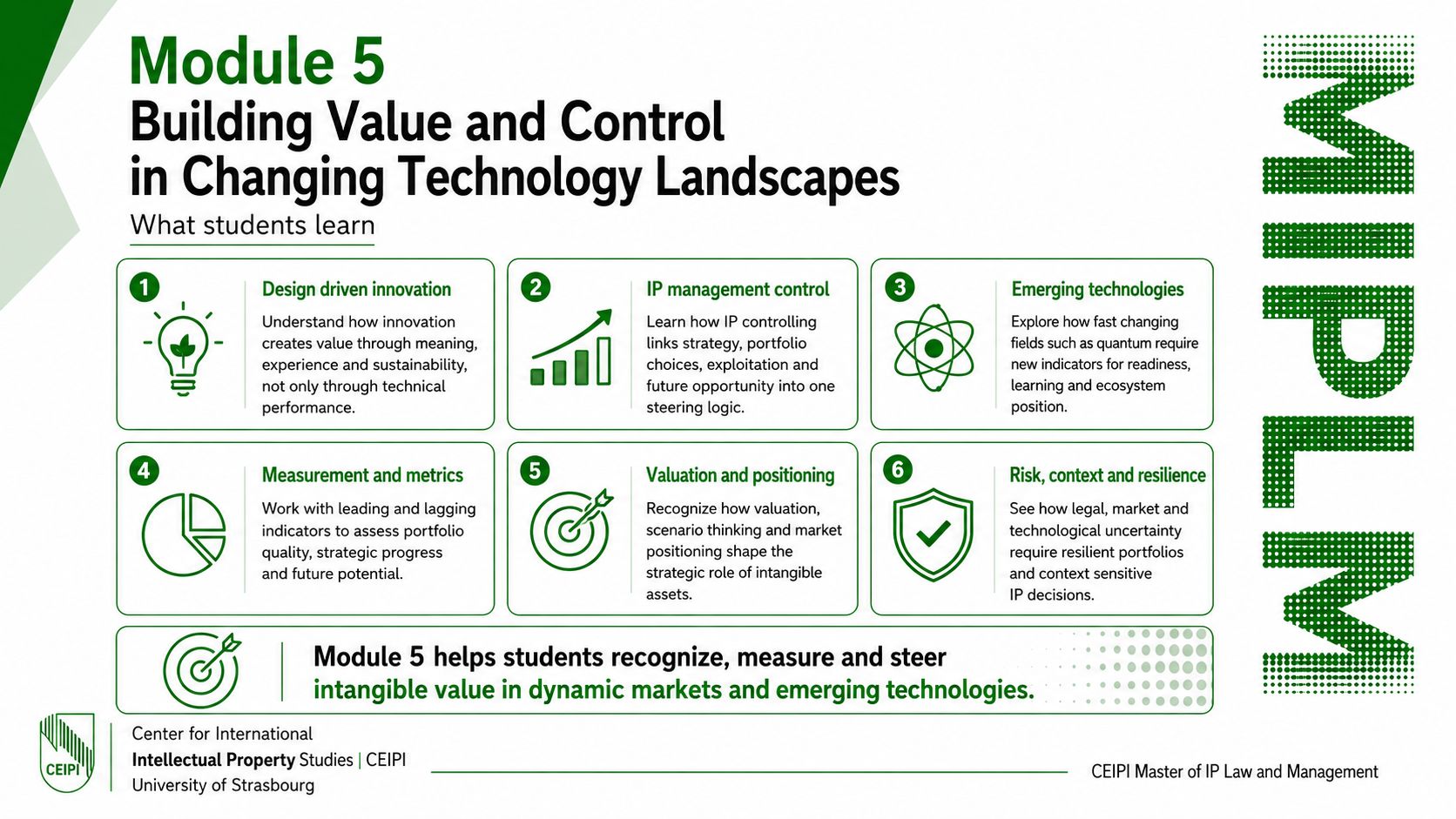
Module 6: The Final Test, Can Knowledge Become a Business?
The final module 6 brings the program together. Strategy, valuation, innovation, organization and control must support business development.
Students examine business models as the bridge between technology and economic value. They learn how IP priorities change when a company chooses closed control, open architectures, licensing, platforms, services or ecosystems. Business planning forces technical and strategic assumptions into a coherent account of customers, revenues, costs, resources, risks and defensibility.
The module extends this logic to open innovation, technology transfer, finance, change management and digital transformation. It asks what knowledge can be codified, what remains embedded in people and routines, and what a receiving organization must absorb. It also looks ahead to the agentic economy, where artificial intelligence changes workflows, authority, liability, interfaces and the speed of adaptation.
 Alejandra Gutierrez says the MIPLM exceeded her expectations and introduced her to IP management as a much broader strategic discipline than she had anticipated. She learned to understand intellectual property as a tool for value creation, innovation support and alignment with corporate strategy. She also highlights the international cohort and the resulting professional network as one of the most valuable parts of the program.
.
_____________________
The final Module 6 teaches how IP connects business models, business planning, open innovation and technology transfer with organizational transformation. Students learn how to use IP to support scalable growth, manage change and prepare organizations for AI driven and agentic business environments.
_____________________
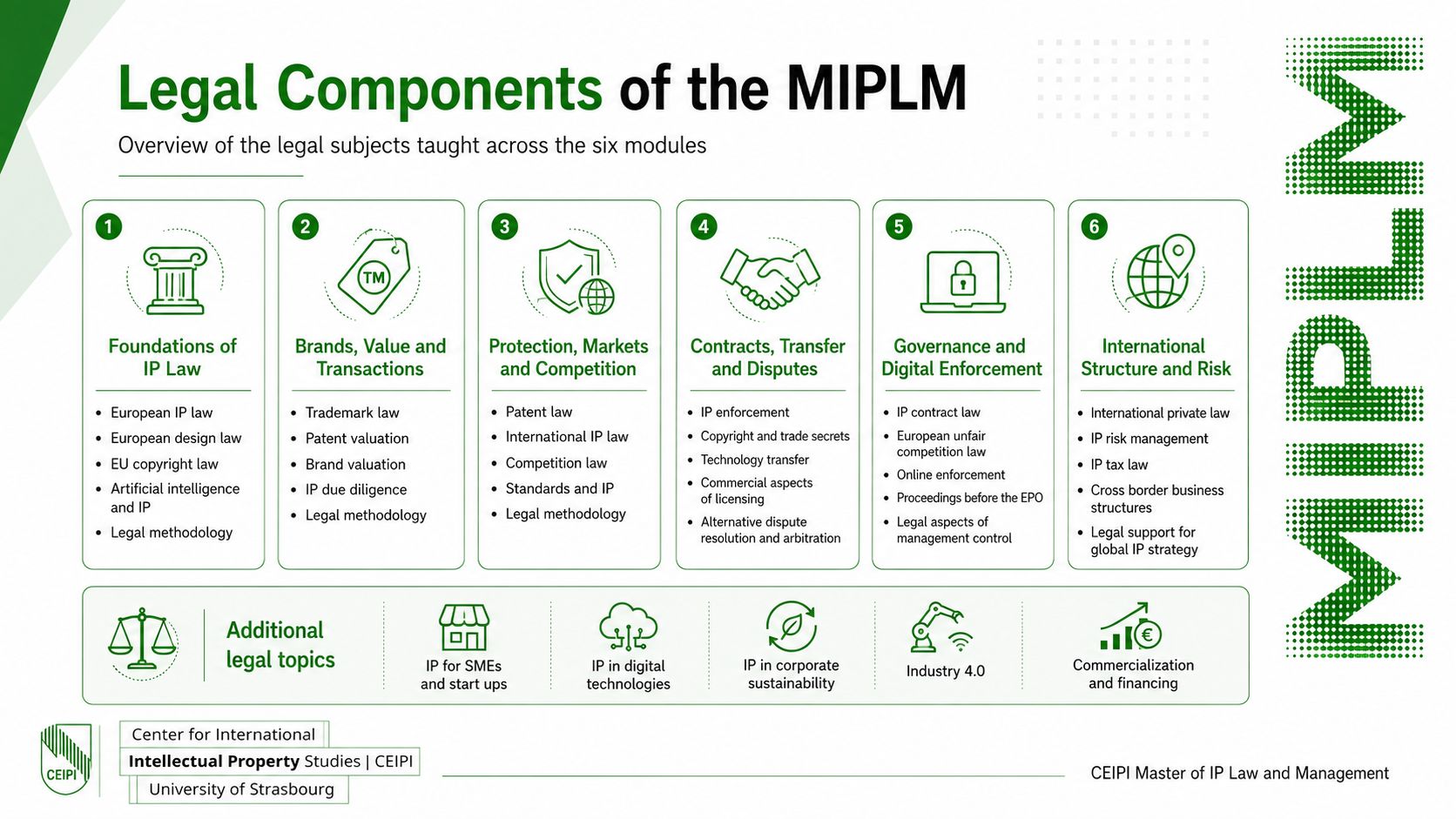
The Legal Architecture Behind Strategic IP Management
The MIPLM does not treat law as an isolated body of doctrine. Legal knowledge is taught as part of the decision architecture through which companies protect innovation, structure collaborations, manage risk and turn intangible assets into business value.
- The legal journey begins in Module 1 with the foundations of European intellectual property law. Participants study European design rights, EU copyright law, the interaction between artificial intelligence and IP, and the legal methodology required to analyse unfamiliar cases systematically. This creates a common legal foundation for an international and interdisciplinary cohort.
- Module 2 adds trademark law, IP due diligence and the legal environment of patent and brand valuation. Students learn that valuation cannot be separated from questions of ownership, enforceability, scope of protection and legal risk. The value of an IP right depends not only on projected income, but also on what the right actually allows its owner to control.
- In Module 3, the focus shifts towards implementation. Patent law, international IP law, competition law, technical standards and IP are examined in connection with innovation management. This is particularly important where market access, interoperability, standard essential technologies or third party rights influence the commercial viability of a new product.
- Module 4 addresses the legal structures required to organize IP management. Its subjects include IP enforcement, copyright, trade secrets, technology transfer, commercial aspects of licensing, alternative dispute resolution and arbitration. These legal areas show how responsibilities, knowledge flows and commercial relationships can be designed before conflict arises, and how disputes can be handled when preventive structures are no longer sufficient.
- Module 5 connects leadership and management control with IP contract law, European unfair competition law, online enforcement and proceedings before the European Patent Office. Students therefore examine not only how rights are obtained, but also how they are governed, defended and embedded in organizational responsibilities and control systems.
- The legal perspective concludes in Module 6 with international private law, IP risk management and IP tax law. These subjects become essential when business models, licensing structures, technology transfers and collaborations cross national borders. They help participants understand which law applies, where contractual and tax consequences arise, and how legal uncertainty influences the design of an international IP based business.
Additional teaching units broaden this legal perspective further. They cover IP for SMEs and start ups, IP in digital technologies, IP in corporate sustainability and Industry 4.0. Topics include rights acquisition and enforcement, financing, commercialization, data, software, robotics, artificial intelligence, virtual environments, blockchain, digital patents and the relationship between IP and ESG requirements.
The aim is therefore not to turn every participant into a specialist in every field of IP law. It is to develop the legal judgement required to recognize when a strategic decision depends on ownership, enforceability, contractual design, jurisdiction, compliance or risk. The MIPLM teaches participants to ask not only whether something can be protected, but also how the law can support the business model, the organization and the intended competitive position.
A Program for Professionals Who Want to Change Their Role
Across all six modules, the MIPLM develops one integrated capability: operating at the intersection of law, technology and business. Participants leave with a perspective that connects customer value, innovation choices, organizational processes, financial logic and strategic action.
The international cohort deepens that learning. Lawyers, patent professionals, engineers, scientists and managers challenge one another’s assumptions through cases, discussions and group work. Several participants describe this network as one of the program’s most valuable outcomes.
The 2026/27 MIPLM is taught in English in a hybrid format, with modules in Strasbourg and online. Enrolment remains open until 13 September 2026. For professionals who understand intellectual property and now want to understand what it can do for a business, the next cohort offers an unusually relevant step: learning to manage IP not at the edge of corporate decision making, but at its centre.
[Here] you can register for this fascinating program and take the next important step in your journey of knowledge and career development.