IP Market Study: The UPC Has Become a Business Development Market

The Unified Patent Court is no longer a legal experiment waiting to prove itself. It has become a market. And like every serious market, it creates new needs, new service categories, new positioning opportunities and new pressure on those who advise companies on IP.
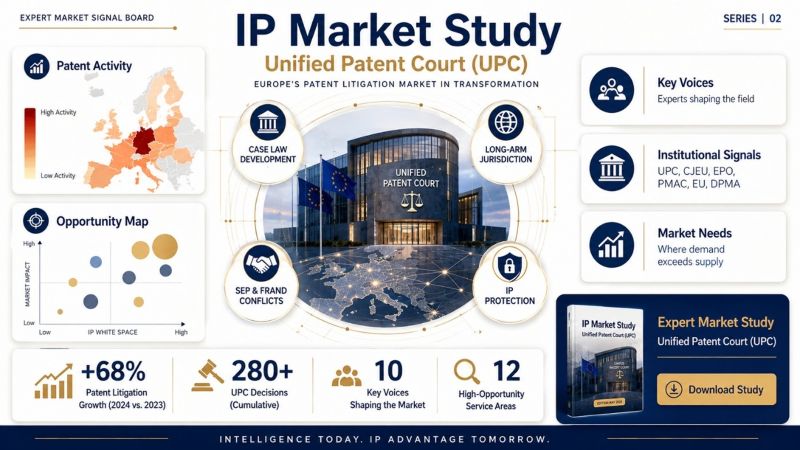
This is the central message of our new IP Market Study on the Unified Patent Court. The report is not written as another procedural overview of UPC rules, nor as a case law bulletin for specialists who already follow every order of the Court of Appeal. It is designed as market intelligence for IP experts, patent attorneys, litigators and adjacent IP service providers who want to understand where client demand is emerging and where the service market still looks surprisingly underdeveloped.
The timing matters. Between late 2025 and May 2026, the UPC has entered a far more mature phase. The Court of Appeal has started to shape substantive law on inventive step. Long-arm jurisdiction has moved from theoretical debate into real procedural conflict and even to the first CJEU referral. SEP and FRAND disputes have turned the UPC into part of a wider jurisdictional contest involving Germany, the UK and European institutions. Court fees have increased. The Patent Mediation and Arbitration Centre is about to become operational. The distribution of UPC cases across Europe has become a strategic and political discussion in its own right.
For companies, this creates a very practical problem. UPC strategy can no longer be reduced to the old opt-out question. It now affects portfolio architecture, enforcement timing, licence negotiations, due diligence, investor communication, litigation budgeting, internal governance and coordination between multiple courts. For IP service providers, this creates a different problem. Many firms have strong legal capability, but much of that capability is still communicated in the language of procedure, doctrine and litigation credentials. Clients, however, increasingly experience the UPC as a business decision environment.
That is the market gap.
The study maps this gap through six core lenses: current UPC topics, key voices shaping the European discussion, topic clusters, market needs, concrete service opportunities and implications for private practice. The aim is simple: to help IP experts see where demand is forming before it becomes fully commoditised.
One of the strongest findings is that the hottest areas are not necessarily the areas where service offerings are most mature. Long-arm jurisdiction and cross-border effect show very high case law activity, intense publication activity and high commercial pressure, but service maturity remains only partial. SEP and FRAND conflicts are even hotter, especially after the InterDigital v Amazon sequence and the emergence of anti-interim-licence injunctions. Yet outside a relatively small group of established SEP litigation firms, implementer-side defensive readiness remains visibly under-supplied.
The same pattern appears in other fields. Portfolio strategy, opt-out logic and prosecution sequencing are discussed frequently, but often in transactional terms. Companies need more than filing support. They need a portfolio architecture that distinguishes between patents best suited for UPC enforcement, patents whose value depends on survival, patents whose value lies in optionality and pending families that should already be prosecuted with UPC enforcement in mind. That is not a narrow procedural task. It is strategic IP management.
The institutional side is equally important. The Patent Mediation and Arbitration Centre is opening a new space for mediation, arbitration, expert determination and FRAND-related dispute resolution within the UPC ecosystem. Yet PMAC-related service positioning is still at an early stage. That makes it a prime example of an opportunity that may not immediately become a primary revenue stream, but can make an adviser sound much more relevant in conversations with corporate counsel, investors and policy-aware stakeholders.
The study also identifies the people shaping the public UPC conversation. Prof. Willem Hoyng of Hoyng Rokh Monegier stands out as one of the central European voices, combining institutional standing, deep involvement in the UPC rules and a prolific stream of UPC Unfiltered commentary. Prof. Dr. Tilman Müller-Stoy of Bardehle Pagenberg has become one of the most visible figures in the case-distribution debate, particularly through the open letter on uneven case allocation across UPC divisions. Dr. Christof Augenstein of Kather Augenstein brings together specialist litigation practice, international institutional work and commentary on structural issues such as long-arm jurisdiction. Sarah Taylor of Pinsent Masons shows how regular, accessible, high-quality UPC commentary can itself become a market position. Matthew Naylor of Mewburn Ellis demonstrates how a patent-attorney firm can build credibility through a steady UPC Weekly publication rhythm. Thomas Prock of Marks & Clerk has become particularly visible on long-arm jurisdiction and enforcement beyond UPC territory.
The institutional voices are just as important. Klaus Grabinski, President of the UPC Court of Appeal, provides the strongest public signal on how the court sees its own development. Aleš Zalar, Director of the Patent Mediation and Arbitration Centre, represents one of the most important structural additions to the UPC system in 2026.
For IP service providers, the practical consequence is clear. The UPC is not only a litigation venue. It is becoming a business development field.
The opportunity map in the report translates market needs into concrete service propositions. These include a UPC portfolio audit and opt-out strategy reset, a UPC litigation-readiness programme, implementer-side SEP defence readiness, pan-European coordinated litigation strategy, UPC integration for prosecution and validation, investor and M&A-facing UPC due diligence, a UPC plus UK combined strategy service, PMAC-ready ADR strategy, UPC cost and budget modelling, board-level UPC briefings and a European IP strategy watchtower.
None of these services are exotic. Most are extensions of capabilities that already exist in many firms. The missing layer is visible packaging. Companies cannot buy what they cannot recognise. A Head of IP, CFO, investor or board member rarely searches for “excellent understanding of Rule 262A” or “deep familiarity with Court of Appeal procedural orders.” They search for help with risk, timing, exposure, budget, enforcement leverage, valuation and decision confidence.
This is why the UPC market is so interesting for business development. The legal system has matured faster than the advisory market has repositioned itself. Many IP experts still speak as if the audience were other IP experts. The next opportunity is to translate UPC expertise into the language of operating decisions.
This is also why the study is useful beyond litigation boutiques. Patent attorneys, IP strategy consultants, due diligence providers, litigation funders, investor advisers, IP management software providers and business-development teams in law firms can all use the report as a map of where client conversations are likely to move over the next eighteen to thirty-six months.
More background on the structural logic behind our IP Market Study format can be found in the Industry Focus on the digital IP lexicon 🧭dIPlex:
👉 https://profwurzer.com/diplex/docs/unified-patent-court/
The full IP Market Report is available free of charge here and can be downloaded directly:
👉 https://profwurzer.com/diplex/docs/unified-patent-court/ip-market-report-unified-patent-court-upc/
There is also an overview episode on 🎧IP Management Voice discussing the key findings of this IP Market Report.
👉 https://ip-management-voice.podigee.io/89-ip-in-unitary-patent-and-upc
For anyone active in the European IP market, the core message is straightforward. The UPC is not only changing patent litigation. It is changing what companies expect from IP advisers. The firms and experts who understand that early will not only comment on the UPC market. They will help shape it.
Expert quotes and source links
Prof. Willem Hoyng, Hoyng Rokh Monegier, Amsterdam, Honorary Member and former President of EPLAW, co-drafter of the UPC Rules of Procedure, is described in the report as one of the central anchors of the European UPC conversation. His public work includes UPC Unfiltered and the AI-powered UPC Intelligence search engine. Source: 👉 https://www.hoyngrokhmonegier.com/news-insights/detail/upc-unfiltered-by-willem-hoyng-upc-decisions-week-02-2026 and https://www.eplaw.org/blog/detail/news-willem-hoyng-launches-upc-intelligence-an-ai-built-upc-cases-and-commentary-search-engine/
Prof. Dr. Tilman Müller-Stoy, Bardehle Pagenberg, Munich, UPC Representative and Honorary Professor for Patent Law at the Technical University of Munich, co-authored the open letter on UPC case distribution. The report highlights this contribution as a reference text in the debate about user choice and German dominance. Source:
👉 https://www.bardehle.com/en/ip-news-knowledge/ip-news/news-detail/open-letter-uneven-distribution-of-upc-cases-between-the-different-local-regional-central-divisions-of-the-court-of-first-instance-by-bardehle-pagenberg
Dr. Christof Augenstein, Kather Augenstein, Düsseldorf, Founding Partner, Chair of the AIPPI Standing Committee on the Unitary Patent and Unified Patent Court, and lecturer at CEIPI, is cited through his interview “Unfortunate that rules for judges UPC came so late” and his podcast discussion on UPC trends and long-arm jurisdiction. Source: 👉 https://legalblogs.wolterskluwer.com/patent-blog/unfortunate-that-rules-for-judges-unified-patent-court-came-so-late/ and https://ipfray.com/podcast-interview-with-sep-litigation-veteran-dr-christof-augenstein-on-upc-trends-and-predictions-long-arm-jurisdiction-powers/
Sarah Taylor, Pinsent Masons, Senior Practice Development Lawyer for the European patent litigation team and Editorial Board member of EPLAW Patent Blog and The Patent Lawyer, is highlighted for her UPC commentary, including “Rewriting the European patent litigation landscape one decision at a time.” Source: 👉 https://www.iam-media.com/article/rewriting-the-european-patent-litigation-landscape-one-decision-time and https://www.pinsentmasons.com/out-law/news/upc-court-appeal-inventive-step-test
Matthew Naylor, Mewburn Ellis, London, Partner and patent attorney, is highlighted as co-lead of UPC Weekly, including commentary on the first UPC SEP injunction and the Court of Appeal’s inventive-step framework. Source: 👉 https://www.mewburn.com/forward/upc-weekly-the-first-upc-sep-injunction and https://www.mewburn.com/forward/upc-weekly-court-of-appeal-settles-the-upc-framework-for-inventive-step
Thomas Prock, Marks & Clerk, London, Partner and European patent attorney, is highlighted for commentary on long-arm jurisdiction, the Dyson v Dreame CJEU referral and enforcement outside UPC territory. Source: 👉 https://www.marks-clerk.com/insights/latest-insights/102mqk9-upc-long-arm-jurisdiction-the-challenge-of-enforcement-outside-the-upc-territory/ and https://www.marks-clerk.com/insights/latest-insights/102mmb2-dyson-v-dreame-long-arm-jurisdiction-and-the-upc-s-first-cjeu-referral/
Klaus Grabinski, Unified Patent Court, Luxembourg, President of the Court of Appeal and chairperson of the Presidium of the UPC, is cited through the statement “Economic logic suggests the UPC will continue to grow.” Source: 👉 https://www.juve-patent.com/legal-commentary/klaus-grabinski-economic-logic-suggests-the-upc-will-continue-to-grow/
Aleš Zalar, Patent Mediation and Arbitration Centre of the UPC, Ljubljana, Director of the PMAC, is highlighted through his public positioning of the PMAC as a dispute-resolution forum tailored to the needs of the parties. Source: 👉 https://www.juve-patent.com/people-and-business/ales-zalar-i-like-to-compare-the-pmac-to-a-restaurant-offering-dispute-resolution/ and https://ipfray.com/upcs-patent-mediation-and-arbitration-centre-pmac-will-bear-frand-in-mind-when-designing-dispute-resolution-interview-with-director-ales-zalar/