Engineering Biology & Biomanufacturing in Motion: Why IP Is Becoming the Control Architecture of Programmable Biology

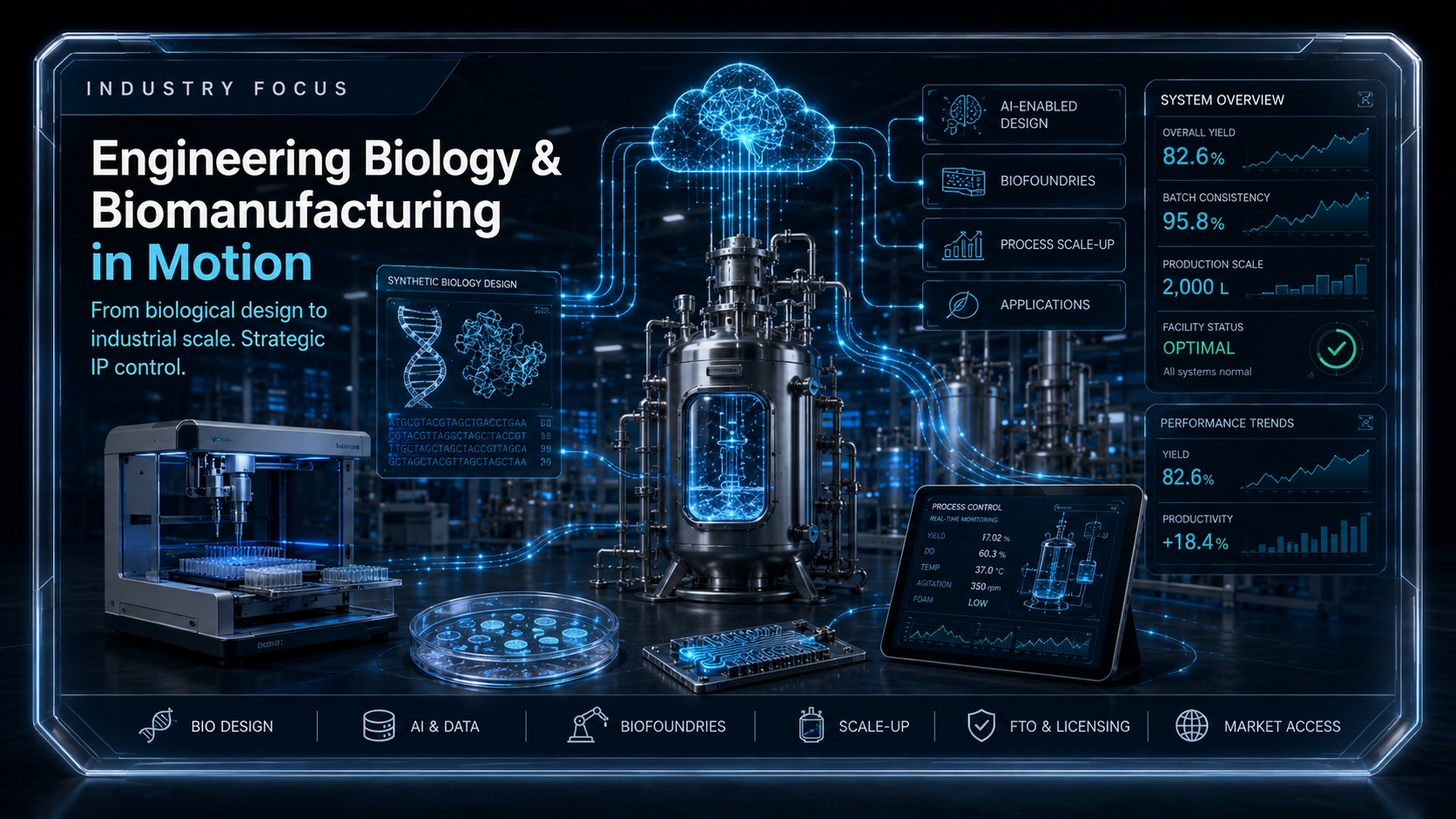
Engineering biology is moving from scientific possibility into industrial decision making. Biological systems are increasingly designed, digitally modelled, experimentally automated and transferred into production environments. The strategic IP question is therefore no longer limited to whether a sequence, protein, cell or process can be patented. It is becoming a broader question of who can control the path from biological design to scalable production, market access and commercial deployment.
Europe is shifting its attention from research to industrial deployment
In June 2026, the European Commission launched three complementary initiatives intended to accelerate the European bioeconomy. The Bio based Europe Alliance is intended to support market scale up, the Bioeconomy Investment Deployment Group is designed to improve access to finance, and an expert group will support implementation across Member States.
The Commission describes a persistent European problem: substantial funding has supported research, innovation and demonstration projects, yet many bio based companies still struggle to reach commercial production. Some promising European businesses are acquired by non-European investors before industrial deployment, taking strategic knowledge and future economic value with them. The Bio based Europe Alliance aims to mobilise €10 billion in corporate purchase commitments by 2030 to create demand signals for European production.
At the same time, the Commission has started preparing Biotech Act II for industrial biotechnology and biomanufacturing. The stated objective is to create a more enabling environment, develop lead markets and provide greater predictability for investors considering industrial commitments in Europe. These initiatives are more than individual policy announcements. They reveal where the critical transition is taking place. Europe does not only need more biological discoveries. It needs mechanisms that turn scientific knowledge into investable companies, reproducible processes, production capacity and market demand.
This is precisely where intellectual property becomes strategically important. Between an engineered biological system and a commercially viable product lie multiple decisions about ownership, control, disclosure, collaboration, manufacturing, financing and market access.
Biology is becoming an engineered and digitally supported system
Traditional biotechnology often began with the observation and exploitation of naturally occurring biological functions. Engineering biology increasingly starts with a desired function and works backwards toward the biological system capable of delivering it. Cells, microorganisms, enzymes, proteins and genetic circuits are becoming design objects. Artificial intelligence can support the prediction of structures and functions. Automated laboratories and biofoundries can test larger numbers of biological variants. Data from each development cycle can be used to improve the next cycle.
Simon Kremer, Partner and Patent Attorney at Mewburn Ellis, illustrates this transition in his March 2025 publication, Enzyme Engineering with AI: The Latest Chapter in a Long Story. Discussing recent work on the computational design of enzymes, he describes:
“a roadmap for designing entirely novel enzymes that catalyse multistep transformations”
The significance is not simply that artificial intelligence makes biological research faster. It changes the architecture of innovation. Competitive advantage may arise from the model, the training data, the design method, the generated sequence, the experimental validation, the production process or the combination of these elements.
The result is a more layered innovation environment. Laura Johnson, Senior Associate Patent Attorney at Carpmaels & Ransford, captures this development in her June 2025 article, Digital Life Sciences: Mapping a Shifting IP Landscape:
“the most effective patent portfolios are likely to be those that reflect the full complexity of the underlying innovation”
She completes the thought with the phrase “biological, digital and everything in between.” Her analysis points to a convergence of biotechnology companies, software providers, artificial intelligence developers, data platforms and technology infrastructure providers. These actors increasingly share access to models, discovery pipelines and biological data.
The IP object is therefore becoming more difficult to isolate. Protecting only the final biological product may leave the development platform exposed. Protecting only the computational method may fail to control the biologically validated result. Keeping everything confidential may restrict collaboration, investment and regulatory disclosure. The strategic task is to identify which combination of rights, information and capabilities actually creates control.
The relevant IP position exists across several technical layers
Engineering biology rarely creates value at only one level. The commercially relevant position can lie in a modified organism, a genetic sequence, a biological function, an engineered protein, a cell line, a screening method, a bioreactor, a process parameter or a specific application.
Anais Cassaignau, Alex Fennell and Anna Leathley of Carpmaels & Ransford make this point directly in their October 2024 publication, Exploiting Biotechnology to Meet Sustainable Ends:
“Innovation in sustainable biotech, including synbio, can be protected by patents at a variety of levels.”
Their analysis includes claims directed to cells and microorganisms, biological products, specific uses, modification and cultivation processes, bioreactors and machine learning methods used to monitor or model biological processes.
This variety creates opportunity, but it also creates a portfolio architecture problem.
A patent on a biological product may not prevent competitors from using an alternative organism or manufacturing route. A process patent may be difficult to enforce if production occurs within a third party facility. A broad platform claim may face questions about technical support and reproducibility. A trade secret may preserve process knowledge, but only while access, documentation and confidentiality remain controlled.
The strategic question is not simply what can be protected. It is which layer should be patented, which layer should remain confidential, which layer must be licensed, and which layer may need to be shared with regulators, manufacturing partners or standardisation bodies. This distinction separates a legal patentability analysis from an IP Management decision. Patentability asks whether a specific invention meets the legal requirements for protection. IP Management asks whether protecting that invention creates a meaningful position in the planned business model.
The strongest patent is not necessarily the patent covering the most scientifically interesting result. It is the position that gives the company leverage over the development path, the production process, the application market or a critical collaboration.
The decisive control point may emerge during scale up
A biological system can perform successfully in a laboratory and still fail in industrial production. Yield, stability, contamination, nutrient supply, temperature, oxygen levels, purification, process duration and quality requirements may change as production volumes increase.
Anja Koller, Senior Associate and Patent Attorney at Mewburn Ellis, describes this problem in her January 2025 publication, The Power of Bioprocess Engineering:
“The assumption that a successful lab-scale process can be easily converted to industrial-scale production often proves incorrect.”
Koller explains that scale up frequently requires additional scientific work and process adaptation. Innovation can arise in cultivation, upstream processing, downstream processing, bioreactor operation, purification and quality control. These innovations can support patent protection that complements, and potentially outlasts, protection for the original biological product.
This has major consequences for strategic IP Management.
The original biological construct may be only the starting point. The commercially decisive knowledge may be created later, while engineers and scientists learn how to manufacture the product reliably and economically. Much of this knowledge may remain invisible in the final product and may therefore be suitable for protection as a trade secret. Yet scale up also requires knowledge transfer. Startups may rely on pilot facilities, contract development organisations, contract manufacturers, equipment suppliers and industrial partners. Each transfer creates questions about access, improvements, documentation, confidentiality and ownership.
- Who owns an improved production strain developed during process optimisation?
- Who controls the data generated by a contract manufacturer?
- Can a production partner use the process knowledge for other customers?
- Which improvements must be disclosed back to the technology owner?
- Can the company replace the manufacturing partner without losing access to critical operational knowledge?
These are not secondary contractual questions. They determine whether the company controls its own industrialisation path.
Collaboration makes IP a coordination infrastructure
Engineering biology is structurally collaborative. Universities may contribute foundational research. Startups may build development platforms. Biofoundries may provide automated testing. Data companies may supply models. Industrial partners may contribute production expertise. Investors may finance demonstration facilities. Regulators determine whether the resulting application can enter the market. No single actor necessarily controls all the resources required for commercial deployment.
This means IP must coordinate relationships across the innovation system. Patents define some exclusion positions, but they are only one element. Material transfer agreements regulate access to biological materials. Research agreements allocate background knowledge and new results. Data provisions determine who can use experimental and process information. Licence agreements can divide applications by industry, territory or field of use.
A single biological platform may support applications in healthcare, food, agriculture, chemicals and materials. Granting broad rights to one early partner may therefore close future markets. Conversely, retaining every possible right may make a partnership commercially unattractive.
The role of IP is to structure controlled openness.
Companies must share enough knowledge, material and rights to enable collaboration and scale. At the same time, they must preserve the positions needed for future development, alternative partnerships and additional application markets.
Sara Holland, Partner and Patent Attorney at Potter Clarkson, connects IP directly with the transition from science to application. In her November 2025 publication, If You’re Not Thinking About Intellectual Property, You’re Not Thinking About Impact, she writes:
“Patents tell a story that academic papers can’t: they show which ideas are moving toward commercialisation.”
Her point reaches beyond patent statistics. Academic publication demonstrates scientific contribution. Commercialisation requires a structure through which others can invest, license, manufacture and participate while still expecting a defensible economic position. IP becomes the language through which scientific results are translated into investable and transferable positions.
New uncertainties are creating early decision gaps
The increasing maturity of engineering biology does not reduce uncertainty. It changes its location. Companies must still ask whether an invention is patentable, whether a claim is sufficiently supported and whether third party rights create infringement risks. But these legal questions are now surrounded by broader strategic uncertainties.
- Where does control arise when a biological product depends on a proprietary digital platform?
- Who owns a design generated through a collaboration between biological scientists and an external artificial intelligence provider?
- How should Freedom to Operate be assessed when the organism, production process, delivery system and application are each covered by different patent landscapes?
- Should process knowledge be patented, or would disclosure weaken the company’s long term position?
- Which rights must remain available for future applications of the same platform?
- How can an investor evaluate whether a biological technology is not only scientifically credible, but manufacturable and commercially controllable?
The provenance of biological resources also creates a growing documentation issue. The WIPO Treaty on Intellectual Property, Genetic Resources and Associated Traditional Knowledge was adopted in May 2024 and establishes a patent disclosure requirement for inventions based on relevant genetic resources or associated traditional knowledge once the Treaty enters into force for the applicable jurisdiction. The Treaty has not yet entered into force as of July 2026, but it already signals a closer relationship between patent strategy, material provenance and research documentation.
These uncertainties require decisions earlier than many companies expect. Waiting until a patent application is drafted, a manufacturing contract is negotiated or an investor begins due diligence can be too late. Publications may already have restricted protection. Collaboration agreements may already have allocated rights. Process knowledge may already have spread across organisations. A licence may already have granted away a strategically important application field.
Fragmented advice does not reveal the complete control architecture
Engineering biology creates a market problem for advisory services because expertise is often organised around individual legal or technical tasks. A patent attorney may assess the protection of a sequence or production method. A commercial lawyer may review a development agreement. A regulatory specialist may evaluate the product pathway. A data specialist may examine access to models and databases. A manufacturing consultant may address process scale up. An investor may commission a due diligence review. Each contribution may be correct, yet the company may still lack an integrated answer to the central question:
What must the company control to execute its business model?
A patent portfolio can appear strong while failing to cover the production process that makes the product economically viable. A company may own the biological design but depend on a partner for the data needed to improve it. It may hold broad patent rights but lack Freedom to Operate for a critical delivery technology. It may protect a platform but grant away the most valuable application fields in its first commercial agreement.
This is why Adam Gregory, Partner and Patent Attorney at Mewburn Ellis, describes IP strategy as an adaptive management process in his April 2025 publication, Crafting IP Strategies for Innovative Biotechs:
“A well-designed IP strategy should be a dynamic, ‘living’ plan that adapts as the venture grows.”
Gregory connects IP strategy with technology development, commercial ambition, financing, licensing, partnerships, acquisition and Freedom to Operate. The relevant strategy changes as the company moves from academic disclosure to startup formation, external financing, product development, manufacturing and market entry.
The advisory gap is therefore not a lack of specialist knowledge. It is a lack of integration between legal rights, technical development and business decisions.
IP experts must become strategic translators
The role of IP experts in engineering biology is not limited to explaining what can be patented or whether a contract is legally enforceable. Their strategic role is to translate between biological science, production engineering, data, regulation and business models. This requires understanding where the technology is heading, how the company expects to create revenue, which partners are necessary, which capabilities remain internal, which application markets may become relevant and which rights will be examined by investors or potential licensees.
The IP expert should help decision makers compare options.
Should the company build a broad platform portfolio or focus resources on a first commercial application?
Should a process innovation be patented or maintained as confidential operational knowledge?
Should a licence be exclusive, non-exclusive or limited to a particular field of use?
Should Freedom to Operate analysis focus only on the current biological construct, or also on manufacturing, data tools and future markets?
Should the company participate in emerging standards, and what knowledge would that participation require it to disclose?
These are not questions with universal answers. Their value lies in making strategic choices explicit before technical and contractual dependencies become fixed. This is what it means to treat IP as decision infrastructure. IP connects technology choices with financing, collaboration, production, market access and competitive positioning.
Control must extend from design to industrial application
Engineering biology and biomanufacturing are not becoming important because biology has suddenly become patentable. Biological inventions have been protected for decades. The structural change is that biological systems are becoming programmable, digitally supported, collaboratively developed and industrially scalable across multiple markets. As this happens, the relevant IP position moves beyond the individual sequence, protein or organism. Control can arise in data, design methods, biological materials, development platforms, production processes, standards, manufacturing knowledge and application rights.
Four implications follow.
First, portfolio architecture must reflect the complete innovation system. Companies need to understand how biological, digital, process and application related positions reinforce each other.
Second, scale up must become part of IP strategy. Production knowledge is not merely operational detail. It can become the main source of differentiation, dependency and economic value.
Third, Freedom to Operate must be continuous. Changes in the organism, process, partner, application or target market can each introduce new third party rights and contractual restrictions.
Fourth, collaboration agreements must preserve strategic options. Access to materials, data, improvements and application fields should be designed around the future business model, not only the immediate project.
Engineering biology matters because it shows how IP is moving from a narrow legal protection function into a strategic decision system for control, collaboration, market access, risk management and competitive positioning.
Companies that understand this shift early gain the ability to shape partnerships, protect critical knowledge and choose where they want to compete. Companies that address IP only after the science is completed or the production path is fixed risk discovering that the most important control points already belong to someone else.
The article refers to the following expert publications and institutional sources
Simon Kremer, “Enzyme Engineering with AI: The Latest Chapter in a Long Story,” Mewburn Ellis Forward, 28 March 2025.
👉 https://www.mewburn.com/forward/enzyme-engineering-with-ai-the-latest-chapter-in-a-long-story
Laura Johnson, “Digital Life Sciences: Mapping a Shifting IP Landscape,” Carpmaels & Ransford, 10 June 2025.
👉 https://www.carpmaels.com/digital-life-sciences-mapping-a-shifting-ip-landscape/
Anais Cassaignau, Alex Fennell and Anna Leathley, “Exploiting Biotechnology to Meet Sustainable Ends,” Carpmaels & Ransford, 14 October 2024.
👉 https://www.carpmaels.com/exploiting-biotechnology-to-meet-sustainable-ends/
Anja Koller, “The Power of Bioprocess Engineering,” Mewburn Ellis Forward, 16 January 2025.
👉 https://www.mewburn.com/forward/the-power-of-bioprocess-engineering
Sara L. Holland, “If You’re Not Thinking About Intellectual Property, You’re Not Thinking About Impact,” Engineering Biology, 2025, article e70001, first published 7 November 2025, DOI: 10.1049/enb2.70001.
👉 https://ietresearch.onlinelibrary.wiley.com/doi/10.1049/enb2.70001
A shorter version and commentary by Potter Clarkson is available here:
👉 https://www.potterclarkson.com/news/if-youre-not-thinking-about-ip-intellectual-property-youre-not-thinking-about-impact
Adam Gregory, “Crafting IP Strategies for Innovative Biotechs,” Mewburn Ellis Forward, 3 April 2025.
👉 https://www.mewburn.com/forward/crafting-ip-strategies-for-innovative-biotechs
European Commission, Directorate General for Environment, “Commission Steps Up Action on Europe’s Bioeconomy,” 10 June 2026.
👉 https://environment.ec.europa.eu/news/commission-steps-action-eu-bioeconomy-2026-06-10_en
European Commission, Directorate General for Internal Market, Industry, Entrepreneurship and SMEs, “Commission Seeks Feedback on Industrial Biotechnology and Biomanufacturing,” 18 May 2026.
👉 https://single-market-economy.ec.europa.eu/news/commission-seeks-feedback-industrial-biotechnology-and-biomanufacturing-2026-05-18_en
World Intellectual Property Organization, “WIPO Treaty on Intellectual Property, Genetic Resources and Associated Traditional Knowledge,” adopted on 24 May 2024.
👉 https://www.wipo.int/en/web/treaties/ip/gratk/index
The official WIPO summary of the treaty is available here:
👉 https://www.wipo.int/en/web/treaties/ip/gratk/summary_gratk