
Two Ways to Make GreenTech IP Legible: Innovation-to-Scale Translation at J A Kemp and Full-Lifecycle IP Leverage at Finnegan

GreenTech presents a particular communication challenge for IP practice groups. It is not one technology field. It includes renewable energy, batteries, hydrogen, carbon capture, sustainable fuels, recycling, water treatment, smart grids, low-carbon manufacturing, sustainable transport, energy-efficient buildings and software-enabled resource management. Many of these technologies combine chemistry, materials science, engineering, biotechnology, software, data and industrial infrastructure.
The resulting IP questions do not arise only when a patent application is ready to be drafted. They appear throughout the development and commercialisation process.
A GreenTech company may need to decide:
- which technical elements should be patented;
- which manufacturing parameters should remain confidential;
- whether its portfolio will withstand investor due diligence;
- how background and foreground IP should be allocated in a development partnership;
- whether third-party rights could prevent industrial deployment;
- where patents must be filed to capture relevant manufacturing or commercial activity;
- whether licensing would accelerate adoption without surrendering strategic control;
- and how the company should prepare for enforcement once the market becomes more competitive.
This makes conventional sector language insufficient. A statement such as “we advise clients on patents in cleantech” may establish technical relevance, but it does not yet explain which uncertainty the practice group helps clients resolve.
Good public communication must make the field legible. It must show where IP decisions arise, how they relate to scaling and commercialisation, and what role the adviser can play before a conventional legal mandate has been clearly formulated.
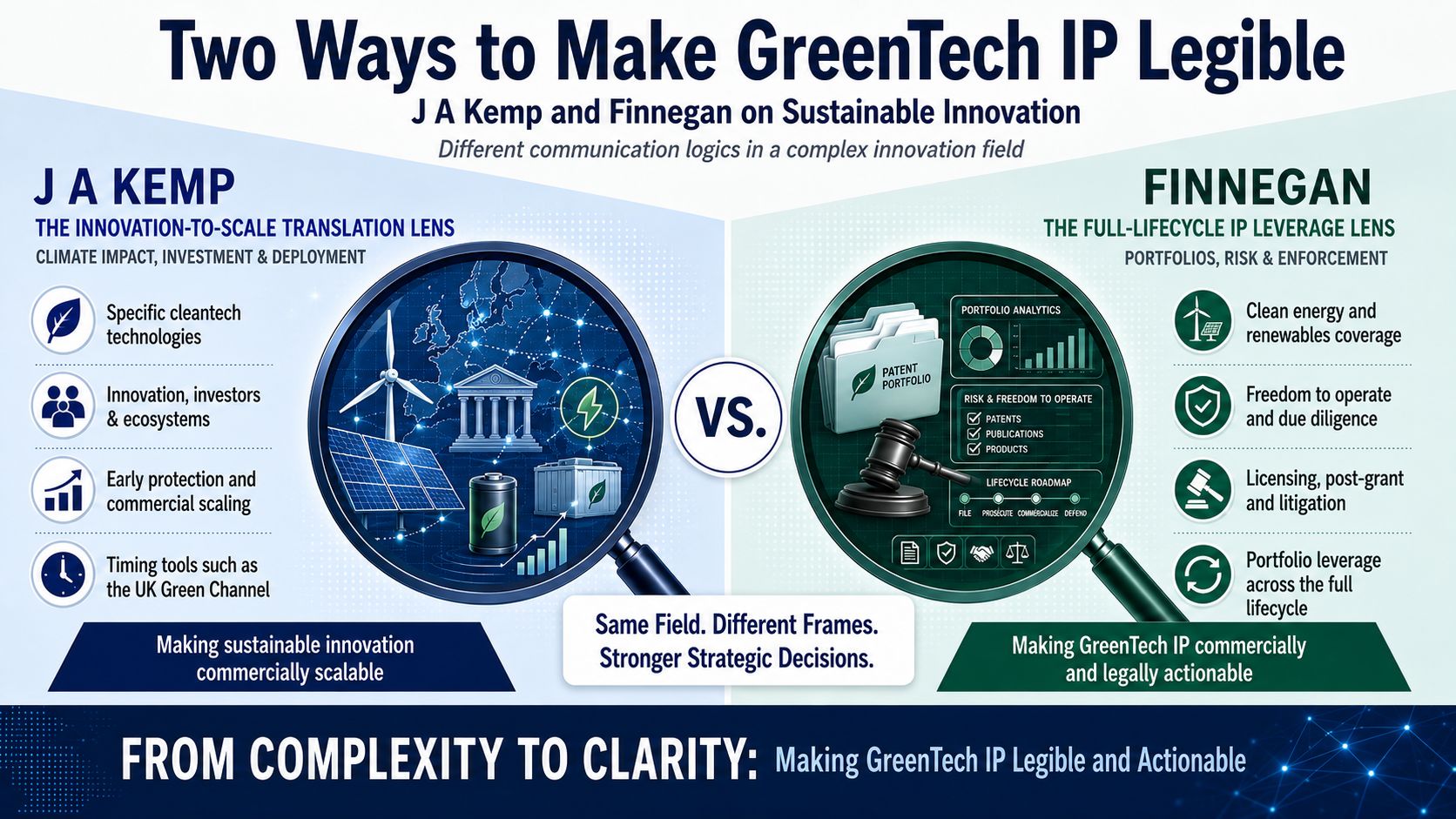
The public communications of J A Kemp and Finnegan provide two credible but distinct approaches.
J A Kemp uses “cleantech” alongside the broader categories of green energy and climate technology. Its communication frequently connects technical innovation with investment, ecosystem participation and the process of turning early-stage research into deployable solutions.
Finnegan publicly presents the field primarily under “Clean Energy and Renewables”. Its communication places greater emphasis on using IP throughout the complete commercial and legal lifecycle, including portfolio development, freedom to operate, licensing, due diligence, enforcement, post-grant proceedings and litigation.
This is not a ranking of the two firms’ capabilities. Public communication cannot establish which practice is stronger. It is an examination of how two IP practices make sustainable innovation understandable, relevant and commercially meaningful to potential clients.
GreenTech is difficult to communicate because the IP problem is not limited to protecting one environmentally beneficial invention. It concerns how a technology can move from technical promise to industrial scale while retaining control, investment credibility and room to operate.
The Common Field
J A Kemp and Finnegan are both useful examples because neither firm treats GreenTech merely as a generic patent category.
J A Kemp’s green energy and climate-tech page identifies specific areas such as carbon capture, hydrogen production, methane reforming, batteries, fuel cells, bioreactors, biofuels, plastics recycling, combined heat and power, air purification and water treatment. The page also addresses a broad client spectrum extending from start-ups and universities to research institutions and multinational companies.
Finnegan’s Clean Energy and Renewables page similarly divides the field into recognisable technical categories. These include biofuels, biomass, hydrogen, photovoltaics, wind energy, smart grids, batteries, energy management, emissions reduction, water filtration, advanced materials and sustainable transportation. The firm connects this technical breadth with patent prosecution, portfolio management, freedom-to-operate counselling, licensing, due diligence, post-grant proceedings and litigation.
Both firms therefore communicate technical specificity. They show that GreenTech is not one homogeneous industry. Different technologies create different patentability questions, competitive landscapes, development timelines and commercial risks. A solar-cell manufacturer, a hydrogen infrastructure company and a carbon-capture start-up may all operate within the sustainable innovation economy, but they will not require the same portfolio architecture or market-entry strategy.
Both firms also recognise that GreenTech innovation takes place within collaborative environments. Universities, start-ups, investors, manufacturers, infrastructure operators, utilities, public authorities and multinational companies may all participate in the development and deployment of the same technology. IP therefore becomes relevant not only as a protection mechanism, but also as a basis for investment, technology transfer, commercial partnerships, licensing and enforcement.
The commonality is not that both firms use identical terminology. It is that both make the category more concrete by connecting GreenTech with identifiable technologies and business situations. The difference lies in the route through which they create relevance.
J A Kemp appears to lead predominantly from emerging technology, climate impact and the innovation ecosystem towards patent protection and commercial scaling. Finnegan appears to lead predominantly from multidisciplinary IP capability and lifecycle planning towards commercial leverage, risk management and enforceable market positions.
J A Kemp: Positioning GreenTech Through Innovation-to-Scale Translation
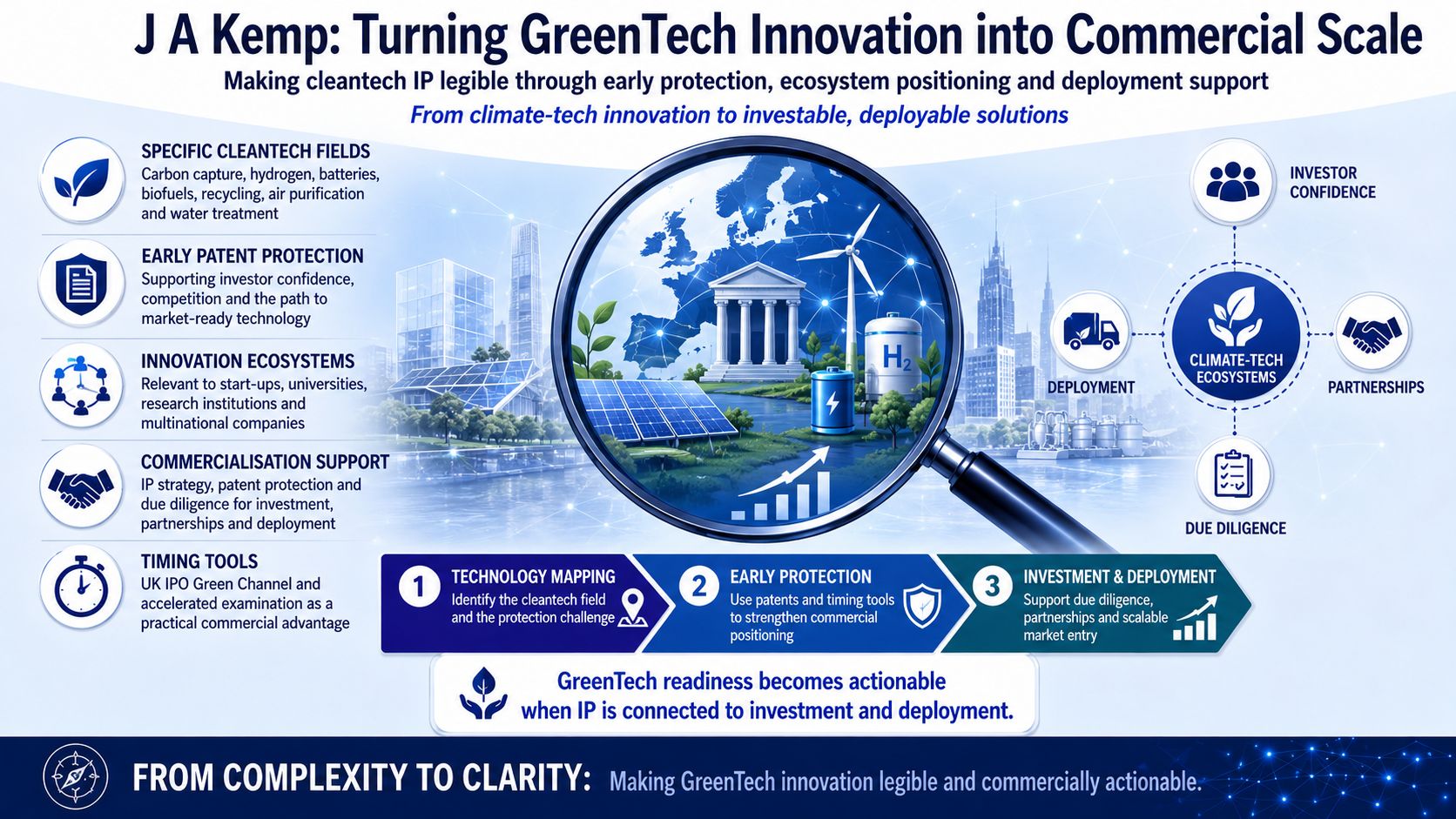
The public communication of J A Kemp suggests an organising principle of innovation-to-scale translation. The firm’s green energy and climate-tech page begins with the development of practical solutions to global challenges. It describes the growth of patenting activity, the expanding role of multinational companies in sustainable innovation and the development of technologies ranging from renewable-energy generation to air-quality improvement and carbon capture.
This sequence is significant from a communication perspective. The reader is not taken immediately into a detailed list of legal procedures. The communication first establishes the technological and societal context. GreenTech inventions are presented as mechanisms for enabling a cleaner industrial system. Patent advice is then positioned as support for innovators attempting to convert scientific and engineering advances into practical solutions.
The same logic appears in J A Kemp’s communication on protecting GreenTech innovation. That communication places early patent protection inside the commercialisation journey. Intellectual property is described as an asset that can support investor confidence, enable competition and help transform promising research into market-ready renewable technology. The underlying narrative is not simply that an invention should be patented because patents are legally available. It is that protection contributes to the transition from technical breakthrough to investment and real-world deployment.
This is an important positioning choice. GreenTech companies often face a difficult gap between successful technical validation and industrial adoption. A technology may function in a laboratory or pilot environment while still requiring substantial capital, production partnerships, regulatory approval, infrastructure integration and international market access. Within that context, IP becomes part of the evidence that the company possesses a defensible and transferable position.
J A Kemp’s event communication reinforces this ecosystem framing. Its participation in Cleantech Venture Day is presented in the context of meetings between innovators, investors, corporates, infrastructure operators and public-sector stakeholders. The firm describes its role through IP strategy, patent protection and due diligence designed to support investment, partnerships and commercial deployment.
This is more than an event announcement. It positions the practice at a specific point in the GreenTech development process: where inventions must become investable product ideas, pilot projects, strategic collaborations and scalable businesses.
The firm’s memberships in Cambridge Cleantech and Oxfordshire Greentech create a similar communication signal. They indicate participation in innovation ecosystems rather than visibility only within the patent profession. Its public commitment not to charge for requesting combined search and examination and entry into the UK Intellectual Property Office Green Channel also makes accelerated patent processing part of its GreenTech proposition.
The Green Channel point is relatively narrow in legal terms, but important in positioning terms. It connects the firm’s GreenTech identity with a practical intervention that may help applicants obtain earlier examination and greater certainty. For start-ups, university spin-outs and companies approaching investment or market entry, timing may be commercially significant. The communication therefore translates procedural patent knowledge into a recognisable development benefit.
J A Kemp’s wider content also tends to begin with the technology and its possible environmental contribution. Its material on sustainable AI, for example, discusses energy-efficient model training, sustainable data centres, AI-supported materials discovery and technology for waste management. The communication explains the environmental problem, describes emerging technical responses and then places the firm’s expertise around the technologies involved.
Its communication on fusion energy similarly explains the development of fusion projects, the technical architecture of the field and the types of inventions likely to arise, including materials, confinement systems, tritium handling, safety systems and grid integration. The IP message follows the technology narrative: organisations participating in this field should treat patent strategy as part of the innovation journey.
The firm’s earlier webinar on green-technology patenting follows the same broad pattern. It combines patent trends, technology developments and procedural aspects of protection rather than presenting GreenTech only as a service catalogue. Taken together, these materials suggest that J A Kemp wants to be seen as an adviser close to the process through which sustainable technologies emerge, attract investment and progress towards commercial deployment.
This communication is likely to resonate particularly strongly with:
- GreenTech founders and scale-ups;
- university spin-outs;
- research institutions;
- technology-transfer teams;
- investors evaluating early-stage technology;
- corporate innovation teams;
- and companies preparing partnerships, pilots or funding rounds.
The implicit message can be read as:
“We understand how GreenTech innovation develops, and we help turn technical progress into protectable, investable and commercially deployable assets.”
This does not mean that J A Kemp lacks experience in contentious work, freedom to operate or established-company portfolio management. Such a conclusion could not be drawn from public communication alone.
The narrower observation is that its GreenTech communication appears to lead with the journey from invention to impact. Technology explanation, innovation ecosystems, investment readiness and practical deployment provide the principal narrative through which patent expertise becomes relevant.
J A Kemp makes GreenTech IP legible by placing protection inside the broader movement from research and technical development to investment, collaboration and industrial scaling.
Finnegan: Positioning Clean Energy Through Full-Lifecycle IP Leverage
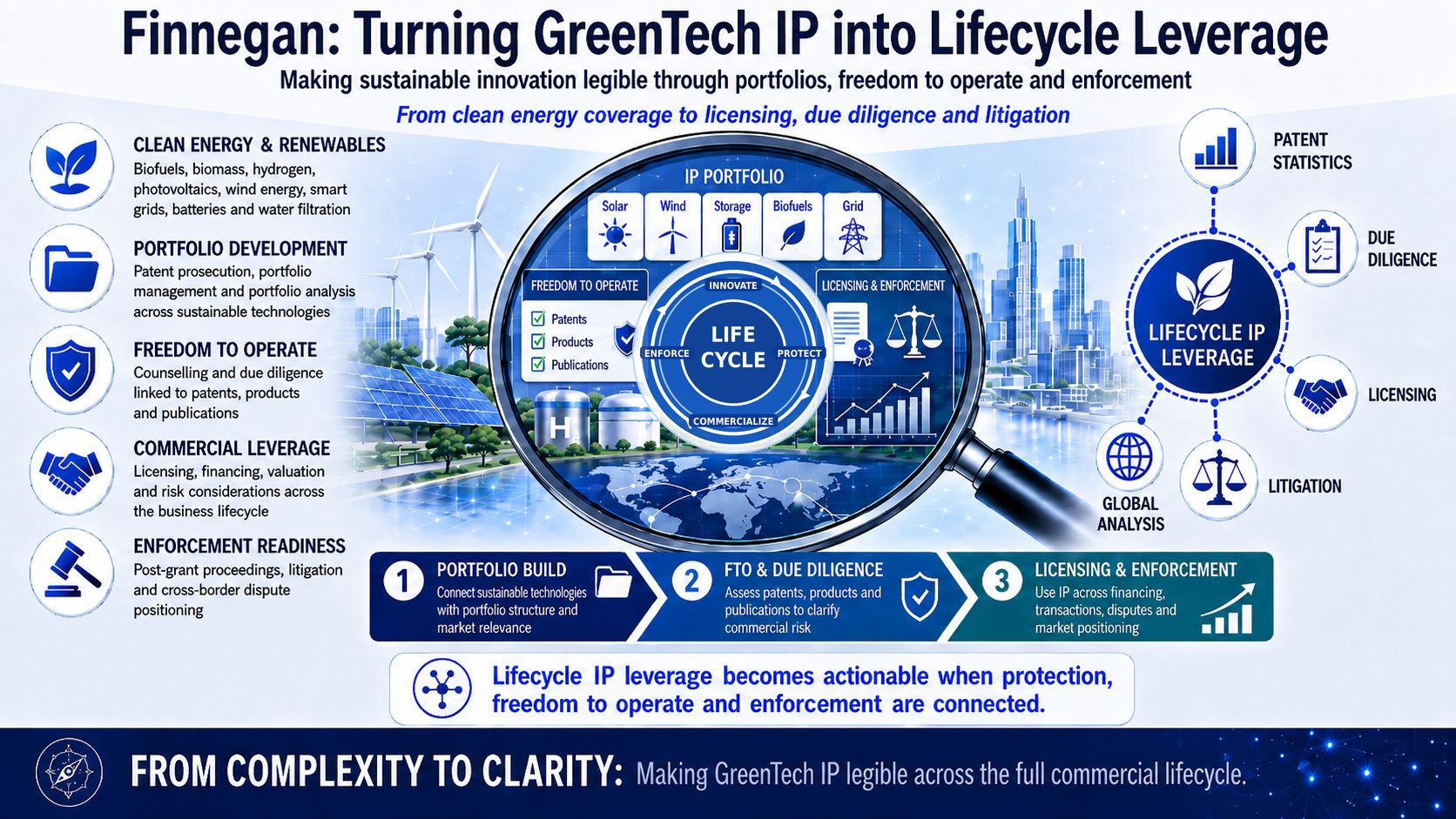
Finnegan uses a different communication logic. Its Clean Energy and Renewables page begins by describing the market as both multidisciplinary and highly collaborative. It then connects the firm’s scientific breadth directly to an extensive range of legal and strategic functions. The communication uses three particularly revealing verbs: protect, advocate and leverage. These verbs extend the proposition beyond obtaining patents.
Finnegan states that it assists clean-energy companies through:
- patent prosecution;
- portfolio management;
- research and development counselling;
- freedom-to-operate analysis;
- licensing and other transactions;
- due diligence;
- litigation;
- post-grant Patent Office proceedings;
- and dispute-resolution mechanisms.
The sequence moves the reader across the complete IP lifecycle. An invention must first be identified and protected. The portfolio must then be aligned with research, markets and third-party rights. The company may need to license technology, enter a transaction or evaluate an acquisition. At a later stage, rights may need to be asserted or defended in court and before patent offices. This creates a broad but coherent positioning proposition: clean-energy IP should be built so that it can support commercial activity and withstand legal pressure.
Finnegan reinforces this proposition with publicly visible matter experience. Its clean-energy page includes examples involving solar-cell litigation, inter partes review proceedings, biofuel patent strategy, market analysis and global freedom-to-operate work. One published experience description explains how the firm coordinated prior-art searches in Europe and the United States, reviewed more than 500 patents, assessed freedom to operate and established an ongoing monitoring system for a renewable-energy acquisition.
This is a different type of communication signal from technology explanation. The reader is shown what the practice does when a defined commercial decision already exists. A company wishes to acquire a technology. The relevant questions concern third-party rights, future patent grants, competitive exposure and whether the transaction can proceed with an acceptable level of risk.
Finnegan’s communication on GreenTech patent statistics adds a market-intelligence layer. The article uses European Patent Office data to examine international patent-family growth, technological concentration, geographic filing activity and the size of companies participating in GreenTech patenting. Its conclusion is that patent filing is strategically relevant to companies ranging from start-ups and spin-outs to multinational corporations.
The positioning effect is important. Patent data is not presented merely as evidence that the market is growing. It is used to help companies understand the behaviour of competitors and peers, the direction of technical activity and the role patents play within the industry.
Other Finnegan materials move further into portfolio competition and enforcement. Its analysis of TOPCon and back-contact solar cells describes a technology race shaped by overlapping patent portfolios, freedom-to-operate concerns, licensing, enforcement, strategic patent acquisitions and market consolidation. Rather than treating solar innovation only as a field for obtaining new patents, the article presents it as an IP-intensive competitive environment in which portfolio decisions can influence commercial outcomes.
Its communication on sustainable-technology litigation before the Unified Patent Court performs a similar function. A dispute concerning microbial fuel cells becomes the basis for examining infringement by equivalence, claim interpretation, drafting quality, prosecution decisions and the scope of enforceable protection.
This takes the reader from a sustainable invention into the practical consequences of how that invention was claimed and prosecuted. A patent is not presented merely as proof that innovation occurred. It is presented as an instrument whose strategic value depends on whether it can capture competing implementations and survive validity scrutiny.
Finnegan’s communication on offshore patent enforcement adds another dimension. For technologies used on ships, wind farms, underwater cables and offshore installations, the location of the final product may make infringement difficult to establish. The firm’s analysis therefore recommends constructing patent protection around acts occurring on land, such as manufacturing and installation, and considering the countries and ports through which relevant products will move.
This is a highly operational form of IP communication. The question is not only whether the technology is patentable. The question is whether the resulting rights correspond to the acts that can realistically be detected, proven and stopped.
Finnegan also explicitly links clean-energy portfolios to financing and valuation. Its public communication on offshore energy projects describes a robust patent position as a signal of technological substance, competitive advantage and protected revenue opportunities for investors and lenders.
Investment therefore appears in both firms’ communication, but it plays a different role. At J A Kemp, investment is frequently part of the journey through which emerging GreenTech innovations move towards commercial deployment. At Finnegan, investment is more often connected to the quality, enforceability and risk profile of the IP position that has been constructed.
This distinction should not be exaggerated. Finnegan also communicates with start-ups and early-stage companies, while J A Kemp also supports established businesses and complex portfolio situations. The difference concerns the dominant entry point. Finnegan tends to lead from the question of how IP can be used across the commercial and legal lifecycle:
- How should the portfolio be constructed?
- Where may third-party rights restrict activity?
- How should rights support a transaction?
- Which claims will be enforceable?
- Where can infringement be captured?
- How should a company respond to a dispute?
- How can IP create licensing, negotiating or investment leverage?
This framing is likely to resonate strongly with:
- in-house IP teams;
- established clean-energy manufacturers;
- companies entering crowded technology fields;
- businesses conducting acquisitions or collaborations;
- organisations preparing international product deployment;
- patent owners considering enforcement;
- and companies already exposed to competitive patent activity.
The implicit message can be read as:
“We help you build, test and use clean-energy IP across prosecution, market entry, transactions, licensing and disputes.”
Finnegan makes clean-energy IP legible by demonstrating how technical knowledge, portfolio strategy and contentious capability can be combined to create commercial leverage throughout the IP lifecycle.
The Connecting Element
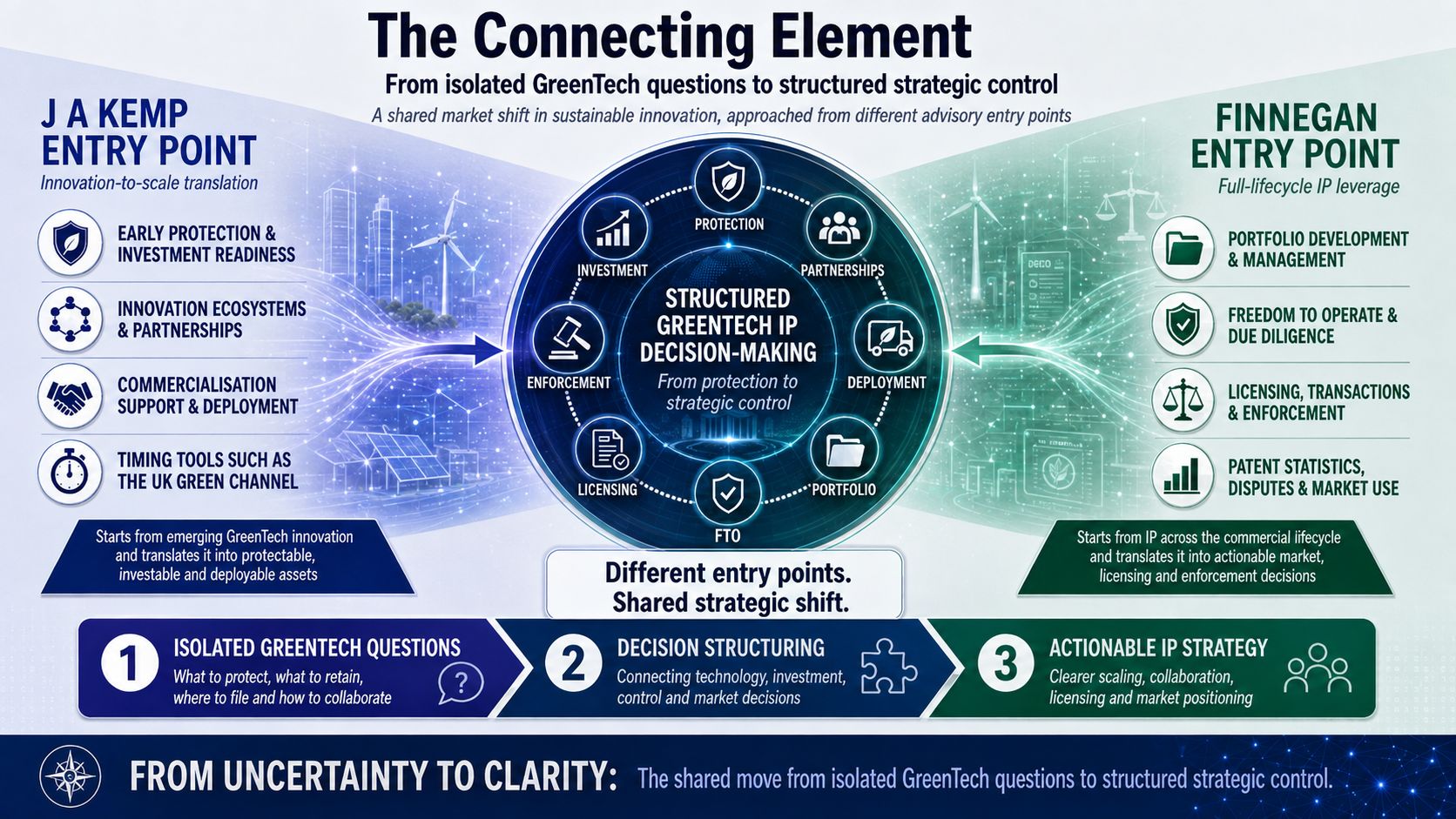
The connecting element between both firms is a larger change in the GreenTech market. Sustainable innovation is moving from isolated inventions into interconnected industrial systems.
A battery business may depend on cell chemistry, thermal management, production methods, charging software, recycling technologies, supply agreements and access to critical materials. A hydrogen company may depend on catalysts, electrolysers, storage, transport infrastructure, safety requirements, industrial partners and long-term purchasing agreements. A solar manufacturer may operate within a dense landscape of process patents, cell architectures, module designs, manufacturing equipment, licences and cross-border enforcement risks. A smart-energy company may combine physical hardware with software, data, cybersecurity, interoperability and regulated infrastructure.
The analysis on GreenTech describes this as a movement from protection towards strategic control. Patents remain important, but they increasingly operate alongside trade secrets, software, data, standards, contracts, regulatory disclosure and collaboration structures. The central question becomes what a company must control in order to scale and maintain freedom to operate. This creates demand for IP advice before a conventional patent mandate becomes obvious.
A company may need strategic orientation before it knows which application should be filed. It may need to understand what investors will examine before entering a financing process. It may need to structure improvement ownership before beginning a pilot project. It may need to assess the patent landscape before selecting a technical architecture.
J A Kemp and Finnegan address this changing environment from different entry points. J A Kemp addresses the uncertainty of moving sustainable innovation from technical development into investment, collaboration and deployment. Finnegan addresses the uncertainty of converting intellectual property into a portfolio that can support market entry, transactions, licensing and enforcement.
Both approaches respond to the same underlying shift: GreenTech companies need IP expertise earlier, more strategically and with a clearer connection to commercial decisions. The shared market movement is therefore the transition from protecting individual green inventions to constructing defensible positions within sustainable industrial systems.
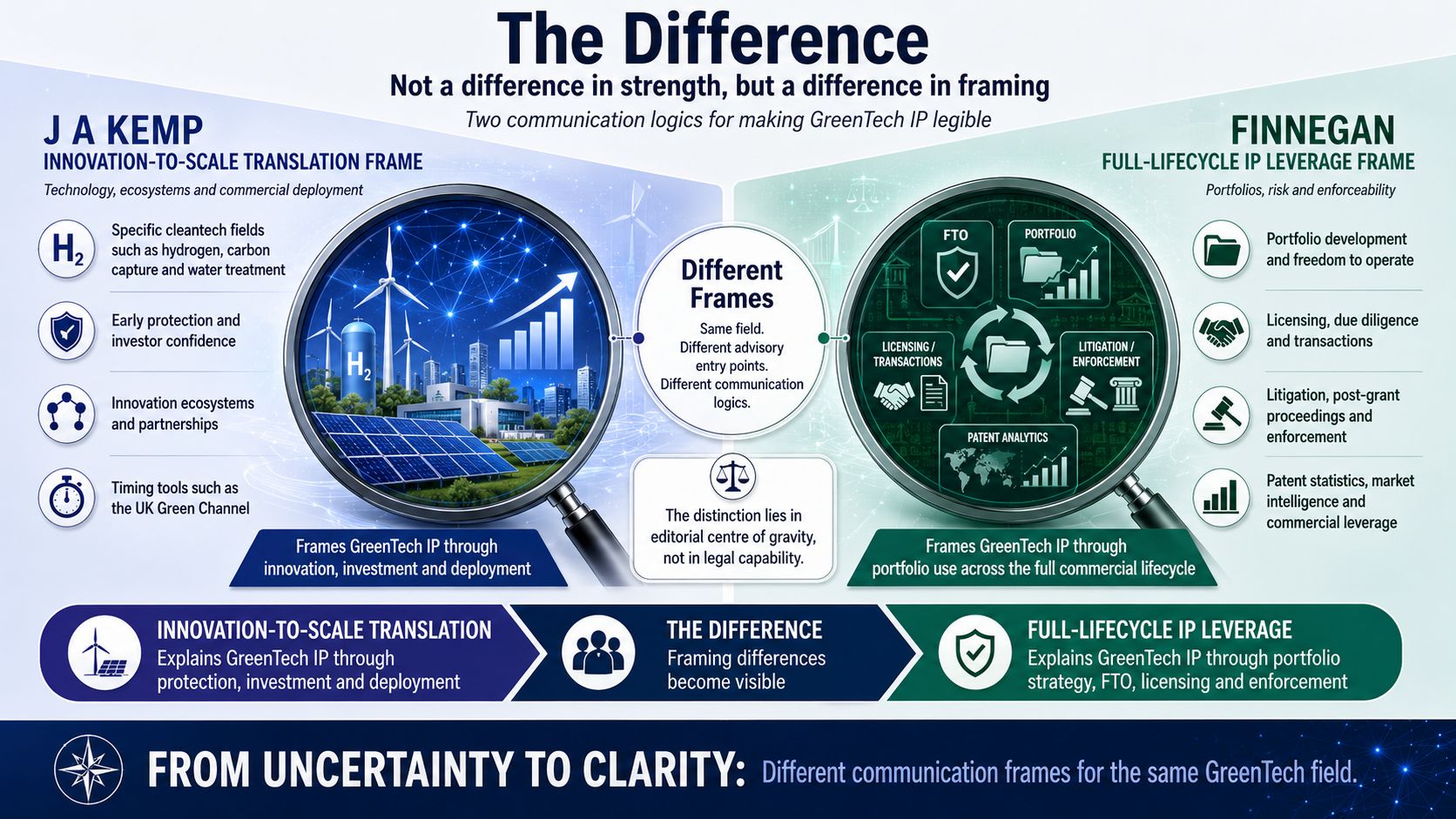
The Difference
The central difference can be described as:
Innovation-to-scale translation versus full-lifecycle IP leverage.
J A Kemp appears to lead the reader from the climate challenge and emerging technology towards protection, investment readiness and commercial deployment. Its communication frequently begins by explaining the technology, the environmental problem it addresses and the ecosystem through which it may reach the market. Patent expertise becomes relevant as one of the mechanisms that helps transform research into an investable and scalable position.
Finnegan appears to lead the reader from technical and legal complexity towards a coordinated set of IP actions across the commercial lifecycle. Its communication emphasises prosecution, freedom to operate, portfolio management, transactions, licensing, enforcement and post-grant proceedings. Clean-energy IP becomes relevant as an asset that must be constructed, tested and used in competitive markets.
J A Kemp creates relevance by explaining the innovation journey. Finnegan creates relevance by demonstrating the operational uses of intellectual property throughout that journey. Neither approach excludes the other.
J A Kemp also communicates procedural knowledge, technical breadth and strategic patent advice. Finnegan also communicates commercialisation, financing and early portfolio development.
The difference lies in emphasis, sequence and editorial centre of gravity. J A Kemp foregrounds the transition from sustainable invention to industrial impact. Finnegan foregrounds the creation and use of enforceable IP leverage across protection, transactions and disputes. The difference is not one of strength. It is one of framing.
What IP Practice Groups Can Learn from This
The first lesson is that “GreenTech” is not a positioning strategy. The term covers too many technologies, development stages and business situations. A firm that merely lists batteries, hydrogen, solar energy, recycling and carbon capture demonstrates sector coverage, but not yet a distinctive advisory proposition.
An organising lens is required. That lens might be:
- innovation-to-scale support;
- GreenTech funding readiness;
- portfolio architecture;
- freedom to operate;
- manufacturing know-how;
- collaboration governance;
- patent intelligence;
- standards and interoperability;
- licensing;
- regulatory disclosure;
- circular-economy data;
- or enforcement readiness.
The second lesson is that technical specificity remains an important trust signal. J A Kemp names concrete fields such as hydrogen production, methane reforming, carbon capture, fuel cells and water treatment. Finnegan similarly identifies photovoltaics, biofuels, batteries, smart grids, carbon sequestration and energy-management systems. These details allow a potential client to recognise its own technical environment.
However, specificity becomes more powerful when connected to a decision. A list of technologies shows knowledge. A description of how IP affects scaling, investment, FTO, licensing or enforcement shows relevance.
The third lesson is that content format should support the positioning proposition. J A Kemp’s technology explainers, climate-focused white papers and ecosystem events are consistent with an innovation-to-scale narrative. They help readers understand where technologies are emerging and why protection may matter during commercialisation. Finnegan’s market analyses, litigation updates, matter descriptions and portfolio-focused articles are consistent with a lifecycle-leverage narrative. They show how patent positions behave when companies enter transactions, crowded markets and disputes. The communication format itself therefore becomes evidence of the positioning.
The fourth lesson is that investment communication should go beyond the general statement that patents attract investors. Potential clients need to understand what investors may actually examine:
- ownership;
- claim scope;
- geographic coverage;
- relevance to the commercial roadmap;
- design-around risk;
- freedom to operate;
- dependence on trade secrets;
- partner rights;
- and the ability to enforce the portfolio.
J A Kemp’s communication makes investment part of the transition from invention to deployment. Finnegan’s communication makes it part of the evaluation of asset quality, competitive position and risk. Both are credible entry points, but they create different expectations about the adviser’s role.
The fifth lesson is that different audiences require different routes into the subject. A GreenTech founder may first need to understand how IP can support a funding round or manufacturing partnership. A corporate IP department may first need an assessment of freedom to operate or competitor portfolios. An investor may need to know whether the company controls the commercially important technology. A manufacturer may need to know whether its claims can be enforced against imports, offshore use or alternative technical implementations.
The strongest practice-group communication does not attempt to address every audience in the same way. It establishes a recognisable path into the problem. Visible expertise emerges when a practice group consistently shows not only which technologies it understands, but which commercial uncertainty it is particularly equipped to structure.
Why This Matters for IP Business Development
GreenTech creates a temporary opportunity for IP practices to help shape how companies understand their own problems. Many potential clients will not initially search for a “GreenTech patent attorney”. They may begin with a more immediate concern:
- A university spin-out needs to raise capital.
- A pilot project requires access to a corporate partner’s facilities.
- A manufacturer wants to adopt a new solar-cell architecture.
- A hydrogen company is entering a strategic collaboration.
- A battery business must disclose product information to customers and regulators.
- A renewable-energy company is considering an acquisition.
- An offshore technology provider is uncertain where its patent can be enforced.
- A competitor has begun asserting patents in an emerging market.
- A scale-up must decide which parts of its process should remain confidential.
Each situation contains IP questions, but the company may not yet have translated the business problem into a conventional mandate. The practice group that structures these questions becomes relevant earlier. J A Kemp’s communication creates early relevance by connecting IP with technical development, investment, ecosystems and commercial deployment. Finnegan’s communication creates relevance by showing how IP can be constructed and used across market entry, transactions, licensing and enforcement. In both cases, public communication reduces the client’s cognitive burden.
It helps the potential client understand:
- why the problem contains an IP dimension;
- which decisions must be made;
- when external advice becomes necessary;
- and what type of adviser may be appropriate.
This changes the central question for practice-group marketing. The question is not:
“Do we understand GreenTech?”
Many firms can credibly make that claim. The more demanding question is:
“Which uncertainty in the transition from sustainable invention to industrial competition do we help the market understand?”
J A Kemp and Finnegan offer two credible answers. One helps make the path from innovation to investment and deployment more understandable. The other helps make the construction and use of IP leverage across the commercial lifecycle more concrete.
IP Expertise Demand Index 2026
The public communication of both firms also illustrates why GreenTech represents a structurally growing field of demand for IP expertise. The IP Expertise Demand Index 2026 does not measure demand only through the number of patent applications being filed. It considers market momentum, the strategic relevance of IP, decision pressure, the accessibility of affected users and the gap between emerging needs and visible expert positioning.
GreenTech produces strong signals across all these dimensions. Investment is moving into batteries, energy storage, hydrogen, clean mobility, sustainable fuels, carbon capture, recycling, smart-energy infrastructure and low-carbon industrial processes. IP is strategically relevant because competition may depend on patents, manufacturing know-how, data, software, standards, licensing rights, supply-chain access and freedom to operate. Decision pressure is increasing because companies must make protection and disclosure choices while technologies, regulations, infrastructure and business models are still evolving. The potential users of IP expertise are identifiable. They include start-ups, scale-ups, research institutions, investors, manufacturers, utilities, infrastructure operators, technology-transfer organisations and corporate innovation teams.
At the same time, the GreenTech Strategy Gap identified by IP Business Academy shows that public IP communication can remain fragmented. Firms may communicate patents, freedom to operate, trade secrets, contracts and licensing as separate services while companies experience them as one interconnected control problem.
The comparison between J A Kemp and Finnegan is therefore more than an analysis of two communication styles. It shows how IP practices can begin to close that gap. J A Kemp makes sustainable innovation more legible by connecting technical progress with protection, investment and deployment. Finnegan makes it more legible by connecting portfolio construction with freedom to operate, transactions, licensing and enforcement.
Both approaches demonstrate that GreenTech companies need more than proof that an adviser understands environmental technology. They need visible frameworks for deciding what to protect, what to retain, where to file, how to collaborate, how to prepare for investment and how to defend the resulting position. The strongest GreenTech communication does not merely state that the firm has relevant expertise. It shows how that expertise turns sustainable innovation into a structured basis for control, scale and commercial action.
Sources Used
J A Kemp
Green energy and climate-tech
https://www.jakemp.com/what-we-do/technology-and-engineering/green-energy-and-climate-tech/
Protecting cleantech innovation, 6 November 2025
https://www.jakemp.com/knowledge-hub/protecting-cleantech-innovation/
Cleantech Venture Day – Amsterdam 2026, 19 March 2026
https://www.jakemp.com/knowledge-hub/cleantech-venture-day-amsterdam-2026/
Sustainable AI white paper: Innovation with environmental integrity, 3 September 2025
https://www.jakemp.com/knowledge-hub/sustainable-ai-white-paper-innovation-with-environmental-integrity/
Fusion energy research powers innovation and intellectual property, 11 March 2024
https://www.jakemp.com/knowledge-hub/fusion-energy-research-powers-innovation-and-intellectual-property/
Green technologies – patenting trends and technology development, 7 October 2021
https://www.jakemp.com/knowledge-hub/green-technologies-patenting-trends-and-technology-development/
Finnegan
Clean Energy and Renewables
https://www.finnegan.com/en/work/industries/chemical-industrial-and-materials/clean-energy-and-renewables.html
Patent Statistics in the Cleantech Industry, 20 June 2025
https://www.finnegan.com/en/insights/blogs/european-ip-blog/patent-statistics-in-the-cleantech-industry.html
TOPCon v. Back-Contact Solar Cells: The Technology Race Fueled by Patent Strategy, Enforcement and Licensing, 27 April 2026
https://www.finnegan.com/en/insights/articles/topcon-v-back-contact-solar-cells-the-technology-race-fueled-by-patent-strategy-enforcement-and-licensing.html
Sustainable Technology Patent Litigation Confirms a Doctrine of Equivalence in the UPC, 13 June 2025
https://www.finnegan.com/en/insights/blogs/european-ip-blog/sustainable-technology-patent-litigation-confirms-a-doctrine-of-equivalence-in-the-upc.html
Enforcing Your Patent Rights at Sea: A UK Perspective, 18 June 2026
https://www.finnegan.com/en/insights/articles/enforcing-your-patent-rights-at-sea-a-uk-perspective.html
Patent Strategy Could Shape Financing, Valuation and Risk in Offshore Energy Projects, 30 June 2026
https://www.finnegan.com/en/firm/news/patent-strategy-could-shape-financing-valuation-and-risk-in-offshore-energy-projects.html
Global patent analysis for renewable energy
https://www.finnegan.com/en/work/experience/global-patent-analysis-for-renewable-energy.html
IP Business Academy / dIPlex
The GreenTech Strategy Gap: What Sustainable Innovation Companies Need, and What IP Advice Still Often Fails to Integrate, 29 May 2026
https://ipbusinessacademy.org/the-greentech-strategy-gap
GreenTech in Motion: How IP Is Becoming the Control Layer of Sustainable Innovation, 27 May 2026
https://ipbusinessacademy.org/greentech-in-motion-ip-control-sustainable-innovation
IP in Green Tech: From Protecting Inventions to Controlling Sustainable Innovation | dIPlex
https://profwurzer.com/diplex/docs/green-tech/
Why Green Tech Is Reshaping the Role of Intellectual Property | dIPlex
https://profwurzer.com/diplex/docs/green-tech/why-green-tech-is-reshaping-the-role-of-intellectual-property/
The Emerging Market for Green Tech IP Services | dIPlex
https://profwurzer.com/diplex/docs/green-tech/the-emerging-market-for-green-tech-ip-services/
IP Market Report: IP in Green Tech | dIPlex
https://profwurzer.com/diplex/docs/green-tech/ip-market-report-ip-in-green-tech/
Europe’s Hidden IP Bottlenecks: What the 2026 Index Reveals About Europe’s Next Innovation Challenge
https://ipbusinessacademy.org/ip-expertise-demand-index-2026