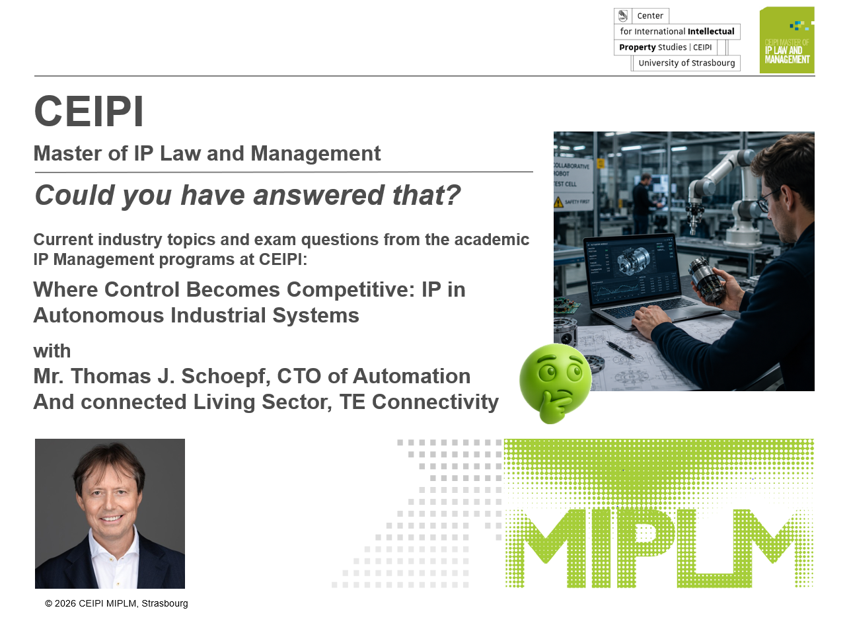
IP Decision Case with Thomas Schoepf. Where Control Becomes Competitive: IP in Autonomous Industrial Systems

Autonomous industrial systems are no longer only about automating individual production steps or replacing manual work with robotic motion. They are increasingly changing how industrial companies design, control and scale complex production environments. In modern industrial automation, value is not created by one actuator, one sensor, one switching device or one isolated software function alone.
It emerges from the reliable interaction of electromechanical components, embedded control logic, power electronics, safety routines, diagnostics, connectivity features and system integration. The decisive competitive advantage may therefore sit less in a visible machine than in the architecture that enables the system to operate reliably, safely and efficiently in an autonomous production environment.
This creates a strategic IP challenge for companies developing robotics, autonomous systems and mechatronic automation solutions. A new generation of mechatronic modules may become valuable because it enables precise motor control, robust switching behaviour, electrical safety, intelligent diagnostics, predictive maintenance, power distribution and interoperability across production systems.
Yet the same integration that is needed for industrial deployment, supplier cooperation, customer-specific configuration and ecosystem adoption can also expose the control logic, interface decisions, validation know-how, safety routines and system-level architecture that make the solution defensible. In such environments, the decisive IP question is often not whether one component or one control method can be patented, but where control over the future system architecture should be created.
The Thomas Schoepf case highlights exactly this tension in the context of autonomous industrial systems, where competitive value depends on the interaction between mechatronics, electrical engineering, power electronics, embedded control, switching technology, safety functions and industrial integration.
This is closely connected to the shift described in the CEIPI IP Business Academy analysis “The Robotics Strategy Gap”. The article shows that robotics is becoming one strategic control environment in which IP can no longer be reduced to patents on mechanical components, software functions or individual control methods alone. Robotics and autonomous systems companies need to decide what to protect, what to disclose, what to keep secret, what to contractually control and where the technical architecture creates future bargaining power.
Here you find the findings of this study: “The Robotics Strategy Gap: What Autonomous Systems Companies Need, and What IP Advice Still Often Fails to Integrate”.
Against this background, the CEIPI IP Business Academy integrates practice-based questions from industry into its teaching. These questions help students understand IP not only as a legal protection tool, but as a management instrument for strategic decision making in complex technology systems. In robotics, autonomous systems and mechatronics, this means looking beyond isolated inventions and asking where the value-bearing layers of an autonomous industrial environment actually lie.
We are therefore pleased to include this industry case study with Thomas Schoepf, who brings a practitioner perspective from the field of electrical engineering, power electronics, mechatronic systems, switching devices, motor control, safety and industrial technology strategy.
His practical question focuses on a central issue for autonomous industrial systems: how to structure IP protection when the most valuable knowledge may sit not in one visible component, but in the interaction between hardware, embedded control, energy management, diagnostics, safety validation, supplier interfaces and the orchestration of the overall system architecture.
The case shows why robotics and autonomous industrial systems require a hybrid IP management approach that connects patents, trade secrets, contracts, access rules, data governance and engineering know-how into one coherent strategy.
Decision Context
An industrial automation company is developing a new generation of mechatronic modules for autonomous production environments. The system combines electromechanical components, embedded control logic, power electronics, switching functions, sensor interfaces, safety routines and connectivity features. Its value does not sit in one visible robot or one isolated component. It emerges from the reliable interaction of hardware, control, energy management, diagnostics and system integration.
The company expects the market for autonomous industrial systems to grow, but the competitive field is still unstable. Customers want interoperability, suppliers push for platform access, and competitors are experimenting with similar architectures. The IP question is therefore not simply whether individual inventions can be patented. The strategic question is where control over the future system architecture should be created, protected and defended.
The Decision
Management must decide whether to build the IP portfolio primarily around the core mechatronic control architecture or whether to protect only selected components while keeping the broader system logic flexible for partnerships and ecosystem adoption.
A strong portfolio around the system architecture could create a defensible position in motor control, switching, electrical safety, diagnostics and power distribution. It would make imitation harder and could support future enforcement against competitors that copy the integrated system logic. However, it may also expose more technical detail, increase filing costs and create friction with partners who need access to parts of the architecture.
A more selective portfolio would reduce disclosure, preserve room for trade secrets and make collaboration easier. But it could leave the company with patents on components while competitors capture the more valuable control points at system level.
Why This Decision Is Difficult
There is no obvious right answer because the company does not yet know where the dominant value pool will emerge. It may be in the physical module, in the embedded control routines, in fault diagnostics, in safety validation, in field data, in software updates or in the ability to integrate reliably into customer production lines.
The enforcement question is equally uncertain. A narrow component portfolio is easier to explain but may be easier to design around. A system-level portfolio may create stronger leverage but can be harder to detect, prove and enforce, especially when relevant functions are distributed across firmware, suppliers, customer configurations and operational data.
The decision also affects business positioning. A closed IP position may support premium differentiation and licensing power. A more open architecture may accelerate adoption and make the company a preferred integration partner. The wrong balance could either give away the strategic core too early or isolate the company from the ecosystem it needs to scale.
Practitioner Perspective
A practitioner inspired by Thomas Schoepf’s background would likely view this not as a patent-counting exercise, but as an engineering and business architecture decision. His experience in electrical engineering, power electronics, mechatronic systems, switching devices, motor control, safety and industrial technology strategy points to a central insight: in industrial automation, reliability and control often arise from the interaction of layers, not from one spectacular invention.
From that perspective, the IP portfolio should mirror the architecture of value creation. Patents may be appropriate where competitors can observe and reproduce system functions. Trade secrets may be stronger where know-how lies in validation, calibration, materials behaviour, contact physics, failure data or process routines. Contracts and access rules may be necessary where partners, suppliers and customers interact with the system.
The practical challenge is to decide early which technical layers should become exclusionary rights, which should remain confidential, and which should be opened selectively to support adoption.
Implication for IP Management Education
This case shows why IP management education must move beyond the question of patentability. In robotics, autonomous systems and mechatronics, IP decisions shape the future structure of the business. They influence what can be enforced, what can be licensed, what can be shared, what remains secret and where competitors are forced to work around the company’s position.
Students and managers should learn to read the system before they read the patent list. The key capability is to identify control points under uncertainty: technical functions that may later determine margins, dependence, interoperability, enforcement leverage and market access.
The lesson is clear: in industrial automation, IP strategy is not an afterthought to product development. It is part of the architecture of competitive control.
Thomas J. Schoepf
 Thomas J. Schoepf is Vice President and Chief Technology Officer of the Automation and Connected Living Sector at TE Connectivity, based in Schaffhausen, Switzerland. He also serves as Vice President and Chief Technology Officer of TE Connectivity’s Industrial Business Unit and previously led the company’s Energy Business Unit as CTO. His career combines senior technology leadership with deep expertise in engineering management, electrical engineering and power electronics, with a particular focus on industrial automation, power management, motor control, switching devices, electrical safety and connected systems. Before joining TE Connectivity, he held executive technology roles at DEHN SE + Co KG, including Chief Technology Officer, Member of the Board and Managing Director, and served as Director R&D at Belden Deutschland GmbH.
Earlier in his career, Thomas Schoepf held senior research and engineering leadership positions at Eaton, Delphi and Siemens Electromechanical Components, later Tyco Electronics EC. At Eaton, he led global Power Systems and Architectures teams across the United States, China, Europe and India, with responsibility for technology strategy, innovation portfolios and advanced power management solutions. At Delphi, he worked on mechatronic systems, product validation, power distribution, fault diagnostics and electrical contacts technology. He holds a Dr. techn. degree in Electrical Engineering from Technische Universität Wien and has been recognized with the Armington Recognition Award and the Morton Antler Lecture.