
IP Strategy for Data-Driven Businesses: Protecting Knowledge and Enabling Growth

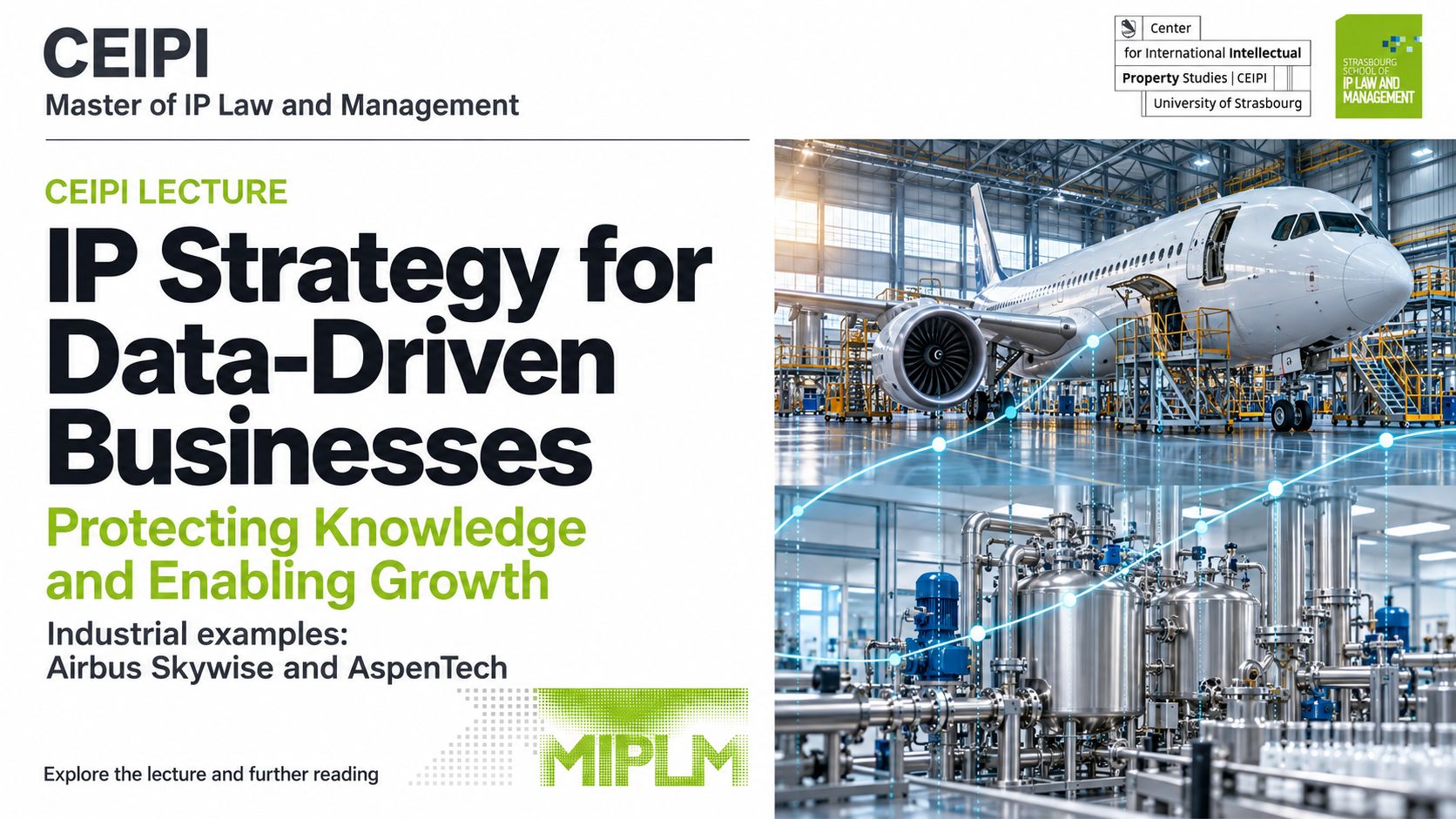
A data-driven business grows when its insights become useful in more customer decisions. An analytics provider may begin with a dashboard and later deliver forecasts, performance indicators or risk assessments through partner interfaces. Each connection increases commercial reach. It also raises questions about what recipients may use, what they may pass on and which knowledge the provider can retain and develop. IP strategy becomes part of designing a service that customers can use and a business that can continue learning.
The CEIPI lecture explores this challenge across industries. Its central question is how companies can make valuable results accessible while protecting the resources behind them. The accompanying battery analytics practical question provides an application: insights can support operators and commercial partners while the provider’s accumulated experience across systems remains strategically important. The lecture develops a framework that also applies to industrial software, predictive maintenance and other analytics services.
Locate the knowledge behind the result
A useful starting point is to distinguish four layers: customer inputs, software and analytical methods, accumulated learning, and delivered results. Their contributions to value differ, as do the permissions needed to use them. Access to a forecast does not automatically settle rights to the underlying measurements, the software producing it or improvements developed during service delivery. Broad references to data ownership often leave these questions unresolved.
The resource-based view helps management identify which resources support an enduring advantage. A large database becomes strategically valuable through its relevance, quality, context and the organisation’s ability to learn from it. Teece’s work on profiting from innovation adds a second question: who controls the complementary assets needed to capture value? Integration capabilities, customer relationships and reliable deployment can determine whether superior analysis becomes a sustainable business. Dynamic capabilities provide a third lens, focusing attention on routines that adapt models, permissions and partnerships as circumstances change.
Design protection and access together
These perspectives lead to a practical management task: match protection to the resource and the intended use. Selected technical inventions may justify patent assessment. Software copyright, confidentiality arrangements and trade-secret measures can protect other aspects. Under the EPO’s AI guidance, mathematical models do not become patentable merely because they are commercially useful; the relevant technical contribution matters. Patent disclosure, enforceability and cost therefore belong in the business discussion.
Protection also depends on implementation. Authentication, differentiated interfaces and proportionate output detail can help align access with agreed purposes. Teams need to distinguish service delivery from benchmarking, general model development and onward disclosure. They also need workable rules for improvements and termination. The WIPO guidance on trade-secret management emphasises identifying valuable secrets, assessing risks and maintaining appropriate measures. A contractual promise becomes useful when systems and working practices can honour it.
Airbus Skywise illustrates controlled collaboration
Airbus Skywise offers a concrete example of combining access boundaries with operational utility. A 2020 Airbus–Palantir partnership overview describes private airline folders alongside information that an airline agrees to share with Airbus. This architecture makes the scope of sharing an explicit part of collaboration. Airbus’s historical account also distinguishes participation in Skywise from additional analytical services.
The operational application is documented. On the Skywise Fleet Performance page, an easyJet testimonial reports 35 technical cancellations avoided in August 2022. This supplier-published account illustrates customer value; it does not isolate an economic return caused by IP arrangements. The transferable lesson concerns deliberate sharing boundaries. Airbus’s OEM position and aviation relationships also matter, and public sources do not disclose every customer’s rights to model improvements or future learning.
AspenTech illustrates repeatable software use
AspenTech provides a complementary perspective through GSK’s use of Aspen Mtell®. Its published case study reports 35 days of advance warning of potential issues and deployment across 30 sites in 18 countries. These are vendor-reported results, demonstrating an implemented predictive-maintenance application and a distributed deployment footprint.
The distinction between customer use and vendor software ownership is visible in AspenTech’s historically published standard licence, revised in November 2013. It retains software IP with AspenTech or its licensors and includes protection for proprietary information. That document is not evidence of GSK’s negotiated terms or ownership of customer-specific models. Together, the sources illustrate how reusable software and defined use rights can support repeated delivery. They leave customer-specific data and improvement rights as separate questions requiring evidence.
Make the growth model economically workable
The two cases support different management lessons. Skywise foregrounds participation and controlled information sharing. AspenTech foregrounds licensed software use across multiple sites. Transferring these lessons requires attention to the receiving business: partner dependence, integration effort, support obligations and the ability to enforce agreed limits all affect the outcome. Wider access should be assessed through the value it creates and the costs of delivering and governing it.
The lecture therefore connects IP choices with practical indicators such as integration time, recurring contribution, renewal and permitted reuse of learning. Business, technical and IP responsibilities need to meet at the same decision points. The platform’s resources on know-how management, protecting trade secrets and IP in ecosystem business models deepen these connections. The GreenTech Strategy Gap places them within the broader challenge of integrating IP management into commercial strategy.
From lecture foundations to the practical question
Students can use this framework to build a justified recommendation: map the valuable resources, establish existing permissions, select appropriate protection and access measures, then assign responsibilities and review points. An expert model solution can develop this reasoning for the practical question and explain the trade-offs behind a proposed sequence. The lecture prepares that discussion without assuming deficiencies in a company’s existing arrangements.
The slides embedded below introduce the framework, compare the two industrial examples to examine how protecting accumulated knowledge and enabling customer value can become coordinated choices in the growth of a data-driven business.