Developing IP Strategy in the First Module of MIPLM 2026 27: Connecting the IP economy, competitive advantage and management decisions

A transport drone carries robotic mowing units to a park. A scout drone observes the site, fixed sensors provide information about local conditions, and cloud coordination helps the machines work together. The technology offers an engaging starting point. The management question is more demanding: how can a company turn this system into a business that earns sustainable returns?
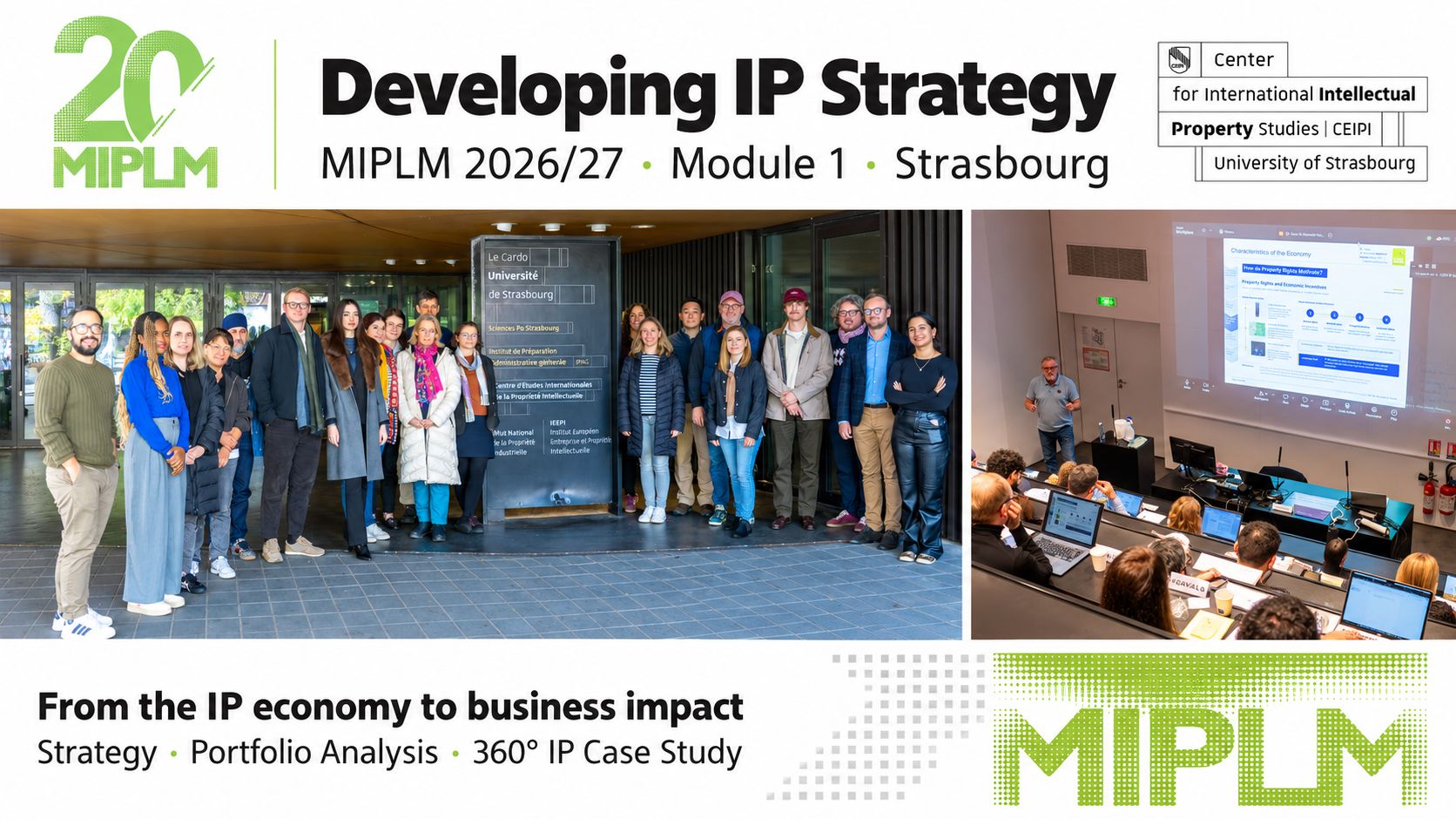
This question connects the lectures and practical work in the first module of the Master of Intellectual Property Law and Management, MIPLM 2026/27, currently taking place at CEIPI, University of Strasbourg. Across the IP Economy lecture, IP Strategy Development, portfolio analysis training and an integrated case study, we examine how IP decisions contribute to business outcomes. The task is to make that contribution explicit, explain the assumptions behind it and justify the choices it requires.
Understanding the economy in which IP operates
The IP Economy lecture establishes the economic context for this work. It addresses the development of IP regimes, the concept of property rights and the characteristics of intangible assets. It also introduces the different perspectives through which economics and business administration examine IP. These perspectives help explain why the same right can raise different questions for a policymaker, a company and an individual decision maker.
For management, a central issue is the relationship between value creation and value capture. A company can develop useful technology, improve a service or create a distinctive customer experience. Earning a return from those contributions depends on how the business is organized, what customers will pay for, which alternatives are available and how value is distributed among the participants.
Software, know-how, brands and other intangible resources make these relationships particularly relevant. Their contribution depends on how they are combined with equipment, organizational capabilities, market access and complementary services. Ownership and access arrangements influence who can use these resources, under which conditions and with what consequences for cooperation and competition.
This provides a foundation for treating IP as a management responsibility. A legal position must be understood within the economic setting in which it is expected to work. Its contribution becomes clearer when we identify the business objective, the relevant actors and the alternative situation against which the outcome will be assessed.
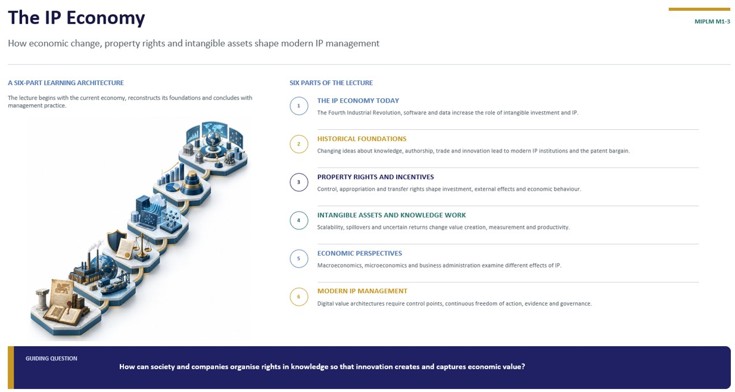
Understanding IP as a business responsibility begins with the relationship between intangible resources, ownership and value capture, explored further in our overview of IP in the Knowledge Economy.
Connecting competitive advantage with IP strategy
The strategy lecture develops this foundation through industry and competitive analysis, the resources of the firm and the formulation of strategic objectives. Students work with both the market-based and resource-based views of the firm. Together, these perspectives connect the conditions of competition with the resources and capabilities a company can bring to a particular opportunity.
The market perspective directs attention to customers, substitutes, competitors, suppliers and the distribution of profitability. The resource perspective examines the capabilities and assets that can support a sustainable advantage. IP can contribute to both: it can help protect strategically relevant resources and influence the conditions under which others compete or cooperate.
The relationship has to be explained in the context of the business. A technical feature may matter because it reduces operating costs, enables a distinctive customer benefit or supports a service that competitors find difficult to reproduce. Each explanation creates different requirements for the IP strategy. The relevant question is what must remain under the company’s control, or be available to it, for the intended advantage to persist.
The lecture also introduces generic IP strategies, including fortress monopoly and value-added monopoly. In the practical work, students assess their suitability and justify their choices. Using a strategy concept requires an explanation of how it fits the customer benefit, the company’s resources and the way the business intends to earn money.
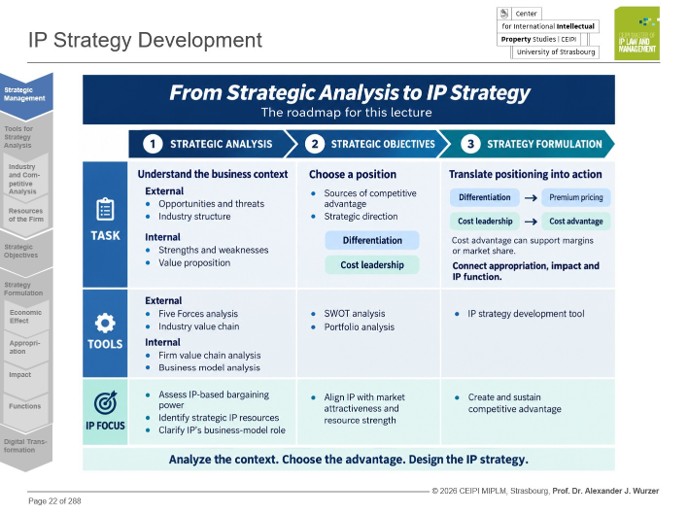
An effective IP strategy connects the company’s resources and market position with the mechanisms that sustain its advantage, as explained in our overview of Competitive Advantage and IP.
Formulating strategy from the intended economic effect
The formulation method starts with the intended economic effect and works through appropriation, competitive impact and IP functions. This sequence helps students define what IP is expected to achieve before selecting instruments or activities.
First, the economic objective specifies the business result the strategy should support. Depending on the business model, this could concern margins, sales, costs or the durability of a revenue stream. The objective needs enough precision to guide a decision and later support an assessment of whether the strategy is working.
Second, appropriation asks how the company can retain a relevant share of the value it helps create. This requires attention to customer willingness to pay, the contributions of partners and the resources needed to deliver the offering. A technically attractive solution can still leave its provider with an unfavorable share of the economic return.
Third, competitive impact identifies what must change for customers, competitors or partners. The desired impact might involve making a distinctive offering harder to imitate, strengthening a negotiating position or securing access to a necessary contribution. Students must explain how that change supports appropriation.
Fourth, IP functions specify what the chosen instruments must do to bring about the required impact. This is where the selection and coordination of rights and contractual arrangements acquire a concrete purpose.
Planning therefore moves from economic effect to appropriation, competitive impact and IP functions. The causal explanation runs in the other direction: an IP function produces an impact, that impact supports appropriation, and appropriation contributes to the intended economic effect. Being able to explain both directions is a practical test of the strategy’s coherence.
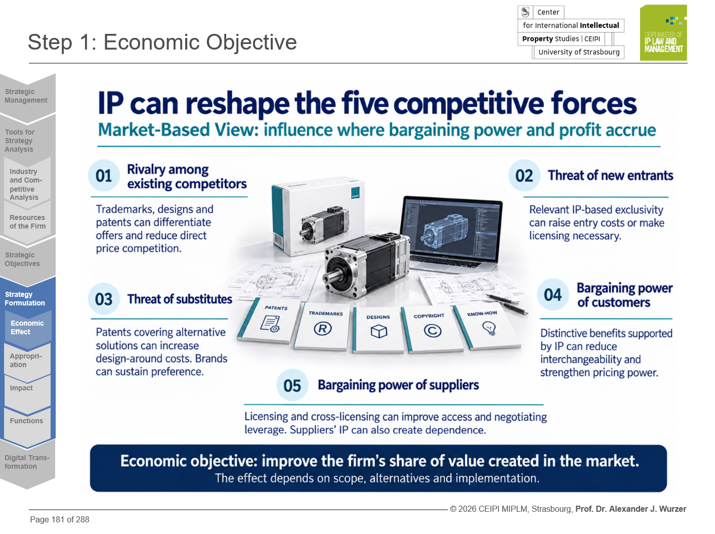
Starting with the intended business result gives IP decisions a clear direction and purpose, a principle developed further in our overview of IP Strategy Development.
Using portfolio analysis to support resource decisions
The portfolio analysis training adds a disciplined approach to comparison and prioritization. Limited resources make choices unavoidable. Management needs a defensible basis for deciding where to develop capabilities, maintain protection or strengthen a market position.
The first requirement is to define what is being compared. Technologies, patent rights and market brands represent different analysis objects. A database can provide information, but the available records do not determine the management question. Students learn to choose the object and method according to the decision that needs support.
The two portfolio dimensions must also provide distinct assessments. A technology portfolio can combine field attractiveness with the strength of the company’s position. Both assessments require a declared context, including the relevant application, competitor benchmark and time horizon. Consistent criteria and scales make the objects comparable; transparent weights and assumptions make the result open to review.
The training distinguishes this approach from SWOT. SWOT classifies internal strengths and weaknesses and external opportunities and threats. Portfolio analysis positions comparable objects along assessment dimensions. Both can support strategic work, provided their results are interpreted according to the question each method can answer.
A position in a matrix still requires further reasoning before it supports action. An attractive technology field in which the company has a weak position raises questions about the cost and timing of capability development. A patent with little current use can still have future, complementary or competitive relevance. The analysis must consider those possibilities before recommending investment or withdrawal.
Value analysis makes the alternative situation explicit. Renewal value compares the company’s profit with and without renewal. Asset value examines the consequences of ownership by the focal company versus a competitor. These comparisons clarify the economic claim being made and help distinguish an assessment score from the value of a particular decision.

Applying the method to autonomous park care
The integrated case study brings these ideas together through a fictional commercialization exercise inspired by Husqvarna’s SOLEA design concept. The film and concept provide the technological starting point. The market conditions, resources and commercial choices in the exercise are teaching assumptions.
In the scenario, a European equipment manufacturer is preparing to serve municipalities and operators of urban parks and campuses. It has robotics expertise and an established dealer network, while needing external drone components and cloud development capacity. Management must choose a revenue logic involving equipment, ongoing services or an offering delivered with partners.
Customers can compare the proposed system with conventional landscaping services and stand-alone robotic mowers. The provider therefore needs to explain the additional benefit of the complete offering. Technical feasibility and operating permissions are treated as given so that the exercise can focus on commercialization and IP strategy.
The strategic object is the whole offering: machines, coordination, digital interfaces, partner contributions and service delivery. The IP budget is limited. Students must prioritize protection, access and implementation investments while explaining how their choices support sustainable returns.
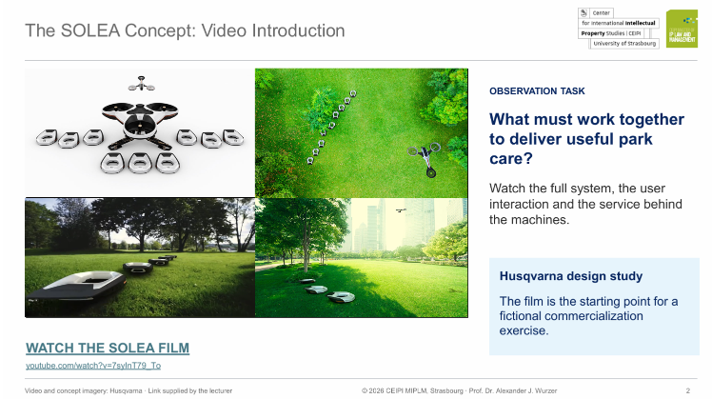
Here you can watch the SOLEA video.
The park-care case illustrates why IP strategy for autonomous systems must address how hardware, software, data and partner contributions work together to create a defensible offering, a challenge examined in our Robotics, Drones and Autonomous Systems Industry Focus.
Combining three contributions into a 360 degree strategy
The first group addresses competitive position and IP strategy. It compares the customer benefit with the available alternatives, distinguishes cost and differentiation effects and defines the desired economic result. It then explains appropriation after partner contributions and service costs, identifies necessary resources and assesses the generic IP strategy appropriate to the case.
The second group develops the business model and a prioritized 360 degree system of IP objectives. Its work covers customers, partners, resources, capabilities, channels, relationships and revenue logic. The objectives matrix connects IP-related risks, resource exclusivity, market positioning and communication of the unique selling proposition to that business model. Budget constraints require the group to justify priorities and address dependencies between partners and interfaces.
The third group designs the IP and communication concept. It selects the required competitive impacts and proposes a coordinated mix of patents, design rights, trade secrets, trademarks, copyright and contractual arrangements. Each instrument needs an explained function, relevant conditions and a place within the overall strategy. Brand architecture and a unique communication position must help customers recognize the benefit and understand why they should pay for it.
The three contributions must then fit together. A customer promise has to be supported by the proposed service capabilities. A revenue model has to be consistent with partner arrangements. An IP portfolio has to serve the priorities established in the objectives system. Resolving inconsistent assumptions is part of the assignment.
Students are required to justify their choices, label assumptions and verify any AI-assisted content. Every member must be able to explain the group’s complete proposal. This requirement connects the quality of the final presentation with the quality of the reasoning behind it.
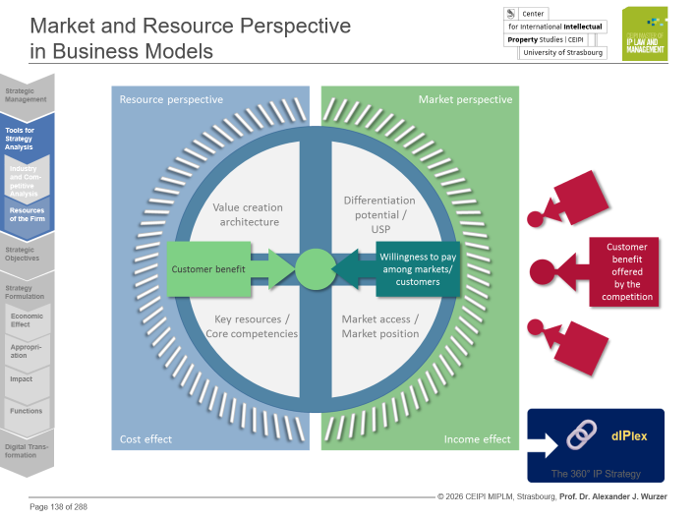
Combining business objectives, customer benefits and coordinated IP instruments creates the coherence required for a 360-Degree IP Strategy that supports sustainable value capture.
Developing the judgment needed for IP management
The first module connects economic understanding with strategic analysis and practical decision making. The IP Economy lecture explains the setting. Strategy development provides a method for linking IP to a business objective. Portfolio analysis supports comparison and allocation. The SOLEA exercise requires students to use these capabilities in one connected commercialization problem.
For the IP community, this is a concrete educational challenge: developing professionals who can explain how their expertise contributes to sustainable competitive advantage and business results. That requires legal understanding alongside the ability to examine customer benefit, resource dependencies, commercial alternatives and the limits of the available evidence.
The autonomous park-care case makes the task visible. The machines can perform useful work. The management challenge is to explain how the provider can deliver that benefit, retain a sufficient share of its value and sustain its position as the market develops. Making that explanation convincing is the work we are practicing in Strasbourg.

The judgment developed in this first module provides the foundation for connecting strategy with valuation, innovation, organization and business development throughout the learning journey described in The MIPLM in Six Modules.