Biotech and MedTech IP: Keeping evolving platforms clear to market

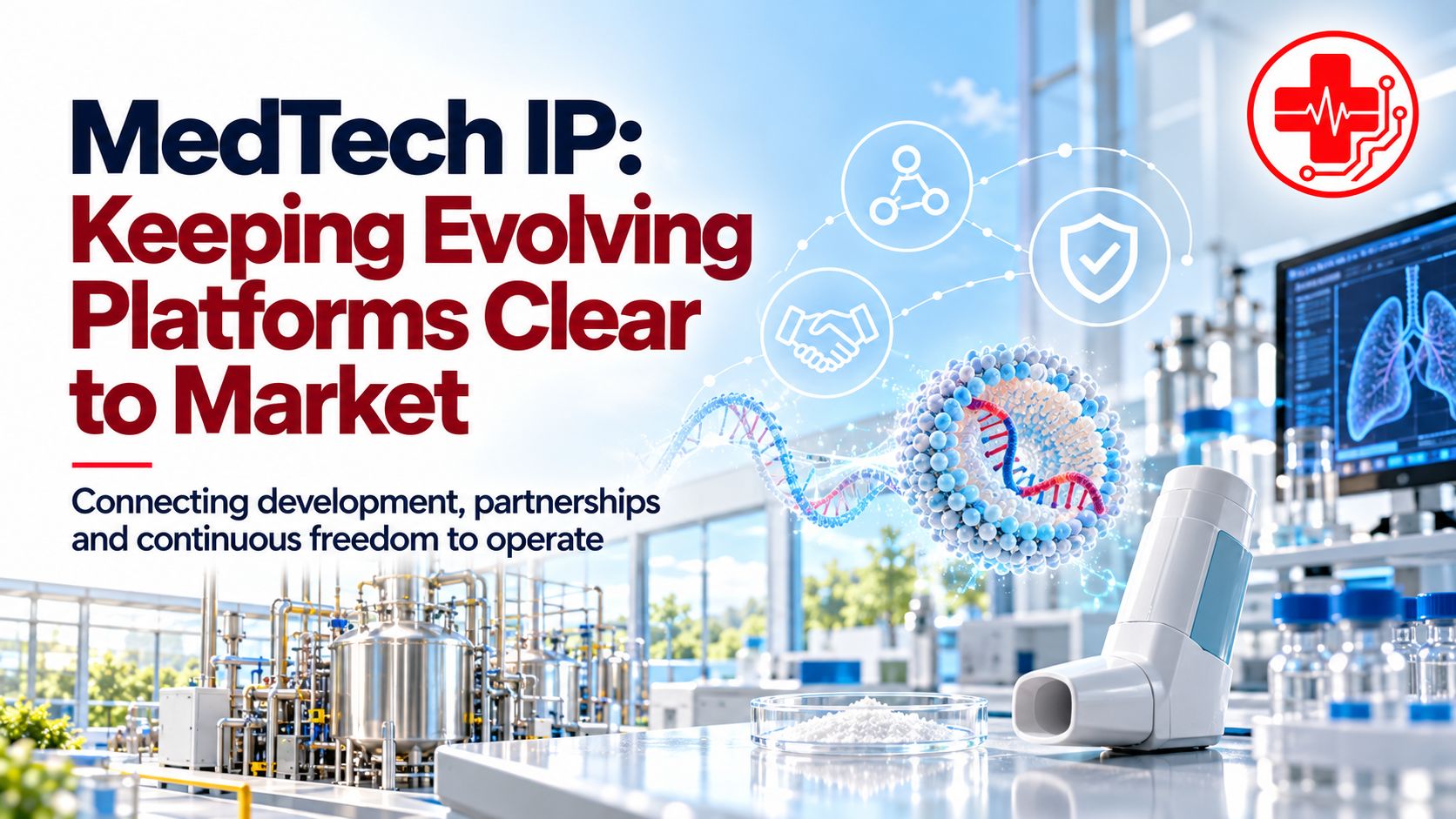
A healthcare innovation becomes more valuable as it moves towards patients. It also becomes harder to change. Formulations, manufacturing processes, device configurations and partnerships gradually turn development options into commitments. Managing the freedom to proceed through that transition is a strategic task for companies building therapies, medical devices and reusable technology platforms.
Dr. Benjamin Winkeljann, Co-Founder and CEO of rnhale, brings this challenge into focus through a practical question contributed to the CEIPI IP Business Academy. The case examines an inhaled RNA platform combining therapeutic cargo, carriers, powder formulation, manufacturing and a delivery device. Its central question is how continuous, product-centric Freedom-to-Operate management can support a first therapeutic programme while preserving the platform’s use across future applications and partnerships.
Published contributions from five voices in the Biotech and MedTech ecosystem explain why the conditions behind this question matter across the sector. Their perspectives address development speed, connected technologies, collaboration, continuing evaluation and access to care. The FTO implications developed below are our editorial interpretation of those contributions.
Thomas Schinecker and the decisions that shape the development journey
In his address to Roche’s Annual General Meeting on 12 March 2024, Thomas Schinecker describes the time, uncertainty and organisational discipline involved in developing medicines. He connects faster development with clearer priorities, responsibilities and informed decisions. He also highlights external partnerships, including Roche’s collaboration with Alnylam, as a source of pipeline innovation.
This gives Benjamin’s question a wider business context. Development teams repeatedly choose which technologies to advance, combine and obtain through partners. Each choice influences the next investment and the options available later.
Our FTO implication is that reviews should inform those choices before major commitments. A delivery platform company can ask whether a formulation change, manufacturing route or proposed collaboration alters the third-party rights relevant to its plans. Management can then compare development alternatives, licensing possibilities and commercial priorities while it still has room to act.
For a young company, this makes the timing of FTO work part of development governance. The useful output is a documented basis for the next decision.
Nadine Hachach-Haram and the connections between technologies
Nadine Hachach-Haram describes a connected approach to surgery in Proximie’s discussion of the trends shaping healthtech, published in December 2023. She explains how the company’s software development kit is intended to connect previously separate technologies within the operating room and bring their information together.
The connection to an inhaled RNA platform is structural: clinical usefulness can depend on technologies working together. In Benjamin’s case, that combination spans a therapeutic payload, its formulation, production and delivery. In digital MedTech, it may span devices, software and clinical workflows.
Our IP interpretation is that a product-centred review should follow the complete configuration and its relevant interfaces. Reviewing one component leaves unanswered how it will be used with the others. A change in a device, formulation or technical integration should therefore prompt a check of whether the existing analysis still covers the intended product.
This is why Benjamin’s question reaches beyond RNA delivery. Companies developing combined systems need visibility into the dependencies created by their chosen architecture.
Jurgi Camblong and the partnerships that allow platforms to scale
In SOPHiA GENETICS’ November 2022 announcement of its strategic partnership with Microsoft, Jurgi Camblong connects the company’s analytical platform with Microsoft’s scale and the ambition to improve healthcare through data-driven medicine. The announcement describes a collaboration combining cloud infrastructure, analytical tools and a network of institutions.
It illustrates a recurring platform challenge: reaching more users can require complementary capabilities supplied by other organisations. The commercial opportunity grows through collaboration, while the business becomes dependent on the terms supporting that collaboration.
Our interpretation for Benjamin’s case concerns platform reuse. A company should establish which background technology it can bring into a programme, how partner contributions may be used and whether improvements remain available for subsequent applications. Access to necessary manufacturing knowledge also deserves attention when production involves external specialists.
These contractual permissions complement patent FTO analysis. Together, they help management explain which parts of the platform can support the next programme and which require additional agreements. A successful first partnership should leave a clear basis for assessing future ones.
Mark Slack and the value of continuing evaluation
A 2023 research paper co-authored by Mark Slack describes a prospective registry supporting the clinical implementation of the Versius Robotic Surgical System. The researchers explain how accumulating real-world evidence and monitoring performance can support the evaluation of surgical technology during use.
Clinical surveillance and patent FTO answer different questions. The relevant management parallel is the need to keep evidence connected to an evolving technology. Information gathered at one stage provides a baseline for subsequent assessment.
Our FTO implication is that a review needs an update mechanism. Changes to the product, new intended uses, additional markets and developments in relevant patent applications can alter the basis of an earlier assessment. Responsibilities and review triggers make it possible to identify when that basis needs reconsideration.
For Benjamin’s platform, this could mean revisiting the assessment when a formulation is selected, a production process changes or a partner introduces a new payload. Continuous FTO becomes useful through defined actions at meaningful development points.
Bernd Montag and the route from innovation to wider access
Bernd Montag‘s published engagement on building sustainable healthcare ecosystems includes the global and local conditions for scaling MedTech innovation and improving access to healthcare. Siemens Healthineers’ accompanying discussion of global health emphasises that scalable products need infrastructure and cooperation with healthcare providers and governments.
This broadens the commercial horizon of Benjamin’s question. A platform intended for several applications and partners needs a credible path beyond its initial development setting. Expansion can involve different markets, production arrangements and delivery requirements.
Our IP implication is that the FTO scope should follow the intended expansion. Management needs to connect the planned activities and jurisdictions with the rights that may affect them. A manufacturing change or entry into an additional territory can require a fresh assessment.
For a growing Biotech or MedTech company, the practical question is which next deployment step its existing analysis supports, and what must be reviewed before committing resources to that step.
Bringing the ecosystem back to Benjamin’s question
These perspectives explain the wider importance of the challenge. Schinecker focuses attention on development decisions and external innovation. Hachach-Haram illustrates the connections between technologies. Camblong shows how partnerships support platform scale. Slack’s research demonstrates the role of continuing evaluation, while Montag’s ecosystem perspective extends the discussion to wider access.
Taken together, they strengthen the business rationale for asking how commercial freedom can be maintained as a healthcare platform evolves. The specific FTO work will differ across therapies, diagnostics, devices and software. The shared management need is to understand dependencies before the next commitment makes them expensive to change.
A leadership team can begin with six questions:
- Which product configuration, intended uses and markets does our current assessment cover?
- Which changes in technology or relevant patent rights require a new review?
- At which development and investment gates must findings inform a decision?
- Who is responsible for escalating issues and comparing available responses?
- Which partner permissions support future use of improvements and essential know-how?
- Can we explain the platform’s dependencies and remaining options to the next partner or investor?
This connects with our Industry Focus on the structural shift of IP in MedTech on the IPBA Plattform, which examines how connected technologies and healthcare ecosystems change the decisions IP management must support.
Benjamin Winkeljann’s practical question gives that discussion a concrete starting point. Its relevance extends to companies whose next stage of growth depends on combining technologies, working with partners and carrying valuable capabilities into further applications. Continuous FTO management helps bring those ambitions into the decisions made throughout development.