CEIPI IP Business Talk with Andrew Cockerell: Patenting the Transition to Net Zero

Bringing a sustainable technology into industrial use requires decisions about what a company can develop independently, where it needs partners and how it will retain value as adoption grows. In aviation and energy, these decisions span several connected technologies. A new fuel needs production capacity and a route to customers. A new propulsion system must work within an aircraft and the infrastructure supporting its operation. IP strategy needs to follow these relationships.
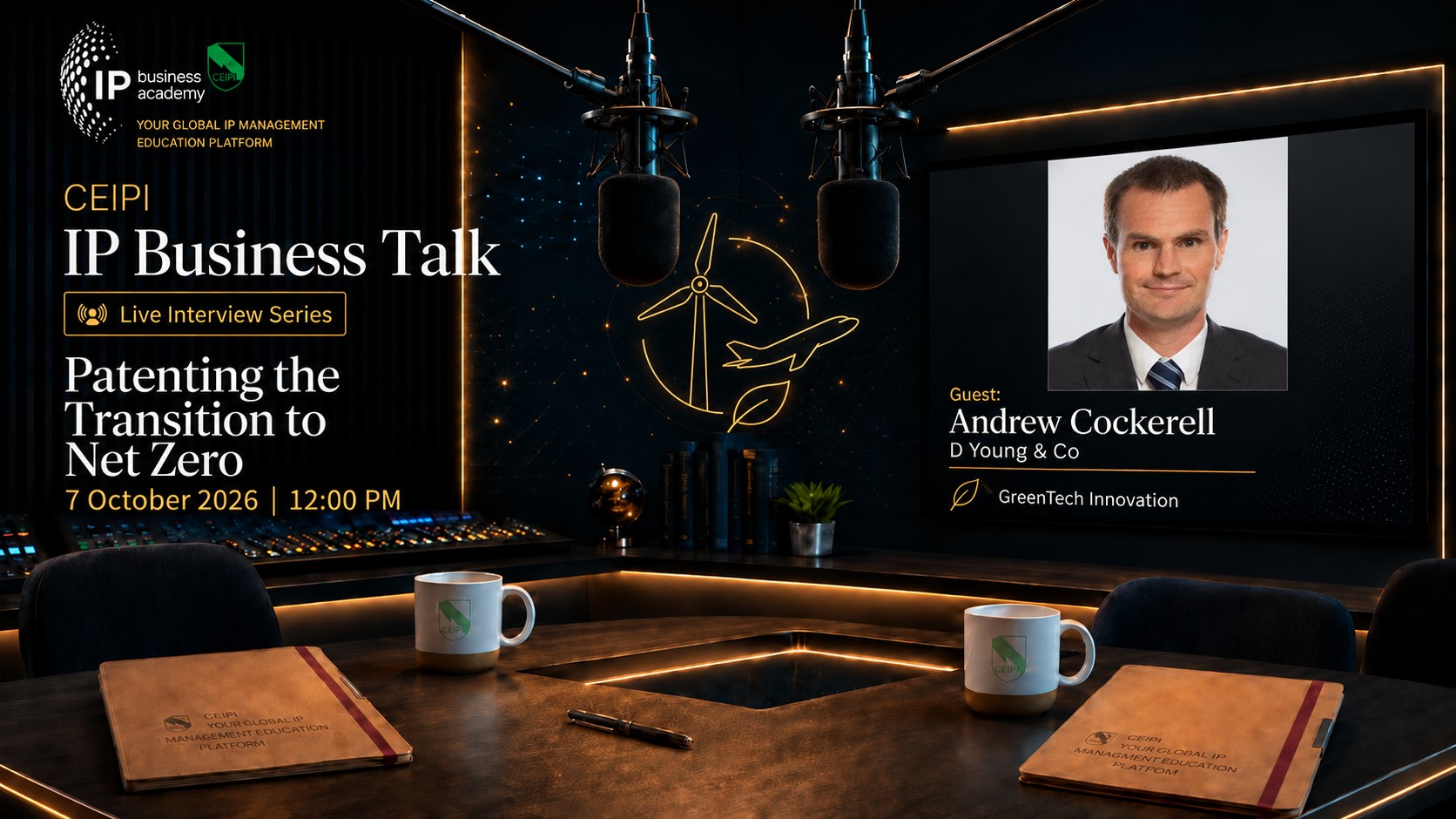
On Wednesday, 7 October 2026, at 12:00 PM, Andrew Cockerell, Partner at D Young & Co, will join Prof. Dr. Alexander J. Wurzer for a live CEIPI IP Business Talk on Patenting the Transition to Net Zero. The conversation will explore how companies can align patent strategy with the technical, commercial and policy conditions shaping sustainable innovation.
👉 Join the event via our LinkedIn invitation.
Building IP strategy across connected technologies
The first theme concerns innovation distributed across fuels, power systems, infrastructure, components and digital technologies. A business may make a valuable contribution within one part of this system while depending on developments elsewhere for commercial adoption. Understanding that position is essential when deciding where to seek protection and which relationships deserve early attention.
Consider a supplier developing equipment for a future hydrogen-powered aircraft. Its opportunity will depend on how the equipment integrates with the aircraft, how it is manufactured and how it performs during operation. An invention review can therefore benefit from following the intended application: which features distinguish the supplier’s contribution, which interfaces connect it to other technologies and which adaptations might customers require?
For management, this creates a practical way to discuss IP alongside product strategy. A company can examine the capabilities it wants to retain, the access it needs from others and the scope for using its technology in additional applications. The talk will consider how this wider view can guide patent strategy across the technologies contributing to net zero.
Adapting patent strategy as technologies mature
Sustainable aviation fuels, hydrogen propulsion and electrification face different development paths. The second theme will examine how patent strategy should evolve as a technology moves from an experimental concept towards industrial deployment. The relevant decisions change as technical uncertainty decreases and the requirements of manufacturing, integration and operation become clearer.
An early research project may establish that a particular approach works. A pilot can reveal which operating conditions affect performance. Industrial engineering may then produce improvements that make the process reliable or economical at scale. Each stage can generate a different contribution to the eventual business, requiring a fresh assessment of what deserves protection.
This suggests a useful management practice: review the portfolio at development milestones. Does it still reflect the version being prepared for customers? Have changes in design or production created new inventions? Are earlier assumptions about the intended market still valid? These questions help teams connect patent decisions with the evidence emerging from development.
The discussion will also place these decisions within the realities of a growing business. Resources committed to protection need to support a credible commercial path, while the strategy must accommodate technical learning and changing partner requirements.
Interpreting green patent trends for business decisions
Patent filing trends offer a further perspective on sustainable innovation. Andrew’s published analysis of worldwide green patent statistics examines differences between jurisdictions, the influence of policy and funding, and the position of smaller businesses. It also highlights why the meaning of a dataset depends on what it measures: domestic filings, international activity and requests for accelerated examination can tell different stories.
👉 Read Andrew’s analysis of worldwide green patent statistics.
For a company considering a new market, the practical task is to translate these observations into questions worth investigating. Which applicants are active in technologies relevant to its roadmap? Are portfolios concentrated in particular parts of the value chain? Does filing activity suggest that competitors are preparing for expansion into markets the company hopes to enter?
The third part of the talk will explore how patent intelligence can inform strategic IP choices. This requires combining the data with technical expertise and knowledge of the business. A filing trend may justify closer investigation; its commercial significance depends on the technologies, rights and activities involved.
For smaller innovators, that investigation can also support preparation for partnerships. Understanding the surrounding patent landscape can help a team explain its contribution more precisely and identify issues to address before committing to a development relationship.
Choosing when accelerated examination adds value
The fourth theme concerns mechanisms for accelerating the examination of environmentally beneficial inventions. Availability and eligibility vary, and programmes can change. The strategic question is when a faster examination process supports a company’s objectives and how that choice fits its international filing plans.
The business case for acceleration begins with a milestone. A company preparing a licensing discussion may want greater clarity about the scope of protection. A team approaching investment or commercial deployment may have a different reason to seek an earlier examination outcome. In each situation, the desired benefit should be made explicit before choosing the procedural route.
Timing also needs to be considered alongside the technology’s development. How stable is the implementation? Which markets matter most? What information will management need for the next decision? Andrew will discuss how green innovators can approach accelerated examination as part of a coordinated patent strategy.
Connecting patent decisions with sustainable growth
These themes reflect the perspective developed in our GreenTech Industry Focus: IP affects a company’s ability to scale, attract resources and work with partners while retaining a commercially meaningful position. Patent strategy becomes more useful when it is connected with the route through which a technology will reach industrial use.
The upcoming talk offers founders, R&D leaders, IP managers and advisers an opportunity to examine that connection. Aviation and energy provide concrete settings for a wider management challenge: making protection decisions while technologies, infrastructure and commercial relationships are developing together.
👉 Explore our Industry Focus on IP in Green Tech.
Andrew Cockerell
 Andrew Cockerell is a Partner and UK and European Patent Attorney at D Young & Co. He holds an MEng in Aeronautical Engineering from Imperial College London and became a Chartered Engineer in 2014. Before joining the patent profession, he worked as an aerodynamicist at Airbus and held engineering roles at Rolls-Royce involving gas turbine components and reactor coolant pumps. His technical practice spans physics, engineering and IT.
Andrew advises multinational companies, SMEs and academic institutions on patent protection and portfolio strategy. His work includes patent analysis and competitor intelligence, European Patent Office proceedings, and infringement, freedom-to-operate and validity opinions. He has a particular interest in renewable energy and green technologies and participates in the Intellectual Property Owners Association’s Green IP working group. His combination of industrial engineering experience and patent expertise provides a practical foundation for the discussion.
👉 Read Andrew Cockerell’s profile at D Young & Co.
Join Andrew Cockerell and Prof. Dr. Alexander J. Wurzer on Wednesday, 7 October 2026, at 12:00 PM, for this live CEIPI IP Business Talk on Patenting the Transition to Net Zero.
👉 View the event details and register via the LinkedIn invitation.