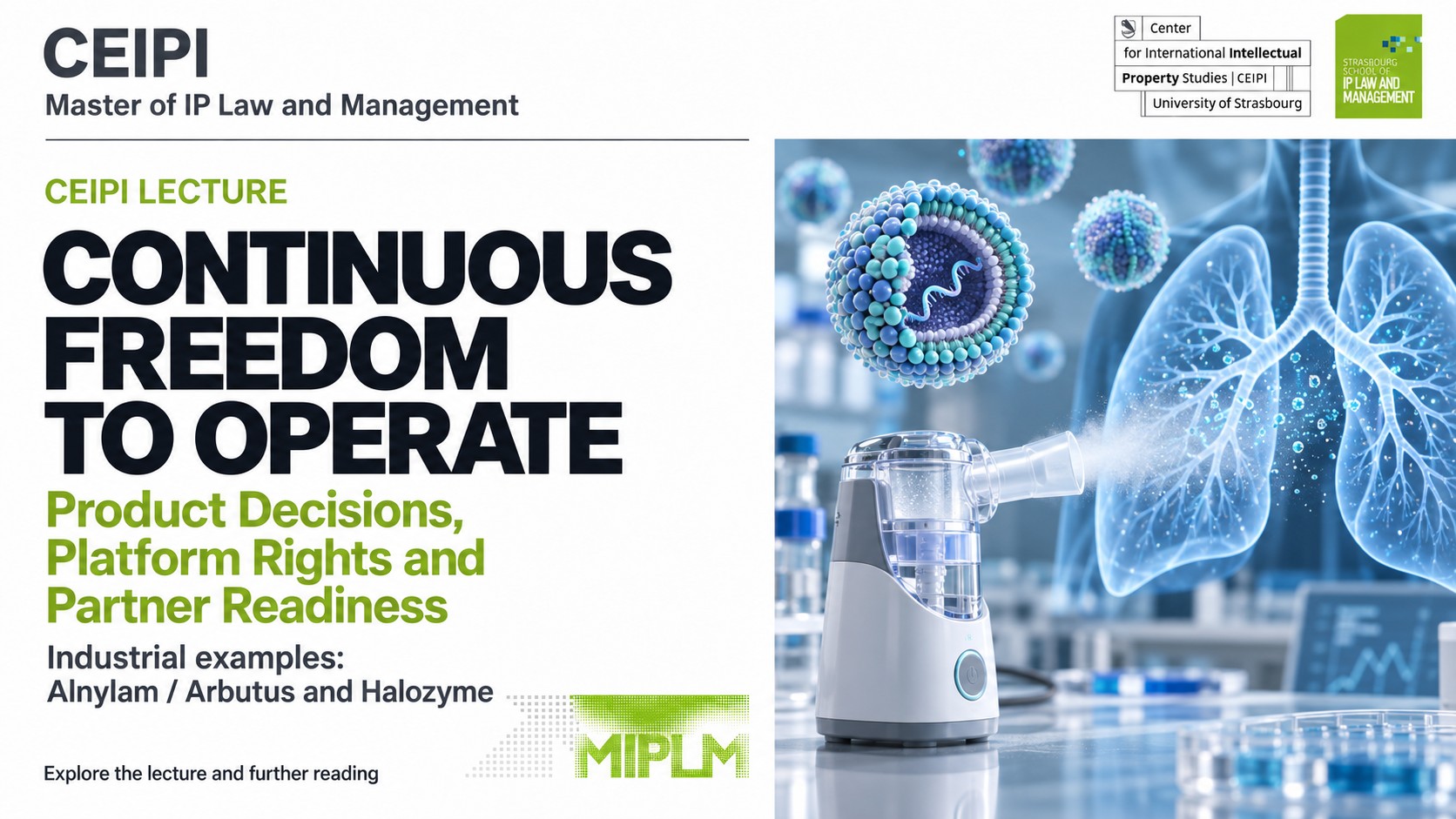
Continuous Freedom to Operate: Product Decisions, Platform Rights and Partner Readiness

A biotechnology company has a promising therapeutic candidate and a delivery platform that could support several future programmes. Preclinical work is progressing, manufacturing decisions are becoming more specific, and potential partners are considering how the technology might fit their pipelines. Each commitment gives the business greater definition. It also makes some alternatives more expensive to pursue.
For an inhaled RNA platform, these commitments span the RNA payload, lipid carrier, powder formulation, production process and inhalation device. The management challenge concerns the interaction of these elements. A technically attractive formulation may introduce a new dependency. An agreement that supports the first candidate may leave questions about partner manufacturing or future indications. Continuous Freedom-to-Operate management connects these issues with the next business decision.
The decision behind the risk map
A living Product FTO Risk Map provides a valuable starting point. Its usefulness increases when each material issue leads to a clear question: what activity can the company reasonably authorise, on which evidence, and under which conditions? The answer needs a defined product version, the relevant territories and activities, and a documented understanding of third-party claims. The dIPlex introduction to Freedom to Operate explains these foundations.
The next step concerns decision ownership. R&D establishes the technical facts. Patent counsel evaluates the legal position. Manufacturing specialists assess alternatives and transfer requirements. Business development tests the commercial scope of access rights. Management decides how to allocate resources with the remaining uncertainty. A useful decision record identifies the authorised scope, unresolved assumptions, responsible owners and the event that requires another review.
Why timing changes the economics
Established management theory helps explain the significance of these choices. Real options theory examines the value of retaining flexibility while information develops. Applied here, it asks whether maintaining an alternative formulation or staging an investment is worth its cost. The relevant comparison includes what the company can still change after the next commitment.
Transaction cost economics examines dependence created by specific investments. Once a company has validated a process around a particular supplier or technology, switching can become difficult. Institutional economics therefore provides a useful basis for discussing access, adaptation and continuity before those commitments accumulate. Dynamic capabilities adds the organisational dimension: monitoring becomes useful when the company can turn new information into revised decisions and working routines.
Comparing routes on a common basis
Consider an illustrative situation in which a lipid substitution improves performance before manufacturing scale-up. The company needs to compare the current route, access through licensing and a technically credible alternative. Each option requires its own evidence. A possible alternative still needs performance testing and a fresh claim assessment. A prospective licence still needs acceptable terms and sufficient scope.
A commercial comparison should include upfront payments, development effort, royalties and the consequences of delay. It should also examine the number of programmes that each route can support. A low initial fee may cover only a narrow field. A more expensive technical route may preserve broader future use. Scenario ranges make these trade-offs visible without assigning invented probabilities to legal or clinical outcomes.
Alnylam and Arbutus demonstrate a route to access
ONPATTRO provides a relevant historical example. Alnylam obtained access to Arbutus lipid nanoparticle technology through a licence in 2012, and ONPATTRO subsequently reached the market. Alnylam announced FDA approval in August 2018. Arbutus later described the licence and its royalty economics.
The transferable lesson concerns the combination of a therapeutic programme with externally controlled delivery technology. A dependency can become a defined access arrangement. The comparison has clear boundaries: ONPATTRO uses intravenous administration, and the public record does not establish the companies’ internal continuous FTO process. Its success also reflects scientific development, clinical evidence and commercial execution. The case illustrates an implemented access mechanism rather than a complete operating model to copy.
Halozyme demonstrates repeated platform use
Halozyme offers a complementary example through ENHANZE. Its 2024 annual report describes nine approved partner products and reports annual royalty revenue of $571 million. These results show commercial use of an enabling delivery platform across multiple programmes.
The management lesson concerns the relationship between programme rights and continuing platform availability. Each partner needs sufficient access for its product, while the platform provider needs room for further applications. ENHANZE is a mature subcutaneous delivery platform, with a different technology and development history from inhaled RNA. Its revenue cannot serve as a forecast for an emerging platform, and its adoption does not demonstrate universal freedom to operate.
Rights that work in the next programme
Platform reuse depends on more than the ownership label attached to an improvement. A company may also need permission to appoint a manufacturer, transfer essential know-how, use development data and make technology available within another programme. The practical test is whether the intended activity can actually proceed through the proposed partner structure.
This calls for explicit questions about fields of use, sublicensing, manufacturing permissions and continuity after a relationship changes. The appropriate answer depends on the technology, bargaining position and applicable law. The platform readings on strategic licensing and know-how management provide further context for these decisions.
The lecture and the planned expert application
The CEIPI lecture develops these issues through a product-and-rights map, development gates, a route comparison and the two industrial cases. Additional reading includes Christian Heubeck’s contribution on life-sciences monitoring and FTO and the discussion of David Teece’s dynamic capabilities.
A model solution by Christian Heubeck is planned and is not yet available. Its intended additional value lies in applying the framework to the practical question: identifying the evidence needed, explaining a preferred course of action and showing which findings would change that recommendation. The lecture below provides the foundations for assessing that application and for discussing the next development commitment with the relevant specialists.