
From Patent Monitoring to IP Intelligence

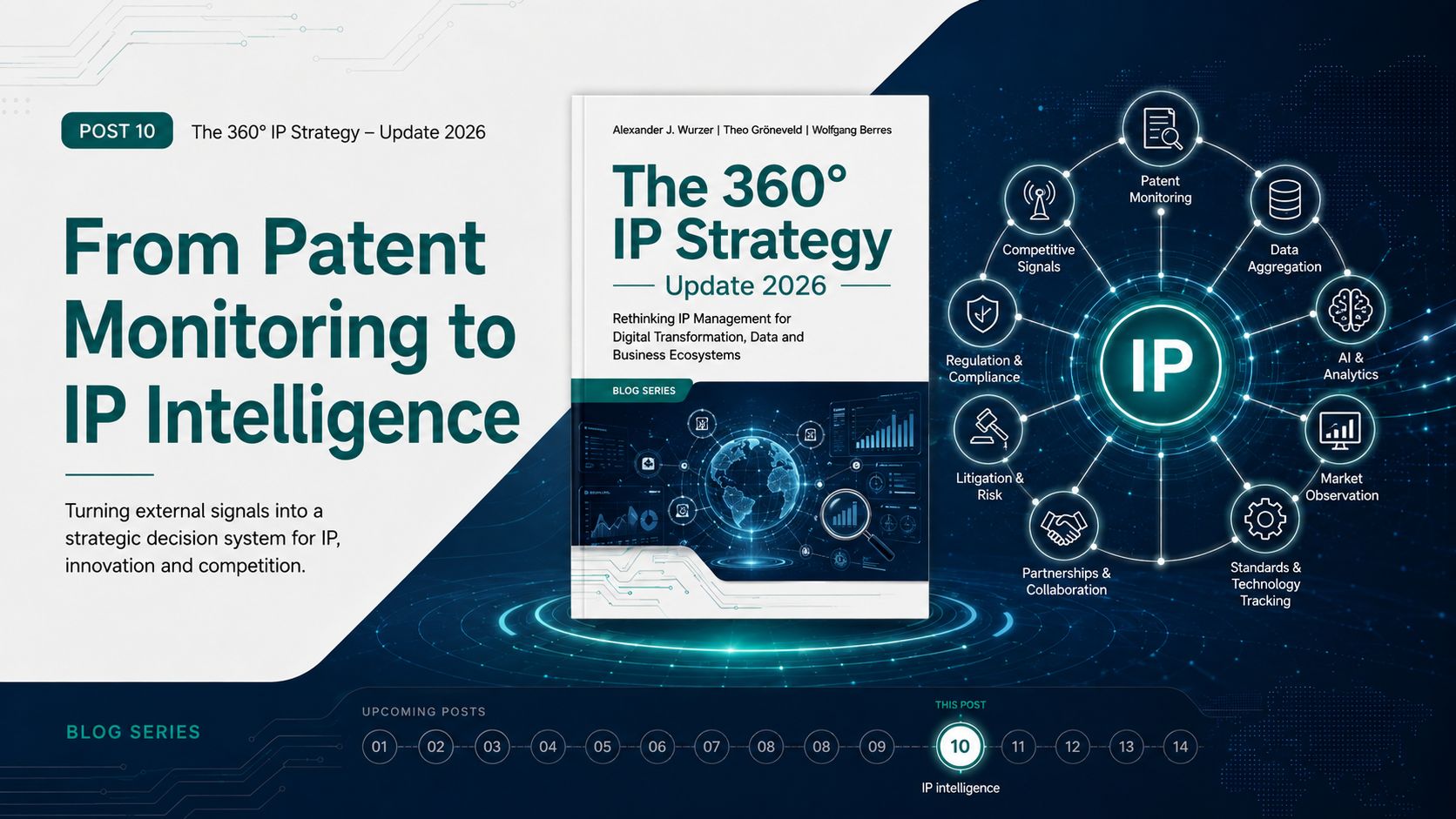
The original 360° IP Strategy treated patent monitoring as a central function of integrated IP management. Patent publications were not merely legal documents to archive. They were indicators of technological competition, sources of technical knowledge and triggers for action in R&D, product management, marketing and IP. That logic remains valid, but the competitive environment has expanded.
A modern competitor does not reveal its direction through patent filings alone. Strategic movement may become visible in software releases, standards participation, platform rules, recruitment, partnerships, start-up investments, scientific publications, regulatory submissions, litigation or licensing. Each signal is incomplete. Together, they can reveal where a market is moving, where a control point is emerging and where a company may lose freedom or bargaining power. The task is not simply to monitor more information. It is to connect external signals with the business model, technology roadmap, IP objectives and decision processes.
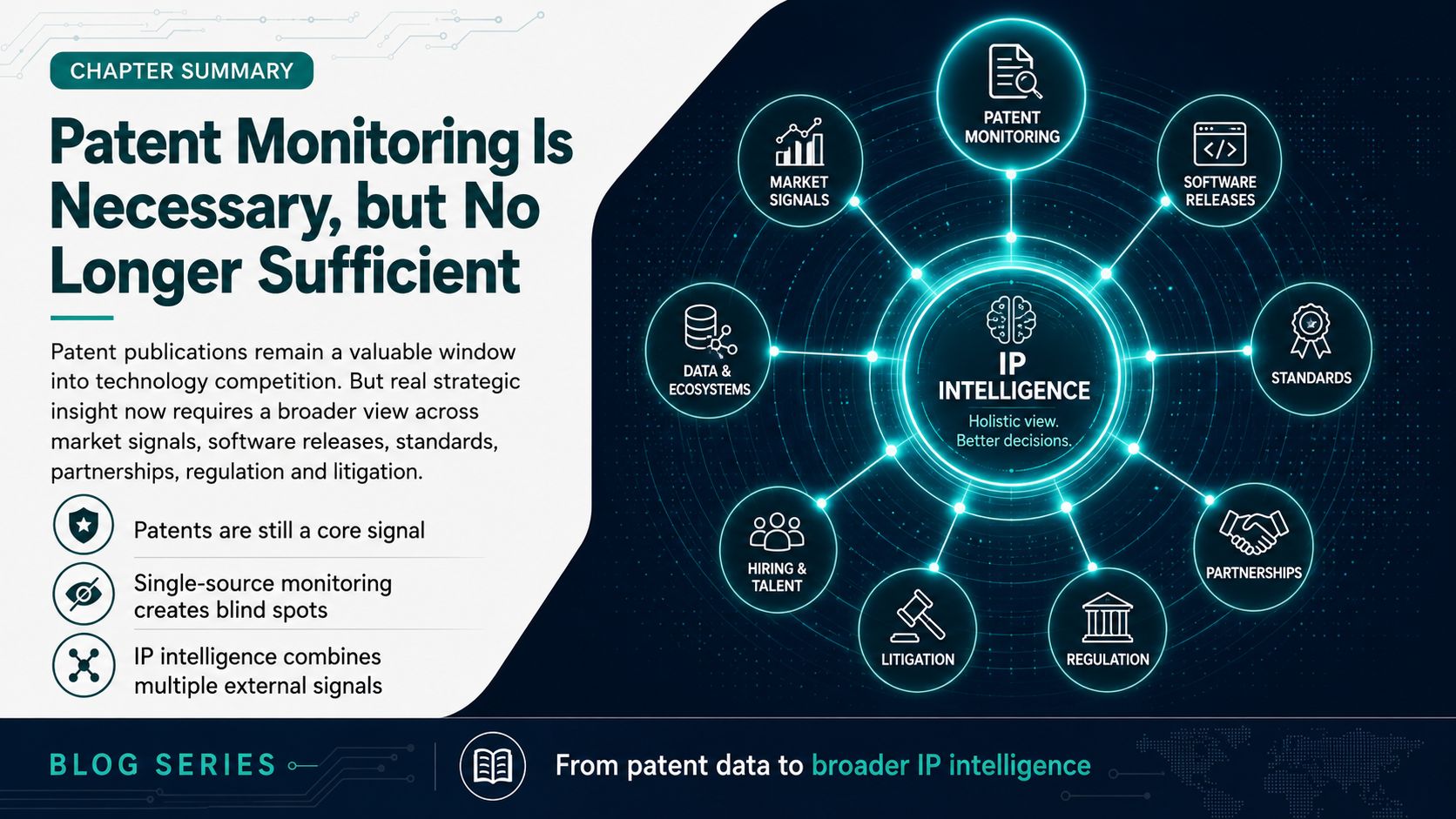
Patent monitoring is necessary, but no longer sufficient
Patent monitoring remains one of the most valuable windows into technological competition. Patent documents combine technical disclosure, applicant and inventor information, classifications, territorial choices, priority dates, citations and legal-status events in a structured form. A continuous process can show which competitors are entering a field, which technical problems attract investment, where portfolios are becoming denser and which applications may create future risks.
The original management insight was already broader than a search alert. Relevant publications had to be evaluated by people who understood the technology and business context. The IP function could organise search profiles and legal assessment, but R&D, product management and marketing had to interpret whether a document affected a development path, product promise, market position or partnership. The value arose from the workflow around the information, not from the feed itself.
That distinction is even more important today. Automated monitoring can produce thousands of results, yet a larger stream does not create greater transparency. Search profiles may reflect outdated categories. Corporate names may miss start-ups, subsidiaries or acquisitions. Semantic searches may retrieve related documents with little strategic relevance, while an important competitor may use unfamiliar vocabulary. Patent data also contains a time lag: publication follows choices already made.
Monitoring must therefore be treated as a hypothesis system. A cluster of filings may indicate a serious technology direction, defensive portfolio building, an acquisition target, a standards strategy or deliberate noise. An absence of filings may mean withdrawal, secrecy, a changed applicant structure or a move towards software and data advantages. The question is not merely, “What did the search find?” It is, “Which explanation fits the pattern, and what evidence would confirm or challenge it?”
Patent monitoring remains the disciplined backbone of external IP observation, but its output becomes useful only when experts connect documents with technological meaning, competitive intent and business decisions. The modern system must preserve that depth while extending observation beyond patent databases.
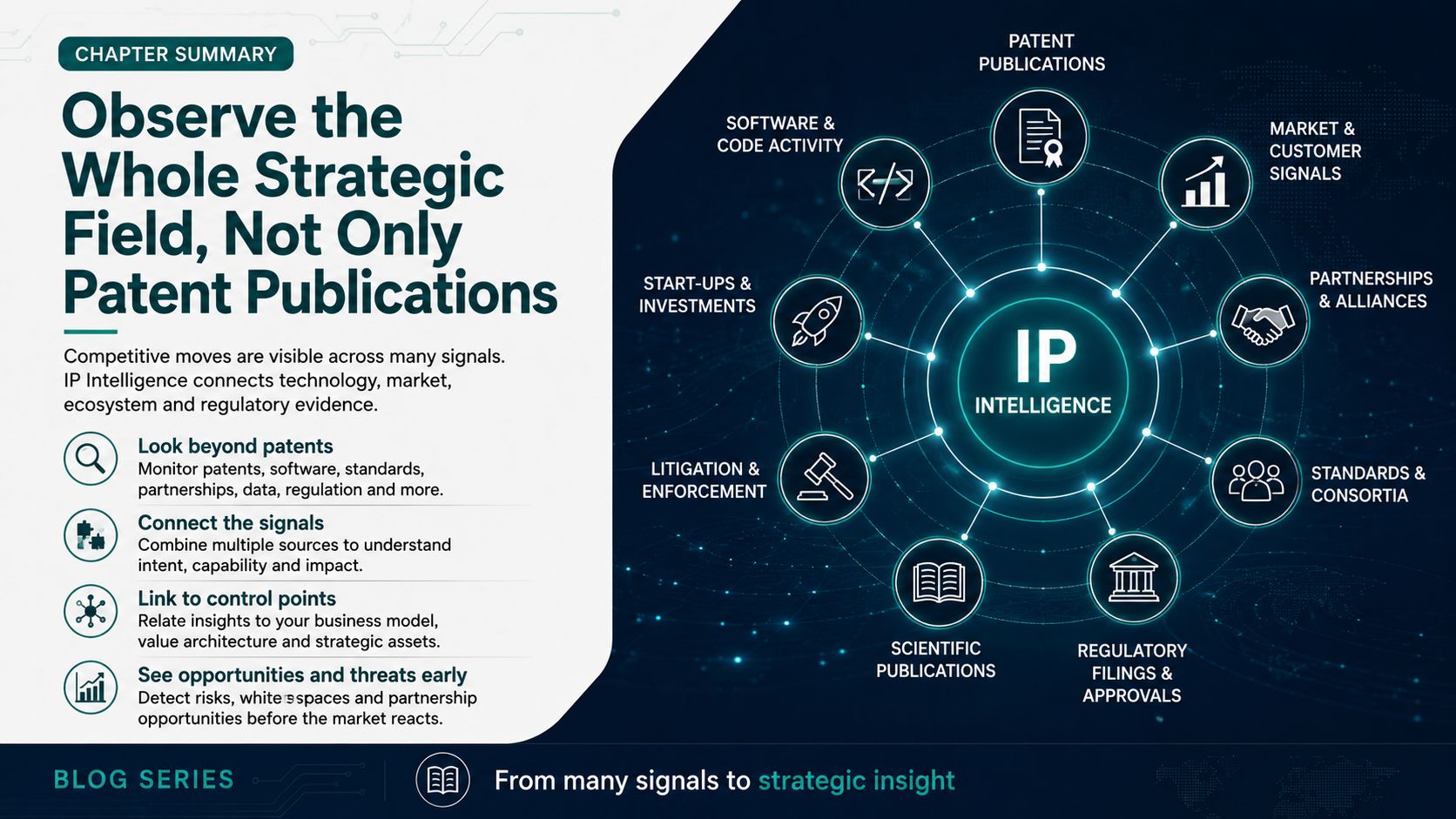
Observe the whole strategic field, not only patent publications
Digital and ecosystem-based competition distributes strategic intent across many observable activities. A company may signal a new direction through an API release, developer programme, change in licensing terms, open-source contribution, technical job advertisement, cloud partnership or standards activity. In regulated markets, clinical trials, certification pathways or regulatory submissions may reveal progress before launch. Litigation and oppositions show which rights companies are prepared to defend and where they perceive real market stakes.
These sources should not be collected indiscriminately. IP Intelligence begins with the value architecture and control points identified in the 360° IP Strategy. If recurring service revenue depends on operational data, the system should observe competitor data partnerships, platform integrations, interoperability initiatives and access rules. If a future position depends on becoming the accepted interface standard, standards participation, reference implementations and ecosystem alliances may matter more than raw patent volume.
Sources must also be read in combination. A patent filing around sensor calibration may be modest on its own. It becomes more meaningful when the applicant recruits edge-computing specialists, joins an interoperability consortium and launches a pilot with a major manufacturer. Conversely, extensive patenting without product activity, partnerships or capability building may indicate an option, licensing strategy or negotiating portfolio rather than an imminent market offer.
A useful signal architecture distinguishes four perspectives. Technology signals show emerging functions, architectures and convergence. Market signals show adoption, pricing models, distribution and new entrants. IP signals show filings, ownership changes, legal status, licensing and enforcement. Ecosystem and regulatory signals show standards, alliances, dependencies, approvals and access rules. The aim is not to merge everything into one score, but to create a coherent picture in which contradictions remain visible.
IP Intelligence expands the unit of observation from the patent document to the competitive system. By connecting technology, market, IP, ecosystem and regulatory evidence to known control points, management can recognise strategic movement earlier and avoid treating one data source as the complete reality.
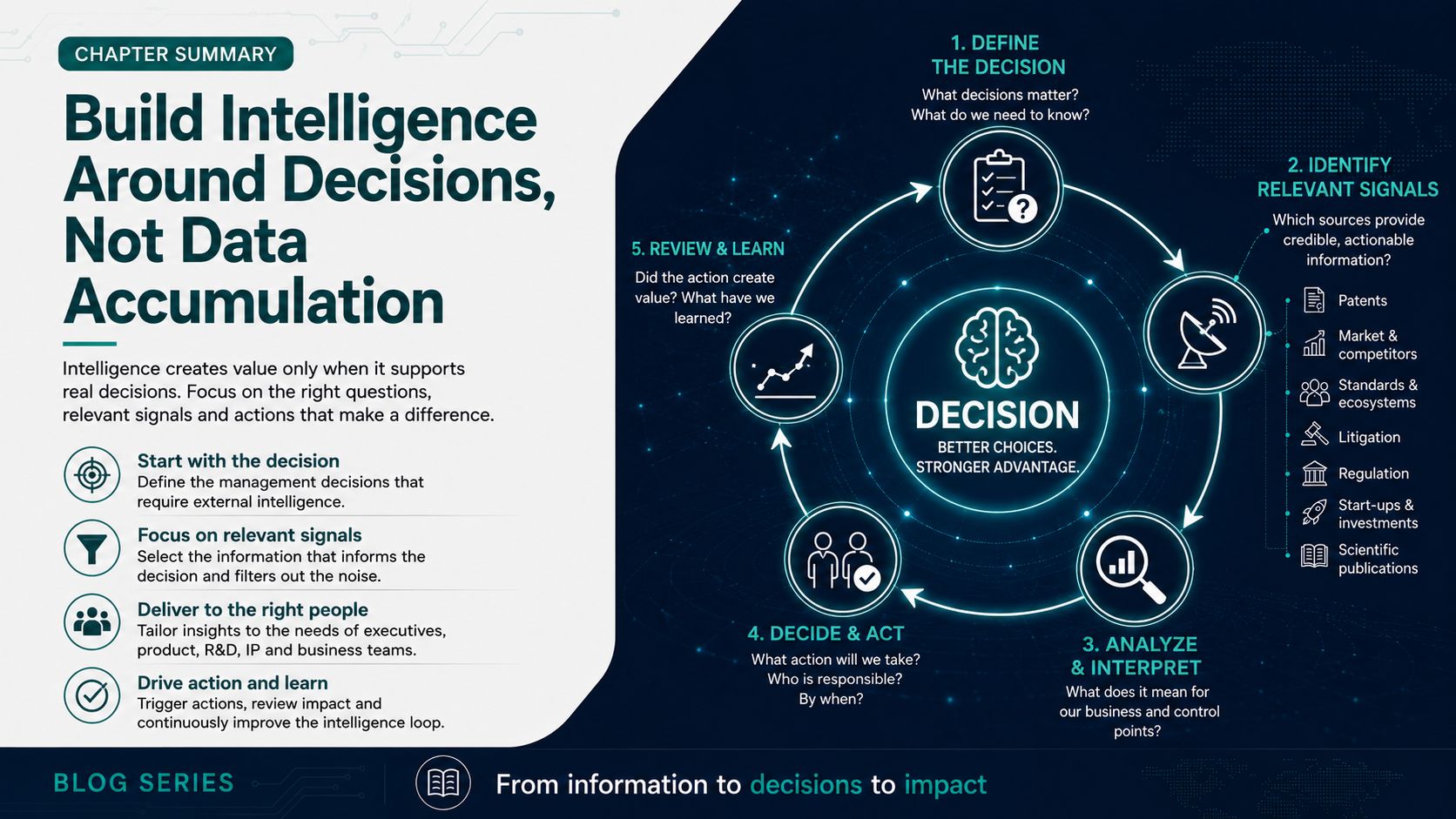
Build intelligence around decisions, not data accumulation
Many intelligence projects fail because they begin with available data rather than management questions. Teams build dashboards, subscribe to databases and distribute reports, but recipients do not know what decision should follow. The result is a sophisticated archive with little influence on investment, innovation or competitive action.
The starting point should be a decision catalogue. Which recurring decisions require external IP-related intelligence? Examples include selecting innovation fields, prioritising roadmap options, entering a market, choosing a partner, acquiring a start-up, setting a standardisation position, initiating synthetic inventing, licensing technology or challenging a competitor right. Each decision needs an observation horizon, relevant signals, responsible interpreters and escalation criteria. This creates different intelligence products for different users. Executives may need a quarterly view of emerging control points, vulnerable assumptions and major competitor moves. Product management may need alerts on technologies, interfaces and ecosystem changes affecting the roadmap. R&D may need landscapes, white-space hypotheses and named experts active in a field. Business development may need evidence on partners, acquisition candidates and licensing positions. The IP function may need claim-level monitoring, ownership changes and litigation signals.
The internal data model is decisive. External findings should connect to the company’s own taxonomy of customer benefits, system functions, technologies, competitors, business models and IP objectives. Without this translation layer, information remains externally organised and difficult to compare with internal choices. A signal evaluated once should be reusable across Freedom to Operate, synthetic inventing, portfolio review, partnership analysis and strategic planning.
Decision thresholds prevent underreaction and alarm fatigue. A weak signal may simply be stored. Several independent signals around a strategic control point may trigger deeper analysis. A potentially blocking right linked to a committed roadmap may require immediate escalation. A new entrant combining relevant patents, specialist recruitment and a powerful partner may justify a scenario review before commercial activity is visible.
An effective IP Intelligence system is designed backwards from decisions. It delivers the right evidence, in the right form, to the people who can act, while preserving the taxonomy, evaluation history and assumptions required for organisational learning.
Use AI to detect patterns, not to outsource judgement
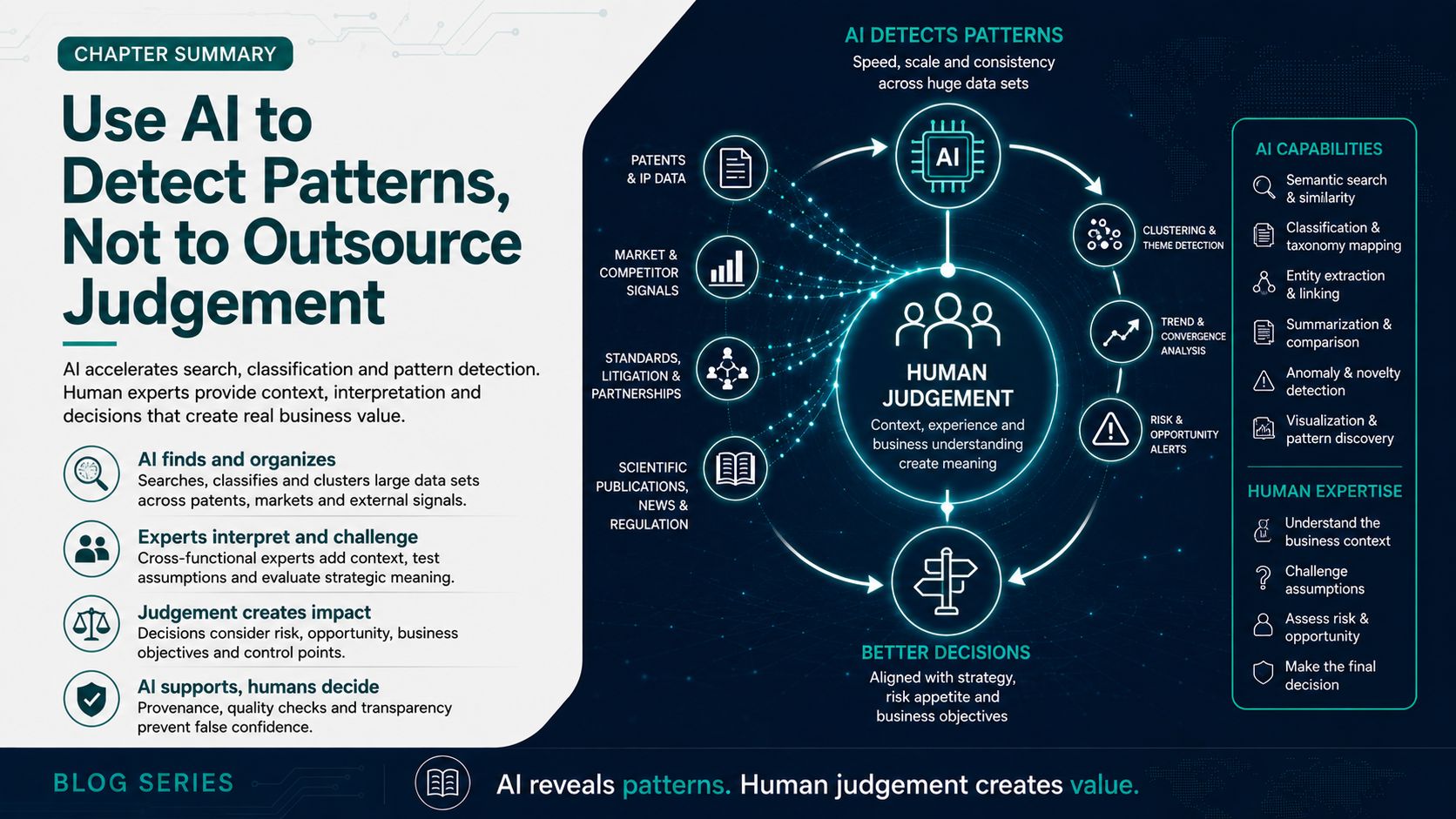
AI changes the economics of intelligence work. Semantic search can identify related documents beyond fixed keywords. Classification models can assign large document sets to company-specific technology fields. Clustering can reveal emerging themes, convergence and unusual concentrations of activity. Language models can summarise documents, compare claims and extract entities. These capabilities make analyses possible that would be too slow or expensive manually.
The greatest benefit is not replacing experts, but changing where their time is spent. Instead of screening every document, specialists can define the questions, validate the search space, examine high-impact findings, test explanations and decide what the evidence means for the business. AI can reduce information volume; it cannot determine which customer benefit matters, which dependency is acceptable or which response fits the company’s risk appetite.
False confidence is the central danger. Similarity is not infringement. A cluster is not automatically a market trend. A predicted direction is not a fact. A generated summary may omit a decisive claim limitation, confuse family members or treat applicant names inconsistently. Models can reproduce biases in source data and give polished answers when evidence is incomplete. Outputs therefore need provenance: source links, search boundaries, model version, confidence level, reviewer and date.
Human interpretation should be deliberately cross-functional. A patent attorney may recognise the importance of a claim amendment. An engineer may see that the technical route is commercially impractical. A product manager may know that customers are moving towards a different outcome. A standards expert may understand that an apparently open interface will soon be governed by certification rules. Strategic meaning often emerges only when these perspectives meet.
AI should support a transparent workflow: scope the question, collect and classify evidence, expose patterns, test alternative explanations, obtain expert review and record the decision. The system should preserve uncertainty rather than hide it behind one relevance score. AI makes IP Intelligence scalable by accelerating search, classification and pattern recognition. Strategic quality still depends on explicit questions, auditable evidence, competing interpretations and expert judgement across IP, technology and business.
Turn IP Intelligence into an early-warning and opportunity system
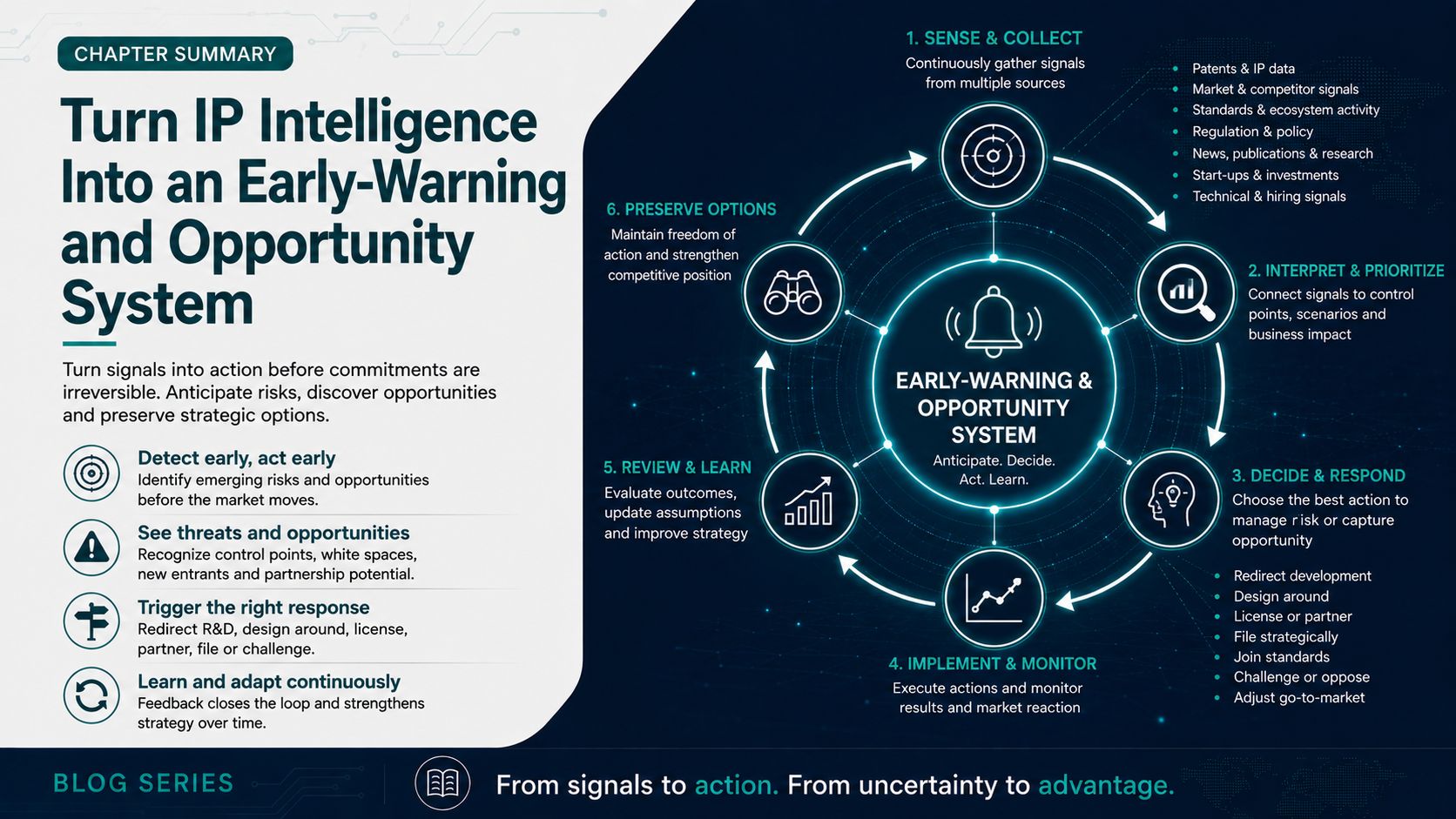
The purpose of intelligence is not to describe the external world more elegantly. It is to preserve options and improve the timing of action. An early signal can allow a company to redirect development, create an invent-around, contact a partner, file before a field becomes crowded, secure data access, join a standards initiative or challenge a problematic application. The same information discovered after architecture, contracts and customer promises are fixed has far less value.
A practical intelligence loop links sensing, interpretation, decision and follow-through. Sensing captures relevant events from defined sources. Interpretation connects them to business objectives, control points and scenarios. Decision-making assigns an action, owner and deadline. Follow-through checks whether the action changed the risk or opportunity and whether assumptions remain valid. Intelligence without this last step becomes reporting; action without feedback prevents learning.
The system should search for opportunities as actively as threats. An abandoned competitor application may reveal a technical route worth examining. A dense patent cluster may indicate demand for complementary services. A new standard may create licensing, certification or implementation opportunities. Start-up activity may reveal capabilities that should be partnered with or acquired. Litigation may expose which portfolio positions have real leverage. White spaces may suggest questions for synthetic inventing, provided that absence in a selected dataset is not confused with market attractiveness.
Scenario thinking prevents linear interpretation. For each material signal, the team can ask: What if this is the beginning of a new control point? What if the competitor is building a licensing position rather than a product? What if the technical direction becomes part of a standard? What if regulation makes the current architecture unattractive? These scenarios translate uncertainty into preparatory choices rather than false prediction.
Governance determines whether the capability remains alive. Intelligence topics should be reviewed with roadmaps, portfolio decisions, business planning and major partnerships. Search profiles and taxonomies must evolve as technologies and business models change. Analysts need feedback on which insights influenced decisions. Management must distinguish routine observation, deeper strategic analysis and urgent escalation.
IP Intelligence turns external information into a corporate sensing capability. It identifies where control points, risks and cooperation opportunities may emerge, preserves strategic options before commitments become irreversible and creates a continuous learning loop between the market, technology, IP and business decisions.
Supplementary content on the IPBA® platform:
Patent Monitoring
Defines the difference between time-bound patent analysis and continuous monitoring, and connects patent information with competitor observation, technology trends, legal-status changes and Freedom-to-Operate decisions.
👉 Read more
AI in Operational IP Management
Shows how AI can combine patent data, market signals, competitor activity and internal innovation information while keeping the IP function connected to R&D, product management and corporate strategy.
👉 Read more
Application Fields of AI based Patent Analysis
Explains how classification, clustering, landscape analysis and trend detection can reveal competitive focus, emerging convergence and white spaces without reducing strategic interpretation to a single automated score.
👉 Read more
Patent and Innovation Management
Provides a practical case in which Innovation Intelligence and Patent Intelligence are integrated with expert evaluation, innovation fields, collaboration platforms and investment decisions.
👉 Read more
Driving Innovation in Steel: How to Use Patent Intelligence for a Competitive Edge
Demonstrates how patent intelligence can serve as an early-warning system for expensive R&D choices, competitor benchmarking, licensing, workarounds and geographic strategy in a capital-intensive industry.
👉 Read more
Market Monitoring and FtO Analysis in the Life Sciences Industry
Broadens the evidence base beyond patents by combining competitor filings with clinical trials, scientific conferences, partnerships, M&A and regulatory progress to guide pipeline and business-development decisions.
👉 Read more
Innovation as a Second or Third Mover: Why Patents Matter for Timing Decisions
Shows how continuous market monitoring helps later entrants avoid blindly following pioneers, choose alternative technical routes and use timing as a strategic advantage.
👉 Read more
Stay Ahead or Fall Behind: Why Market Intelligence Is the IP Expert’s Secret Advantage
Connects technology, competitor and client intelligence with more strategic IP advice, stronger positioning and a repeatable intelligence system rather than isolated research assignments.
👉 Read more
From Nuclear Standoffs to Patent Races: What Game Theory Teaches Us About IP Strategy
Adds the behavioural layer: competitors react to filings, licensing offers, litigation threats and standards activity, so intelligence must anticipate interaction rather than merely catalogue events.
👉 Read more
White Spot Analysis
Clarifies how to define and visualise gaps under explicit boundaries and reproducible rules, preventing teams from confusing an observed absence in the selected data with proof of market opportunity.
👉 Read more