Quantum IP and Ethics: Who Will Control the Next Computing Paradigm?

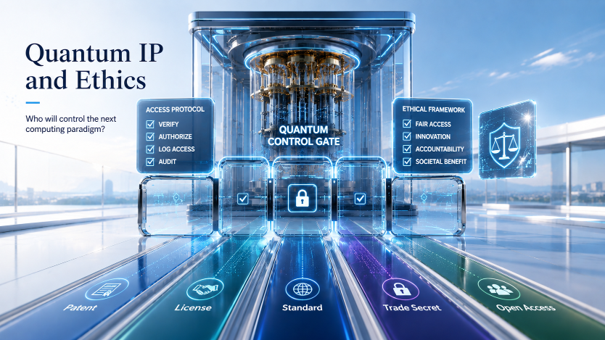
Quantum technology is moving from scientific promise towards strategic infrastructure. As companies, governments and research institutions build hardware, algorithms, software platforms, communications systems and application portfolios, intellectual property is becoming one of the main mechanisms through which control will be allocated.
That makes the ethics debate inseparable from IP strategy.
Patents determine who may exclude others from using a technical solution. Trade secrets determine which knowledge remains inaccessible. Copyright and database rights may shape control over software and training resources. Standards determine which technologies become interoperable. Licensing models influence who can participate in emerging markets. Contractual arrangements decide who owns results created through publicly funded research, joint development and international collaboration.
The central question is therefore not only whether quantum technologies can be developed responsibly. It is also whether the structures used to own, protect, license and commercialise quantum innovation will support responsible outcomes.
From Technical Progress to Responsible Control
Andrew Fearnside places this challenge at the centre of his article, “Ethical Quantum Computing: Nobody Said It Was Easy”. He argues that technical excellence is insufficient when the underlying objective, access model or use case is questionable. His discussion of the UK National Quantum Computing Centre’s Quantum STATES framework is especially relevant for IP professionals because the framework asks whether quantum development is societally beneficial, trusted, accountable, transparent, equitable, safe and secure.
These principles immediately create IP questions. What should be patented, and what should remain open? When should exclusivity reward risky investment, and when could it obstruct safety research, interoperability or access? What information must be disclosed for accountability, even where trade secret protection would normally favour secrecy?
Mauritz Kop has developed one of the clearest conceptual responses. In “Towards Responsible Quantum Technology”, Kop and his coauthors propose a framework based on safeguarding against risks, engaging stakeholders and advancing innovation. This approach avoids the false choice between unrestricted technological acceleration and precautionary paralysis. It suggests that governance should be embedded in research and commercialisation decisions from the beginning.
For IP management, this means that responsibility cannot be added after a portfolio has been built. Ethical intent must influence invention harvesting, filing decisions, ownership structures, licensing principles and collaboration agreements.
Ownership, Access and the Quantum Divide
One of the most persistent concerns in the debate is the possibility of a quantum divide. Access to advanced systems may become concentrated among a small number of states, technology companies, cloud providers and defence organisations. That concentration may be reinforced by patents, proprietary interfaces, restricted datasets, scarce talent, confidential manufacturing know how and control over specialised supply chains.
Catherine Lefebvre has consistently connected quantum development with equitable access and applications addressing the United Nations Sustainable Development Goals. Through the Open Quantum Institute, she has promoted access to quantum resources and the development of use cases intended to benefit a broader international community rather than only the best funded technology centres.
Mira Wolf-Bauwens similarly argues that responsible quantum development requires community building, education and international cooperation. Her work on institutionalising responsible quantum shows that no single company, government or technical discipline can anticipate the full distribution of benefits and harms.
This is where licensing becomes an ethical design instrument. A company may retain strong patents while offering research licences, humanitarian licences, field restricted licences or transparent access rules. Public funders may attach responsible licensing requirements to grants. Standards bodies may require fair access to essential technologies. Research consortia may create differentiated ownership rules for background knowledge, project results and safety relevant information.
Brian Lenahan contributes an important business perspective. Through the Quantum Strategy Institute and his writing on quantum readiness, he argues that leaders must treat quantum as a strategic capability rather than a distant technical experiment.
The ethical extension is clear: readiness should include decisions about who will gain access, who may be excluded and which forms of control are compatible with an organisation’s public commitments. A technically mature company without an access policy, responsible licensing principles or a clear position on societal impact is not fully quantum ready.
Dual Use, Security and the Limits of Openness
Quantum technologies have civilian, commercial, intelligence and military applications. Quantum sensing may support medical imaging or submarine detection. Quantum communication may protect infrastructure or support secure military networks. Quantum computing may accelerate materials discovery while also undermining existing encryption.
Carolyn Ten Holter and Mira Wolf-Bauwens address this complexity directly in their 2026 paper, “Dual Use, Quantum Technologies, and Responsible Innovation”. They argue that the label “dual use” is too crude to function as a complete moral judgement. Ethical assessment must consider funding, context, intended use, institutional processes and geopolitical realities.
Michal Krelina adds the perspective of defence, security and critical infrastructure. His work on threat analysis and countermeasures for quantum communication systems demonstrates that technologies presented as inherently secure may still contain physical, operational and implementation vulnerabilities.
These observations challenge simplistic calls for either complete openness or complete secrecy. Open publication may support verification, interoperability and scientific progress, but it may also reveal capabilities with security implications. Trade secrecy may protect legitimate commercial investment, but excessive secrecy can prevent scrutiny and conceal unsafe practices.
IP governance must therefore distinguish between technical exclusivity, security classification, commercial confidentiality and public accountability. These are different instruments with different purposes. Responsible organisations need review mechanisms that assess whether a patent filing, publication, licence or confidentiality restriction changes the risk profile of the technology.
The timing of such reviews is critical. A patent application may disclose an invention long before the related system reaches the market. An international filing strategy may extend knowledge of the invention into jurisdictions with different security interests. A licence may transfer capabilities that appear commercially harmless in isolation but become strategically significant when combined with other technologies.
Quantum IP decisions are therefore also information security and geopolitical decisions.
Standards, Accountability and Explainability
The debate is now moving from voluntary principles towards institutional frameworks. The OECD Recommendation on Quantum Technologies, adopted on 28 May 2026, is the first intergovernmental standard establishing shared principles and policy guidance for the responsible development and use of trusted quantum technologies.
Audrey Plonk and Sara Rendtorff-Smith have helped communicate the policy significance of international cooperation, secure access, resilient supply chains and coherent governance. Their contribution matters because quantum markets will be transnational, while patents, export controls, competition law and research security rules remain divided across jurisdictions.
Martin Ebers has amplified the legal importance of the OECD Recommendation as a shared framework for trusted quantum technologies. His intervention is a reminder that soft law can influence later regulation, procurement rules, technical standards and corporate governance long before binding quantum specific legislation exists.
Prof. Dr. Ingrid Vasiliu-Feltes has connected the UNESCO ethics report with human rights, global solidarity, sustainable development and ethical foresight. Her contribution places quantum governance within the wider debate about responsible leadership and technology diplomacy.
Bruno Schneider has also highlighted the UNESCO report and framed ethics as an orchestration challenge across interconnected technology systems. This systems perspective is particularly important where quantum computing is combined with artificial intelligence, high performance computing, cloud infrastructure and proprietary data.
For IP teams, accountability must become operational. Patent landscapes should identify not only competitive barriers but also concentrations of control. Licensing records should show who receives access and under what conditions. Algorithmic or simulation based inventions may require documentation that supports explainability. Standards participation should be coordinated with portfolio strategy so that proprietary positions do not undermine interoperability commitments.
Explainability also has a specifically IP related dimension. Patent law demands sufficient disclosure, but commercial strategy often encourages applicants to disclose only what is legally necessary. Responsible innovation may require more extensive documentation of assumptions, training data, system dependencies, limitations and foreseeable misuse, even where these details are not required for obtaining a patent.
Building Ethical IP Governance Before Scale
The strongest message across the debate is that governance must precede scale. The NQCC Action Plan discussed by Andrew Fearnside is one example of the transition from broad principles to organisational practice. It embeds responsibility into research, industry engagement and decision processes over a five year horizon.
Zeki C. Seskir, together with a broader Responsible Quantum Technologies community, has argued that responsible development must address stakeholder participation, sustainability, education and emerging quantum divides.
This work is important for IP because portfolio decisions are often made before wider social implications are visible. By the time a dominant patent position, proprietary platform or closed supply chain is established, the range of realistic governance choices may already be narrow.
Bob Dameron brings the debate back to executive decision making. His article “Non-Technical Perspectives on Quantum and AI” emphasises that leaders do not need to become physicists, but they do need to understand strategic consequences.
That includes responsibility for cyber migration, investment priorities, claims about quantum advantage and the governance of hybrid quantum and AI systems. It also includes understanding that an IP portfolio is not merely a collection of legal assets. It is an architecture that determines which actors can develop, combine, manufacture and deploy a technology.
Ethical quantum IP governance therefore requires more than a code of conduct. It requires a repeatable decision architecture. Organisations need criteria for responsible patenting, rules for access and licensing, review of dual use implications, transparency requirements, portfolio level accountability and escalation routes when commercial objectives conflict with societal commitments.
A practical review should ask four questions at every major portfolio decision. What form of exclusivity is genuinely necessary? Which stakeholders could be affected by the resulting control position? Which safeguards, access conditions or disclosure duties should accompany that position? How will the decision be reassessed as the technology, market and risk environment evolve?
Such questions turn ethics from an abstract ambition into evidence based IP governance.
Quantum ethics is not separate from value creation. It determines whether value is created through trusted participation or concentrated control. The decisive question is not simply who will invent the next quantum breakthrough. It is who will own it, who will be allowed to use it, under which conditions, and with what responsibility for the consequences.