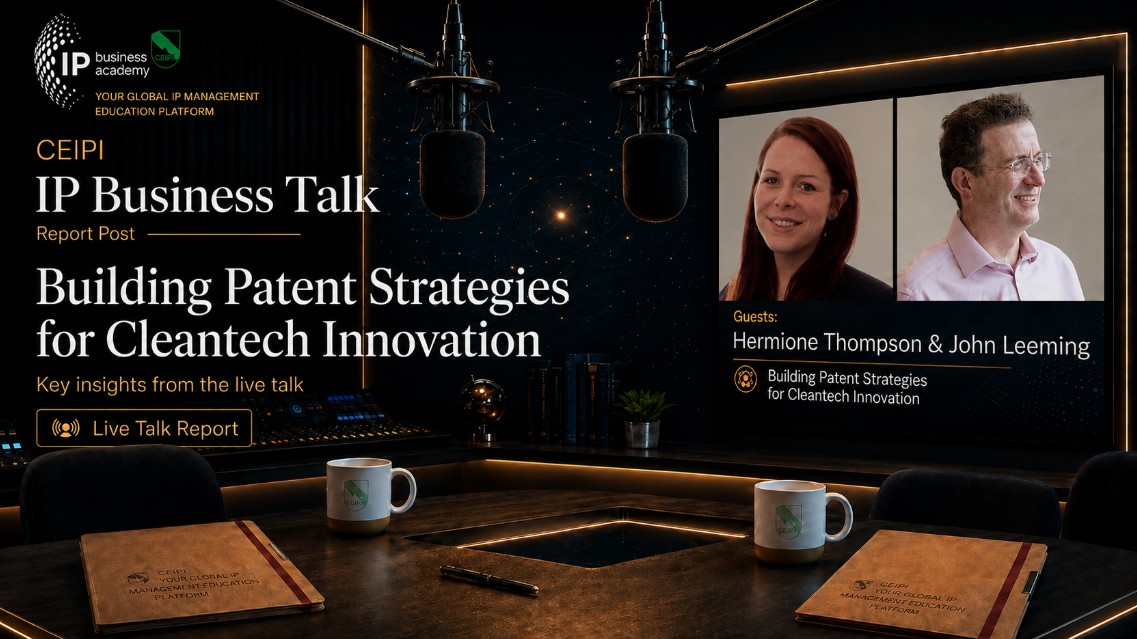
Building Patent Strategies for Cleantech Innovation: Hermione Thompson and John Leeming on Invention Capture, Scaling and Portfolio Architecture

Cleantech innovation rarely develops within a single technical discipline. A commercially relevant solution may combine mechanical engineering, advanced materials, electronics, software, manufacturing processes, control systems and environmental performance. This technical breadth creates a demanding IP management question: how can a company identify the contributions that deserve protection and build a portfolio that remains useful as the technology moves from development to industrial deployment?
In the CEIPI IP Business Talk, Hermione Thompson and John Leeming from J A Kemp explained why the answer begins inside the organisation. Engineers and researchers need workable channels for surfacing relevant developments. Decision-makers then need to connect those developments with commercial priorities, confidentiality, freedom to operate, investment plans and future technology options. Patent strategy therefore develops through an ongoing conversation between technical teams, the business and IP advisers.
Technical relevance should trigger the IP conversation
One of the first challenges is invention capture. The people closest to a development often lack the patent-law perspective needed to judge whether their work is patentable. They may also regard an important improvement as obvious or routine because they understand the technical context so well. Asking them to perform a first legal assessment can cause valuable developments to disappear before the IP function ever sees them.
Thompson described a more workable division of responsibility. Engineers, designers and researchers should understand why IP matters, which internal channels are available and when a development has sufficient technical or economic relevance to be raised. The later decision about patenting, confidentiality or another form of protection can then be made by the people who understand the wider IP and business strategy.
This distinction shifts the internal task from identifying a legally defined invention to recognising relevance. Training still matters, especially where it helps technical teams understand the available IP rights, confidentiality requirements and the basic timing of the patent process. Its purpose is to support timely escalation and preserve strategic options.
Every disclosure can become an IP decision
The discussion also showed why invention capture has to continue after an initial filing. A development may improve substantially during the twelve months following a first application. Engineers need to know that later results, performance gains and implementation changes may still influence follow-on filings and claim development. They also need to recognise that publishing a new feature on a website, presenting it to a partner or including it in a grant application can affect future protection.
Companies make many practical IP decisions through ordinary operational activity. Presentations, contracts, pilot projects, partner discussions and product communications all shape what remains protectable or confidential. An effective process makes these consequences visible while decisions can still be influenced.
Cleantech adds contractual, regulatory and classification complexity
Several features make this process particularly demanding in cleantech. Research frequently emerges from universities, sponsored projects or public funding. Grant terms, ownership provisions, application procedures and disclosure rules can therefore affect who controls an invention and whether patentability is preserved. Patent costs also need to be considered in funding applications and business planning.
Regulation creates another layer. Environmental and energy technologies often develop within tightly governed markets, and regulatory requirements can influence product architecture, market entry and the relevance of third-party rights. A further challenge concerns how companies classify themselves. Many established industrial companies improve recyclability, energy efficiency or environmental performance without describing themselves as cleantech businesses. A single sustainability-driven product decision can nevertheless move the company into a dense and unfamiliar patent landscape. This increases the importance of freedom-to-operate analysis and competitor awareness, particularly where the organisation underestimates the IP activity surrounding the new technical field.
Patent timing should follow the scaling strategy
Fast-growing cleantech companies often work under time and funding pressure. Thompson emphasised that patent prosecution does not automatically have to slow the scaling process. Several patent offices provide accelerated routes for environmentally beneficial technologies. The UK Green Channel can, for example, help an applicant obtain earlier examination, and comparable mechanisms exist in other jurisdictions.
Acceleration remains a strategic choice. An early grant can give investors greater certainty about the scope of protection and may support a financing round or transaction. Continued pendency can preserve flexibility while the product, manufacturing process or commercial model is still changing. Slower prosecution can also help align patent expenditure with the company’s funding position.
The appropriate pace depends on the company’s intended development path. A business preparing for acquisition may need a different portfolio profile from one planning an IPO or building an independent operating company. Patent timing, territorial coverage and portfolio cost should therefore be organised around the financing and growth strategy.
Freedom to operate becomes a continuing management task
Scaling also changes the third-party rights landscape. Companies usually know their closest competitors, which makes targeted monitoring a practical starting point. Thompson described the use of recurring reviews of recently granted competitor patents. In Europe, this can be particularly valuable because a problematic right identified early enough may be addressed through an opposition within the nine-month period following grant. This can create an opportunity to have the patent revoked or amended before it becomes a greater commercial obstacle.
A broader monitoring programme may provide additional security, yet it also produces higher search and review costs. The scope of monitoring should reflect the commercial risk, the maturity of the product and the strategic importance of the market. Freedom to operate consequently develops into a risk-based process that evolves alongside technical development and commercial expansion.
Investors look for credibility behind the filing count
Patent applications can signal that a company has identified protectable technology and taken action to secure it. The strength of that signal varies considerably among investors. Some investors treat the existence of an application as a basic diligence item. More experienced investors examine whether the application has credible validity prospects, meaningful claim coverage and a clear relationship to the company’s competitive position.
Thompson and Leeming therefore linked investor confidence to the quality of the surrounding system. A defensible application sits within a wider strategy for capturing internal developments, selecting the assets that matter, monitoring external rights and allocating a realistic budget. This demonstrates that the company understands how its technological assets support future competitiveness. The credibility comes from the relationship between the patent application, the protected technology and the company’s development path.
Portfolio architecture should follow the layers of value creation
Solar technology illustrates how protection can be distributed across several technical layers. An innovation may concern the smallest independently inventive component, a cell architecture, a semiconductor material, a panel, a control function, a manufacturing process or the integration of the technology into a wider energy system.
Leeming described a claim-development approach that begins with the core inventive contribution and then examines the relevant upstream and downstream positions. The initial claim architecture may begin with a new component or cell structure and extend towards panels, systems, control functions, manufacturing processes and relevant use cases.
Early applications should create room for manoeuvre wherever the disclosure supports it. Later, as the prior-art position, market direction and company strategy become clearer, prosecution can be directed towards the commercially most valuable scope. This flexibility matters because a company’s initial implementation may change. An application drafted narrowly around the first planned product can lose relevance when the team discovers that another technical route works better. The drafting process should therefore explore alternative materials, system configurations, manufacturing routes, use cases and control concepts that could carry the same underlying contribution.
The business and the IP adviser need an ongoing dialogue
Patent attorneys can explain what forms of protection are available, identify legal options and help test the breadth of a technical concept. The business contributes the information that makes those options commercially meaningful: target markets, competitor positions, development plans, revenue expectations, manufacturing locations, investor requirements and budget constraints.
This is why an invention disclosure passed across an organisational boundary provides an incomplete foundation for strategic protection. Valuable portfolio decisions emerge through repeated discussion with the people who understand where the company is now and where it intends to go. That dialogue can also influence research priorities, jurisdiction choices and the timing of further filings. The IP adviser can ask the questions that connect a technical development with the business strategy, while the company supplies the market and organisational knowledge needed to make the answer useful.
Trade secrets require an operational protection system
Some cleantech advantages are difficult to detect from the final product. Manufacturing parameters, process settings, accumulated data and trained machine-learning models may improve cost, yield or performance while remaining invisible to the market. Leeming identified detectability as an important factor in choosing between patenting and secrecy. If a competitor used the same process internally, would the company be able to recognise the infringement? Can the relevant parameters be reverse-engineered from the product? Does the advantage appear in an observable technical feature?
Where the answer is uncertain, trade secret protection may provide a more practical route. Trade secret protection still requires more than an internal label. The company needs to identify the information, record why it is valuable, restrict access, educate the people who handle it, use appropriate contractual measures and maintain evidence of the management process.
A credible system can also support investor discussions because it demonstrates that non-patented assets are being governed deliberately. The company may be able to explain that it controls valuable manufacturing data, process parameters or trained models without disclosing the confidential information itself.
Next-generation solar portfolios need technological reach
Perovskite and tandem solar cells show how quickly the relevant technology path can change. Laboratory performance forms one part of the commercial challenge. Stability, scalable production, encapsulation, equipment, control electronics, system architecture and integration with existing photovoltaic technologies can all determine whether the innovation reaches the market.
For companies building defensible positions in this field, territorial strategy should consider both sales markets and manufacturing concentration. Solar products can be used almost everywhere, while manufacturing capacity remains concentrated in particular jurisdictions. This affects where patent protection may create the greatest practical leverage.
Leeming also stressed the value of avoiding unnecessary dependence on one base technology. Where an invention in geometry, controls or system design can operate across several cell types, the application should preserve that reach.
A technology may initially be developed around one semiconductor substrate or cell architecture and later become relevant to another. Patent drafting should therefore examine how far the underlying contribution can remain applicable as materials, manufacturing methods and system configurations evolve. This allows the portfolio to support future generations of the technology as well as the current prototype.
From individual patents to a protection architecture
The talk demonstrated that cleantech IP strategy is a continuous management capability. Technical teams need a simple way to surface relevant developments. The company needs decision criteria grounded in commercial impact. Patent prosecution, confidentiality, freedom to operate and monitoring need to evolve with the scaling process.
Portfolio design then needs to protect the layers through which value is created and preserve credible options for future development. This protection architecture also clarifies the role of the patent attorney. The adviser helps the company translate a changing technical and business position into legally usable options. The quality of the result depends on the continuity of that interaction.
When IP decisions accompany the development process, the portfolio can support investment, market entry and long-term control of the company’s technology path.
Hermione Thompson
 Hermione Thompson is a Partner and European and UK Patent Attorney at J A Kemp and a member of the firm’s cleantech team. With a background in general engineering, she advises on patent protection across mechanical systems, electronics, software and manufacturing technologies.
Her work also includes invention capture, freedom-to-operate analysis and strategic portfolio development. This combination makes her particularly relevant to companies that need to connect technical developments, internal IP processes and commercial scaling decisions.
John Leeming
 John Leeming is a Partner and European and UK Patent Attorney at J A Kemp. With a background in physics and extensive experience in electronics, optics, semiconductors and solar technologies, he advises on patent protection across materials, devices, manufacturing processes and system architectures.
His perspective is particularly relevant to emerging photovoltaic technologies and the creation of portfolios that remain useful as innovations move from laboratory development towards industrial production.
J A Kemp’s cleantech positioning
The discussion reflects J A Kemp’s multidisciplinary approach to cleantech patent work. Thompson’s engineering and portfolio perspective connects internal invention processes, scaling decisions and freedom to operate. Leeming’s experience in physics-based technologies and solar innovation shows how claims can be structured across components, processes and systems while preserving room for future development.
This combination is valuable in a field where the commercial advantage often extends across several technical layers. Effective advice requires an understanding of the core contribution, the manufacturing and market context, the company’s financing path and the way the technology may evolve. The resulting patent strategy becomes part of the company’s wider system for managing innovation and competitive control.