
Scaling Proprietary Technology Through Licensing and Technology Transfer with Doris Hafenbradl

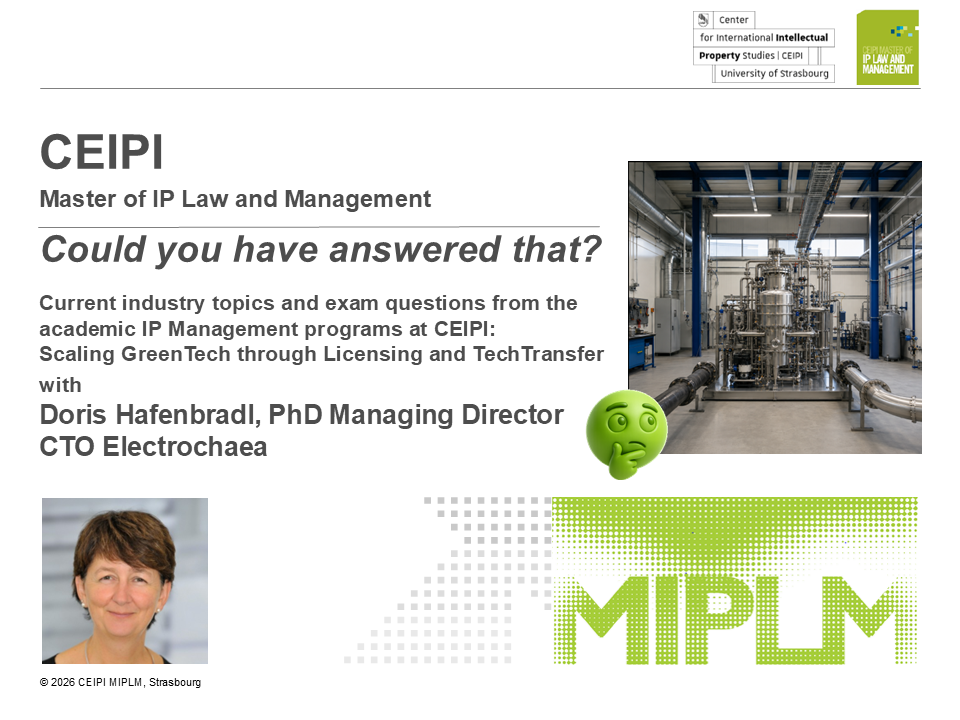
GreenTech companies that scale proprietary process technologies face a distinctive IP management challenge. Commercial deployment often depends on established engineering companies, technology providers and local industrial partners. These partners require access to technical information, engineering documentation, operating parameters, training and implementation support.
The economic value of the technology is typically distributed across several interconnected layers: patents, proprietary biological or chemical processes, engineering know-how, operating parameters, process integration expertise and experience gained from earlier projects. Together, these elements determine whether the technology can be implemented reliably under different industrial conditions.
The transition from demonstration projects to international deployment makes the governance of these assets strategically important. Each industrial partner needs sufficient knowledge to deploy and operate the technology successfully. At the same time, every implementation can generate adaptations, improvements and new operational knowledge with relevance for further projects, applications and geographic markets.
The structure of technology transfer therefore shapes where knowledge accumulates, who can use improvements and how effectively the technology provider can continue developing its platform. Licensing agreements, access rights, confidentiality arrangements, technical support models and improvement provisions become part of the company’s strategic control architecture.
This is exactly the type of challenge described in the CEIPI IP Business Academy analysis “The GreenTech Strategy Gap”. The study shows that sustainable innovation companies increasingly operate in layered industrial transition systems in which patents, trade secrets, process know-how, data, contracts, partnerships, financing and market access need to be connected through a coherent IP strategy.
The central management question concerns the capabilities and knowledge flows that the technology provider must continue to control in order to scale through partners, preserve future commercialization opportunities and strengthen its position through the experience generated across multiple projects.
Here you find the findings of this study: The GreenTech Strategy Gap: What Sustainable Innovation Companies Need, and What IP Advice Still Often Fails to Integrate
Against this background, the CEIPI IP Business Academy integrates practice-based questions from industry into its teaching. These questions help students understand IP as a management instrument for strategic decision-making in complex innovation and commercialization systems.
In the context of proprietary process technologies, this means identifying how patents, confidential know-how, engineering documentation, operating experience, contractual access rights and licensing economics can be combined to support international deployment while preserving the technology provider’s strategic control points.
We are therefore pleased to include this industry case study with Doris Hafenbradl. Her practical question focuses on how a GreenTech company should design its IP, technology transfer and licensing strategy when scaling a proprietary process technology through international industrial partners. It addresses which capabilities should remain under the provider’s strategic control, which elements partners need to access, how rights to improvements and implementation knowledge should be allocated, and how licensing models can support recurring revenues and multiple future applications of the same core technology.
Mini case study
A European clean-tech company has developed a proprietary process technology for producing renewable energy carriers from industrial feedstocks. Over several years, the company has moved the technology from research and demonstration projects towards commercially relevant industrial scale.
Its competitive position is based on several interconnected elements: patented technology, a proprietary biological or chemical process, engineering know-how, operating parameters, process integration expertise and experience gained from implementing the technology in different industrial environments.
The company is now entering a new phase of commercialization. Large-scale deployment increasingly requires collaboration with established engineering companies, technology providers and local industrial partners. In some markets, direct project participation may be the preferred route. In others, technology transfer and licensing can enable faster market entry and broader deployment.
These models require partners to receive substantial technical information and implementation know-how. They may need access to engineering documentation, process parameters, operating experience, training and ongoing technical support. At the same time, each implementation can generate improvements, adaptations and new operational knowledge.
As the number of projects, partners and geographic markets grows, the company needs to decide how its technology should be made accessible while preserving the strategic assets that enable future differentiation, further development and additional commercialization opportunities.
Question
How should such a company design its IP, technology transfer and licensing strategy when scaling a proprietary process technology through international industrial partners?
Which technological capabilities, know-how and IP rights should remain strategic control points of the technology provider, and which elements need to be transferred or licensed to enable partners to successfully deploy the technology?
How should rights to improvements, implementation know-how and jointly generated developments be allocated so that experience from individual projects can strengthen the technology platform as a whole?
And how can licensing models be structured to support international scaling, recurring revenues and multiple future applications of the same core technology?
Why this is a highly practice relevant question
For many clean-tech companies, successful commercialization depends on the ability to replicate sophisticated process technologies across industrial sites, partners and geographic markets. Scaling therefore requires systematic transfer of technological knowledge across company boundaries.
This creates a complex IP management task. The economic value of the technology can be distributed across patents, proprietary process knowledge, engineering documentation, operating experience and application-specific know-how. Different commercialization models require different levels of access to these assets.
The structure of individual partnerships can also shape the company’s future strategic freedom. Improvements generated during implementation may become relevant for other customers and markets. Access rights, improvement rights and knowledge flows therefore influence how effectively the company can continue developing and commercializing its technology platform.
A scalable licensing architecture needs to connect these technological control points with the company’s commercialization strategy. This includes deciding what can be licensed, what knowledge needs to be transferred, how improvements are handled and how economic participation develops as the technology is deployed more widely.
For IP managers, the case illustrates how IP strategy, technology transfer, collaboration design and licensing economics interact when a proprietary industrial technology moves from successful demonstration to international commercialization.
Effective technology transfer is essential for clean-tech companies seeking to scale through partners while retaining IP ownership. Given the frequent imbalance in size between innovators and strategic partners, robust licensing agreements with clear improvement-sharing provisions are key to long-term success. A strong IP portfolio serves as the primary differentiator against competitors and a critical driver of company valuation and investor interest.
Here you will find the lecture “Scaling Proprietary Technology: How IP Management Shapes the Next Stage of Growth” regarding this exam question:
Doris Hafenbradl, PhD
 Doris Hafenbradl, PhD, is an executive leader with more than 25 years of experience in biotechnology, cleantech and energy-transition technologies. Since 2015, she has served as Managing Director, CTO and Business Development Executive at Electrochaea, where she has led the development and commercialization of power-to-gas and biomethanation technology for renewable methane production. Her responsibilities have included scaling the technology from laboratory development to industrial demonstration, building multidisciplinary teams across research, engineering, operations and business development, securing more than €20 million in grants and strategic funding, establishing international partnerships, managing IP strategy and conducting licensing negotiations.
Before joining Electrochaea, Doris held senior scientific and commercial leadership positions across the biotechnology and pharmaceutical sectors, including roles at Hit Discovery Constance, Axxam, BioFocus, PROTEROS biostructures, GPC Biotech, Axxima Pharmaceuticals, the Genomics Institute of the Novartis Research Foundation and Diversa. Her work has covered technology-platform development, organizational leadership, international business development, strategic alliances and the creation of new commercial offerings. She holds a PhD in Microbiology from the University of Regensburg and combines deep scientific expertise with extensive experience in transforming complex technologies into scalable commercial businesses.